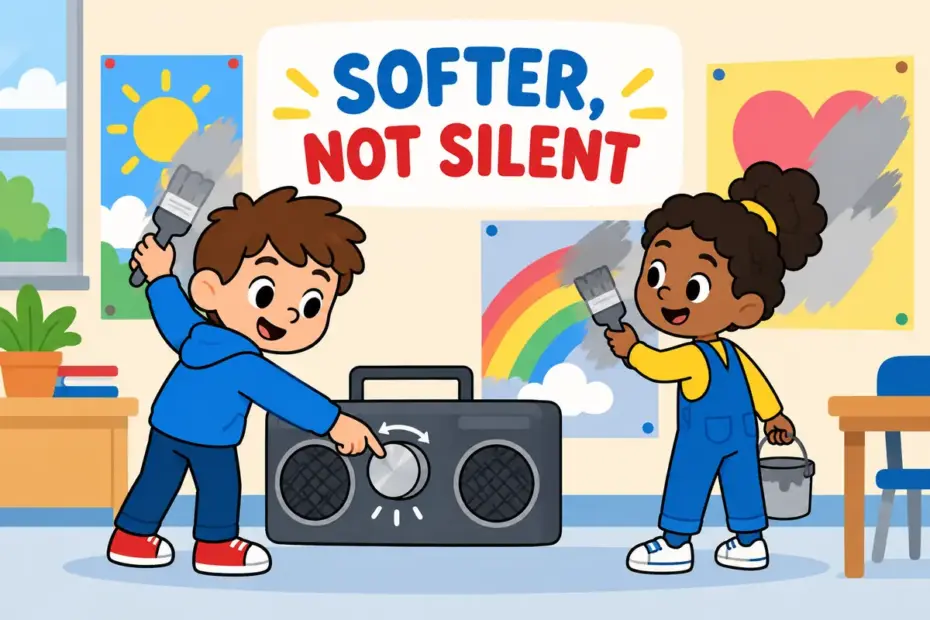
Tone down means to make something less extreme, less bright or less loud. To use tone down in a sentence, put the object after the particle or between the verb and the particle: “She toned down her criticism.” The verb is transitive, so it always needs something to soften, and it is separable, so the object can move inside it.
Tone down at a glance
- Tone down is a transitive, separable phrasal verb; its forms are tones down, toned down and toning down.
- The two core senses are softening language or behaviour and reducing the brightness of colour or light.
- The usual objects are criticism, a headline, a tone, colours, music and a design.
- The particle may follow the object, as in tone the warning down, but a pronoun must sit between the two halves.
- The commonest error is placing a pronoun after the particle, as in tone down it.
What does tone down mean?
Tone down is a transitive phrasal verb meaning to make something less extreme, less intense or less bright. The Cambridge entry for tone down records the two everyday senses: lowering the force of language or behaviour, and lowering the strength of colour or light. Where a sentence only means reducing loudness, quiet the crowd is the more literal choice, because tone down usually implies softening a manner or a shade rather than muffling a sound.
| Sense | Plain meaning | Example sentence |
|---|---|---|
| Soften language or behaviour | Make a remark or manner less forceful | The editor asked him to tone down the headline. |
| Reduce brightness | Make a colour or light less vivid | A grey wash toned down the bright orange wall. |
| Lower volume or intensity | Reduce the level of sound or activity | Please tone down the music after ten. |
| Calm a design | Make a page or room visually less busy | Plain drapes tone down the glare from the window. |
One honest limitation is worth stating. Tone down does not mean erase or remove. A toned-down complaint is still a complaint, and a toned-down headline is still printed; the word signals a gentler version, not silence.
How do you use tone down in a sentence?
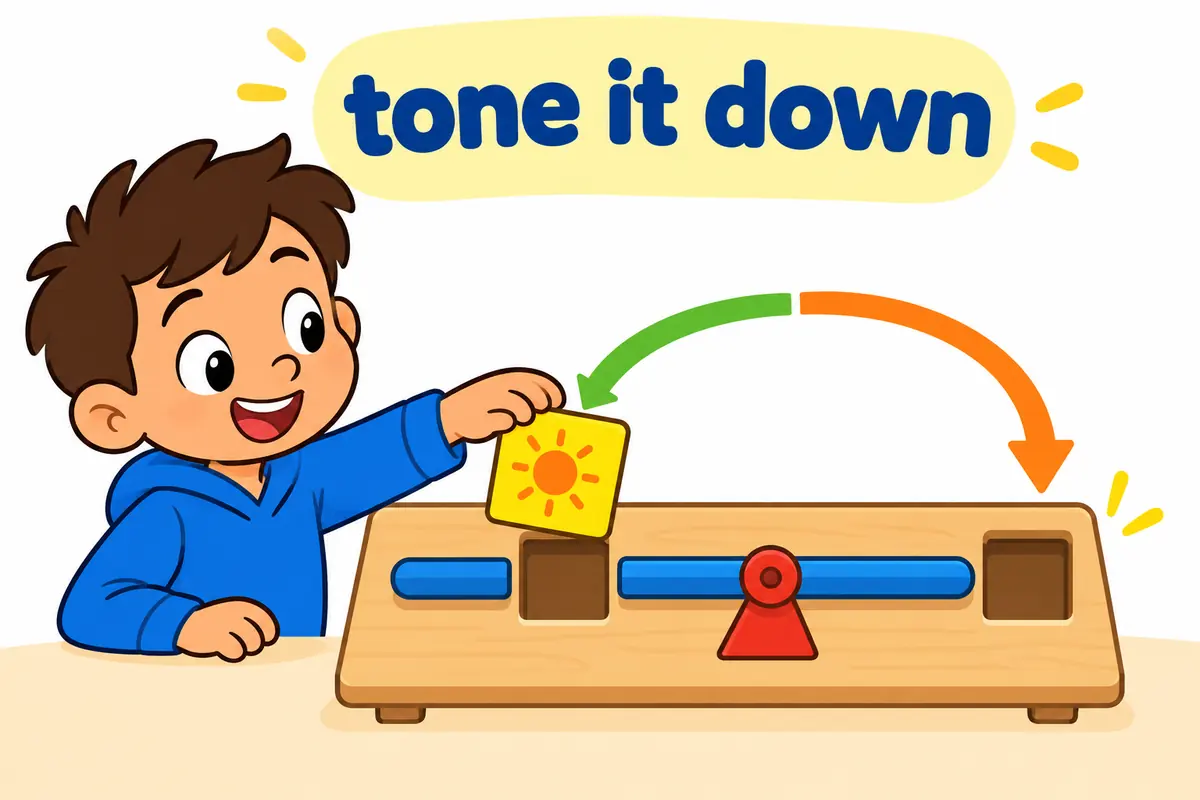
Put the verb and particle together, then place what you are softening either after the particle or between the two halves. Tone down is transitive, so a sentence such as the music toned down is incomplete without naming what was quietened. The object is what decides the order: a short noun can go either side, while a pronoun must split the pair.
| Pattern | Example | What it signals |
|---|---|---|
| tone down + object | They toned down the warning. | The standard order, with the object after the particle. |
| verb + object + down | They toned the warning down. | The separated form, common when the object is long. |
| verb + pronoun + down | He toned it down. | Pronouns must sit between the two halves. |
| be toned down | The finale was toned down for broadcast. | Passive voice, used when the editor of the change is unknown. |
| tone down + to + level | She toned it down to a whisper. | Names the reduced level that is reached. |
The particle may strand at the end for emphasis, as in the bright reds had to be toned down, but it can never be separated from a pronoun. Writers soften an argument with moderate the wording when the change is about balance rather than force.
Tone down in a sentence: examples across contexts
The same phrasal verb moves from a classroom to a mixing desk without changing meaning. Each sentence below names what is being softened, which is the habit that keeps tone down grammatical.
| Context | Example sentence | Why this works |
|---|---|---|
| Classroom | The teacher toned down the rebuke so the new pupil would not cry. | Shows a manner being softened rather than a fact removed. |
| Workplace email | Please tone down the final paragraph before we send it. | An instruction with a clear, named object. |
| News report | The minister toned down a prepared speech after the backlash. | A formal subject and a stated cause. |
| Product review | The updated app toned down the bright colours. | Applies the brightness sense to design. |
| Conversation | Hey, tone it down, the baby is asleep. | The pronoun form, which is the one used in speech. |
| Academic writing | The authors toned down their conclusion to match the evidence. | Signals cautious, measured claims. |
| Sports commentary | The captain toned down his celebrations after the warning. | The behaviour sense applied to a public figure. |
| Audio mixing | The producer toned down the drums in the final mix. | The technical volume sense. |
| Parenting | She toned down her alarm so the child would stay calm. | Reduces emotional intensity, not volume. |
A person who refuses to tone down an argument may refuse to back down from a threat, while a plan that is toned down is not the same as one that break down completely.
Tone down vs dampen
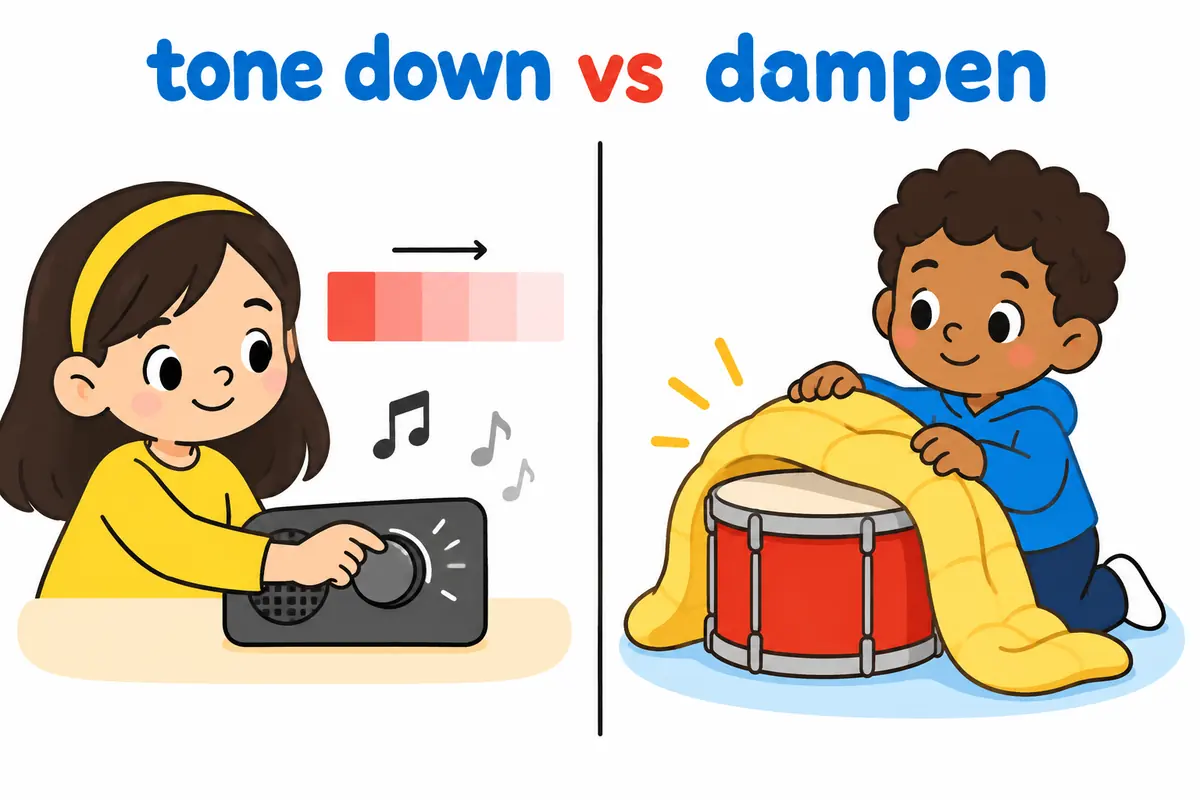
Tone down and dampen both lower intensity, but they attach to different things. dampen the noise is the physical option, while tone down is the editor’s choice for a manner, a shade or a written tone.
| Attribute | tone down | dampen |
|---|---|---|
| Core job | Reduce the force of language, colour or sound | Make sound, spirits or enthusiasm less lively |
| Typical object | A criticism, a headline, colours, music | Noise, spirits, a fire, enthusiasm |
| Register | Neutral, everyday to editorial | Neutral, often physical |
| Implies a prior excess | Usually yes | Usually yes |
| Describes colour or light | Yes, common | Rarely |
Verdict: choose dampen for literal sound or low spirits, and choose tone down when you soften a manner, a shade or a written tone; a writer who wants to reduce force without implying excess can also temper the language.
Word forms and grammar of tone down
| Form | Part of speech | Example |
|---|---|---|
| tone down | phrasal verb, base form | We should tone down the opening. |
| tones down | phrasal verb, third person singular | She tones down every press release. |
| toned down | past and past participle | The speech was toned down. |
| toning down | present participle | Toning down the artwork took a week. |
| tone it down | pronoun pattern | Tone it down, please. |
| toned-down | attributive adjective | A toned-down version of the logo ran on Monday. |
Common mistakes with tone down
- Incorrect:
Tone down it before the guests arrive.Correct: Tone it down before the guests arrive. Rule: A pronoun object must sit between the verb and the particle. - Incorrect:
The music toned down at midnight.Correct: They toned down the music at midnight. Rule: Tone down is transitive, so name what was softened. - Incorrect:
She toned down that she disagreed.Correct: She toned down her disagreement. Rule: The verb takes a noun phrase, never a that-clause. - Incorrect:
He toned down to a whisper.Correct: He toned it down to a whisper. Rule: Keep the object before the phrase naming the reduced level. - Incorrect:
The bright reds were tone down by the sun.Correct: The bright reds were toned down by the sun. Rule: The passive needs the past participle, toned down.
Practice using tone down
Work through the six items, then read the reasons rather than only the keys.
- Fill the gap: The coach asked the players to ______ their language.
- Choose the better word: A curtain can (tone down / dampen) the glare from the street.
- Correct the error: Please tone down it before the guests arrive.
- Build a sentence: use verb + pronoun + down about loud music in a flat.
- Spot the register: which belongs in an email to a manager – the report tones down the risks, or the report tones down the scary bits?
- Rewrite in the passive: The studio toned down the final scene.
Answers
- tone down – a bare infinitive after asked, and language is the named object.
- tone down – a colour or light sense fits tone down, while dampen suits sound.
- Please tone it down before the guests arrive – the pronoun splits the verb and particle.
- Model answer: Could you tone it down? The upstairs neighbours are studying.
- The report tones down the risks – a workplace email avoids the casual phrase scary bits.
- The final scene was toned down by the studio – the passive needs the past participle.
The bottom line
Use tone down in a sentence when you soften a manner, a shade or a written tone, and name the object being changed. The two nuances that decide most sentences are these: the verb is separable, so the object can move, but a pronoun must sit between tone and down, and the meaning is always a gentler version rather than removal. When the subject is literal sound, quiet or muffle is often the plainer verb.
Frequently asked questions about tone down
Is tone down formal or informal?
Tone down works in both registers, which is why it appears in chat and in editorials. The words around it set the formality: the editor toned down the headline reads as professional, while tone it down reads as speech. The phrasal verb itself carries no formal label, so let the sentence decide.
Can tone down be used without an object?
No. Tone down is transitive, so it needs a named object such as criticism, colours or music. The sentence the colours toned down leaves the reader asking what was softened. The single exception is the fixed imperative tone it down, where the pronoun it supplies the object.
What is the difference between tone down and tone up?
Tone down lowers intensity, while tone up raises it. A editor tones down a harsh paragraph, and a fitness class tones up a muscle. Both verbs are transitive and separable, so the object can move, but only tone down means making something gentler or dimmer.
Is tone down always about sound?
No. Sound is one sense, and the word equally covers colour, language and behaviour. A designer tones down bright paint, an editor tones down a headline, and a parent tones down an alarm. Check the object to see which sense the sentence is using.
Have you ever been in a situation where you needed to tone down your behavior or language? To tone down means to make something less intense, harsh, or extreme. It involves adjusting one’s actions or words to be more moderate or subdued.
In social interactions, it’s often prudent to tone down aggressive conduct to maintain harmony. Whether it’s softening the delivery of a critique or dialing back a loud voice in a quiet setting, knowing how to properly tone down communication is a valuable skill in various scenarios.
7 Examples Of Tone Down Used In a Sentence For Kids
- Tone down the volume of your voice.
- Let’s all try to tone down our excitement and listen carefully.
- Remember to tone down your giggles during class.
- Please tone down your running in the hallway.
- It’s important to tone down our energy before nap time.
- We should all tone down our brightness during quiet time.
- Can you please tone down the music while we work on our art projects?
14 Sentences with Tone Down Examples
- Tone down the volume of your music, your roommates might be studying.
- It’s important to tone down the use of slang in your academic essays.
- Let’s tone down the party plans for this weekend and focus on our assignments instead.
- Remember to tone down your excitement during the guest lecture and maintain decorum.
- It’s time to tone down the competitive spirit in group projects and collaborate effectively.
- Don’t forget to tone down the brightness of your laptop screen in class to avoid disturbing others.
- It’s advisable to tone down the use of social media during exam weeks for better focus.
- Make sure to tone down your arguments during debates to maintain a respectful dialogue.
- Learn to tone down your reactions to feedback and use it constructively to improve.
- It’s essential to tone down the use of abbreviations in formal emails to professors.
- Before presenting, practice to tone down nervousness and speak confidently.
- To avoid conflicts, try to tone down discussions on sensitive topics in class.
- Always tone down your celebrations after winning a competition to show respect to other participants.
- Remember to tone down your expectations when approaching campus placements to avoid disappointment.
How To Use Tone Down in Sentences?
To use the word Tone Down in a sentence, first think about a situation where you want to make something less intense or strong. For example, if someone is speaking loudly on the phone in a quiet library, you can ask them to tone down their voice.
When constructing a sentence with Tone Down, make sure to place this phrase before the behavior or expression you want to reduce. For instance, “Please tone down the music so we can have a conversation.” This way, you are clearly conveying your request to decrease the level or intensity of something.
It is important to remember that Tone Down is used when you want to make something less extreme, not to completely stop it. So, be specific in your sentence about how you want the intensity to be reduced.
Additionally, you can use Tone Down in various contexts such as asking someone to lower the volume, reduce the brightness, or decrease the aggression in their tone. By incorporating this phrase into your communication, you can effectively express your desire for moderation or calmness in a situation.
Practice using Tone Down in different scenarios to become more comfortable with incorporating it into your everyday conversations.
Conclusion
In conclusion, incorporating sentences with a tone down approach can help in softening the delivery of a message, especially when discussing sensitive or contentious topics. By using language that is more gentle and less confrontational, individuals can better communicate their opinions without causing offense or escalating conflicts. This approach can foster constructive dialogue and promote a more respectful exchange of ideas.
When seeking to engage in difficult conversations or navigate tense situations, employing sentences that tone down the rhetoric can lead to more productive interactions and maintain a sense of mutual understanding. It allows for differences to be expressed with care and consideration, ultimately contributing to a more harmonious and cooperative environment. By being mindful of the language we use and opting for a more tempered tone, we can cultivate relationships built on respect and empathy.


