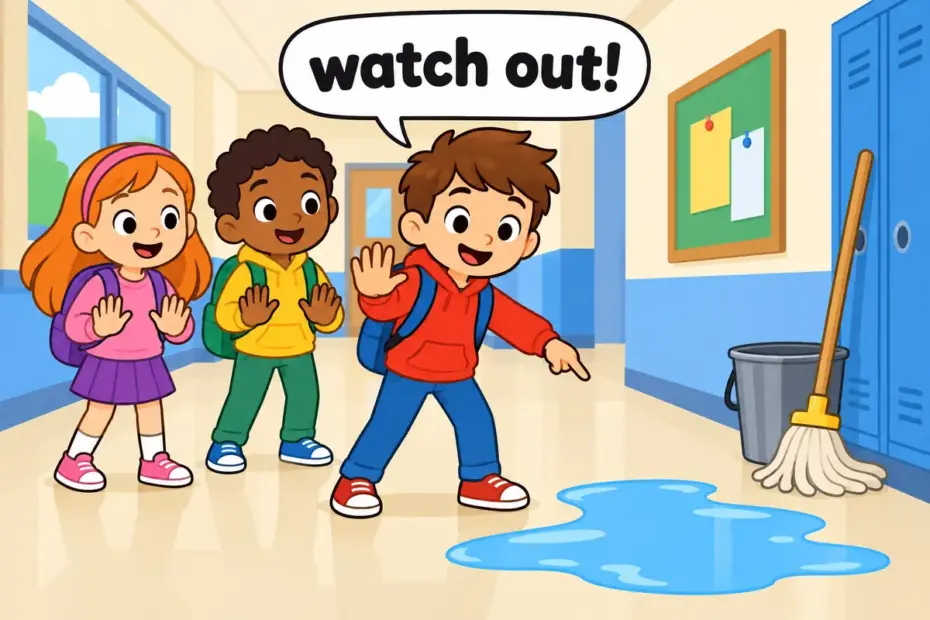
Watch out is a phrasal verb that warns someone of danger or tells them to stay alert. To use watch out in a sentence, use it as a short command or add for and a noun: “Watch out for the wet floor.” The phrase is informal, intransitive, and rarely names a risk without for.
Watch out at a glance
- Watch out is an intransitive phrasal verb; its forms are watches out, watched out and watching out.
- It means be careful, usually about a danger that is present or expected.
- The pattern watch out for introduces the specific risk; watch out alone stands as a shout.
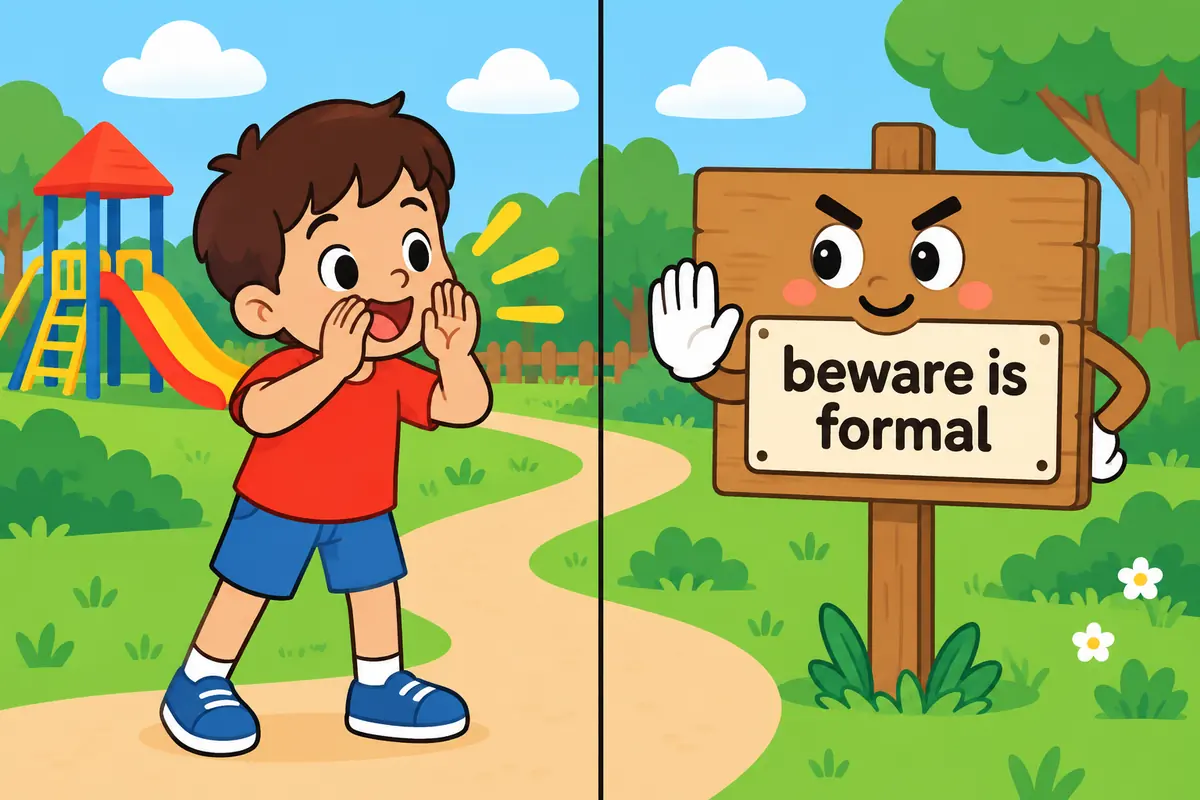
- The phrase is informal and spoken, while beware and take care suit formal notices.
- The commonest error is dropping for and treating a danger as a direct object.
What does watch out mean?
Watch out is an intransitive phrasal verb meaning to be careful or to stay alert to danger. The Cambridge entry for watch out records it as a warning, and that warning can point at a sudden risk or at a person you must protect. A driver who tells a passenger to stay alert and a lifeguard who warns swimmers are using the same phrase.
| Sense | Plain meaning | Example sentence |
|---|---|---|
| Warn of immediate danger | Alert someone to a risk right here | Watch out, the door is swinging back. |
| Stay alert to a threat | Keep noticing a danger you expect | Watch out for pickpockets on the train. |
| Protect someone | Look after a person who needs it | Watch out for your little brother at the pool. |
One limitation is worth stating plainly. Watch out is not a synonym for watch. You watch a film or a clock, but you watch out only when there is a risk, and you must add for before naming it. In formal writing, be careful reads better than a shouted phrase.
How do you use watch out in a sentence?
Watch out is intransitive, so it never takes a direct object: you watch out for something, you do not watch out something. Five patterns cover the real uses, and the particle never moves to the end of the sentence.
| Pattern | Example | What it signals |
|---|---|---|
| watch out (standalone) | Watch out! | A sudden warning with no object at all. |
| watch out for + noun | Watch out for the icy step. | Names the specific danger that is present. |
| watch out for + person | Watch out for your little brother. | Means look after someone, not fear them. |
| watch out when + clause | Watch out when you cross the road. | Marks the moment the risk appears. |
| watch out, or + clause | Watch out, or you will slip. | Adds the consequence of ignoring the warning. |
Because the phrase is intransitive, there is no passive and no split form. You cannot say the step was watched out, and you cannot say watch the step out. A security notice would instead ask staff to remain vigilant.
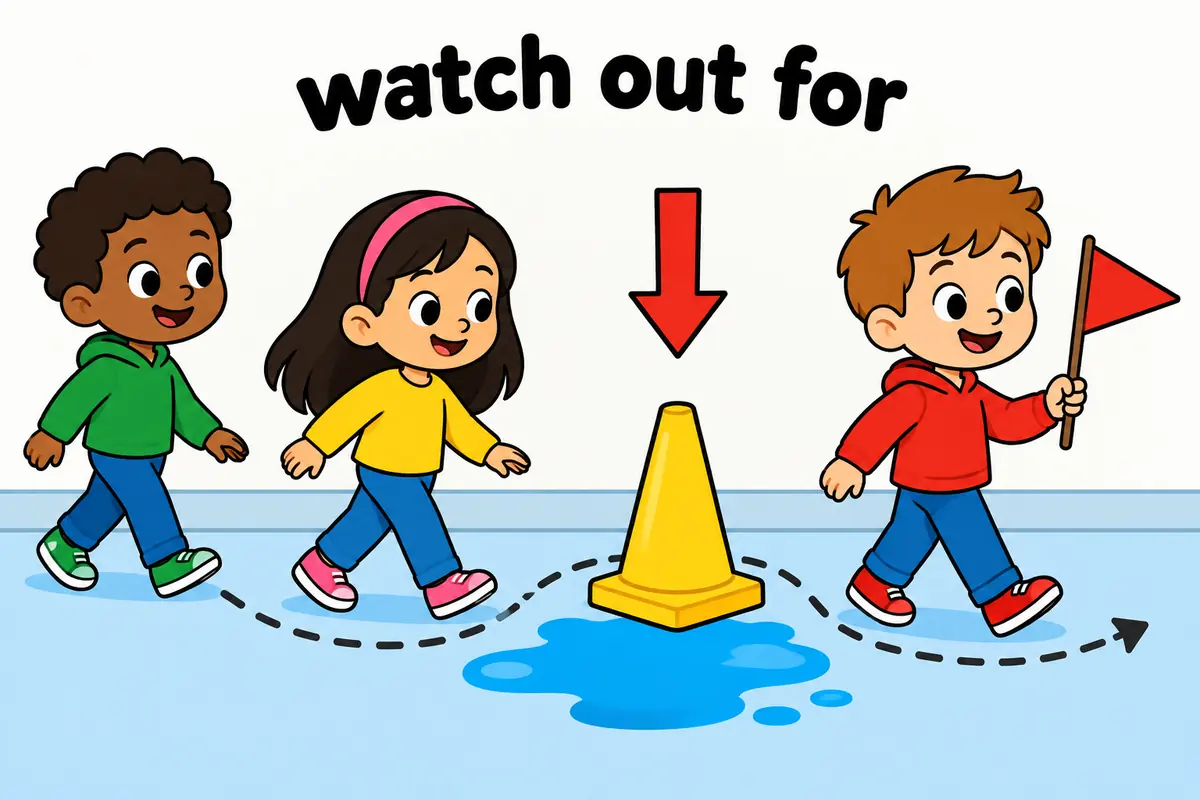
Watch out in a sentence: examples across contexts
Watch out keeps its warning force while the setting changes. The nine sentences below move from a playground to a workshop, and each one names either the danger or the person who needs protection.
| Context | Example sentence | Why this works |
|---|---|---|
| Playground | Watch out for the swing coming back. | Names a moving object and a shared space. |
| Home | Watch out, the kettle is still hot. | A standalone warning with the reason added after a comma. |
| Classroom | Watch out for the wobbly leg on that chair. | Points at a specific, fixable fault. |
| Road safety | Watch out when you step off the kerb. | The when-clause marks the exact moment of risk. |
| Workplace | Watch out for the cables across the aisle. | A hazard notice in plain, spoken form. |
| Travel | Watch out for the pickpockets near the market. | A warning about people, using for plus a plural noun. |
| Swimming lesson | Watch out for the younger swimmers near the deep end. | Uses the protect-someone sense of the phrase. |
| Sports | Watch out, the ball is coming your way. | A fast shout with the reason trailing after it. |
| Formal notice | Staff should be careful near the loading bay. | Shows the formal rewrite of the same warning. |
Notice how the informal examples are short and the formal one is longer. The phrase loses its place when the sentence has to sound official. To guard against a hazard, a written notice names it calmly.
Watch out vs beware
Watch out and beware both warn of danger, but they sit in different registers. Look where you step is a third option, and it names the action rather than the danger.
| Attribute | watch out | beware |
|---|---|---|
| Core meaning | Warns of a specific, present danger | Warns of a general or serious danger |
| Grammar | Intransitive, needs for before a noun | Takes of before a noun, or stands alone |
| Register | Informal and spoken | Formal and literary |
| Tone | Quick and practical | Sober and weighty |
| Typical place | Playgrounds, kitchens, building sites | Notices, stories, legal warnings |
| Example | Watch out for the dog. | Beware of the dog. |
Verdict: choose watch out for spoken warnings and quick classroom or workplace alerts, and beware when the notice must carry weight, as in a formal sign that says beware of hidden costs.
Word forms and grammar of watch out
Watch out keeps the same shape across its tenses because it never takes an object. The table also shows the fixed for pattern that learners most often leave out.
| Form | Part of speech | Example |
|---|---|---|
| watch out | phrasal verb, base | We watch out for loose stones on this path. |
| watches out | third person singular | She watches out for the younger children. |
| watched out | past and past participle | He watched out for traffic at the gate. |
| watching out | present participle | They are watching out for the rising tide. |
| watch out! | imperative interjection | Watch out, the floor is wet. |
| watch out for | fixed pattern with for | Watch out for pickpockets on the train. |
The phrase carries no passive and no noun form, so there is nothing like a watched-out step. Its only close relative is the verb watch, which takes an object in a completely different sense.
Common mistakes with watch out
- Incorrect:
Watch out the car.Correct: Watch out for the car. Rule: The phrase needs for before the danger is named. - Incorrect:
Please watch out about the traffic.Correct: Please watch out for the traffic. Rule: Use for, not about, before a risk. - Incorrect:
The step was watched out.Correct: The hikers watched out for the step. Rule: Watch out is intransitive and has no passive. - Incorrect:
He watched out the window.Correct: He looked out of the window. Rule: Watch out means be careful, not look through an opening. - Incorrect:
Staff should watch out in the safety report.Correct: Staff should be careful in the safety report. Rule: Watch out is conversational, so formal writing prefers be careful.
Practice using watch out
Work through the six items, then read the answers for the reasoning rather than only the key.
- Fill the gap: The sign says ______ out for falling rocks.
- Choose the better phrase: You should (watch out for / watch out) the slippery tiles.
- Correct the error: Watch out the cycling lane on your left.
- Build a sentence: warn a classmate about a loose step, using watch out for.
- Spot the register: which fits a school newsletter, watch out for icy paths or pedestrians please be careful on icy paths?
- Rewrite: Be careful of the low beam. Use watch out for.
Answers
- watch — the fixed phrase is watch out for, with for before the danger.
- watch out for — the tiles are the named danger, so for is required.
- Watch out for the cycling lane on your left — the object needs for.
- Model answer: Watch out for the loose step by the door.
- Pedestrians please be careful on icy paths — a newsletter avoids the spoken phrase.
- Watch out for the low beam — the warning keeps its shape and names the beam.
The bottom line
Use watch out in a sentence to warn somebody of a present or expected danger, and add for the moment you name that danger. The two details that decide most sentences are these: the phrase is intransitive, so it takes no direct object, and it is conversational, so a formal notice prefers be careful.
Frequently asked questions about watch out
Is watch out rude?
Watch out is direct rather than rude, and it usually shows care because it gives someone time to avoid a danger. Tone depends on delivery, so a calm voice sounds helpful while a sharp shout can sound accusing. In a formal setting, be careful or take care removes any sense of blame.
What is the difference between watch out and watch out for?
Watch out stands alone as a sudden warning, as in watch out, that branch is low. Watch out for introduces the specific danger that follows, as in watch out for the broken glass. The for is what lets the phrase name a risk instead of leaving the listener to look around.
Can watch out be used in formal writing?
Watch out rarely appears in formal writing because it belongs to speech. A safety report would say staff should be careful near the loading bay rather than watch out near the loading bay. Use the phrase for dialogue and informal notes, and choose be careful or take care for official documents.
Is watch out one word or two?
Watch out is always written as two words, never as watchout. The compound noun lookout is a single word, which may cause the confusion. Remember that the phrasal verb keeps the verb and particle apart, so a sentence reads watch out for ice, not watchout for ice.
“Watch out” is a phrase commonly used to alert someone to a potential danger or issue that may be ahead. It serves as a cautionary warning for individuals to be vigilant and careful in their actions or surroundings.
This expression is often used informally in everyday conversations to highlight a specific problem or concern that others should be aware of. Whether it’s pointing out a slippery surface, a potential scam, or an impending conflict, “watch out” plays a crucial role in helping people stay safe and avoid potential pitfalls.
7 Examples Of Watch Out Used In a Sentence For Kids
- Watch out for the big puddle on the playground.
- Watch out for your friends while playing outside.
- Watch out for cars when crossing the road.
- Watch out for flying birds in the sky.
- Watch out for the swing moving back and forth.
- Watch out for the slippery floor after rain.
- Watch out for the ball coming towards you.
14 Sentences with Watch Out Examples
- Watch out for pickpocketers in crowded places.
- Watch out for fake news on social media.
- Watch out for deadlines and prioritize your assignments accordingly.
- Watch out for your mental health and seek help if needed.
- Watch out for scam emails asking for personal information.
- Watch out for peer pressure when making decisions.
- Watch out for plagiarism in your academic work.
- Watch out for unsafe drinking water and always carry a water bottle.
- Watch out for hidden fees in college activities and events.
- Watch out for group projects that may require more time and effort.
- Watch out for career opportunities and internships to enhance your resume.
- Watch out for unhealthy eating habits and try to maintain a balanced diet.
- Watch out for long commutes that may affect your attendance and performance.
- Watch out for academic dishonesty consequences such as failing a course.
How To Use Watch Out in Sentences?
Watch Out is used to alert someone to be cautious or aware of a potential danger or problem. When using Watch Out in a sentence, it is important to follow a few simple guidelines for clarity and effectiveness.
-
Placement: Watch Out is usually placed at the beginning of a sentence to grab the reader’s attention and emphasize the warning. For example, ” Watch Out, there is a car coming!”
-
Context: Watch Out is often followed by the specific warning or danger that needs to be heeded. For instance, ” Watch Out, the floor is wet and slippery.”
-
Tone: The tone of voice when saying Watch Out can convey the level of urgency or seriousness of the situation. It can range from a calm warning to a more urgent shout, depending on the level of danger.
-
Non-verbal cues: In spoken language, using body language and facial expressions along with Watch Out can enhance the message and help convey the potential danger more effectively.
In summary, using Watch Out in a sentence is a simple and effective way to warn someone about potential dangers or problems. By following these guidelines on placement, context, tone, and non-verbal cues, you can effectively communicate the need for caution and awareness in various situations.
Conclusion
In conclusion, “watch out” is a phrase commonly used to alert someone about a potential danger or to advise caution. It is often used in various contexts to warn others to be careful or vigilant in a particular situation. For instance, “Watch out for that slippery floor” or “Watch out for pickpockets in crowded areas” are examples of how the phrase can be applied in everyday language.
By heeding the advice to “watch out,” individuals can prevent accidents, avoid harm, or stay alert to potential risks. This simple yet effective phrase serves as a reminder to stay attentive and mindful of one’s surroundings, ultimately contributing to personal safety and well-being.


