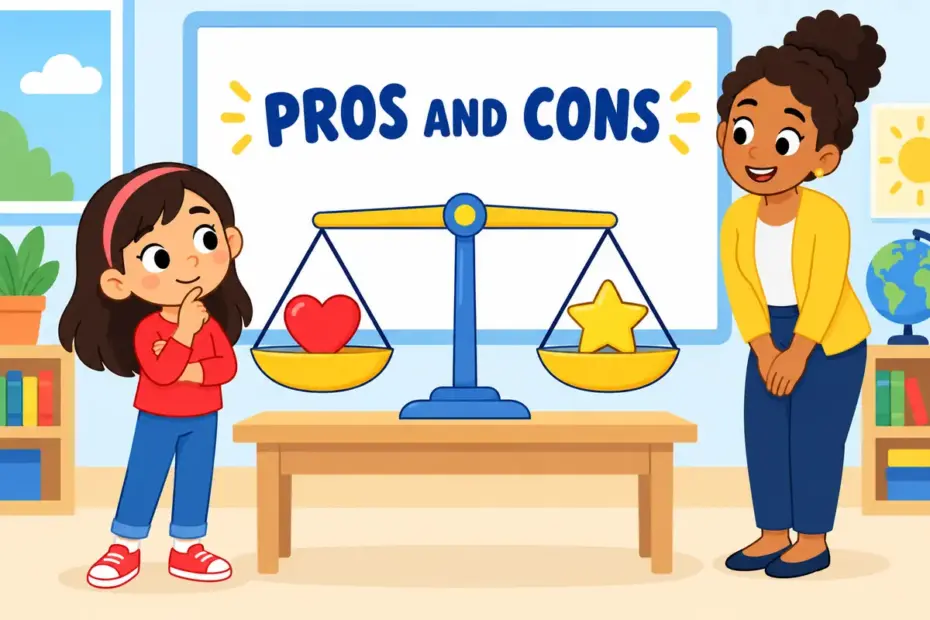
Weigh up means to consider something carefully by comparing its advantages and disadvantages before deciding. To use weigh up in a sentence, give it a choice or an option: “She weighed up the two job offers.” The verb is transitive, and a pronoun goes between weigh and up: weigh it up.
Weigh up at a glance
- Weigh up is a phrasal verb meaning to assess something before deciding.
- Its forms are weighs up, weighing up and weighed up.
- The usual pattern is weigh up + a choice, offer, risk or person.
- The particle up can move after a noun but not after a pronoun.
- The commonest errors are weigh up it and the spelling weight up.
What does weigh up mean?
Weigh up is a phrasal verb meaning to examine something carefully and form a judgement about it, usually by setting one side against another. The Cambridge entry for weigh up ties it to thinking about a problem or situation before acting. The idea comes from a balance: the options go into the pans and the heavier one wins. A manager told to consider the options is being asked, in plainer words, to weigh them up.
| Sense | Plain meaning | Example sentence |
|---|---|---|
| Compare before deciding | Set the pros and cons against each other | They weighed up the two routes before setting off. |
| Assess a risk or plan | Judge how serious or sound something is | The board weighed up the risk of delay. |
| Size up a person | Form a view of someone’s character or worth | The coach weighed up the new player at training. |
One limitation is worth stating. Weigh up is not the physical act of weighing something on a scale. A parcel is weighed, not weighed up. The phrase is about judgement, and it also needs an object, so a sentence that leaves out what is being considered reads as unfinished.
How do you use weigh up in a sentence?
Put the choice or risk after the verb and, if you use a pronoun, place it between weigh and up. Five frames cover nearly every real sentence, and the last row shows the judgement being evaluate the evidence one item at a time.
| Pattern | Example | What it signals |
|---|---|---|
| weigh up + option or choice | The panel weighed up three bids. | A formal comparison before choosing. |
| weigh + object + up | She weighed the offer up carefully. | The particle moves right with a noun object. |
| weigh + pronoun + up | Weigh it up before you sign. | A pronoun must sit between verb and particle. |
| weigh up whether to + verb | They weighed up whether to move abroad. | A decision still being tested. |
| weigh up + a person | The editor weighed up the young writer. | Judging someone’s character or skill. |

Weigh up in a sentence: examples across contexts
Weigh up suits any setting where a choice needs care. The ten sentences below run from a shop to a hospital, and each one names what is being compared and why.
| Context | Example sentence | Why this works |
|---|---|---|
| Shopping | She weighed up the cheaper coat and the warmer one. | Two real options make the comparison concrete. |
| Workplace | The team weighed up the two designs before voting. | Shows a group judgement, not a snap choice. |
| Education | He weighed up a gap year against starting at once. | Sets two paths side by side. |
| Finance | Investors weigh up the return against the risk. | Names both sides of the balance. |
| Healthcare | The surgeon weighed up the benefits of waiting. | Shows a careful professional judgement. |
| Sport | The captain weighed up a risky substitution. | A single decision with a clear cost. |
| Politics | The minister weighed up the cost of a U-turn. | Frames a decision in terms of consequences. |
| Family | We weighed up moving nearer to my parents. | The first person keeps the register warm. |
| Science | Reviewers weigh up the strength of the evidence. | Applies the verb to proof rather than people. |
| Conversation | Weigh it up and let me know by Friday. | The pronoun sits between verb and particle, as speech demands. |
Where the task is adding up costs or facts before the comparison, add up the figures first, then weigh up the result.
Weigh up vs weigh in
Weigh up and weigh in share the verb and split the work. Weigh up means to judge privately before a choice, while weigh in means to join a debate with an opinion. A reader who ponders a decision alone is weighing it up; one who speaks is weighing in.
| Attribute | weigh up | weigh in |
|---|---|---|
| Core meaning | Judge something before deciding | Add your opinion to a debate |
| Who acts | One person or panel thinking | Someone joining a discussion |
| Typical object | A choice, risk or person | On a topic or argument |
| Typical particle test | Weigh it up | Weigh in on the plan |
| Register | Neutral, business and everyday | Informal to journalistic |
Verdict: choose weigh up to describe the thinking before a choice and weigh in to describe the moment someone states a view.
Word forms and grammar of weigh up
Only the verb weigh inflects, and up stays fixed. The same verb appears with other particles, and weigh down means the opposite of lightening a choice: it means to burden.
| Form | Part of speech | Example |
|---|---|---|
| weigh up | phrasal verb, base form | Take a day to weigh up the offer. |
| weighs up | third person singular | The committee weighs up every application. |
| weighing up | present participle | She is weighing up the move to a new city. |
| weighed up | past and past participle | They weighed up the risk and went ahead. |
| weigh | base verb, literal | Weigh the parcel before posting it. |
| weigh down | phrasal verb, other meaning | Debt can weigh down a small firm. |
Common mistakes with weigh up
- Incorrect:
We need to weigh up it tonight.Correct: We need to weigh it up tonight. Rule: A pronoun must sit between the verb and the particle. - Incorrect:
She weighted up the two offers.Correct: She weighed up the two offers. Rule: The verb is weigh, not weight. - Incorrect:
Please weigh up the parcel on the scale.Correct: Please weigh the parcel on the scale. Rule: Physical weighing takes weigh alone, without up. - Incorrect:
They weighed up on the new policy.Correct: They weighed in on the new policy. Rule: Giving an opinion in a debate is weigh in on. - Incorrect:
The judge weighed up.Correct: The judge weighed up the evidence. Rule: Weigh up is transitive, so an object cannot be left out.
Practice using weigh up
Work through the six items, then read the reason behind each answer.
- Fill the gap: The council ______ the cost of repairing the bridge.
- Choose the better word: At the meeting she finally (weighed up / weighed in) on the new timetable.
- Correct the error: He weighted up the risks before agreeing.
- Build a sentence: use weigh up whether to about choosing a university.
- Spot the register: which belongs in a formal report — the panel weighed up the bids, or the panel had a good think about it?
- Rewrite with a pronoun: We must weigh up the proposal tonight.
Answers
- weighed up — the council is judging the cost, so the phrasal verb fits.
- weighed in — she joined the debate with an opinion, which is weigh in on.
- He weighed up the risks before agreeing — the verb is weigh, not weight.
- Model answer: She weighed up whether to study locally or move away.
- The panel weighed up the bids — a formal report prefers the precise phrasal verb.
- We must weigh it up tonight — the pronoun goes between verb and particle.
The bottom line
Use weigh up in a sentence when something is judged carefully before a choice, and name the options or risks after the verb. The two nuances that settle most sentences are these: a pronoun goes between weigh and up, and the phrase means judgement rather than physical weighing. Where the next step is to state a view, weigh in on takes over.
Frequently asked questions about weigh up
Is weigh up formal or informal?
Weigh up sits between neutral and slightly informal, and it is common in British English. Reports, meetings and everyday speech all use it. In very formal writing, writers may prefer assess or evaluate, which carry the same judgement without the particle. All are correct, and the choice is one of tone.
What is the difference between weigh up and weigh in?
Weigh up is the private act of judging something before deciding, as in weighing up two offers. Weigh in is public: it means joining a discussion with an opinion, usually with on, as in weighing in on the plan. One is thought and the other is speech, which is why the two are easy to mix up.
Can you weigh up a person?
Yes. To weigh someone up is to form a view of their character, skill or trustworthiness, as a coach weighs up a new player. The sense is real and common, though a little informal. It usually implies a careful, silent assessment rather than a quick first impression, which is why it fits interviews and try-outs especially well.
Is it weigh up or weight up?
The correct verb is weigh, so the phrase is weigh up. Weight up is a common misspelling that confuses the verb weigh, meaning to judge or measure, with the noun weight. Weight is what a scale shows, while weigh is what you do, so only weigh up makes sense in a sentence about a decision.
When faced with a decision that requires careful consideration and evaluation, we often find ourselves needing to “weigh up” our options. In simple terms, to “weigh up” means to carefully analyze the pros and cons of a situation before making a decision.
This phrase indicates the process of comparing different factors or considerations in order to come to a reasoned conclusion. Whether it involves deciding between two job offers, choosing a vacation destination, or figuring out which car to purchase, the ability to “weigh up” options allows us to make informed choices based on a thoughtful assessment of the available information.
7 Examples Of Weigh Up Used In a Sentence For Kids
- Weigh up the fruits to see which one is heavier.
- Let’s weigh up the puppies to know their weight.
- It’s important to weigh up your options before making a decision.
- Can you help me weigh up these colorful blocks?
- I will use this scale to weigh up the toys.
- Remember to weigh up the ingredients before baking a cake.
- Please weigh up the books to see which one is lighter.
14 Sentences with Weigh Up Examples
- Weigh up the pros and cons of taking up a part-time job during the semester.
- Before buying a new laptop, make sure to weigh up your budget and requirements.
- It’s important to weigh up the academic workload before committing to extracurricular activities.
- As college students, we need to constantly weigh up our priorities and time management skills.
- Before signing up for a study abroad program, be sure to weigh up the financial implications.
- When choosing electives for the next semester, take the time to weigh up your interests and career goals.
- As college students, we often have to weigh up the benefits of attending networking events versus studying for exams.
- Before deciding on a major, it’s crucial to weigh up your passions and future job prospects.
- As part of our research project, we need to weigh up the reliability of different sources of information.
- In order to maintain a healthy lifestyle, it’s essential to weigh up the nutritional value of meal options in the campus cafeteria.
- Before deciding on a study group, make sure to weigh up the strengths and weaknesses of each member.
- As college students, we must constantly weigh up the need for socializing with the need for academic success.
- When preparing for exams, it’s helpful to weigh up the effectiveness of different study techniques.
- As we approach graduation, it’s time to weigh up our post-graduation options and make a concrete plan.
How To Use Weigh Up in Sentences?
To use Weigh Up in a sentence, follow these simple steps:
-
Identify the main idea: Think about the topic you want to discuss or evaluate.
-
Introduce Weigh Up: Start by introducing the term “weigh up” in your sentence. You can place it at the beginning or in the middle of the sentence.
-
Provide context: Explain what you are comparing or considering using Weigh Up. This could include different options, ideas, or factors you are analyzing.
-
Use Weigh Up: Insert the term Weigh Up in your sentence to indicate that you are evaluating the different aspects of a situation.
-
Present the conclusion: Conclude your sentence by expressing your thoughts, opinions, or decisions based on the evaluation you have done with Weigh Up.
For example:
– “I need to weigh up the pros and cons of studying abroad before making a decision.”
– “Let’s weigh up the costs and benefits of renovating the kitchen this summer.”
Remember, using Weigh Up in a sentence is a way to show that you are carefully considering and evaluating different options or aspects of a situation. It helps you make informed decisions by looking at the different factors involved. Practice using Weigh Up in your sentences to enhance your communication skills and critical thinking abilities.
Conclusion
In conclusion, when we weigh up our options, we carefully consider the pros and cons of each choice before making a decision. It’s essential to weigh up various factors such as cost, time, and potential outcomes to make the best possible choice for our situation. By taking the time to weigh up our options, we can make informed decisions that align with our goals and values.
Ultimately, the process of weighing up decisions helps us navigate through uncertainty and complexity, providing us with a clear path forward. So, whether it’s choosing between job offers, deciding on a major purchase, or making personal choices, taking the time to weigh up our options is crucial for making well-informed decisions that will lead to positive outcomes.


