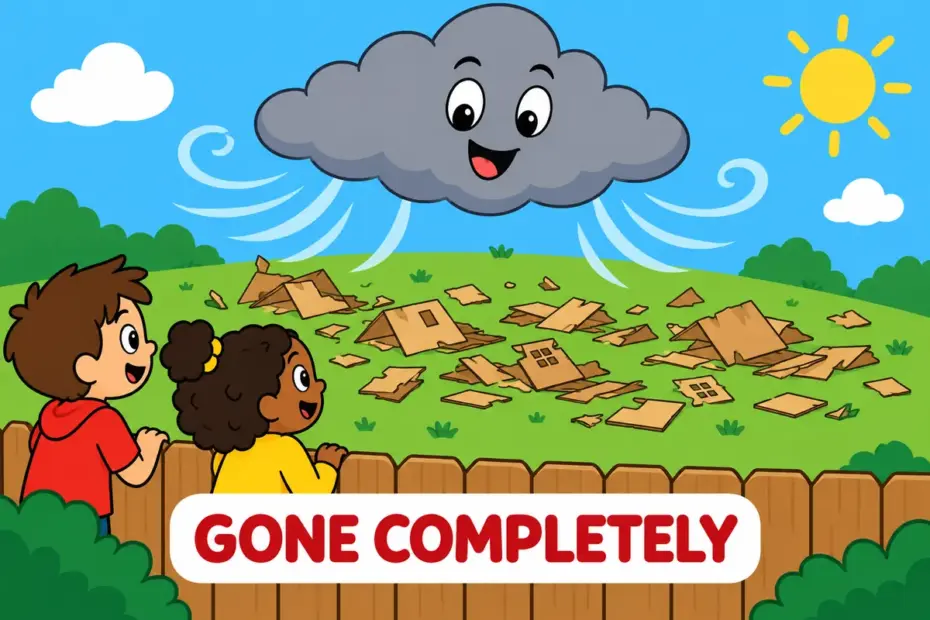
Wipe out means to destroy something completely, to remove it entirely, or to fall and crash while riding a board, skis or a bike. To use wipe out in a sentence, place the thing being removed after the verb: “The flood wiped out the bridge.” The particle moves, so “wiped the bridge out” means the same.
Wipe out at a glance
- Wipe out is a phrasal verb; its forms are wipes out, wiped out and wiping out.
- Most senses are transitive, so a person, place or thing receives the action.
- When it means to fall while surfing or skiing, wipe out takes no object at all.
- The particle can move: wipe out the enemy and wipe the enemy out are both standard.
- The commonest learner error is using wipe out for cleaning, which belongs to wipe off.
What does wipe out mean?
Wipe out is a phrasal verb meaning to destroy, defeat or remove something completely, and in sport it also means to fall while riding a board or skis. The Cambridge entry for wipe out records both the destruction sense and the sporting fall, and the two never share a grammar: one needs an object, the other refuses one.
| Sense | Plain meaning | Example sentence |
|---|---|---|
| Destroy completely | Remove every part of something | The wildfire wiped out the hillside village. |
| Defeat utterly | Beat an opponent so completely that resistance ends | The champions wiped out the visiting side in two sets. |
| Fall in sport | Lose control and crash on a board or skis | She wiped out on the last wave of the heat. |
| Exhaust | Drain someone’s energy completely | Three night shifts wiped me out. |
One limitation matters. Wipe out does not mean to clean or to rub a surface, and it does not describe a small loss. A wiped-out team has been beaten beyond recovery, while a wiped-off table has simply been cleaned. Where the damage is partial, damage is the honest verb.
How do you use wipe out in a sentence?
The verb is separable in its destructive senses, so the object may follow the whole phrase or sit between the two parts. Learn the two orders as one pattern with two shapes, and keep the sport sense apart, because a fall takes no object.
| Pattern | Example | What it signals |
|---|---|---|
| wipe out + object | The storm wiped out the crop. | Total destruction, object after the particle. |
| wipe + object + out | The storm wiped the crop out. | Same meaning, object between the two parts. |
| be wiped out | The village was wiped out in an hour. | Passive voice that keeps attention on the loss. |
| wipe out (no object) | He wiped out on the final turn. | The sport sense: a fall, not a defeat. |
| be wiped out by + agent | Twenty jobs were wiped out by the merger. | Names the force that did the destroying. |
Where the target is a structure rather than a population, destroy a building is the plainer choice, because wipe out adds an idea of leaving nothing at all.
Wipe out in a sentence: examples across contexts
Wipe out keeps one meaning of total removal while its subject changes from weather to finance to sport. Each sentence below names what was removed, which is the detail that keeps the verb from sounding vague.
| Context | Example sentence | Why this works |
|---|---|---|
| News report | The cyclone wiped out three coastal hamlets overnight. | Names a countable loss and a clear cause. |
| Sports commentary | The champion wiped out the field on the final lap. | Uses the defeat sense with a concrete opponent. |
| Surfing report | She wiped out on the biggest wave of the morning. | Shows the intransitive fall sense with no object. |
| Workplace email | The outage wiped out today’s orders, so we are reprocessing them. | States the consequence in the same breath. |
| Conversation | That hill at the end of the run wiped me out completely. | Uses the exhaust sense that survives in speech. |
| Science writing | A single blight wiped out the island’s banana crop. | Makes a disease the subject, which suits formal prose. |
| Marketing note | A rival wiped out our price advantage in one weekend. | Applies the verb to an abstract asset. |
| History essay | The plague wiped out nearly a third of the town. | Quantifies the loss rather than gesturing at it. |
| Classroom | A leak wiped out the whole set of posters on the wall. | Keeps the scene concrete for young readers. |
The same particle turns up in ask someone out, where it means to invite a person on a date, so the particle alone never fixes a meaning.
Wipe out vs erase
Both words remove something, but they remove different kinds of thing and with different force. Wipe out is broad and often violent; erase a file is narrow and usually gentle. Choosing between them is a question of what is being removed.
| Attribute | wipe out | erase |
|---|---|---|
| Core job | Destroy or remove completely | Rub out marks, records or data |
| Typical object | People, groups, crops, jobs | Text, files, memories, lines |
| Force | Total and often sudden | Targeted and gradual |
| Typical subject | Storm, war, disease, rival | Eraser, editor, software |
| Register | Informal to neutral | Neutral to technical |
Verdict: use erase when a specific mark or record disappears, and wipe out when an entire population, resource or lead is gone.
Word forms and grammar of wipe out
Wipe out inflects like any regular phrasal verb, and its noun is written as one word. The table also lists the partners that keep the meaning clear, plus the two structures learners sometimes join by mistake.
| Form | Part of speech | Example |
|---|---|---|
| wipe out | phrasal verb, base | Floodwater can wipe out a road in minutes. |
| wipes out | verb, third person | One bad season wipes out a farmer’s savings. |
| wiped out | verb, past and participle | The beetle wiped out the elm trees. |
| wiping out | verb, present participle | They are wiping out the last breeding pairs. |
| wipeout | noun, one word | The wipeout cost the region two harvests. |
| wipe off | phrasal verb, different meaning | Wipe off the counter before you leave. |
When the goal is to end a disease rather than a place, eradicate a disease is the term of art, and eliminate a threat suits policy writing. Annihilate an army is the literary cousin that stresses utter defeat.
Common mistakes with wipe out
- Incorrect:
The team wiped out.Correct: The team was wiped out. Rule: The destroy sense is transitive, so it needs an object or a passive form. - Incorrect:
The waiter wiped out the table.Correct: The waiter wiped off the table. Rule: Cleaning a surface takes wipe off; wipe out means to destroy. - Incorrect:
She wiped out the competition out.Correct: She wiped out the competition. Rule: The particle appears once, whether or not the object moves. - Incorrect:
The village wiped out by the flood.Correct: The village was wiped out by the flood. Rule: A passive sentence needs the verb be. - Incorrect:
He wiped out the mud from his boots.Correct: He wiped the mud off his boots. Rule: Removing dirt is wipe off, never wipe out.
Practice using wipe out
Work through the six items, then read the reasons rather than only the keys.
- Fill the gap: The late frost ______ the whole apricot crop last spring.
- Choose the better word: Please (wipe out / wipe off) the whiteboard before the next lesson.
- Correct the error: The small shop wiped out by the new road.
- Build a sentence: use be wiped out about a village damaged by a storm.
- Spot the register: which belongs in a news report — the flood wiped out the hamlet, or the flood really did for the hamlet?
- Rewrite with the noun: The fire wiped out the market. Use wipeout instead.
Answers
- wiped out — the frost is the cause and the crop is the object it removed.
- wipe off — a whiteboard is cleaned, not destroyed, so the clean sense is needed.
- The small shop was wiped out by the new road — the passive needs the verb be.
- Model answer: The fishing village was wiped out by the storm in a single night.
- The flood wiped out the hamlet — a report avoids the slangy did for.
- The fire caused a wipeout of the market — the noun takes an article and a linking phrase.
The bottom line
Use wipe out in a sentence when something is removed completely, and name the thing that was removed. The two details that decide most sentences are these: the destroy sense is transitive and separable, while the sporting fall sense takes no object at all. Where the loss is only partial, damage or dent is the more accurate verb.
Frequently asked questions about wipe out
Is wipe out one word or two?
The phrasal verb is always two words: wipe out, as in the storm wiped out the road. The related noun is written as one word, wipeout, and means a total loss or a heavy fall. Keep the two apart, because a single word never functions as a verb in a sentence.
Is wipe out formal enough for a report?
Wipe out sits between informal and neutral, so a news report can use it about a disaster or a defeat. A formal scientific paper would usually prefer destroy, eliminate or eradicate instead. Match the verb to the document: a memo can say wiped out, while a journal article should not.
Can you say wipe out without an object?
Yes, but only in the sport sense of falling. He wiped out on the last turn takes no object and simply reports a crash. In every other sense the verb needs something to act on, so a sentence such as the team wiped out is incomplete and should be made passive instead.
What is the difference between wipe out and wipe off?
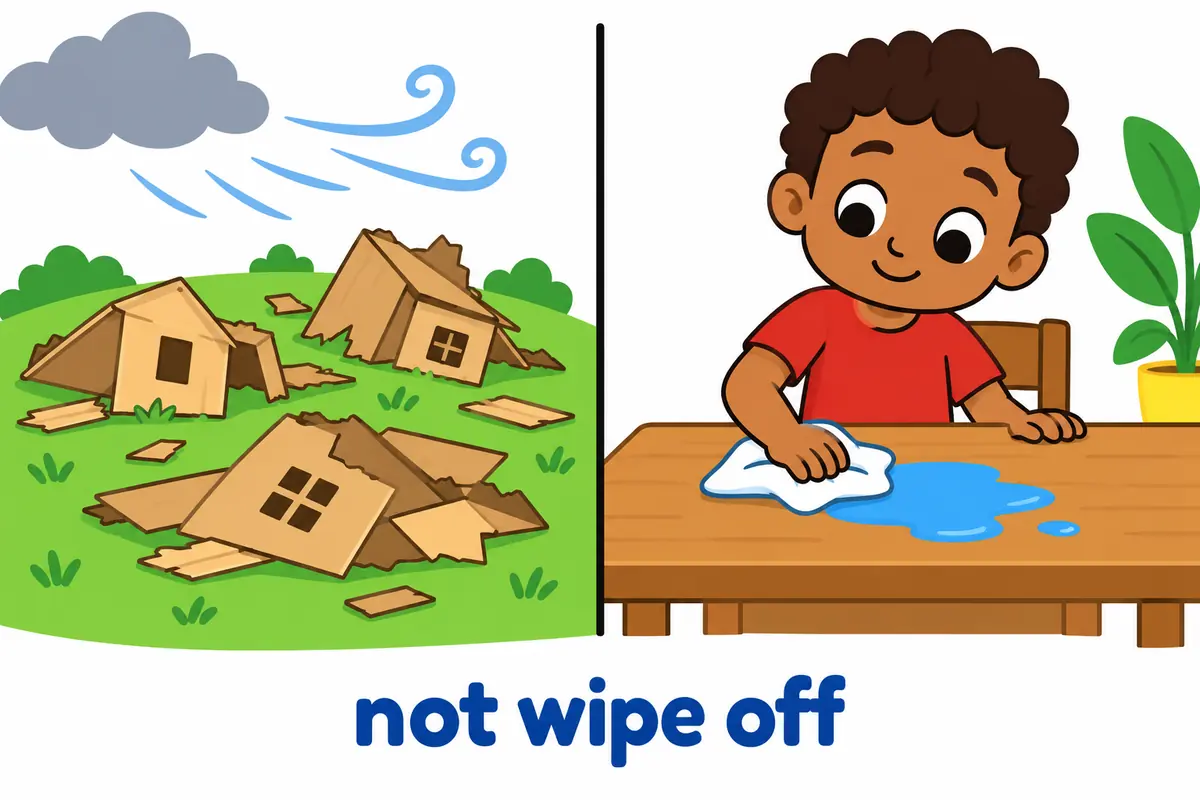
Wipe out removes the thing itself, while wipe off removes something from a surface. A flood wipes out a village, and a cloth wipes off a table. The preposition, not the base verb, carries the meaning, so learners who swap them produce sentences about cleaning an entire village.
Have you ever used a phrase that paints a vivid picture in your mind? This is exactly what “wipe out” does. This phrasal verb means to completely remove something, leaving no trace behind.
When you “wipe out” something, you are effectively erasing it or getting rid of it entirely. It can refer to physical objects, memories, or even entire populations.
7 Examples Of Wipe Out Used In a Sentence For Kids
- Wipe out the whiteboard after drawing.
- Make sure to wipe out all the spills on the table.
- Let’s wipe out the dust from the bookshelves.
- Don’t forget to wipe out your hands after eating.
- We need to wipe out the chalkboard before writing again.
- Always wipe out your feet before entering the house.
- Use a tissue to wipe out your nose if it’s running.
14 Sentences with Wipe Out Examples
- wipe out all the unnecessary data from your study material.
- Make sure to wipe out any distractions before starting your assignment.
- Don’t let stress wipe out your motivation for exams.
- It’s important to wipe out any errors in your project before submission.
- wipe out all negative thoughts and stay optimistic during the semester.
- Try to wipe out procrastination by creating a study schedule.
- Ensure to wipe out any plagiarism from your research paper.
- wipe out any irrelevant information from your class notes.
- Don’t let the fear of failure wipe out your confidence.
- The key is to wipe out any misunderstandings with your professors.
- wipe out any unnecessary expenses to save money for your studies.
- It’s crucial to wipe out any doubts before appearing for exams.
- wipe out any unnecessary apps from your phone to stay focused on studies.
- Try to wipe out any distractions during online classes.
How To Use Wipe Out in Sentences?
To use Wipe Out in a sentence, follow these steps:
-
Identify the Context: Determine the situation where you want to use the phrase Wipe Out. It could refer to erasing something, eliminating a problem, or destroying something completely.
-
Choose the Correct Form: Depending on the tense you require, identify whether you need Wiped Out (past tense), Wipes Out (present tense), or Wiping Out (present participle).
-
Formulate the Sentence: Start your sentence with a subject followed by the word Wipe Out in the correct form. For example:
- The tsunami wiped out the entire village.
- She wipes out all her emails at the end of the day.
- They are wiping out the pests in the garden.
-
Add Context: To provide more information or context, consider including additional details in the sentence, such as where, when, or how the action of Wipe Out is taking place.
-
Review and Edit: After drafting the sentence, review it to ensure it conveys the meaning you intend. Edit for clarity and make any necessary adjustments to improve the sentence structure.
By following these steps, beginners can effectively incorporate the phrase Wipe Out into their sentences with the correct tense and context.
Conclusion
In conclusion, the phrase “wipe out” is commonly used in various contexts to indicate the complete removal or elimination of something. Whether describing the destruction caused by a natural disaster, erasing data from a device, or defeating opponents in a competition, the term conveys a sense of total annihilation or obliteration. “Wipe out” effectively communicates the idea of completely erasing or eliminating something, making it a versatile and impactful expression in everyday language.
From wiping out a virus with a vaccine to wiping out a team in a game, the phrase “wipe out” encapsulates the notion of thorough eradication or defeat. Its straightforward and vivid imagery makes it a powerful way to convey the idea of complete elimination, and its usage in various scenarios highlights its flexibility. Overall, “wipe out” is a dynamic phrase that vividly captures the concept of total eradication, making it a widely understood and impactful expression in communication.