Epithet in a Sentence: Meaning, Uses & Examples
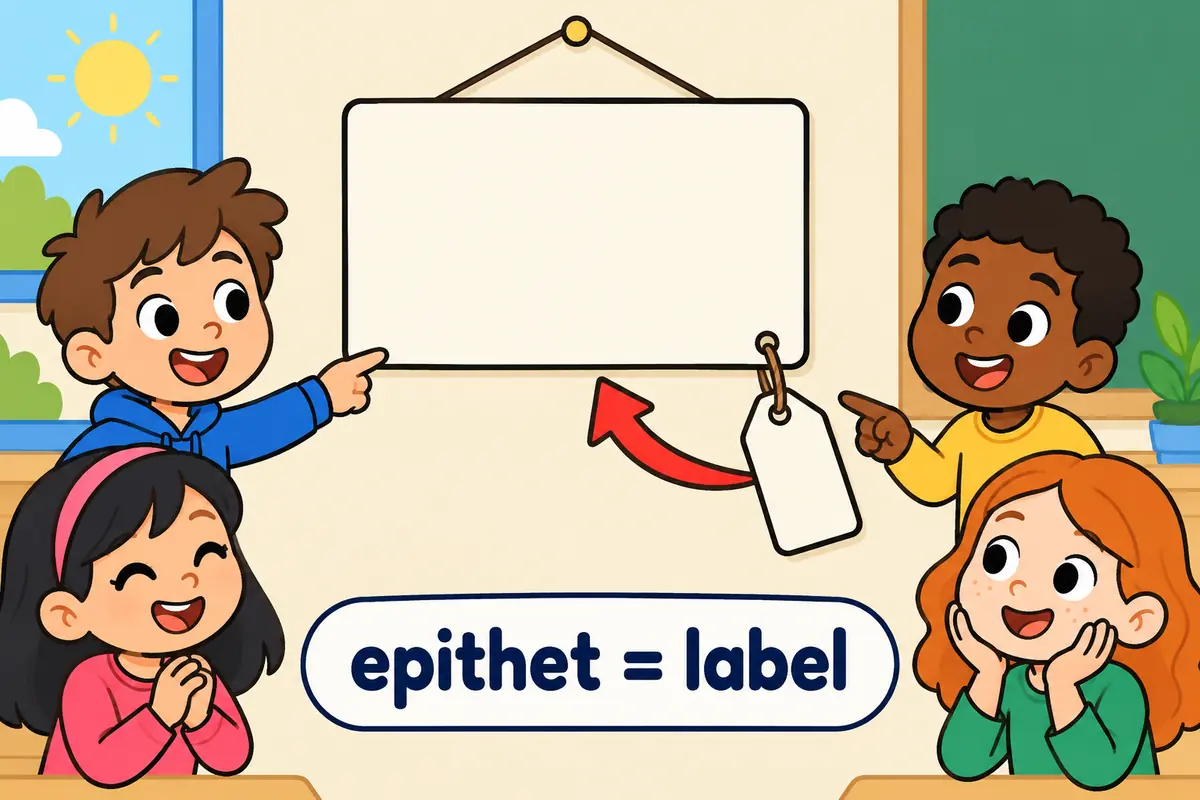
Epithet means a word or phrase that describes or names a person or thing. To use epithet in a sentence, give the phrase and the person it labels: “Critics gave the mayor the epithet ‘the Teflon leader’.” An epithet can be a neutral title or a hostile label, so context decides its force.
Epithet at a glance
- Epithet is a noun; its plural is epithets.
- It names a descriptive word or phrase attached to a person, place or thing.
- The phrase often follows give, earn or apply, and it usually appears in quotation marks.
- Epithets range from flattering titles to hostile labels.
- The commonest error is assuming every epithet is an insult.
What does epithet mean?
Epithet is a noun meaning a descriptive word or phrase joined to a name. The Cambridge entry for epithet records both the neutral descriptive sense and the hostile sense, and the gap between them is the whole story of the word. A a nickname is personal and informal, while an epithet can outlast a lifetime and pass into history.
| Sense | Plain meaning | Example sentence |
|---|---|---|
| Descriptive name | A phrase attached to a person or thing | “The Great” is an epithet shared by several rulers. |
| Literary phrase | A fixed descriptive tag in writing | “Rosy-fingered dawn” is a famous Homeric epithet. |
| Hostile label | A term used to abuse or dismiss | The crowd shouted an epithet at the referee. |
One limitation is worth stating plainly. An epithet is not automatically an insult, because the oldest uses are simply descriptive. In news writing, however, the word often signals a hostile label, and when the target is a group, a slur is the clearer and more accurate word.
How do you use epithet in a sentence?
The verb before epithet usually shows who applied the label and whether it stuck. Five patterns cover nearly every real sentence, and the quoted phrase is what names the words themselves.
| Pattern | Example | What it signals |
|---|---|---|
| give or earn + an epithet | The fans gave him the epithet “the Hammer”. | Shows who applied the label. |
| the epithet + quoted phrase | She disliked the epithet “difficult”. | Names the words directly. |
| a + adjective + epithet | He was stung by a racial epithet. | An adjective judges the label. |
| be known by the epithet | The town is known by the epithet “the windy city”. | Shows that the label stuck. |
| attach or apply + an epithet to | Critics attached the epithet to the whole plan. | Extends the label beyond a person. |
An appellation is the formal label a body or region carries, while an epithet usually carries a judgement. The practitioner rule is simple: if the phrase could appear on a birth certificate, it is an appellation or a designation rather than an epithet.
Epithet in a sentence: examples across contexts
Epithet keeps its meaning while the tone shifts. The sobriquet is the affectionate cousin of this word, and the ten sentences below move from a classroom to a history essay.
| Context | Example sentence | Why this works |
|---|---|---|
| Classroom | The class learned that “the Great” is an epithet, not a surname. | Contrasts the label with a real name. |
| Literary study | Homer repeats the epithet “swift-footed” for his hero. | The fixed phrase shows a literary device. |
| News report | The paper used the epithet “the Iron Lady” in its headline. | A quoted phrase names the label directly. |
| Sports writing | Fans gave the goalkeeper the epithet “the Wall”. | Shows a crowd coining a label. |
| History essay | The epithet “the Great” attaches to rulers across three continents. | Extends the label across many people. |
| Conversation | We earned the epithet “the messy table” at lunch. | A playful use shows the word can be light. |
| Biography | He never escaped the epithet “the quiet one”. | A lasting label shapes a life story. |
| Editorial | The writer rejected the epithet “populist” as unfair. | Signals a hostile label in a formal voice. |
| Travel writing | The city wears the epithet “the Venice of the north”. | Applies the label to a place. |
| Music review | Critics threw the epithet “one-hit wonder” at the band. | Shows a label meant to dismiss. |
Only the playful lunch example carries no judgement. The rest divide clearly into labels that flatter and labels that wound, which is why the surrounding words matter as much as the noun itself.
Epithet vs slur
Epithet and slur overlap when a label is hostile, and the difference is the target. A slur is the word to use when the label attacks a group and causes real harm.
| Attribute | epithet | slur |
|---|---|---|
| Core meaning | A describing word or phrase | An insult aimed at a group |
| Tone | Neutral to hostile | Always hostile and harmful |
| Typical target | A person, place or thing | A person because of a group they belong to |
| Can flatter | Yes, as in a title | No |
| Best in news writing | For a descriptive label | For abuse that harms a group |
Verdict: choose epithet for a label a reader can picture or quote, and choose slur when the label is abuse directed at someone because of who they are.
Word forms and grammar of epithet
Epithet is a regular noun, and its adjective forms are rare enough that most writers avoid them. A plain a designation is the official name on a document, which is the neutral end of the same family.
| Form | Part of speech | Example |
|---|---|---|
| epithet | noun, singular | The epithet stuck long after the match. |
| epithets | noun, plural | Two epithets appeared in the same headline. |
| epithetic | adjective, rare | The epithetic phrase opens the poem. |
| epithetical | adjective, rare | An epithetical use of the name feels heavy. |
| epithetically | adverb, very rare | The hero is named epithetically at each return. |
The two adjective forms are close in meaning and both are uncommon, so a writer who needs an adjective usually rephrases the sentence rather than risk an unfamiliar word.
Epithets in literature
The oldest use of epithet is a fixed descriptive phrase that travels with a name, and the habit runs from Greek epic to modern headlines. The table collects five well-known epithets and the effect each one has.
| Epithet | Attached to | Type | Effect |
|---|---|---|---|
| rosy-fingered dawn | The dawn itself | Nature phrase | Signals a new day in Homeric epic. |
| swift-footed | Achilles | Heroic tag | Keeps one quality before the reader. |
| the Great | Several rulers | Honorific | Records a verdict that outlives the reign. |
| the Iron Lady | A prime minister | Political label | Blends a compliment with a challenge. |
| the Windy City | Chicago | Place epithet | Gives a city a character in two words. |
Literary epithets are repeated on purpose: Homer returns to swift-footed Achilles because the phrase carries the hero’s defining trait each time he appears. A modern epithet works the other way, coined once and then quoted, which is why it so often sits inside quotation marks.
The two habits meet in one test. If the text itself keeps repeating the phrase, it is the literary device; if other people keep quoting it, it is the public label that today’s news writing calls an epithet. Neither use is automatically hostile: rosy-fingered dawn praises the light and the Great praises a ruler, while a courtroom epithet wounds. The noun stays neutral, and the surrounding sentence decides whether the phrase is a title worth keeping or a jibe worth forgetting.
Common mistakes with epithet
- Incorrect:
His surname is an epithet.Correct: His epithet “the Great” outlived his surname. Rule: An epithet is a describing phrase, not the name itself. - Incorrect:
Every epithet is an insult.Correct: An epithet can flatter or wound. Rule: The word is neutral about tone, so context decides. - Incorrect:
The epithet was his real name.Correct: The designation was his real name. Rule: Use designation or name for an official label. - Incorrect:
She gave him an epithet of a smile.Correct: She gave him a faint smile. Rule: Epithet describes a label in words, not a facial expression. - Incorrect:
He was called by many epithets names.Correct: He was called by many epithets. Rule: The noun already means a name, so another noun after it is redundant.
Practice using epithet
Work through the eight items, then check the reasoning rather than only the answer.
- Fill the gap: Fans gave the striker the ______ “the Rocket”.
- Choose the better word: A label that attacks a whole group is best called a (epithet / slur).
- Correct the error: He was known by the epithets name for years.
- Build a sentence: use be known by the epithet about a well-named town.
- Spot the register: which suits a history essay — the ruler earned the epithet the Great, or the ruler got called the Great?
- Rewrite with the plural: The headline used one epithet. Change to plural and keep the verb agreeing.
- Explain the tone: is “the Iron Lady” an insult or a title?
- Fix the word class: She spoke epithet about the plan.
Answers
- epithet — the quoted phrase is the describing label given by the fans.
- slur — the label targets a group, so slur is the accurate word.
- He was known by the epithet for years — the noun already means a name, so names is redundant.
- Model answer: The town is known by the epithet “the windy city”.
- The ruler earned the epithet the Great — an essay prefers precise verbs over got called.
- The headline used two epithets — the plural adds s and the verb stays in the past.
- It can be either, which is why context decides: a supporter hears a title, a critic hears a jibe.
- She spoke dismissively about the plan — epithet is a noun, so it cannot be an adverb.
The bottom line
Use epithet in a sentence for a describing word or phrase attached to a name, and let the surrounding words show whether it flatters or wounds. Two nuances decide most sentences: the noun itself is neutral about tone, and a hostile label aimed at a group is better called a slur. When the label is simply the official name, designation or appellation is the accurate choice.
Frequently asked questions about epithet
Is an epithet always an insult?
No. An epithet can be a neutral or flattering describing phrase, as in the epithet the Great, and the oldest literary uses are simply descriptive. Modern news writing often uses the word for a hostile label, but that is a habit of one register rather than part of the meaning.
What is the difference between an epithet and a nickname?
A nickname is personal, informal and usually invented by friends, while an epithet is a describing phrase that can stick for centuries. A nickname may vanish with a school year, but an epithet such as the Great can outlive the person and pass into history books.
How do you use epithet in a sentence?
Place the phrase after verbs such as give, earn or attach, and put the label itself in quotation marks. For example, fans gave the striker the epithet the Rocket. The surrounding words should make clear whether the label flatters or wounds the person.
When should I use slur instead of epithet?
Use slur when the label attacks someone because of a group they belong to and causes real harm. Epithet is broader and can be neutral, so it softens a serious meaning. In reporting, choosing the stronger word keeps the description accurate rather than mild.