Canard in a Sentence: Meaning & Examples
A canard is a false story or report that people repeat as though it were true. To use canard in a sentence, treat it as a countable noun for an untrue claim: “The editor dismissed the canard about the hidden fee.” It is stronger and more formal than rumor, and it implies that somebody wants the lie believed.
Canard at a glance
- Canard is a countable noun: a canard, the canard, several canards.
- Its core sense is a false report or story that is repeated as fact.
- It suits political, journalistic and formal writing rather than casual chat.
- Common collocates are repeat, spread, debunk and dismiss as a canard.
- The commonest learner error is treating any rumor or small lie as a canard.
What does canard mean?
A canard is a noun meaning a false story or report that is passed around as though it were true. The Cambridge entry for canard gives the sense of a false report, and the word usually implies that someone started or repeated it knowingly. A myth about the founder is often a canard in this sense, because it is repeated long after the facts are clear.
| Sense | Plain meaning | Example sentence |
|---|---|---|
| False report | A story spread as fact although it is untrue | The claim that the tax would double was a canard. |
| Deliberate invention | A made-up tale used to mislead people | Officials dismissed the leak as a canard invented by rivals. |
| Worn-out falsehood | A stale piece of misinformation repeated for years | The idea that we use only ten percent of the brain is a well-worn canard. |
How do you use canard in a sentence?
| Pattern | Example | What it signals |
|---|---|---|
| a / the + canard | The report repeated an old canard. | treats it as a countable thing |
| canard + that clause | It is a canard that cats always land safely. | states the false claim itself |
| dismiss / debunk + canard | Scientists debunked the canard quickly. | shows the false story being corrected |
| spread / repeat + canard | Rivals spread the canard across social media. | shows the false story travelling |
| canard + about + noun | The canard about the missing funds upset voters. | names the subject of the false story |
Canard in a sentence: examples across contexts
| Context | Example sentence | Why this works |
|---|---|---|
| News report | The paper called the rumour a canard with no sources. | formal journalistic judgement |
| Political speech | We will not repeat the canard that our rivals are dishonest. | public denial of a false claim |
| Workplace email | The team should treat the merger story as a canard until it is confirmed. | cautious professional warning |
| Academic writing | Researchers have debunked the canard that left-handed people are less capable. | careful, evidence-based correction |
| Blog comment | That old canard about the missing funding refuses to disappear. | informal but precise criticism |
| Legal argument | Counsel described the allegation as a canard repeated by the prosecution. | measured courtroom register |
| Parent talk | Someone told the children a canard about the park closing for good. | spoken register with a clear example |
| Review article | The essay attacks the canard that older workers resist change. | analytical tone and a specific claim |
| Radio interview | The presenter gently corrected the canard live on air. | Shows a false claim being fixed in public. |
| Opinion poll | Voters repeated the canard despite the published facts. | Shows how stubborn a false story can be. |
| Social media | A single post pushed the canard to thousands of readers. | Names the speed at which a false story travels. |
| Textbook | The chapter lists three canards that science has retired. | Treats the false stories as a settled set. |
Canard vs rumor
| Attribute | Canard | Rumor |
|---|---|---|
| Core meaning | a false story spread as fact | an unverified story in circulation |
| Truth status | already false | still unknown |
| Intent of the teller | usually deliberate | often casual or uncertain |
| Register | formal, political and journalistic | everyday and neutral |
| What it implies | somebody wants the lie believed | nobody has checked yet |
| Typical verb | debunk or dismiss | spread or confirm |
Call a false story a canard when the facts are settled, and call it a rumor around the office while it is still unchecked.
Canard vs hoax, fabrication and lie
Four words name untruths, and each answers a different question about who believed it and how it moved. The table sorts them by truth status, intent and register.
| Word | Truth status | Intent of the teller | Register | Example |
|---|---|---|---|---|
| canard | False and repeated as fact | Often deliberate | Formal and journalistic | The canard about the hidden fee resurfaced. |
| hoax | Invented to deceive | Deliberately deceptive | Neutral to formal | The bomb warning was a hoax. |
| fabrication | Made up from nothing | Deliberately deceptive | Formal and legal | The whole account was a fabrication. |
| lie | Knowingly false | Deliberately deceptive | Everyday | He told a lie about the missing cash. |
| myth | False but widely believed | No single author | Neutral | The myth about the founding survives. |
The distinguishing feature of a canard is circulation: it is not just false but passed along, and it usually carries the suggestion that someone wants it believed. A hoax needs a trick, a fabrication needs an author, and a lie needs a single telling, while a canard needs an audience that repeats it.
That is why canard pairs naturally with spread, repeat and circulate, and with debunk and dismiss when the false story finally meets the facts. Choose it when the untruth has a public life of its own.
| Form | Part of speech | Example |
|---|---|---|
| canard | singular noun | The editor rejected the canard at once. |
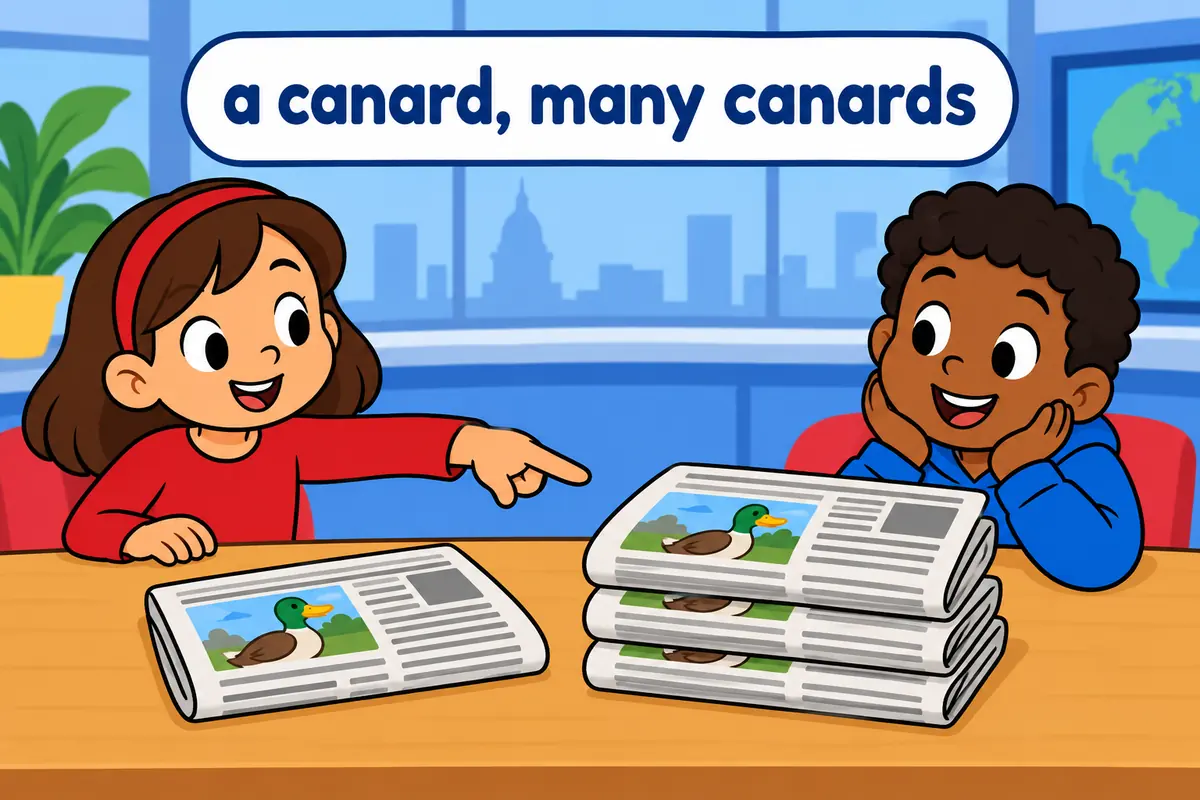
| canards | plural noun | Two old canards surfaced during the debate. |
| a canard | noun with article | That is a canard, not a fact. |
| canard about | noun + preposition | the canard about the hidden fee |
| canard that | noun + clause | the canard that the scheme had failed |
A deliberate fabrication by a rival or a hoax played on the public sits close to a canard, while a lie told for effect is a plainer, weaker word. Canard has no verb or adjective of its own, so writers use debunk, dismiss or repeat beside it instead of inventing a form such as canardise.
Which verbs go with canard?
Canard is almost always the object of a verb that describes what people do to a false story. The table groups the common verbs by direction, from starting the story to ending it.
| Verb group | Verb | Example | What it shows |
|---|---|---|---|
| Starting | invent, coin, start | Rivals coined the canard last spring. | Who first put the false story into circulation. |
| Spreading | spread, repeat, circulate | Pamphlets spread the canard across the town. | How the false story travelled. |
| Ending | debunk, refute, dismiss | Researchers debunked the canard within a week. | How the false story was answered. |
The same noun works on both sides of the fight, so the surrounding verb, not the noun, tells the reader whether the canard is winning or dying. A sentence such as the canard is spreading is far more alarming than one that says the canard has been debunked.
Incorrect: Police confirmed the canard about the stolen car.Correct: Police dismissed the canard about the stolen car. A canard is already false, so it cannot be confirmed as true.Incorrect: It was a canard, so nobody knew whether to believe it.Correct: It was a rumor, so nobody knew whether to believe it. Use rumor when the truth is still unknown.Incorrect: The child told a small canard about eating the cake.Correct: The child told a small lie about eating the cake. Canard is too formal for a personal fib.Incorrect: They canarded the report to mislead.Correct: They spread a canard to mislead. Canard is only a noun.Incorrect: A canards spread quickly online.Correct: A canard spread quickly online. The singular takes a, not a plural s.Incorrect: This canard must be true.Correct: This claim must be true. A canard is by definition false.
Practice using canard
- Fill in the blank: The minister called the story a ___ and refused to answer it.
- Choose the better word: Nobody had checked the claim, so it was a ___. (canard / rumor)
- Correct the error: The court canarded the evidence to confuse the jury.
- Build a sentence: use canard that about a false health claim.
- Spot the register: which sentence belongs in a formal editorial? (a) That story is total nonsense. (b) That claim is a canard that has been debunked.
- Fill in the blank: Two old ___ about the family fortune resurfaced.
- Fill in the blank: The presenter refused to repeat the ___ about the missing funds.
- Build a sentence: use debunk a canard about a health scare.
Answers
- canard – the noun fits a false story denied in public.
- rumor – the truth is still unknown, so canard would be too strong.
- The court dismissed the canard to avoid confusing the jury – canard is a noun, not a verb.
- The canard that the treatment was proven spread quickly – the that clause states the false claim.
- Sentence (b) – canard and debunked suit a formal editorial.
- canards – the plural ends in s.
- canard – the noun fits a false story that is being waved away.
- Model answer: The clinic debunked the canard that the vaccine caused the illness.
The bottom line
To use canard in a sentence, remember that it is a countable noun for a false story spread as fact, as in the paper exposed the canard at once. An act of deception can turn a plain story into a canard. It is stronger and more formal than rumor, because a canard is already false rather than merely unchecked. Sit it beside verbs such as debunk, dismiss or repeat, and never turn it into a verb.
Frequently asked questions about canard
Where does the word canard come from?
Canard is a French word for a duck, and the English sense of a false story grew from an old French phrase about half-selling a duck, or cheating a buyer. You do not need the history to use the word, but it explains why a canard suggests a tale passed off as better or truer than it is.
Is a canard always a lie?
A canard is a false story, and it is usually spread by someone who knows it is untrue. The word therefore leans toward deliberate invention rather than honest error. If a speaker repeats a wrong claim in good faith, rumor or misconception is fairer, but a canard signals that the falsehood has been pushed.
Can canard be used in everyday speech?
Canard appears mainly in political, journalistic and formal writing. In casual conversation, people are more likely to say a story is nonsense, made up or an old myth. Using canard in everyday speech sounds bookish, so reserve it for writing where a precise, slightly formal tone is wanted.
What is the plural of canard?
The plural is canards, formed by adding s like most English nouns, as in two familiar canards surfaced during the debate. Because it is countable, it also takes a or an in the singular: a canard, an old canard. It has no separate verb form, so writers never say someone canarded a report.