
Disaggregate in a Sentence: Meaning, Examples & Practice
Disaggregate means to split a whole into its separate parts, a verb used mostly with data, costs and populations. To use disaggregate in a sentence, name the whole and the dimension: “The report disaggregates spending by region.” The verb is transitive and belongs to technical, statistical and business writing.
Disaggregate at a glance
- Disaggregate is a transitive verb; its forms are disaggregates, disaggregated and disaggregating.
- It means to break a whole into its component parts, especially data.
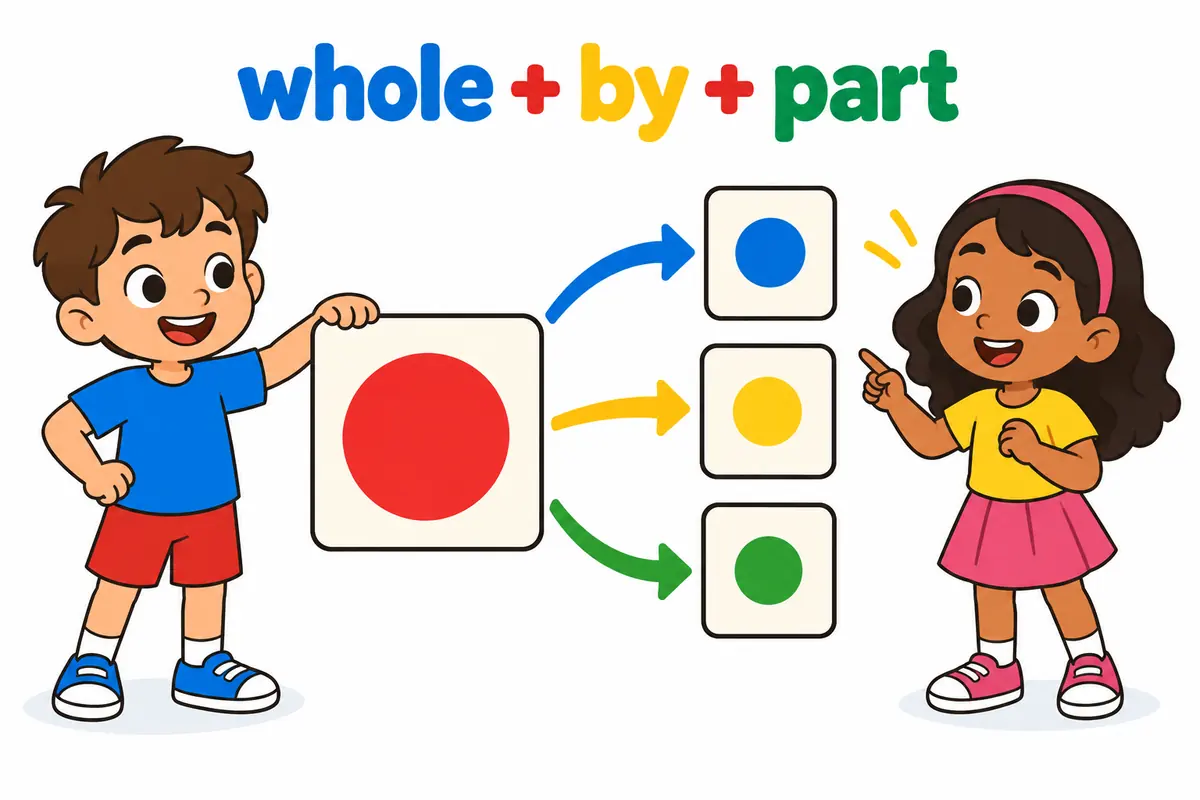
- The dominant patterns are disaggregate + noun + by + dimension and disaggregate + noun + into + parts.
- Disaggregate is the opposite of aggregate and belongs to statistics, economics and planning.
- The commonest error is confusing disaggregate with its opposite, aggregate.
What does disaggregate mean?
Disaggregate is a transitive verb meaning to separate a whole into its parts, usually so that the differences inside a total become visible. The Cambridge entry for disaggregate records this technical sense, and the rows below separate the ways the split can be described. In each case the object is the whole, and a preposition names the basis of the division.
| Sense | Plain meaning | Example sentence |
|---|---|---|
| Split data into groups | Break a total down by a category | The survey disaggregates results by age group. |
| Separate components | Divide a whole into its parts | The model disaggregates the cost into labour and materials. |
| Analyse by subgroup | Examine differences hidden inside a total | Analysts disaggregated the figures by region. |
One limitation is worth stating plainly. Disaggregate is a technical verb, so for a general audience break the total down usually reads better. It also never means simply reducing a total: to divide a figure into parts keeps the same whole, while cutting or shrinking it changes the whole. A split that leaves the parts summing back to the original total is the only one that keeps the analysis trustworthy.
How do you use disaggregate in a sentence?
Put the whole straight after the verb, then name the basis of the split with by or into. By introduces the dimension such as age or region, while into introduces the resulting parts. Five patterns cover almost every real sentence.
| Pattern | Example | What it signals |
|---|---|---|
| disaggregate + noun + by + dimension | The report disaggregates spending by region. | By names the grouping the split follows. |
| disaggregate + noun + into + parts | We disaggregated the total into four categories. | Into names the parts produced by the split. |
| be disaggregated | The data can be disaggregated by school. | Passive, standard in methods sections. |
| disaggregated + noun | Policy rests on disaggregated data. | Attributive use, common in policy writing. |
| disaggregate + noun | The team disaggregated the figures. | Object alone, when the dimension is already clear. |
Learners sometimes omit the preposition entirely, but a sentence such as the team disaggregated the figures by age always sounds more complete with the dimension named. A series that is split into its underlying factors is often said to decompose, and when the split is a detailed reading of a record rather than a table, parse is the closer verb.
Disaggregate in a sentence: examples across contexts
The ten sentences below keep the same verb while moving from a budget meeting to a health report. Each row names the whole and the dimension, because disaggregate always needs both.
| Context | Example sentence | Why this works |
|---|---|---|
| Budget meeting | We disaggregated the marketing budget by channel. | A concrete dimension shows where the money went. |
| Government report | The figures are disaggregated by district and by income. | Two dimensions reveal patterns a single total hides. |
| Academic prose | The study disaggregates the sample into three age bands. | Into names the parts the analysis produced. |
| Business writing | Analysts disaggregated revenue into subscriptions and sales. | Separating streams explains a change in the total. |
| Healthcare | The trust disaggregates waiting times by department. | Comparing departments is the point of the split. |
| Economics | Economists disaggregated the index into food and energy. | The parts show which component moved. |
| Education | Results were disaggregated by school and by year group. | Two groupings expose gaps hidden in the average. |
| Data methods | The dataset can be disaggregated at the postcode level. | States the finest level the split supports. |
| Sustainability | The report disaggregates emissions by source. | Attributing a total to its sources is the core use. |
| Housing | The council disaggregates homelessness figures by household type. | Different household types need different services. |
| Retail | The chain disaggregates sales by store and by day. | Two dimensions separate location from timing. |
| Conversation | Can we disaggregate these numbers by month? | A question form asks for a split without jargon. |
Every sentence names both the whole and the basis of the split. A bare instruction to disaggregate the data leaves the reader asking by what, which is why the prepositional phrase is treated as part of the pattern rather than an optional extra. The dimension is the information the sentence exists to deliver, so burying it or dropping it removes the reason to use the verb at all.
Disaggregate vs aggregate and separate
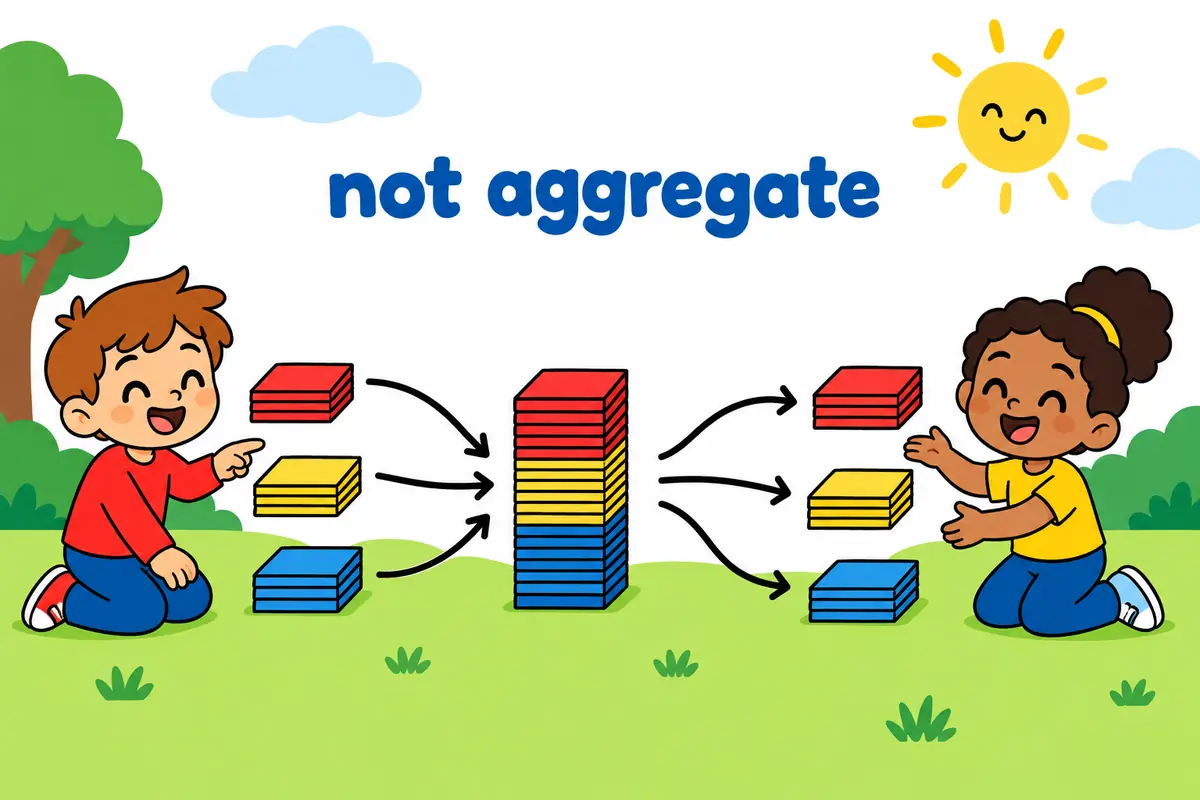
Disaggregate is best understood against its opposite. Aggregate combines parts into a total, disaggregate splits the total back into parts, and partition stresses that the resulting parts do not overlap. The table separates the three by direction and by what they guarantee.
| Attribute | disaggregate | aggregate | separate |
|---|---|---|---|
| Direction | One whole to many parts | Many parts to one whole | Pull things apart |
| Typical object | Data, costs, a population | Data, results, demand | Items, people, concepts |
| Needs a dimension | Usually, with by or into | Often, with across or into | No |
| Guarantees | Parts reveal hidden differences | Parts sum to the total | Items are no longer together |
| Register | Technical and statistical | Technical and statistical | Neutral and everyday |
Verdict: choose disaggregate to reveal what is inside a total, aggregate to combine parts into one figure, and separate when the point is simply that things are no longer together. The two verbs are a matched pair, so a report that disaggregates one table may aggregate the next, and reversing them is the single most common mistake with this pair.
Word forms and grammar of disaggregate
Disaggregate inflects regularly and forms a common noun in plural contexts. The table also pairs the verb with its opposite, because a sentence about combining data needs aggregate rather than a negated form. The noun decomposition is used in the same fields for a related idea.
| Form | Part of speech | Example |
|---|---|---|
| disaggregate | verb, base form | We will disaggregate the results next week. |
| disaggregates | verb, third person singular | The dashboard disaggregates sales by store. |
| disaggregated | verb, past and past participle | The team disaggregated the national figures. |
| disaggregating | verb, present participle | Disaggregating the data took two days. |
| disaggregation | noun | Disaggregation revealed a gap between regions. |
| aggregate | verb, opposite | They aggregate the returns into one total. |
The noun disaggregation often appears where a method is being described, as in the disaggregation of the census returns. The negative form undisaggregated appears mainly in data-quality rules, as in a test that rejects undisaggregated totals, and it is best kept to that technical setting.
Common mistakes with disaggregate
- Incorrect:
The figures were aggregated by region to show the gap.Correct: The figures were disaggregated by region to show the gap. Rule: Aggregate combines parts; disaggregate splits a total to reveal differences. - Incorrect:
We disaggregated down the data.Correct: We disaggregated the data. Rule: By or into carries the split, so no extra down is needed. - Incorrect:
The data was disaggregate by age.Correct: The data was disaggregated by age. Rule: The passive needs the past participle disaggregated. - Incorrect:
They disaggregated into the quarterly sales.Correct: They disaggregated the quarterly sales into four regions. Rule: The whole is the object and comes before into. - Incorrect:
We need to disaggregate up the total.Correct: We need to aggregate the total. Rule: The opposite of disaggregate is aggregate, not a phrase with up.
Practice using disaggregate
Work through the six items, then check the reasoning rather than only the answer.
- Fill the gap: The report ______ the national figures by county.
- Choose the better word: To reveal the regional gap, the team (aggregated / disaggregated) the totals.
- Correct the error: The data was disaggregate by age group.
- Build a sentence: use disaggregate + noun + into about a school budget.
- Spot the register: which belongs in a methods section — The data were disaggregated by school, or We broke the numbers up by school?
- Rewrite for a general reader: replace disaggregate in We disaggregated the costs by month with a plainer phrase.
Answers
- disaggregated — the past tense matches the completed split and keeps the by phrase.
- disaggregated — revealing a gap inside a total is the job of disaggregate.
- The data was disaggregated by age group — the passive requires the past participle.
- Model answer: The school disaggregated its budget into staffing and supplies.
- The data were disaggregated by school — a methods section keeps the technical verb and the passive.
- We broke the costs down by month — a general reader understands the phrasal verb at once.
The bottom line
Use disaggregate in a sentence when a combined total must be split so that the differences inside it become visible, and name the basis of the split with by or into. Two nuances decide most sentences. The verb is the opposite of aggregate rather than a synonym for it, and it never changes the size of the whole. Where the audience is general rather than technical, break the total down is the clearer choice.
Frequently asked questions about disaggregate
What is the opposite of disaggregate?
The opposite is aggregate, which combines separate parts into one total. The two describe matching moves in opposite directions. A dashboard might disaggregate sales by store, then aggregate them back into a national figure, and the same dataset supports both operations without any change of meaning.
Is disaggregate a real word?
Yes. Disaggregate is an established verb in statistics, economics, public policy and data science, formed by adding the prefix dis to aggregate. It appears in official reports and methods sections rather than in everyday conversation, which is why some readers meet it for the first time in a technical document.
How do you use disaggregate in data analysis?
In data analysis, disaggregate means breaking one combined measure into subgroups so hidden differences appear. Analysts disaggregate results by age, region or school. The phrase that follows by names the dimension, and the split is only useful when the parts stay consistent with the original total.
Can disaggregate be a noun?
No. The noun is disaggregation, as in the disaggregation of the figures revealed a gap. Disaggregate stays a verb, so a sentence that needs a subject uses disaggregation instead. Mixing the two, as in the disaggregate of the data, is a common slip in technical writing.