
When it comes to describing depth, finding the right words can add a whole new dimension to your writing. Whether you’re diving into the depths of the ocean or exploring the profound emotions of a character, using the right adjectives can paint a vivid picture in the reader’s mind. In this article, I’ll be sharing a collection of adjectives that beautifully capture the concept of deepness, along with examples to help you bring your writing to life.
From the mysterious depths of a dark cave to the profound thoughts that dwell within our minds, the word “deep” holds a multitude of meanings. To convey these depths effectively, we need a rich vocabulary of adjectives at our disposal. In this comprehensive guide, I’ll be sharing a range of descriptive words that will help you delve into the depths of your writing. Whether you’re searching for words to describe physical depth or the intensity of emotions, you’ll find a treasure trove of examples and inspiration here.
So, let’s dive in and explore the world of adjectives for deepness together. Whether you’re a writer looking to add depth to your prose or simply someone who appreciates the beauty of language, this article is sure to deepen your understanding and appreciation of the power of words.
How to Describe deep? – Different Scenarios
When it comes to describing “deep,” there are various scenarios where this adjective can come into play. Whether you’re a writer looking to add depth to your prose or someone who appreciates the beauty of language, understanding how to describe “deep” in different contexts is essential. Let’s explore a few scenarios together:
1. Deep Water
When describing the depth of water, it’s important to use adjectives that create a vivid image in the reader’s mind. Here are some examples:
- Immeasurable: The ocean stretched out before me, its immeasurable depths reflecting shades of blue.
- Bottomless: The lake appeared calm on the surface, but its bottomless depths held mysteries yet to be discovered.
- Treacherous: The river, with its fast current and treacherous depths, warned us to proceed with caution.
2. Deep Thoughts
Describing the depth of thoughts requires adjectives that convey complexity and introspection. Here are a few examples:
- Profound: His words were filled with profound insights, causing us to question our own beliefs.
- Introspective: She took a deep breath and dived into her introspective thoughts, dissecting her emotions with great precision.
- Philosophical: As we sat by the fire, our conversation turned philosophical, delving into the deeper meaning of life.
3. Deep Emotions
When describing deep emotions, it’s crucial to choose words that evoke empathy and understanding. Here are some examples:
- Overwhelming: She felt an overwhelming sense of joy as she held her newborn baby in her arms for the first time.
- Unfathomable: The pain of losing a loved one can be unfathomable, leaving a deep void in one’s heart.
- Intense: The actress’s performance was so intense that it stirred a deep emotional response from the audience.
4. Deep Space
- Infinite: Looking up at the night sky, I couldn’t help but feel the infinite depths of the universe.
- Mysterious: The black hole’s magnetic pull was both fascinating and mysterious, drawing everything into its unfathomable depths.
Describing Words for deep in English
As a language enthusiast, I find it intriguing how a single adjective like “deep” can be used to describe various aspects of the world around us. From the depths of the ocean to the profundity of our thoughts, this versatile word adds depth and complexity to our descriptions. Let’s explore some adjectives that can be used to convey the different meanings of “deep.”
Describing the Depth of Water
When we talk about the depth of water, we often use adjectives to paint a vivid picture in our minds. Take a look at some words that can enhance our descriptions:
- Abyssal: The abyssal depths of the ocean create a sense of mystery and wonder.
- Bottomless: Gazing into the bottomless lake, I couldn’t help but feel a sense of awe.
- Profound: The profound waters of the sea stretched out before me, hinting at the unknown.
Describing Thoughts and Emotions
Just like water, our thoughts and emotions have depths that can be explored through language. Here are some adjectives that capture the intricacy of our inner worlds:
- Introspective: His introspective nature led him to delve deep into the meaning of life.
- Pensive: As I sat by the window, my pensive thoughts carried me to distant places.
- Profound: The profound sadness in her eyes spoke volumes without a single word.
Describing the Immensity of Space
The vastness of space has always captivated humankind. When we talk about the immense depths of the universe, these adjectives add richness to our descriptions:
- Boundless: The boundless expanse of the cosmos filled me with a sense of wonder.
- Infinite: Lost among the stars, I felt the infinite possibilities of the universe.
- Unfathomable: The unfathomable depths of the universe challenged the limits of human comprehension.
As writers, choosing the right adjectives allows us to create imagery that conveys the depth and complexity of the world around us. Whether we’re describing water, thoughts, emotions, or space, these adjectives help us paint a richer picture for our readers.
Adjectives for deep
Positive Adjectives for deep with 12 Example Sentences
When it comes to describing depth in a positive light, there are several adjectives that can help us paint a vivid picture. Here are twelve examples of positive adjectives that can be used to describe deep:
- Profound: Her wisdom had a profound impact on me.
- Bottomless: The ocean seemed bottomless as we sailed across it.
- Far-reaching: His influence was far-reaching, touching the lives of many.
- Infinite: The possibilities for exploration felt infinite in this vast universe.
- Unfathomable: The mysteries of the deep sea are truly unfathomable.
- Boundless: The depth of their love for each other seemed boundless.
- Plentiful: The deep forest was home to a plentiful array of wildlife.
- Extensive: The research team conducted extensive studies on deep space.
- Immeasurable: The value of her contribution was immeasurable to the project’s success.
- Intense: The depth of his emotions made his performance on stage incredibly intense.
- Perceptive: She had a perceptive understanding of the deep meaning behind the poem.
- Immersive: The virtual reality experience was so immersive, it felt like diving into a deep world.
Negative Adjectives for deep with 5 Example Sentences
Not all descriptions of depth are positive. Some situations call for negative adjectives to capture a different aspect of depth. Here are five examples of negative adjectives that can be used to describe deep:
- Overwhelming: The deep responsibility of caring for a sick loved one can be overwhelming.
- Suffocating: The deep darkness of the cave made me feel suffocated and claustrophobic.
- Buried: The truth was buried deep within the layers of deception.
- Tangled: The deep web of lies became increasingly tangled as the investigation unfolded.
- Daunting: The deep challenges of starting a new business can be daunting for many.
In choosing the right adjectives, we can effectively convey the depth of our experiences, emotions, and surroundings. Whether we use positive or negative adjectives for deep, it’s important to select words that accurately depict the complexity and richness of our world.
Synonyms and Antonyms with Example Sentences
Synonyms for deep
When it comes to finding the right word to describe depth, there are several synonyms that can be used to convey the concept effectively. Here are a few synonyms for “deep” along with example sentences:
| Synonym | Example Sentence |
|---|---|
| Profound | The speaker’s words had a profound impact on me. |
| Bottomless | The ocean seemed bottomless as I looked out into its vast expanse. |
| Far-reaching | The consequences of our actions can have far-reaching effects. |
| Extensive | The cave system was more extensive than we had anticipated. |
| Immense | The mountain stood tall, showcasing its immense beauty. |
Antonyms for deep
On the other hand, sometimes we want to describe the opposite of depth. Here are a few antonyms for “deep” along with example sentences:
| Antonym | Example Sentence |
|---|---|
| Shallow | The river was so shallow that we could easily wade across it. |
| Superficial | His compliments felt superficial and insincere. |
| Surface-level | We need to dig deeper and look beyond the surface-level explanations. |
| Limited | The knowledge I have on this subject is quite limited. |
| Lofty | She always had lofty aspirations, dreaming big and reaching for the stars. |
Remember, choosing the right adjective is crucial in accurately describing the depth of our experiences, emotions, and surroundings.
Conclusion
In this article, I have explored the various adjectives that can be used to describe the concept of “deep.” By providing synonyms such as profound, bottomless, far-reaching, extensive, and immense, I have shown the wide range of words that can be used to convey depth in different contexts. Additionally, I have highlighted antonyms like shallow, superficial, surface-level, limited, and lofty, which help to contrast the idea of depth.
Throughout the article, I have emphasized the importance of choosing the right adjective to accurately describe the depth of our experiences, emotions, and surroundings. By selecting the appropriate word, we can effectively communicate the intensity, significance, and complexity of these aspects of our lives.
Remember, the power of language lies in its ability to capture and convey the nuances of our experiences. So, whether we are describing the depths of our emotions or the vastness of the ocean, let us choose our adjectives wisely to paint a vivid picture for our readers.

Choose an Adjective for the Kind of Depth You Mean
Deep can refer to a measurable distance, a low sound, a dark color, a strong feeling, or an idea that takes serious thought. The best adjective depends on the noun and the kind of depth you want readers to picture. A word that works for an ocean trench may sound exaggerated when applied to a bowl, while a word for emotion may not describe physical distance at all.

For water, holes, and other measurable spaces
Use deep when you mean that something extends a long way from its surface or opening to its bottom. Deep, shallow, great, and considerable can describe measurable depth. Sheer emphasizes a steep, abrupt drop, as in a sheer-sided ravine. Substantial suggests considerable depth without giving a measurement. In technical ocean writing, abyssal and hadal identify particular deep-ocean zones; they are more precise than simply saying very deep. NOAA describes the abyssopelagic zone as about 4,000–6,000 meters and the hadal zone as 6,000 meters and deeper, so reserve those terms for the relevant marine setting.
Examples: “The well is deep, but a marked line gives its measured depth”; “A sheer drop begins just beyond the path”; “Researchers sampled an abyssal plain.” In safety directions, replace dramatic words such as bottomless with a measurement whenever one is available. Bottomless is usually figurative: it means seemingly without a bottom or limit, not literally endless.
For thoughts, questions, and ideas
For thinking, profound suggests great insight, importance, or a far-reaching effect. Complex means made up of connected parts; nuanced points to subtle distinctions; abstract describes an idea considered apart from concrete objects. These words are related to intellectual depth, but they are not interchangeable. A question can be complex without being profound, and a nuanced answer can be clear rather than difficult.

Examples: “Her nuanced explanation separated the two ideas”; “The essay asks a profound question about memory”; “The topic is complex, so the guide defines each term before comparing them.” If your goal is simply to say that a piece is difficult, challenging or dense may be more informative than deep.
For emotions, relationships, and effects
Strong and intense describe force; profound suggests a powerful effect; lasting says that an emotion continues over time. Wrenching usually describes painful emotion, while tender emphasizes affection or care. Choose according to the feeling instead of treating every emotion as “deep.”
Examples: “They felt lasting gratitude for the neighbors’ help”; “The news had a profound effect on the family”; “The actor gave an intense performance.” The sentence “a deep sadness” is natural, but a more specific word can explain whether the sadness is acute, enduring, quiet, or overwhelming.
For colors, sounds, and physical features
A deep color is usually rich, strong, and dark: saturated, vivid, or dark may make that quality clearer. A low, resonant, or sonorous voice has a deep pitch; these do not mean that the speaker is thoughtful. For a cut or wound, deep describes how far it reaches into the body, while serious describes its significance. Keep the physical measurement separate from the judgment about severity.
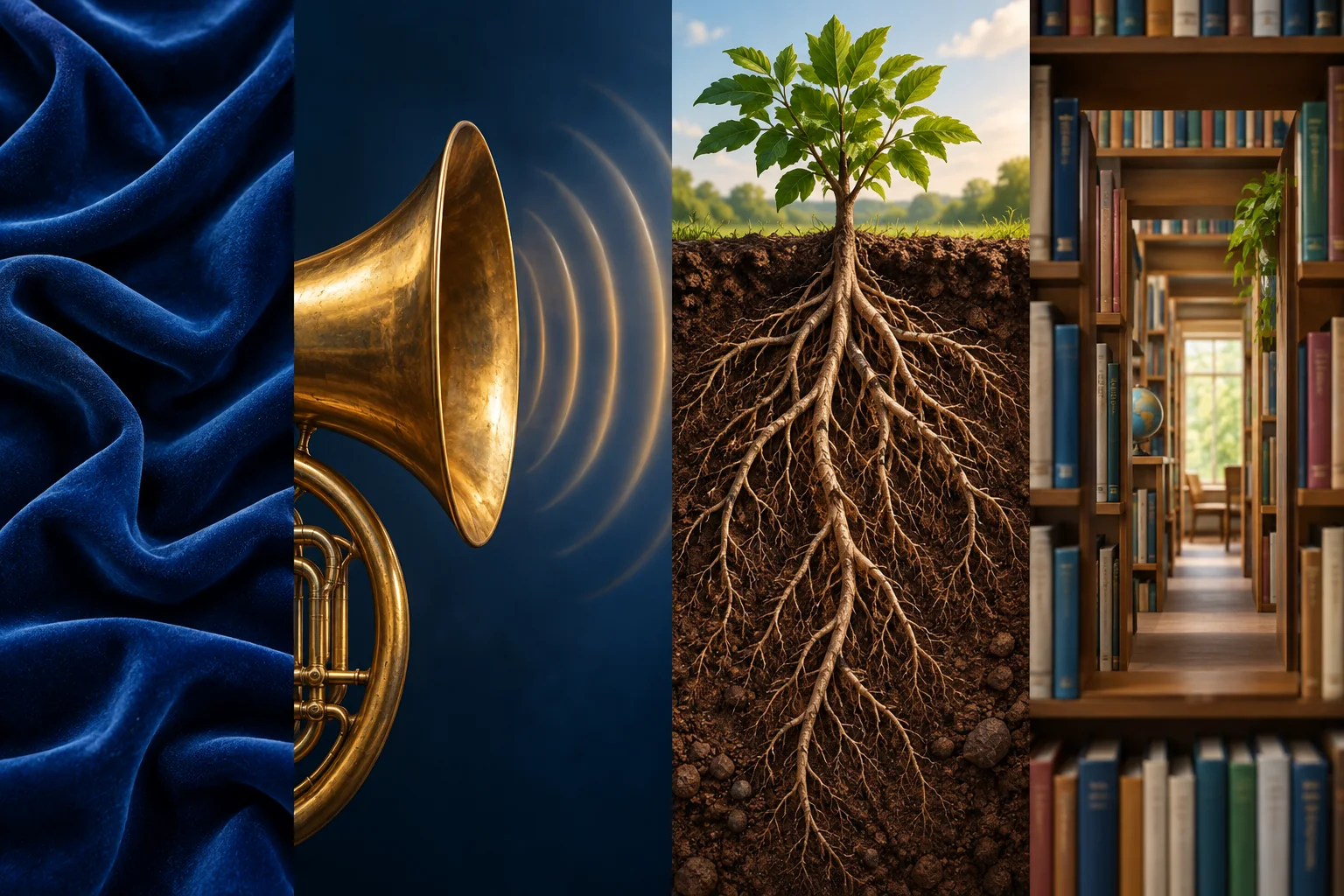
Deep, Profound, Intense, and Related Words
These adjectives overlap, but the choice changes the emphasis. Deep is the broadest and most flexible. Profound usually signals intellectual or emotional importance. Intense describes a high degree of force or concentration, whether or not the experience lasts. Strong is direct and common, but it can be less specific. Complex describes structure or difficulty, not necessarily wisdom or feeling.
| Word | What it emphasizes | Example |
|---|---|---|
| deep | Great extent, strength, darkness, low pitch, or seriousness, depending on the noun | a deep cave; deep affection |
| profound | Great importance, insight, or effect | a profound change |
| intense | Force, concentration, or degree | intense heat; intense relief |
| complex | Many connected parts or difficulty | a complex argument |
| rich | Full, varied quality, especially sound, flavor, color, or detail | a rich brown; a rich voice |
Try a substitution test: if you replace deep with another adjective, does the sentence keep its intended meaning? “A profound ocean” sounds unusual if you mean depth in meters; “a deep insight” works, but profound insight is often more precise. Cambridge’s dictionary groups several senses under deep, including physical distance, low sound, strong feeling, and dark color. That range explains why the surrounding noun and sentence context matter.
Grammar and Common Phrases with Deep
- Comparative and superlative: deeper and deepest are the usual forms: “The eastern end is deeper”; “This is the deepest point we measured.”
- Adjective or adverb: Use deep before a noun (“deep water”) or after a linking verb (“the water is deep”). Use deeply to modify many verbs and adjectives (“deeply concerned,” “deeply appreciate”). In a few established distance expressions, deep itself acts adverbially: “The roots reach deep into the soil.”
- Hyphenated measurements: Before a noun, write a measurement as a compound modifier: “a three-meter-deep pool.” After the noun, use “the pool is three meters deep.”
- Common expressions: deep in thought means absorbed in thinking; deep-rooted means firmly established; deep-seated describes a strongly established feeling or belief; and in deep water is an idiom for being in difficulty.
When using figurative expressions, make sure the context supports the meaning. “A deep-rooted habit” suggests that the habit is firmly established, not that it has literal roots. For learner writing, a direct phrase such as “a long-established habit” may be clearer.

Quick Editing Checklist
- Identify the noun: is it water, a voice, a color, a feeling, or an idea?
- Decide whether deep is literal or figurative. Add a measurement for literal depth when useful.
- Choose a more specific alternative if it names the quality more clearly: low for pitch, dark for color, intense for force, or profound for importance.
- Check that the comparison makes sense. A color can be darker or more saturated; an explanation can be more complex or more nuanced.
Frequently Asked Questions
What is a strong adjective for deep?
Profound works for important ideas or lasting effects; abyssal is a technical choice for certain ocean depths; intense describes strong experiences. The right choice depends on what is deep.
Is profound the same as deep?
No. Profound usually emphasizes importance, insight, or a powerful effect. Deep also describes literal distance, low pitch, dark color, and strong feelings. Sometimes the words overlap, as in “deep/profound sadness,” but they do not fit every context equally well.
What is the opposite of deep?
Shallow is the usual opposite for physical distance from top to bottom or front to back. For figurative meanings, the opposite changes: superficial can oppose intellectual depth, while light may contrast with a deep voice or color. Avoid using one antonym for every sense.
Can deep describe a person?
Yes, but it is vague without context. “A deep person” commonly suggests someone thoughtful or serious. To be clearer, describe the quality directly: “a reflective person,” “a thoughtful speaker,” or “someone with strong convictions.”
Sources and Further Reading
- Cambridge Dictionary: “deep” (physical, emotional, intellectual, sound, and color senses).
- NOAA Ocean Service: How far does light travel in the ocean? (ocean depth-zone terminology).
- NOAA Ocean Service: What is bathymetry? (the study of underwater depth and terrain).


