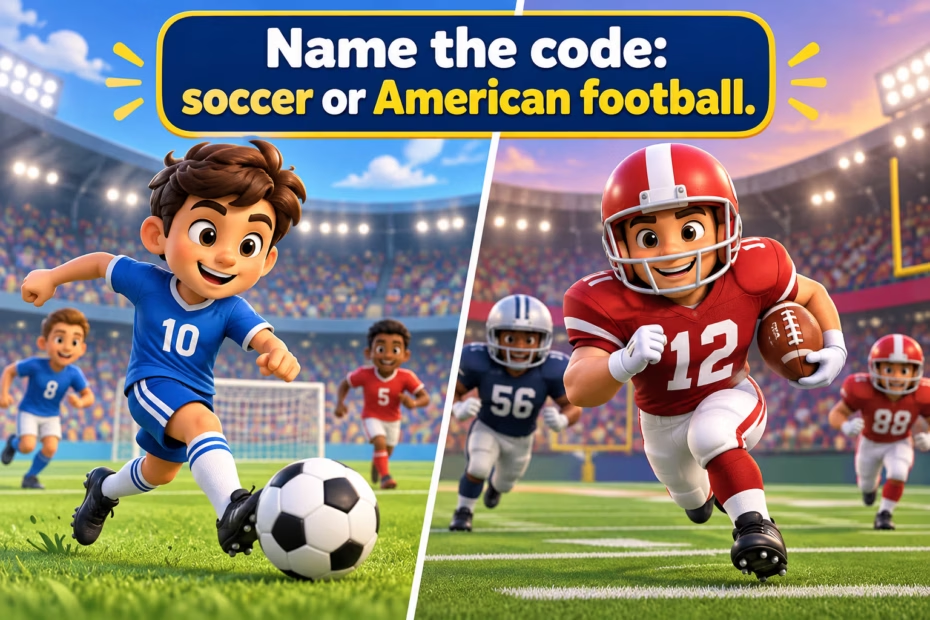
Football adjectives are descriptive words that identify observable qualities of a match, a team’s play, or a spectator’s reaction. Because football can mean association football (soccer) or American football depending on region, name the code first; then support subjective terms such as exciting or boring with the detail that led to your view.
Quick answer
- Use a football adjective to describe a specific match, play, team performance, venue, result, or reaction.
- In the UK and many other places, football usually means association football; in the US, football usually means American football.
- “Fast-paced” describes a match’s tempo; “precise” can describe a pass; “tense” can describe a final.
- Separate observable match details from a fan’s interpretation of them.
- Basketball and baseball are other sports, not antonyms of football.
What Does “Football” Mean Here?
In this guide, football means association football, also called soccer in the United States. Cambridge Dictionary records that the word can also refer to American football in US usage, so international writing should identify the sport when the context does not make it clear.

For example, “a fast-paced match” can describe quick transitions in either code, but “a precise pass” should be interpreted within the rules and actions of the sport being discussed. The adjective belongs to a noun: say whether the word describes the match, pass, team, crowd, or your own reaction.
How Do You Choose an Accurate Football Adjective?
Choose an adjective by naming what you observed and the noun it modifies. A short evidence check keeps match reports vivid without making a personal judgment sound like an agreed fact.

- Name the subject: Is the adjective describing a match, pass, defensive shape, team performance, venue, result, or supporter reaction?
- Check the code: State soccer/association football or American football if readers could interpret the word differently.
- Separate observation from judgment: “The team completed several quick forward passes” reports an observable sequence; “the match was thrilling” records an evaluation.
- Give the reason: Pair an opinion with the moment or feature that prompted it, such as repeated chances, a close score, or a late goal.
One practical editing rule is to replace “good,” “bad,” or “dominant” with the specific feature you mean whenever the evidence allows it. “Dominant” is more informative when it is tied to sustained possession, territory, chances, or another match-specific measure; without that support, it is an impression.
Which Adjectives Describe a Match, a Play, or a Reaction?
The same adjective can point to different things, so the noun and example sentence matter. Use the following distinctions to make the description clear.
| What you describe | Useful adjectives | Example |
|---|---|---|
| Match tempo | fast-paced, measured, stop-start | “The second half was fast-paced, with both sides moving the ball forward quickly.” |
| A pass or touch | precise, misplaced, controlled | “A precise pass found the runner behind the defense.” |
| Score or ending | close, decisive, dramatic | “The close final stayed level until the last goal.” |
| Team performance | organized, disjointed, disciplined | “The team’s organized defense limited clear chances.” |
| Spectator reaction | exciting, frustrating, enjoyable | “I found the match exciting because the lead changed twice.” |
These are writing choices, not official ratings. “Frustrating” describes how a viewer experienced a match; “misplaced” can identify a particular pass if the intended receiver did not receive it. Keep subjective reaction and observable play in separate clauses when both matter.
What Do Positive and Negative Football Adjectives Show?
Positive and negative adjectives can describe the same event from different viewpoints. They work best when a sentence says whether the writer is evaluating the play, the outcome, or the viewing experience.
- Positive: skillful, agile, precise, coordinated, resilient, exciting, impressive.
- Critical: sloppy, disjointed, wasteful, frustrating, disappointing, lethargic.
- Context-dependent: physical, cautious, direct, defensive, chaotic, dominant.
“Physical” may neutrally describe the contact or pace in a particular contest; it does not automatically mean unfair. “Cautious” may be a tactical description or criticism, depending on the writer’s standard. “Chaotic” can describe a disorganized passage of play, while a fan might use it as shorthand for an entertaining match. Make the intended sense explicit.
Are “Soccer,” “Gridiron,” and Other Sports Synonyms or Antonyms?
“Soccer” can name association football in US English, while “gridiron” is an informal term associated with American football; neither word is a universal substitute without context. Basketball, baseball, hockey, and tennis are names of other sports, so they are not strict antonyms of football.
An antonym expresses an opposing meaning on a relevant scale, such as fast and slow when describing pace. A different sport is a category contrast, not the opposite of football. The original synonym and antonym lists below are preserved in full; use them as related sport vocabulary and comparison prompts rather than treating every item as a dictionary synonym or antonym.
How Can You Improve a Football Description?
Replace broad praise or criticism with the match detail that supports it. These examples show how an adjective becomes more useful when the sentence identifies the evidence and subject.
| Broad wording | More precise wording | Why it helps |
|---|---|---|
| “The match was amazing.” | “The match became tense after both teams created chances in the final minutes.” | Names the period and observable source of tension. |
| “The team was dominant.” | “The team controlled possession for long spells and created more clear chances in this match.” | Connects the evaluation with stated evidence. |
| “The game was boring.” | “I found the first half slow because neither side created a clear chance.” | Marks the judgment as the writer’s reaction and explains it. |
| “The player was skillful.” | “The midfielder used close control to move past two defenders.” | Shows the action behind the adjective. |
These are model sentences, not claims about a real fixture. When writing about an actual game, check names, score, chronology, and statistics against a reliable match record before adding numerical detail.
Sources and Further Reading
Cambridge Dictionary’s football entry records the regional senses discussed above. Its entries for soccer and American football help readers identify which code a word refers to. These dictionary entries support the terminology note; match descriptions should still be checked against the specific game being covered.
Original Football Adjective Article
The complete original article is reproduced below, including its examples, lists, headings, and tables. The additions above explain regional usage and clarify where the original sport comparison lists use related categories rather than strict synonyms or antonyms.

Football is a game that is filled with passion, excitement, and breathtaking moments. As a football enthusiast, I have always been fascinated by the power of words in capturing the essence of this beautiful sport. In this article, I’ll be sharing with you a comprehensive list of adjectives that can be used to describe football, along with examples to help you paint a vivid picture in your writing.
From the thunderous roar of the crowd to the lightning-fast pace of the game, football is a sport that evokes a wide range of emotions. Whether you’re a player, a coach, or a fan, finding the right words to describe the intensity and beauty of the game can be a challenge. That’s why I’ve compiled this list of adjectives that will elevate your football-related writing to new heights. So, whether you’re writing a match report, a player profile, or simply expressing your love for the game, these adjectives will help you convey the excitement and energy that football brings.
So, without further ado, let’s dive into the world of adjectives for football and explore the descriptive power of words when it comes to capturing the essence of this beloved sport. Get ready to enhance your writing and bring your football-related content to life with these powerful adjectives and their accompanying examples.
How to Describe football? – Different Scenarios
When it comes to describing football, it’s important to capture the essence and excitement of the game. Whether you’re writing a match report, analyzing a player’s performance, or simply expressing your love for the sport, choosing the right words is key. Here are some adjectives to help you vividly describe different scenarios in football:
1. Intense:
- The atmosphere in the stadium was electric as both teams fought for victory.
- The players showed great determination and intensity on the pitch.
2. Thrilling:
- The match was a thrilling battle from start to finish.
- The last-minute goal added the perfect touch of excitement to an already intense game.
3. Skillful:
- The players displayed incredible skill and technique throughout the game.
- His dribbling and ball control left the opponents in awe.
4. Agile:
- The striker showcased his agility as he gracefully weaved through defenders.
- The goalkeeper made a series of agile saves to keep his team in the game.
5. Fast-paced:
- The game was played at a blistering pace, with both sides constantly pushing forward.
- The quick passing and rapid counterattacks made it an exhilarating watch.
6. Physical:
- The match was a physical battle, with tackles flying in from all directions.
- The players showed great strength and endurance throughout the game.
7. Tactical:
- The coach’s tactical decisions played a crucial role in his team’s victory.
- The players executed the game plan with precision and discipline.
8. Dramatic:
- The match was filled with dramatic moments, from last-minute goals to near misses.
- The crowd was on the edge of their seats, eagerly anticipating each twist and turn.
9. Impressive:
- The team’s performance was nothing short of impressive, showcasing their skills and teamwork.
- The player’s stunning goal was a testament to his immense talent.
10. Passionate:
- The fans showed their passionate support, chanting and cheering throughout the entire match.
- The player’s celebration after scoring the winning goal displayed his deep love for the game.
Remember, these adjectives are just a starting point. Feel free to combine and customize them to create your own unique descriptions. Let your words paint a vivid picture of the exhilarating world of football.
Describing Words for football in English
When it comes to describing football, there are a plethora of adjectives that can help bring the game to life. In this section, I will highlight some of the most common and impactful words that can be used to describe various aspects of football. Whether you’re writing an article, creating content for social media, or simply looking to expand your football vocabulary, these adjectives are sure to be a valuable addition.
- Intense: Football is known for its thrilling and high-energy nature, with matches often filled with intense moments that keep spectators on the edge of their seats.
- Skillful: Footballers display an impressive level of skill and finesse on the field, showcasing their agility, coordination, and mastery of the game.
- Agile: Agile describes the quick and nimble movements of players as they dodge opponents and change directions swiftly during a match.
- Fast-paced: Football is a fast-paced sport, with players sprinting across the field, executing quick passes, and launching rapid attacks to score goals.
- Physical: Football is a highly physical sport that requires strength, endurance, and the ability to withstand tackles and challenges from opponents.
- Tactical: Football teams often employ intricate strategies and tactics to outwit their opponents, making the game a battle of wits as much as it is a test of skill.
- Dramatic: Football matches are known for their moments of drama and excitement, with last-minute goals, penalty shootouts, and unexpected comebacks captivating fans.
- Impressive: The feats and accomplishments of footballers can be truly impressive, whether it’s an acrobatic goal, a precise free-kick, or a stunning display of individual skill.
- Passionate: Football has an undeniable ability to stir emotions and ignite passion in both players and fans, with unrivaled support and devotion shown throughout the game.
These words can be combined and customized to create compelling descriptions that transport readers into the world of football. So go ahead, use these adjectives to paint vivid pictures and evoke strong emotions as you share your love for the beautiful game. Remember, the power of words is immense, and with the right adjectives, you can make your football-related content truly captivating.
Examples of Describing Words for Football
Here are a few examples of how you can incorporate these adjectives into your football writing:
Adjectives for football
Football is a game that elicits a wide range of emotions and experiences. As a football enthusiast, I’ve come to appreciate the power of descriptive words in capturing the essence of the game. In this section, I will share some adjectives that can be used to bring football scenarios to life. Whether you’re a writer, a fan, or looking to engage young learners, these adjectives will help you convey the excitement and intensity of the beautiful game.
Positive Adjectives for Football with 12 Example Sentences
Football is often associated with positive emotions and experiences. Here are twelve adjectives that can be used to describe various aspects of the game, along with example sentences to illustrate their usage:
| Adjective | Example Sentence |
|---|---|
| Thrilling | The thrilling match went into extra time. |
| Skillful | The player showcased his skillful dribbling. |
| Agile | The agile goalkeeper made a spectacular save. |
| Fast-paced | The game was fast-paced, with chances on both sides. |
| Physical | Football is a physical sport that requires endurance. |
| Dramatic | The last-minute goal led to a dramatic victory. |
| Impressive | The team’s passing display was truly impressive. |
| Passionate | The crowd erupted in passionate cheers. |
| Exciting | The game was exciting from start to finish. |
| Electrifying | The electrifying atmosphere fueled the players. |
| Dominant | The team continued their dominant run of victories. |
| Majestic | The player’s majestic strike found the top corner. |
These adjectives can be combined and customized to suit your specific context, leveraging the power of language to create vivid and engaging descriptions of football-related scenarios.
Negative Adjectives for Football with 5 Example Sentences
While football often brings joy and excitement, there are also negative aspects that can be described using appropriate adjectives. Here are five adjectives that capture the less desirable aspects of the game:
| Adjective | Example Sentence |
|---|---|
| Frustrating | It was a frustrating match with missed opportunities. |
| Sloppy | The team’s sloppy defending led to their defeat. |
| Disappointing | The result was disappointing for the home fans. |
| Lethargic | The players looked lethargic and lacked energy. |
| Chaotic | The match descended into chaotic scenes. |
By using these negative adjectives sparingly and in the appropriate context, you can provide a balanced portrayal of football and its associated experiences.
The power of adjectives in football writing cannot be overstated. By carefully selecting and incorporating descriptive words into your content, you can create a vivid and engaging narrative that effectively communicates the energy, excitement, and complexity of the game. So, go ahead and unleash your creativity by using these adjectives to elevate your football-related content.
Synonyms and Antonyms with Example Sentences
Synonyms and Antonyms with Example Sentences
As a writer, it’s important to have a wide range of words to accurately describe football. In this section, I will provide you with a list of synonyms and antonyms that can be used to enhance your football writing. Let’s explore these descriptive words together:
Synonyms for football
- Soccer
- Gridiron
- Pitch
- The beautiful game
Using synonyms can help add variety and depth to your writing. Here are some example sentences showcasing the use of synonyms for football:
- “Soccer is a popular sport played all over the world.”
- “The gridiron is where intense rivalries come to life.”
- “The players sprinted across the pitch, chasing the ball.”
- “The beautiful game captivates fans with its skillful maneuvers.”
Antonyms for football
While synonyms provide alternative words, antonyms give us the opposite meanings, which can be useful for creating contrast in our writing. Here are some antonyms for football:
- Basketball
- Baseball
- Hockey
- Tennis
Let’s see how we can use these antonyms in sentences:
- “The basketball court was filled with fast-paced action.”
- “Baseball players showcased their skills on the diamond.”
- “The hockey game was filled with physicality and excitement.”
- “He served an ace in the tense tennis match.”
By incorporating these synonyms and antonyms into your writing, you can make your descriptions more dynamic and engaging. Remember to use them in the appropriate context to paint a vivid picture for your readers.
Now that we have explored synonyms and antonyms for football, let’s move on to the next section to further enhance our football writing skills.
Conclusion
Football is a sport that evokes passion, excitement, and a sense of camaraderie. As I discussed in this article, the power of words in capturing the essence of football cannot be underestimated. By using the right adjectives, we can create vivid descriptions that transport readers to the heart of the game.
Throughout the article, I provided a range of synonyms and antonyms that can be used to enhance football writing. Words like “soccer,” “gridiron,” “pitch,” and “the beautiful game” can add depth and variety to our descriptions. On the other hand, antonyms such as “basketball,” “baseball,” “hockey,” and “tennis” can help us draw comparisons and highlight the unique aspects of football.
However, it’s essential to use these words in the appropriate context to make our descriptions more dynamic and engaging. By choosing the right adjectives and using them skillfully, we can paint a picture that resonates with readers and brings the excitement of football to life.
So, whether you’re a writer, a fan, or simply someone who appreciates the beauty of the game, I encourage you to explore the world of adjectives for football. Let these words be your guide as you delve into the world of football writing and create compelling narratives that capture the spirit of the game.
Frequently Asked Questions About Adjectives for Football
What are good adjectives for a football match?
Useful match adjectives include fast-paced, tense, close, measured, dramatic, and entertaining. Choose one that fits a specific feature: fast-paced can describe quick transitions, while close describes a narrow contest. If the word expresses your reaction, such as entertaining, make that viewpoint clear or explain what made the match engaging.
How do I describe football without sounding biased?
Separate what happened from what you thought about it. “The team made three clear chances” is an observation if the record supports it; “the match was boring” is an opinion. You can include both by writing, “I found the first half slow because neither team created a clear chance.”
Does football mean soccer or American football?
The meaning depends on region and context. Cambridge Dictionary records association football as the usual UK sense and American football as a US sense of football. In international writing, name soccer or association football, or say American football, before using adjectives whose examples depend on a particular code.
What is an antonym for football?
Football has no simple antonym because it names a sport rather than a quality on an opposite scale. Basketball or baseball is a different sport, not the opposite of football. To create contrast, use antonyms for the feature you mean, such as fast and slow for pace or precise and inaccurate for a pass.
Can one adjective describe both sports called football?
Many broad adjectives, including exciting, physical, tactical, and fast-paced, can describe either association football or American football. The evidence and exact meaning may differ by code, so name the sport and describe the action. A precise pass, for example, should be interpreted within the sport’s rules and terminology.


