
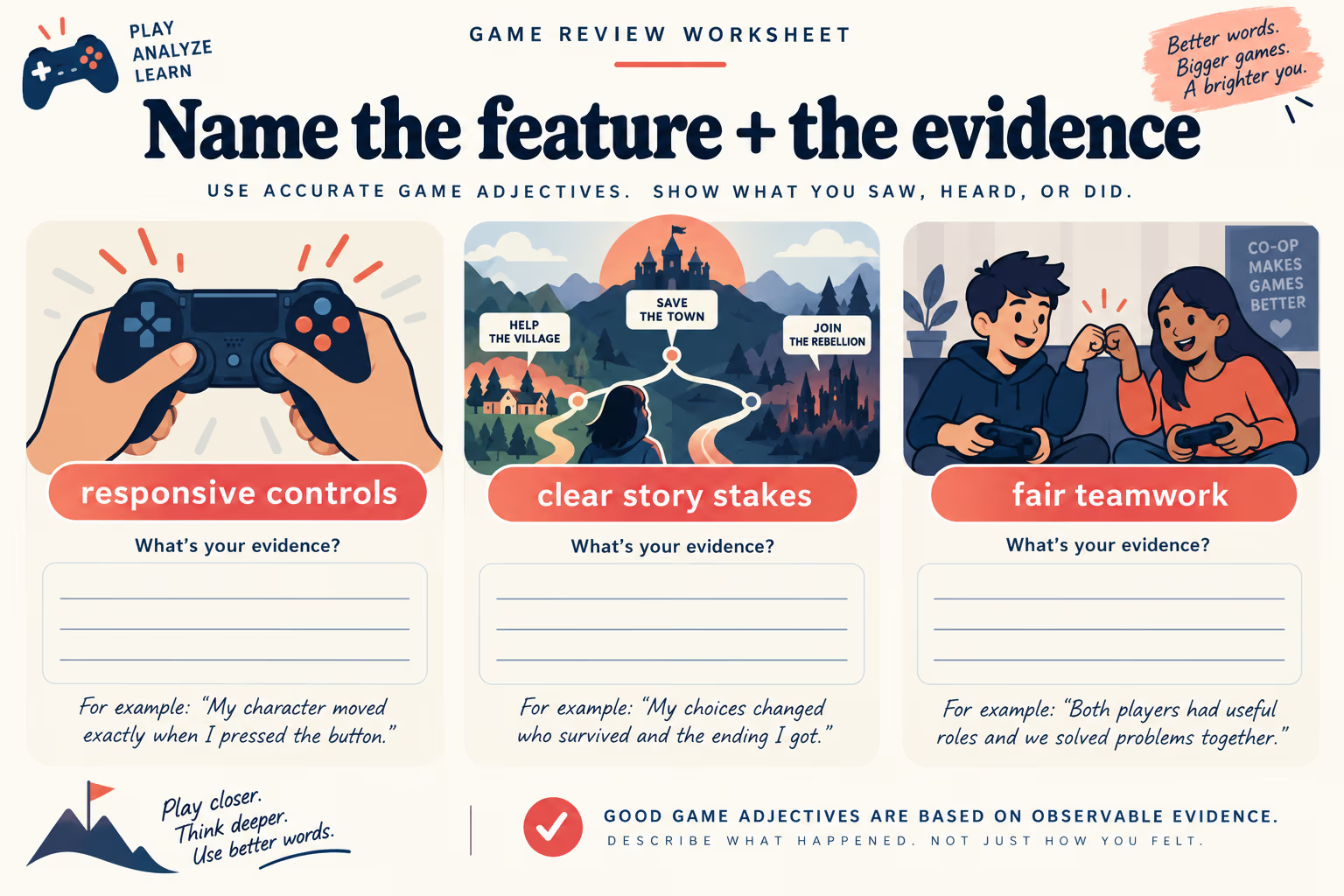
Game adjectives describe what players can observe in a game’s controls, challenge, story, sound, visuals, and social play. A precise review pairs each word with evidence: “responsive controls” is more useful than “great gameplay” when the character reacts quickly to input, while “cooperative” tells readers that players work toward a shared goal.
- Choose adjectives for a specific feature, such as pacing, controls, story, or multiplayer rules.
- Support evaluative words like “fair,” “balanced,” or “immersive” with a concrete example.
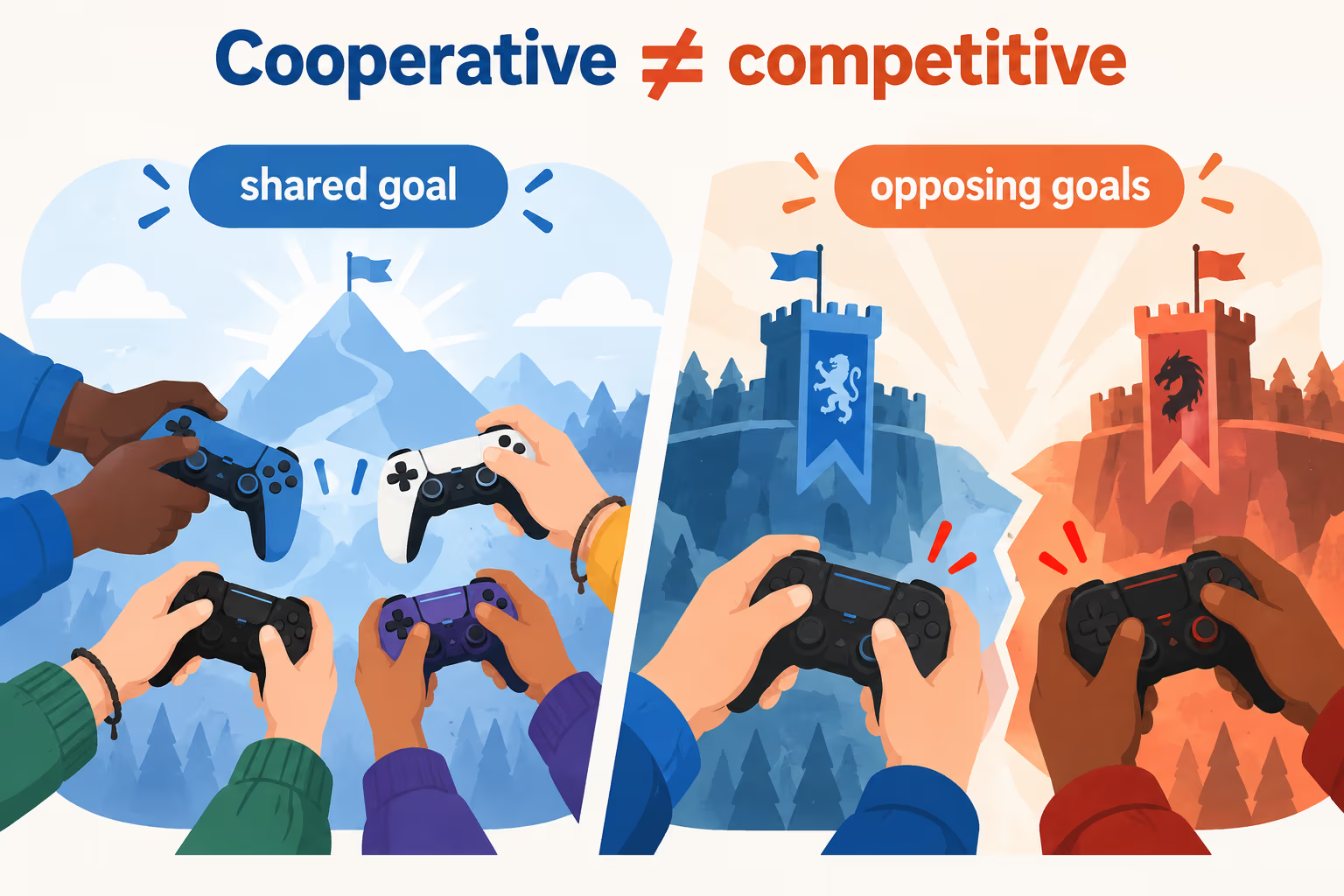
- Use “cooperative” for shared goals and “competitive” for opposing goals; a game can include both modes.
- Describe difficulty by naming its cause: timing, planning, precision, resource limits, or unfamiliar controls.
- Separate subjective enjoyment from factual content and age-rating information.

How do you choose precise adjectives for a game?
Start with the feature you want to describe, then choose a word that identifies a player-facing effect. For example, “tactical” suggests choices about positioning or resources; “fast-paced” describes the frequency or speed of decisions; and “responsive” describes how promptly controls react. Those words tell a reader more than a string of broad praise.
A practical review can follow this three-step pattern:
- Name the feature: controls, level design, difficulty, story, art direction, sound, or online play.
- Choose an accurate adjective: precise, branching, forgiving, atmospheric, orchestral, cooperative, or competitive.
- Give one piece of evidence: a short scenario, mechanic, or comparison that explains why the word fits.
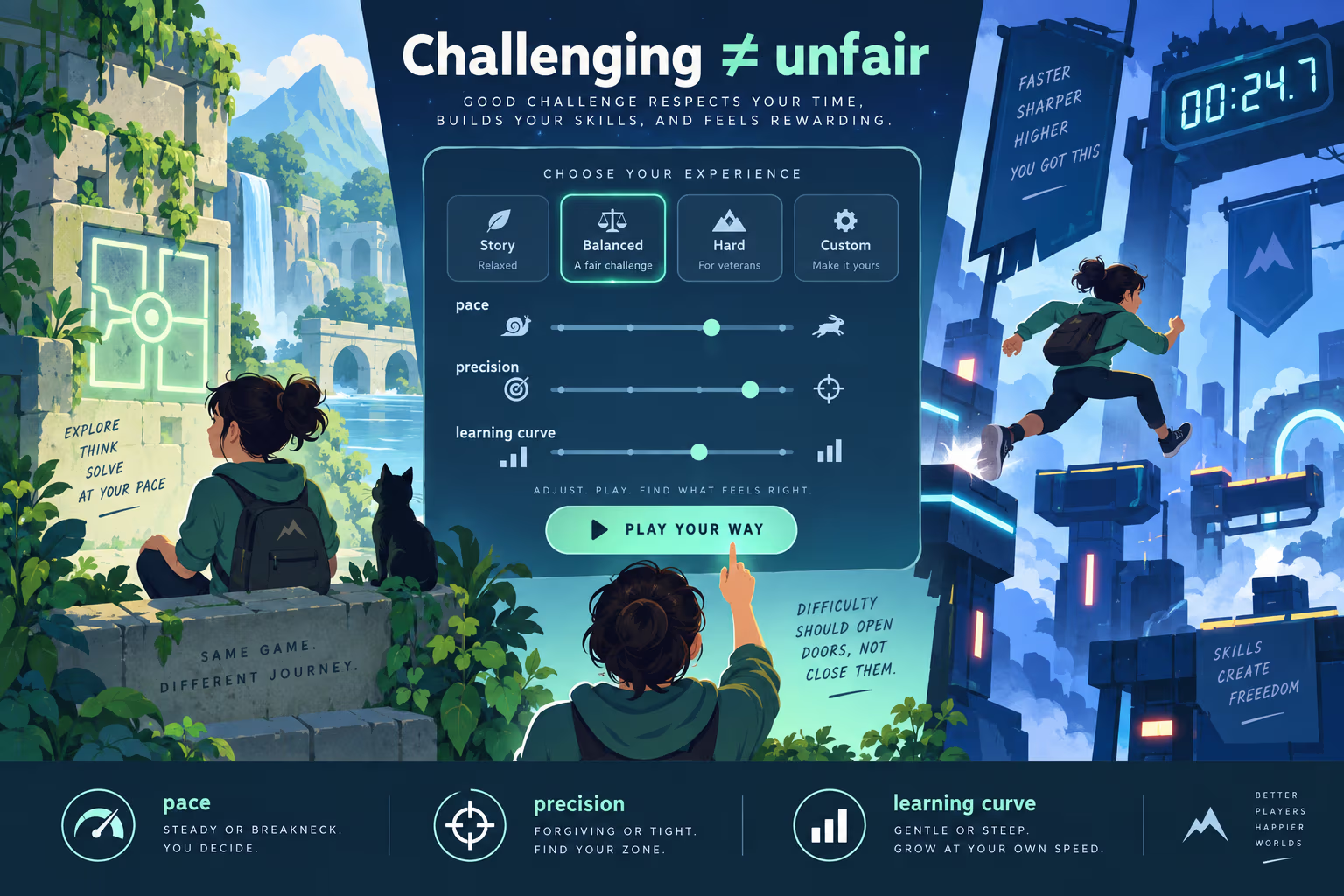
“The game is challenging” is a verdict. “The game is challenging because missed jumps reset a long section” explains the source of that verdict. This difference helps readers decide whether the challenge sounds enjoyable to them.
Which adjectives describe gameplay and difficulty?
Gameplay adjectives describe the actions and decisions players repeat, while difficulty adjectives explain what makes those actions demanding. The same game can be forgiving in its checkpoints but demanding in its combat, so attach each word to the relevant mechanic.
| Adjective | What it communicates | Example |
|---|---|---|
| Responsive | Inputs produce prompt, predictable reactions | “Responsive controls make midair corrections feel reliable.” |
| Tactical | Positioning, timing, or resource choices matter | “The tactical encounters reward cover and careful movement.” |
| Forgiving | Mistakes carry limited penalties or recovery is generous | “Frequent checkpoints make the platforming forgiving.” |
| Punishing | Errors bring substantial costs, such as lost progress | “The punishing boss fight restarts after each defeat.” |
| Repetitive | Actions, objectives, or encounters recur with little variation | “The side quests become repetitive after the first few hours.” |
| Unbalanced | Options, characters, or strategies seem uneven in strength | “One weapon dominates the unbalanced multiplayer matches.” |
Precision tip: “Difficult” does not automatically mean “unfair.” Use “demanding” for a high skill requirement, “punishing” for severe consequences after mistakes, and “unfair” only when rules, feedback, or outcomes appear inconsistent. For accessibility-focused feedback, name the barrier—small text, rapid prompts, or limited remapping—rather than calling the whole game “inaccessible.”
What words describe a game’s story, art, and sound?
Story, art, and sound adjectives work best when they distinguish a creative choice from a personal reaction. A “branching” story gives players decisions that lead to different events; a “linear” story follows a more fixed sequence. “Atmospheric” describes a consistent mood created by elements such as lighting, sound, setting, and pacing.
- Story: character-driven, episodic, branching, linear, suspenseful, coherent, dialogue-heavy, or predictable.
- Visuals: stylized, realistic, hand-drawn, minimalist, colorful, readable, cluttered, or visually consistent.
- Sound: atmospheric, orchestral, sparse, dynamic, repetitive, clear, or difficult to distinguish from effects.
“Beautiful graphics” is a valid preference, but “high-contrast menus and readable labels” communicates a useful design quality. Likewise, a game can be visually simple and still be striking; “pixel-art,” “minimalist,” or “boldly colored” describes style without ranking it against realism.
Game adjectives are not interchangeable with technical claims. “Smooth” may describe how play feels, while a frame-rate figure is a measurable performance claim that should be tied to a particular platform and test. If you did not measure performance, explain the observation instead of presenting an exact number.
How should you describe multiplayer games?
Describe multiplayer by explaining how players relate to one another, not just by calling the experience “fun” or “social.” Cooperative games center on a shared objective; competitive games ask players or teams to oppose one another. A single title may offer cooperative campaigns, competitive matches, and solo modes.
Useful multiplayer adjectives include cooperative, competitive, team-based, asynchronous, cross-platform, voice-chat-enabled, and matchmaking-dependent. Explain what the term means in context: “asynchronous” play can let turns happen at different times, while “team-based” play groups players around a common score or objective.
Online features can also change the audience and privacy considerations. The ESRB rating guide distinguishes age categories, content descriptors, and interactive elements; notices such as “Users Interact” communicate online interaction and do not tell you whether the community is welcoming or toxic. Check the current rating and store details when those questions matter, because a gameplay adjective cannot replace content or feature disclosures.
How can you describe a game without overstating it?
Separate observable features from personal judgments. “The opening level has three routes” is a concrete description; “the level is clever” is an evaluation that readers may interpret differently. Combining the two—“The opening level feels clever because its three routes converge at the same checkpoint”—makes the opinion easier to assess.
| Broad label | More informative wording | Evidence to include |
|---|---|---|
| Fun | Fast-paced, strategic, relaxing, or humorous | What actions or moments create the enjoyment? |
| Immersive | Atmospheric, consistent, or absorbing | Which audio, world, or interface choices hold attention? |
| Addictive | Compelling, replayable, or easy to return to | What progression or short-session structure encourages another round? |
| Bad | Repetitive, unstable, confusing, or unbalanced | Which system creates the problem, and how often? |
“Addictive” is common casual praise, but it can imply loss of control or harm. In a review, “compelling progression,” “hard to put down,” or “rewarding to replay” usually states the intended compliment more clearly. Be equally specific with negative terms: a bug is a technical fault, while confusing instructions are a usability issue.
Ratings systems answer a different question from reviews. The Entertainment Software Rating Board says its categories suggest age appropriateness, content descriptors identify content that may have influenced a rating, and interactive elements flag features such as purchases or user interaction. Use those labels for suitability and disclosure; use adjectives for style, mechanics, and your experience.
Frequently asked questions about game adjectives
What is a good adjective for a fun game?
Choose a word that explains what makes the game enjoyable: “engaging” for sustained attention, “humorous” for comedy, “relaxing” for low-pressure play, or “thrilling” for suspense and urgency. Add an example of the mechanic or scene that creates that reaction.
What is the difference between immersive and engaging?
“Engaging” means a game holds a player’s interest. “Immersive” suggests that its world, presentation, or interaction draws the player into the experience. A quick puzzle can be engaging without building a rich world; a detailed simulation may feel immersive through sound, controls, and consistent rules.
How do you describe a game that is hard but fair?
Call it “demanding but fair” when the challenge requires skill and the rules provide consistent feedback. Explain what the player must learn—such as enemy timing or precise jumps—and why failure feels recoverable. If a mechanic is unclear or inconsistent, describe that separately instead of treating all difficulty as fair.
What are positive adjectives for a board game?
Useful words include strategic, tactile, replayable, accessible, interactive, cooperative, competitive, and quick to learn. Match each adjective to the board game: “quick to learn but strategically deep” distinguishes simple rules from difficult decisions, while “tactile” points to the physical pieces or materials.
Can one game be both relaxing and challenging?
Yes. A game may be relaxing because it has gentle music and no countdown, yet challenging because its puzzles require planning. Specify which parts create each quality—for example, “relaxing exploration with demanding optional puzzles”—so the two adjectives do not seem contradictory.
When it comes to describing games, the right adjectives can make all the difference. As a seasoned gamer, I’ve come across countless titles that have left me captivated, exhilarated, and even awestruck. In this article, I’ll be sharing some of the most powerful adjectives that can be used to describe the immersive worlds, thrilling gameplay, and unforgettable experiences that games have to offer. Whether you’re a casual gamer or a hardcore enthusiast, these adjectives will help you articulate the magic of gaming in a way that truly does justice to the incredible adventures that await.
From epic and immersive to fast-paced and addictive, games have the power to transport us to new realms and ignite our imaginations. As a self-proclaimed gaming aficionado, I’ve had the privilege of diving headfirst into countless virtual worlds, each with its own unique charm and allure. In this article, I’ll be sharing a curated list of adjectives that perfectly capture the essence of what makes a game truly remarkable. So whether you’re seeking a heart-pounding adrenaline rush or a thought-provoking narrative, these adjectives will help you navigate the vast landscape of gaming and discover the experiences that resonate with you on a profound level. Get ready to embark on a linguistic journey that will forever change the way you describe and appreciate games.
How to Describe Game? – Different Scenarios
When it comes to describing games, there are a variety of scenarios and aspects to consider. As a seasoned gamer, I’ve learned that using the right adjectives can make a world of difference in capturing the essence of a game. Let’s dive into different scenarios and explore how we can accurately and vividly describe games using powerful adjectives.
- Gameplay
- Graphics
- Storyline
- Characters
- Atmosphere
- Multiplayer
By using these powerful adjectives, you can effectively describe games and convey their unique qualities to others. Whether it’s the thrilling gameplay, stunning graphics, captivating storyline, or memorable characters, each aspect of a game can be enhanced through the thoughtful use of carefully chosen adjectives.
So, the next time you find yourself struggling to describe a game, remember to consider the different aspects and scenarios it offers. With the right adjectives in your arsenal, you’ll be able to articulate the magic and excitement of gaming in a way that truly does justice to the incredible adventures that await.
Now let’s explore some specific examples of games and the adjectives that best describe them.
Describing Words for Game in English
When it comes to describing games, choosing the right adjectives can make all the difference. The right words can capture the essence of gameplay, graphics, storyline, characters, atmosphere, and multiplayer experiences. In this section, I’ll provide you with a list of powerful adjectives that will help you effectively describe various aspects of a game.
Let’s start with gameplay. This is where the action happens, and the adjectives you use can paint a picture of how the game feels to play. Here are some adjectives that can describe gameplay:
Adjectives
- Intense
- Fast-paced
- Challenging
- Immersive
- Addictive
Moving on to graphics, which play a major role in creating the visual appeal of a game. Here are some adjectives that can help you describe the graphics of a game:
Adjectives
- Stunning
- Realistic
- Vibrant
- Gorgeous
- Eye-catching
Next up, storyline. A captivating storyline can make a game unforgettable. Here are some adjectives to describe different types of storylines:
Adjectives
- Engaging
- Gripping
- Intriguing
- Epic
- Unpredictable
Now let’s talk about characters. The characters in a game can bring it to life and make it memorable. Here are some adjectives to describe characters:
Adjectives
- Heroic
- Mysterious
- Quirky
- Dynamic
- Memorable
Moving on to the atmosphere of a game. The atmosphere can greatly impact the overall experience. Here are some adjectives to describe different atmospheres in a game:
Adjectives
- Eerie
- Thrilling
- Serene
- Mysterious
- Action-packed
Finally, let’s talk about multiplayer experiences. Playing games with others can be an exciting and social experience. Here are some adjectives to describe multiplayer games:
Adjectives
- Competitive
- Cooperative
- Engaging
- Interactive
- Team-oriented
Adjectives for Game
Positive Adjectives for Game
When describing games, it’s important to choose adjectives that effectively capture their unique qualities. Here are some positive adjectives that can be used to describe different aspects of a game:
- Engaging: The game captures and holds the player’s attention.
- Immersive: Players feel completely absorbed in the game world.
- Innovative: The game introduces fresh and original ideas.
- Visually stunning: The graphics and visual effects are breathtaking.
- Challenging: The game provides a satisfying level of difficulty.
- Addictive: Players find it hard to stop playing because it’s so enjoyable.
- Intuitive: The game controls are easy to understand and use.
- Epic: The game offers a grand and memorable gaming experience.
- Dynamic: The game world and characters react and change based on player actions.
- Strategic: Players need to think and plan ahead to succeed.
- Rewarding: The game provides satisfying rewards for achievements.
- Social: The game allows players to interact and play with others.
Negative Adjectives for Game
While it’s important to highlight the positive aspects of a game, it’s also necessary to acknowledge any potential flaws. Here are some negative adjectives that can be used to describe certain aspects of a game:
- Repetitive: The game becomes monotonous after a while.
- Buggy: The game has technical issues or glitches.
- Unbalanced: Some aspects of the game feel unfair or favor certain players.
- Predictable: The game lacks surprises or unexpected twists.
- Limited: The game has a lack of content or variety.
Adjectives play a crucial role in conveying the magic and excitement of gaming to others. By using descriptive and accurate adjectives, we can effectively communicate the unique qualities of a game and guide others in making informed decisions about their gaming experiences. Remember to consider the different aspects and scenarios a game offers and use the right adjectives to capture its true essence.
Synonyms and Antonyms with Example Sentences
Synonyms for Game
When describing a game, it’s important to have a range of adjectives to choose from. Here are some synonyms that can help you express different aspects of a game:
- Exciting: full of thrills and energy
- Entertaining: providing enjoyment and amusement
- Challenging: requiring effort and strategic thinking
- Immersive: deeply engaging and absorbing
- Addictive: causing a strong desire to keep playing
Let me provide you with some example sentences showcasing these synonyms:
| Synonym | Example Sentence |
|---|---|
| Exciting | “The game is exciting with its fast-paced action.” |
| Entertaining | “This game is highly entertaining, especially for kids.” |
| Challenging | “I love playing challenging puzzle games.” |
| Immersive | “The virtual reality experience was immersive.” |
| Addictive | “Beware, this game is addictive and hard to put down.” |
Antonyms for Game
In addition to positive adjectives, it’s also important to acknowledge potential flaws or negative aspects of a game. Here are some antonyms that can help you express the opposite meaning:
- Boring: lacking interest or excitement
- Repetitive: involving the same actions or tasks over and over
- Frustrating: causing annoyance or dissatisfaction
- Confusing: difficult to understand or follow
- Unappealing: not attractive or appealing
Let’s look at some example sentences showcasing these antonyms:
| Antonym | Example Sentence |
|---|---|
| Boring | “The game was boring, and I quickly lost interest.” |
| Repetitive | “I found the gameplay to be repetitive and monotonous.” |
| Frustrating | “The difficult levels were frustrating and made me give up.” |
| Confusing | “The instructions were confusing, and I had trouble understanding the game.” |
| Unappealing | “The graphics were outdated and visually unappealing.” |
Remember, using descriptive and accurate adjectives can help you effectively communicate the unique qualities of a game and guide others in making informed decisions.
Conclusion
Using a variety of adjectives to describe games is crucial in effectively conveying their unique qualities. By utilizing positive adjectives, we can capture the excitement, entertainment, challenge, immersion, and addiction that games offer. These synonyms provide a more nuanced understanding of the game’s experience, allowing others to make informed decisions.
However, it’s equally important to acknowledge potential flaws by incorporating antonyms for negative adjectives. This helps to provide a balanced perspective and ensures that readers have a complete picture of the game’s strengths and weaknesses.
Throughout this article, I have provided example sentences showcasing these synonyms and antonyms. These examples demonstrate how adjectives can be used to accurately describe different aspects of a game, guiding readers in understanding its features and potential.
The use of descriptive and accurate adjectives is essential in effectively communicating the qualities of a game. By employing a diverse range of adjectives, we can provide a comprehensive and insightful description that aids others in their decision-making process.


