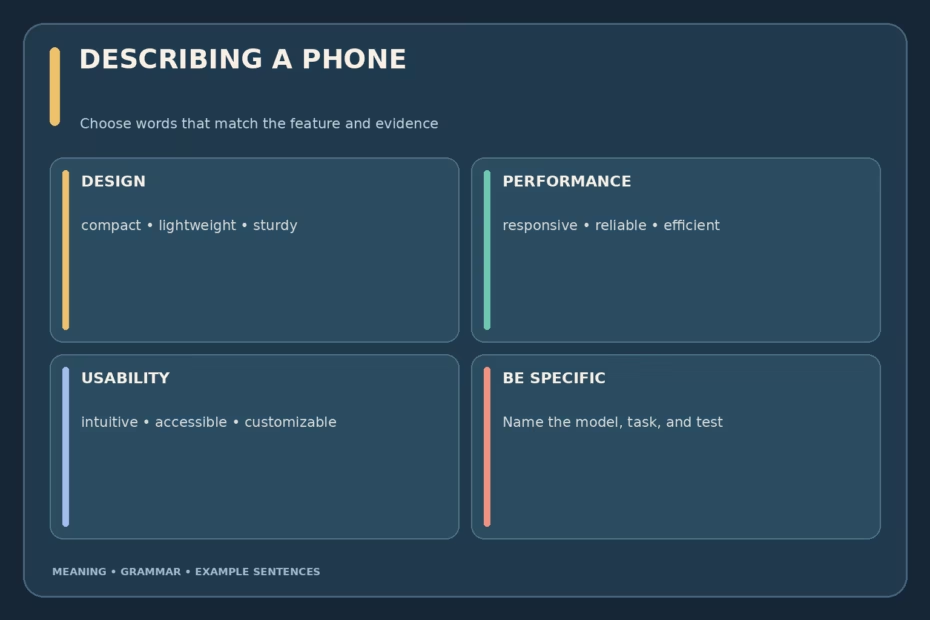
How to Choose the Right Adjectives for a Phone
The best adjective depends on what you want to describe: the phone’s shape, speed, camera, battery, accessibility features, or the way it feels to use. “Sleek” comments on appearance, while “responsive” describes how quickly the device reacts to input. For reviews and product descriptions, pair an adjective with the feature or experience that supports it. That makes the description more useful than a string of general praise.
Phone features vary by model, operating system, settings, and user. A phone can feel lightweight to one person and heavy to another; “intuitive” depends on someone’s experience with similar interfaces. Use measurable details when possible, and qualify judgments with a task or comparison. For example, “the 6.1-inch model felt compact in one-handed use” tells readers more than “the phone is compact.”
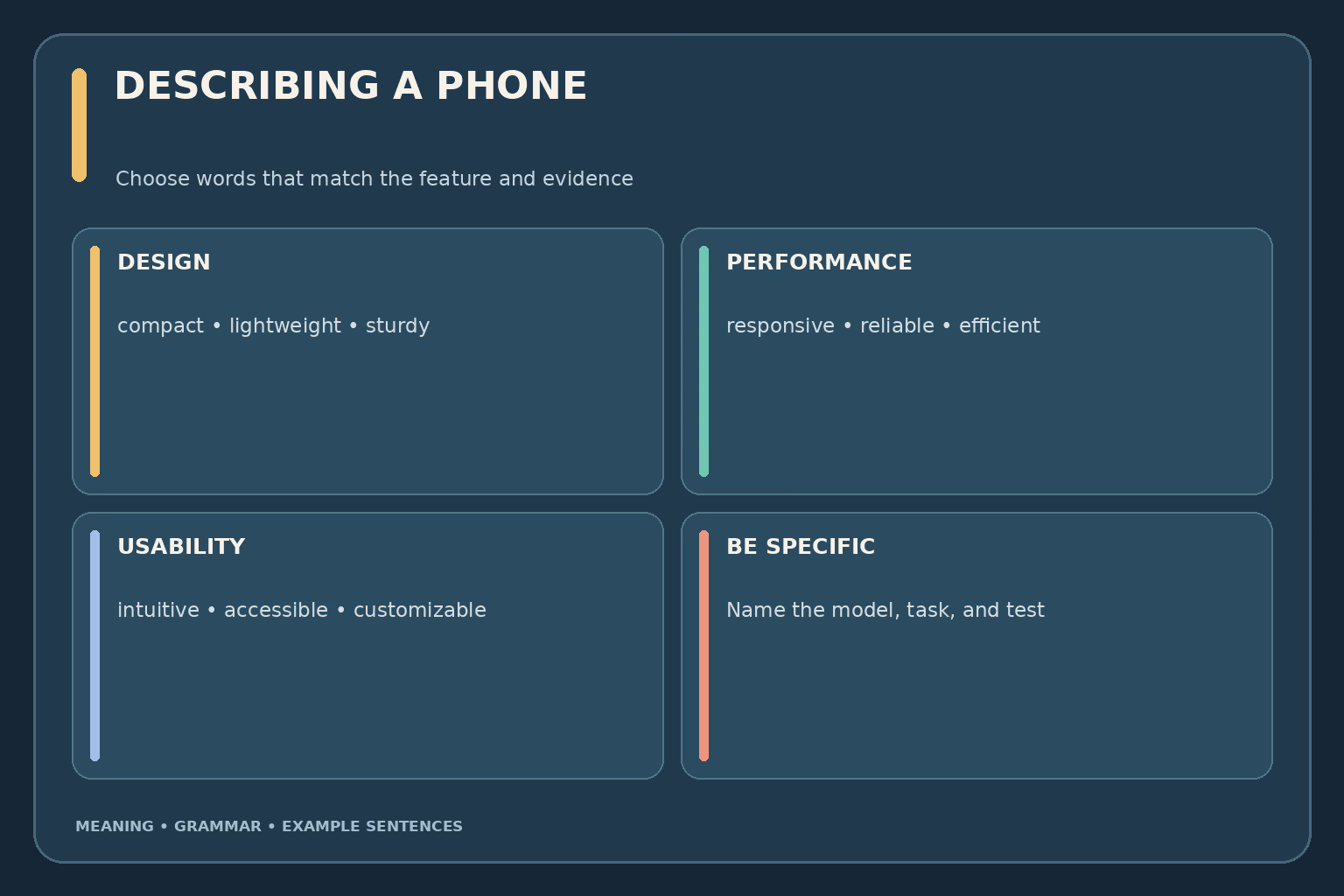
Phone Adjectives by Feature
Use these words as a starting point, then explain what you observed. Some are neutral descriptions; others express a judgment. The context and evidence should make the intended meaning clear.
| Feature | Useful adjectives | What to clarify |
|---|---|---|
| Size and feel | compact, lightweight, ergonomic, balanced, bulky | Dimensions, weight, hand size, or comparison model |
| Appearance | sleek, minimalist, colorful, polished, understated | Finish, shape, bezels, color, or personal preference |
| Screen | bright, crisp, vivid, legible, reflective | Lighting, brightness setting, resolution, or viewing angle |
| Speed | responsive, quick, fluid, laggy, sluggish | App, task, network conditions, and comparison |
| Battery | long-lasting, efficient, slow-charging, dependable | Workload, screen time, settings, and test duration |
| Camera | sharp, detailed, versatile, grainy, consistent | Light, lens, motion, zoom, and intended use |
| Build | sturdy, solid, fragile, water-resistant, slippery | Materials, rating, grip, and care; avoid untested claims |
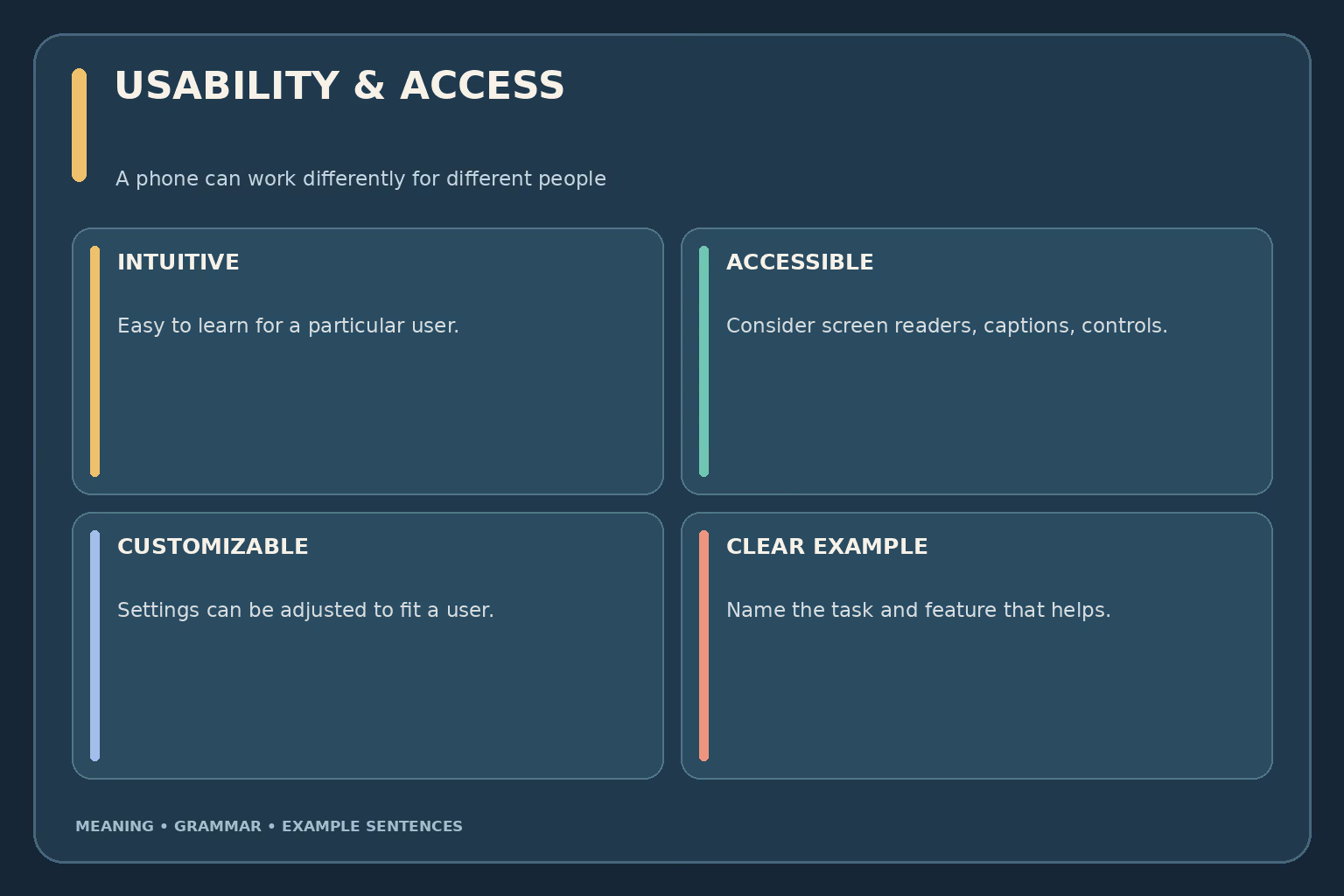
| Software | intuitive, customizable, cluttered, accessible, confusing | User, task, settings, and supported accessibility options |
| Connectivity | stable, compatible, intermittent, versatile | Carrier, network, location, accessories, and supported bands |
| Value | affordable, costly, budget-friendly, premium | Price, region, date, and what the comparison includes |
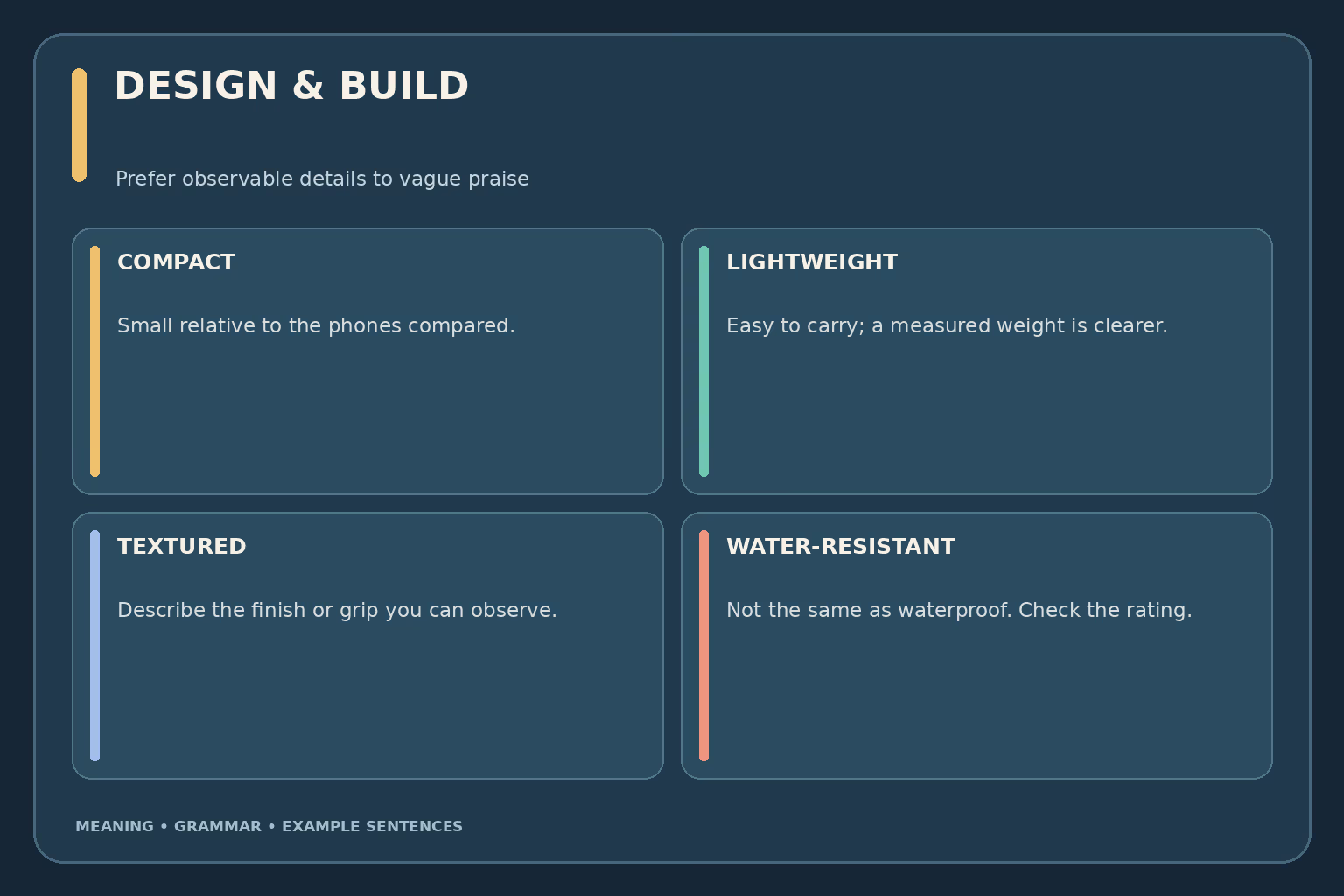
Design words are often subjective: “elegant” or “fashionable” expresses taste, not a technical measurement. By contrast, “lightweight” can be made precise with the device’s weight, and “compact” is clearer when readers know its dimensions or what it is being compared with. “Durable” and “sturdy” also imply resilience, so support them with reliable specifications or tests rather than appearance alone.
Positive Phone Adjectives: Meaning and Examples
- Responsive: reacts promptly to taps or gestures. “The keyboard felt responsive while I typed a long message.”
- Legible: easy to read in the stated conditions. “The large text remained legible outdoors at the brightness setting I tested.”
- Customizable: lets users adjust settings or appearance. “The customizable controls let me move the shortcuts I use most.”
- Accessible: offers features that support people with different access needs. “The phone’s screen reader and magnification options made the settings easier for her to navigate.” Availability differs across devices and software.
- Versatile: useful for several tasks or situations. “Its versatile camera handled close-up food photos and wide landscape shots.” Name the uses that demonstrate the range.
- Efficient: accomplishes a task with relatively little time, power, or effort. “The efficient settings helped the phone last through my usual workday.” Explain the comparison or test.
- Reliable: works consistently over repeated use. “The connection was reliable during three calls from the same office.” A brief observation is not proof of universal reliability.
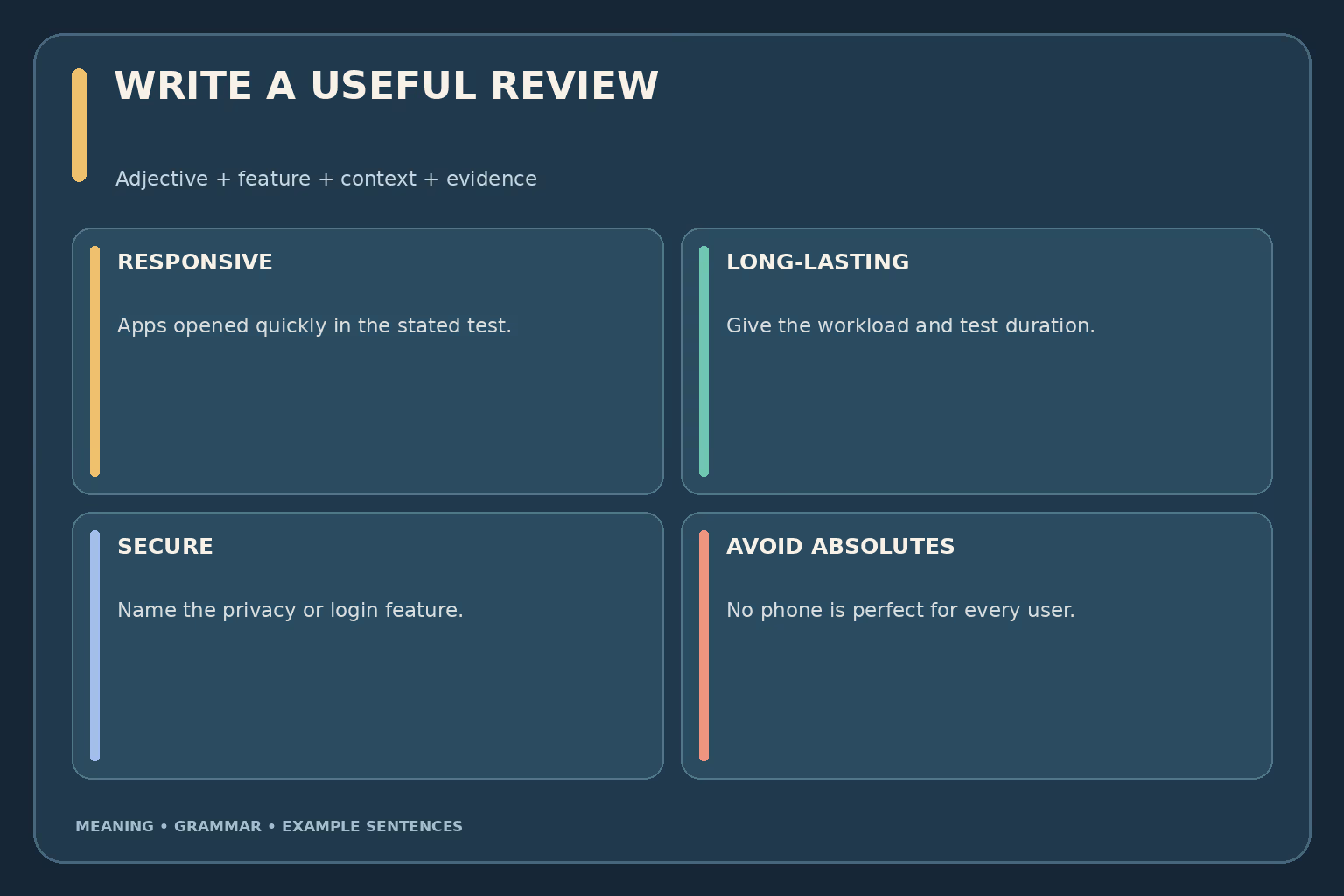
- Secure: protected by identified security measures. “A passcode and biometric sign-in made unlocking convenient while keeping the screen locked between uses.” Say which feature you mean instead of treating “secure” as an absolute guarantee.
- Vivid: displays strong, saturated colors. “The vivid screen made the travel photos stand out.” Some readers may prefer more natural color.
- Sturdy: feels solidly built or has evidence of resilience. “The sturdy case protected the phone during the manufacturer’s specified drop test.” The phone itself and its case are different objects.
Apple documents Face ID as a way to unlock supported iPhone and iPad models and authenticate some purchases and app sign-ins. Android’s accessibility overview describes options such as TalkBack, magnification, captions, and voice or switch controls. These are examples of specific features you can name when calling a phone convenient, accessible, or secure; availability and operation depend on the device and software version. Apple Support: Use Face ID; Android Accessibility overview.
Negative Phone Adjectives: Be Specific and Fair
Critical adjectives can make a review more candid, but they should identify the problem and the conditions in which it occurred. “Slow” is more useful when you explain which action lagged; “fragile” needs evidence about damage risk; and “unreliable” should describe a repeated pattern rather than one isolated fault.
- Bulky: large or awkward to hold compared with a stated alternative. “The bulky case made the phone difficult to fit in my pocket.”
- Sluggish: slow to respond in a particular task. “The older phone felt sluggish when several large apps were open.”
- Reflective: shows distracting reflections in bright surroundings. “The reflective screen was harder to read beside the sunny window.”
- Cluttered: presents many competing icons, apps, or controls. “The cluttered home screen took longer to scan.”
- Intermittent: works only at intervals. “The intermittent connection dropped twice in the underground station.”
- Fragile: easily damaged, but avoid asserting this without meaningful evidence. “The cracked glass looked fragile after the drop,” describes an observation; it does not establish how every unit performs.
Words such as “perfect,” “indestructible,” “the fastest,” and “the safest” are absolute claims. Use them only when the comparison and evidence really support them. “Fast for opening the camera in my timed comparison” or “rated water-resistant to the manufacturer’s stated test conditions” is more informative. A water-resistance rating does not mean a device is waterproof in every situation; follow the specific manufacturer’s limits.
How to Describe a Phone in a Review, Advertisement, or Conversation
For a product review
Separate observable facts from personal impressions. Include the model, task, conditions, and comparison when they matter: “The lightweight phone weighed less than my previous model and stayed comfortable during a one-hour call.” If you discuss battery life, describe your typical workload or test period; battery performance changes with network signal, screen brightness, apps, and settings.
For an advertisement
Choose a small number of specific benefits and substantiate factual claims. “A compact phone with a bright display” is clearer when size and brightness are tied to published measurements or defined test conditions. Avoid presenting subjective words such as “beautiful” as objective proof of quality, and avoid promising identical results for every user.
For everyday conversation
Use familiar words that fit what you noticed: “handy,” “easy to carry,” “quick to unlock,” or “hard to read in sunlight.” A short example often explains your meaning better than a technical label: “It is handy because I can use it comfortably with one hand.”
Phone Synonyms and Related Terms
The synonyms in the original article overlap, but they are not interchangeable in every context. Smartphone usually signals a mobile phone with advanced software and apps. Cell phone and mobile phone are common general terms, with usage varying by region. Handset can mean a phone device, especially in business or technical contexts; more narrowly, it can mean the part held to the ear. Mobile device is broader and can include tablets and other portable electronics. Communication device is broader still: it describes a purpose or category, not necessarily a phone.
“Landline” is not a direct antonym of “phone”; it names a kind of telephone connection or service, often contrasted with a mobile phone. “Silent,” “unplugged,” and “non-functional” describe a phone’s current sound setting, power state, or condition. They are not opposites of the noun phone. This distinction makes comparisons clearer: “a mobile phone versus a landline” compares types, while “an active phone versus a powered-off phone” compares states.
Quick Sentence Patterns
- Appearance: “The [color/size/shape] phone has a [adjective] finish.”
- Performance: “The phone felt [adjective] when I used it for [task] under [conditions].”
- Battery: “During [test period], the battery was [adjective] with [workload/settings].”
- Accessibility: “The [feature] made [task] more [adjective] for [user or situation].”
- Criticism: “The phone seemed [adjective] because [specific observation], especially when [condition].”
Frequently Asked Questions
What are the best adjectives to describe a phone?
Useful choices include compact, lightweight, responsive, reliable, intuitive, accessible, versatile, and durable. Pick a word that fits the feature you actually mean, and add a model, task, or comparison where helpful.
What is another word for phone?
Smartphone, cell phone, mobile phone, and handset can refer to a phone, but their meanings and regional use differ. “Mobile device” can include tablets and other electronics, so it is broader.
What is an antonym for phone?
There is no simple antonym for the noun phone. A landline is another kind of phone, while silent, unplugged, and non-functional describe a phone’s setting or state.
How do I describe a phone’s battery life accurately?
State the duration and conditions you observed, including the type of use if known. “Long-lasting” depends on workload, signal, settings, and the test; it is not a fixed quality shared by every user.
Sources and Further Reading
- Apple Support: Use Face ID on your iPhone or iPad Pro (supported authentication uses).
- Android Accessibility Help: Android accessibility overview (screen readers, display controls, captions, and interaction features).
- Federal Communications Commission: Radio Frequency Safety (RF exposure information and device authorization references).

Are you looking for the perfect words to describe your phone? Look no further! In this article, I’ll be sharing a list of adjectives that will help you paint a vivid picture of your beloved device. From sleek and stylish to powerful and innovative, these adjectives will capture the essence of your phone’s unique features and capabilities. So whether you’re writing a product review, creating a catchy advertisement, or simply want to impress your friends with your descriptive skills, these adjectives will take your phone descriptions to the next level. Let’s dive in and explore the world of adjectives for phones!
How to Describe phone? – Different Scenarios
As an expert blogger with years of experience, I have learned the importance of using adjectives to paint a vivid picture of a phone’s features and capabilities. In this section, I will guide you through different scenarios in which you can effectively describe a phone using descriptive adjectives.
- Product Reviews:
When writing a product review, it’s essential to capture the reader’s attention and provide them with a comprehensive assessment of the phone. Here are some adjectives you can use to describe a phone in a product review:
- Sleek design
- Powerful processor
- Crisp display
- Long-lasting battery
- High-quality camera
By incorporating these adjectives, you can give potential buyers a clear idea of what to expect from the phone.
- Advertisements:
In advertisements, the goal is to entice the audience and highlight the phone’s unique selling points. Here are some adjectives that can make your phone stand out in advertisements:
- Innovative features
- Cutting-edge technology
- Stylish and modern
- Ultra-fast performance
- Exceptional user experience
By using these adjectives, you can create an attractive and compelling advertisement that showcases the phone’s strengths and appeals to potential customers.
- Casual Conversations:
When describing a phone in casual conversations, it’s important to keep it simple and relatable. Here are some adjectives you can use to describe a phone in everyday conversations:
- Handy and portable
- User-friendly
- Affordable
- Versatile
- Trendy and fashionable
Using these adjectives in casual conversations will help you communicate your thoughts about a phone in a way that is easy to understand and engage others in conversation.
So, whether you’re writing a product review, creating an advertisement, or engaging in a casual conversation, utilizing these descriptive adjectives will allow you to effectively convey the features and capabilities of a phone. Remember to choose adjectives that accurately represent the phone and are relevant to the context in which you are describing it.
Next, I’ll provide you with a list of common adjectives to help you further enhance your descriptions of a phone!
| Adjectives | Examples |
|---|---|
| Sleek | The phone has a sleek design. |
| Powerful | It has a powerful processor. |
| Crisp | The |
Describing Words for phone in English
When it comes to describing a phone, there are various adjectives that can capture its features and qualities. In this section, I will provide you with a list of descriptive words that you can use to effectively describe a phone. Let’s dive in:
- Sleek: The phone has a modern and elegant design.
- Compact: It is small and easy to hold in your hand.
- Versatile: The phone offers a wide range of functions and features.
- User-friendly: It has an intuitive interface that is easy to navigate.
- High-quality: The phone is built to last and offers excellent performance.
- Innovative: It incorporates cutting-edge technology and features.
- Fast: The phone operates at a high speed, allowing for quick and responsive use.
- Secure: It employs advanced security features to protect your data.
- Portable: The phone is lightweight and easy to carry.
- Durable: It is resistant to damage and can withstand everyday use.
These are just a few examples of adjectives that can be used to describe a phone. Remember to choose words that accurately represent the phone and its features. Now, let’s move on to the next section where we will explore how these adjectives can be used in different contexts such as product reviews, advertisements, and casual conversations.
[NOTE: Table of descriptive words can be added here if preferred]
Without concluding this section, let’s continue to explore how these adjectives can be utilized in various scenarios to effectively describe a phone.
Adjectives for phone
Positive Adjectives for Phone with 12 Example Sentences
When it comes to describing phones, there are numerous positive adjectives that can capture their various qualities and features. Here are twelve examples of positive adjectives that can be used to describe phones:
- Sleek: The phone has a sleek design that is both stylish and modern.
- Compact: This phone is compact and easily fits in the palm of your hand.
- Versatile: With its multiple features and functions, the phone is highly versatile.
- User-friendly: The phone is user-friendly, making it easy for anyone to navigate and use.
- High-quality: This phone is of high-quality, ensuring durability and long-lasting performance.
- Innovative: The phone boasts innovative technology that sets it apart from others in the market.
- Fast: With its powerful processor, the phone operates at a blazing fast speed.
- Secure: The phone incorporates advanced security measures to protect your data and privacy.
- Portable: This phone is lightweight and portable, making it convenient to carry around.
- Durable: The phone is built to withstand everyday wear and tear, ensuring its durability.
- Reliable: With its consistent performance, you can rely on this phone to meet your needs.
- Efficient: The phone’s efficient battery ensures long hours of usage without frequent charging.
Negative Adjectives for Phone with 5 Example Sentences
While phones have many positive attributes, there are also negative adjectives that can be used to describe certain aspects. Here are five examples of negative adjectives that can be used to describe phones:
- Bulky: The phone is bulky and may not be easy to handle or carry.
- Outdated: This phone is outdated and lacks the latest features and technologies.
- Slow: With its sluggish performance, the phone may be frustrating for users who value speed.
- Unreliable: The phone’s frequent software glitches make it unreliable for consistent usage.
- Fragile: This phone is fragile and prone to damage from accidental drops or impacts.
It’s important to note that these negative adjectives may not apply to all phones. However, understanding their usage can help provide a comprehensive description of a phone’s strengths and weaknesses.
Remember: When describing a phone, it’s essential to choose adjectives that accurately represent its attributes and features. Whether it’s for writing product reviews, creating advertisements, or engaging in casual conversations, using descriptive adjectives can effectively convey the qualities of a phone.
Synonyms and Antonyms with Example Sentences
Synonyms for Phone
When it comes to describing a phone, there are various synonyms that can be used to convey its attributes and features. Here are some examples of synonyms for “phone”:
- Smartphone: A smartphone is a type of mobile phone that offers advanced features and capabilities, such as internet access, apps, and touchscreen functionality.
- Cell phone: This term is commonly used to refer to a mobile phone, which allows users to make calls and send messages wirelessly.
- Mobile device: This term encompasses various portable electronic devices, including phones, tablets, and smartwatches, that can be carried easily and used on the go.
- Handset: This word specifically refers to the part of a telephone that is held to the ear during a call, but it is often used synonymously with “phone.”
- Communication device: This broader term highlights the primary purpose of a phone, which is to facilitate communication between individuals through voice calls, text messages, and other means.
Here are some example sentences using synonyms for “phone”:
| Example Sentence |
|---|
| I can’t imagine my life without my trusty smartphone. |
| She always keeps her cell phone nearby in case of emergencies. |
| The toddler loves playing games on his mobile device. |
| He picked up the handset and dialed the number. |
| Communication devices have evolved significantly over the years. |
Antonyms for Phone
Although it might not be as common to use antonyms when describing a phone, let’s explore a few examples to provide a well-rounded understanding of the concept. Here are some antonyms for “phone”:
- Landline: A landline refers to a telephone that is connected to a physical wire network, typically used in homes or offices. It is the opposite of a wireless phone.
- Unplugged: This term describes a state in which a phone is disconnected or not powered on, emphasizing the lack of connectivity or function.
- Silent: When a phone is set to silent mode or turned off, it is not capable of receiving calls or making sounds, contrasting with its typical usage.
- Disconnected: This word signifies the absence of a phone connection or a state in which the phone is not working properly.
- Non-functional: This term emphasizes that a phone is not operational or not able to perform its intended functions.
| Example Sentence |
|---|
| My grandparents still have a landline in their house. |
| I accidentally left my phone unplugged overnight. |
| He set his phone to silent mode during the movie. |
| The call was dropped because they were in a disconnected area. |
| Her old phone is non-functional and needs to be replaced. |
Conclusion
In this article, I have discussed various adjectives that can be used to describe phones. We explored synonyms such as smartphone, cell phone, mobile device, handset, and communication device, and provided example sentences to illustrate their usage. Additionally, we delved into antonyms such as landline, unplugged, silent, disconnected, and non-functional, and provided example sentences for each.
By using a wide range of adjectives, we can paint a vivid picture of the characteristics and features of phones. Whether we want to highlight the advanced technology of a smartphone or the simplicity of a basic handset, having a diverse vocabulary allows us to accurately convey our thoughts and opinions.
Describing phones using different words not only adds depth to our language but also enhances our ability to communicate effectively. It enables us to express our preferences, opinions, and experiences with clarity and precision.
So, the next time you want to describe a phone, remember to explore the variety of adjectives available to you. By doing so, you can elevate your descriptions and make your writing more engaging and informative.


