Adjectives for rainy weather describe rain’s amount, pattern, temperature, sound, and effect on a scene. Choose drizzly for fine light rain, steady for rain that continues evenly, and torrential for exceptionally heavy rain; the best word reports the detail you actually mean.
Light: drizzly, misty, spitting.
Continuous: steady, persistent, soaking.
Heavy: pouring, driving, torrential.
Scene or mood: gray, chilly, blustery, refreshing.
Which adjectives describe different kinds of rain?
Weather adjectives are clearer when they distinguish intensity from timing. The National Weather Service describes drizzle as very small droplets and showers as precipitation that starts and stops more abruptly; its precipitation guide helps separate those patterns.
Adjective
Best use
Example
Drizzly
Light, fine rain
A drizzly morning left a sheen on the pavement.
Misty
Very fine moisture that hangs in the air
Misty rain blurred the hills in the distance.
Showery
Rain arriving in short, changing bursts
Showery weather cleared long enough for a walk.
Steady
Rain falling at a fairly even rate
Steady rain tapped against the window all afternoon.
Persistent
Rain that continues for a long time
Persistent rain softened the trail into mud.
Pouring
Heavy rain falling quickly
Rain was pouring when the final bus arrived.
Torrential
Exceptionally intense rain
Torrential rain flooded the low-lying street.
Blustery
Windy, unsettled wet weather
A blustery shower sent leaves across the path.
Drizzly commonly means light, fine rain, as Oxford Learner’s Dictionaries notes. It does not mean “a little cloudy”; the adjective describes precipitation.
How can you describe the whole rainy scene?
Pair a rain adjective with a separate detail about the sky, air, or surface. “A cold rain fell under a low, gray sky” gives readers three different observations instead of repeating the idea of wet weather.
Sky: overcast, leaden, clouded, dim.
Air and temperature: chilly, damp, humid, wind-driven.
Sound and movement: pattering, drumming, driving, intermittent.
Effect on the setting: slick, muddy, waterlogged, refreshing.
Drizzly and misty suggest a light, fine fall of rain.
How do you choose the right word?
First identify the feature you can observe: amount, duration, wind, temperature, or emotional tone. Then choose one adjective for that feature and support it with a concrete noun or verb.
Estimate intensity: use drizzly or light for fine drops and heavy or torrential for intense rain.
Describe timing: choose steady for an even fall, persistent for long duration, or showery for changing bursts.
Add one sensory clue: write that rain patters on a roof or slicks the pavement instead of stacking vague mood words.
Check accuracy: do not call rain “torrential” if it is only a light shower.
For example, “A gloomy, miserable, awful rain fell” repeats a judgment. “Cold, steady rain rattled on the tin awning” gives a temperature, pattern, and sound the reader can picture.
Steady, persistent, and torrential describe different rain patterns and strength.
Frequently asked questions about adjectives for rainy weather
What is another word for rainy?
Wet is a broad alternative, while drizzly, showery, and rain-soaked are more specific. Use drizzly for fine light drops, showery for bursts that come and go, and rain-soaked for a person or place already thoroughly wet.
What adjective describes light rain?
Drizzly is a precise adjective for light, fine rain. Misty can work when the moisture is very fine and suspended in the air, while spitting suggests only a few drops have begun to fall.
What is a strong adjective for heavy rain?
Torrential describes exceptionally heavy rain; pouring is a familiar, vivid alternative. Save torrential for genuinely intense rainfall, since the word signals much more than an ordinary shower.
How can I avoid repeating the word rainy?
Name a different observable feature in each sentence: the rain’s intensity, its timing, the wind, the temperature, or what it changes. “A brief shower passed, leaving the stone steps slick” is more informative than repeating rainy with several near-synonyms.
Use a specific adjective for rainy weather
The most useful adjective for rainy weather identifies a real difference: drizzly rain is fine, steady rain is even, and torrential rain is intense. Match the word to the scene, then use a sound, surface, or temperature detail to make the sentence precise.
In this article, we’ll look at a range of adjectives to describe different aspects of rain and rainy weather. Whether you’re writing a weather report, poem, or simply want to chat about the rain, these words will come in handy. It’s worth noting that some of these words can also be used to describe other types of wet weather, like mist and drizzle.
Some of the adjectives here might also be useful for describing other natural phenomena, like storms, floods, and snow. It all comes down to context. Adjective choices can also vary depending on whether you’re talking about the sensation of rain, the temperature, the sound, or the visual impact.
Adjectives For Rainy
Rainy days are the best days. There’s something about the weather that just makes everything feel more romantic, and relaxed. Whether you’re cuddled up inside with a good book, or taking a walk in the rain with your partner, there’s something about the rain that makes everything feel more special.
Here are some of the best adjectives to describe the rain:
Relaxing: Rainy days are the perfect opportunity to relax and take a break from your busy life. There’s something about the sound of the rain that makes everything feel more calm and serene.
Romantic: Rainy days are the perfect time to cuddle up with your partner and enjoy some quality time together. The weather just makes everything feel more romantic.
Cozy: Rainy days are the perfect opportunity to stay inside and get cozy. Whether you’re curled up with a good book or taking a nap, there’s something about the rain that makes everything feel more cozy.
Peaceful: Rainy days are the perfect time to find some peace and quiet. The sound of the rain can be very relaxing, and it’s the perfect opportunity to clear your mind and relax.
Tranquil: Rainy days are the perfect opportunity to find some tranquility. The sound of the rain can be very calming, and it’s the perfect opportunity to clear your mind and relax.
Serene: Rainy days are the perfect opportunity to find some serenity. The sound of the rain can be very calming, and it’s the perfect opportunity to clear your mind and relax.
Joyful: Rainy days are the perfect opportunity to find some joy. The sound of the rain can be very uplifting, and it’s the perfect opportunity to enjoy the simple things in life.
Mysterious: Rainy days are the perfect opportunity to find some mystery. The sound of the rain can be very intriguing, and it’s the perfect opportunity to explore your imagination.
Magical: Rainy days are the perfect opportunity to find some magic. The sound of the rain can be very enchanting, and it’s the perfect opportunity to let your imagination run wild.
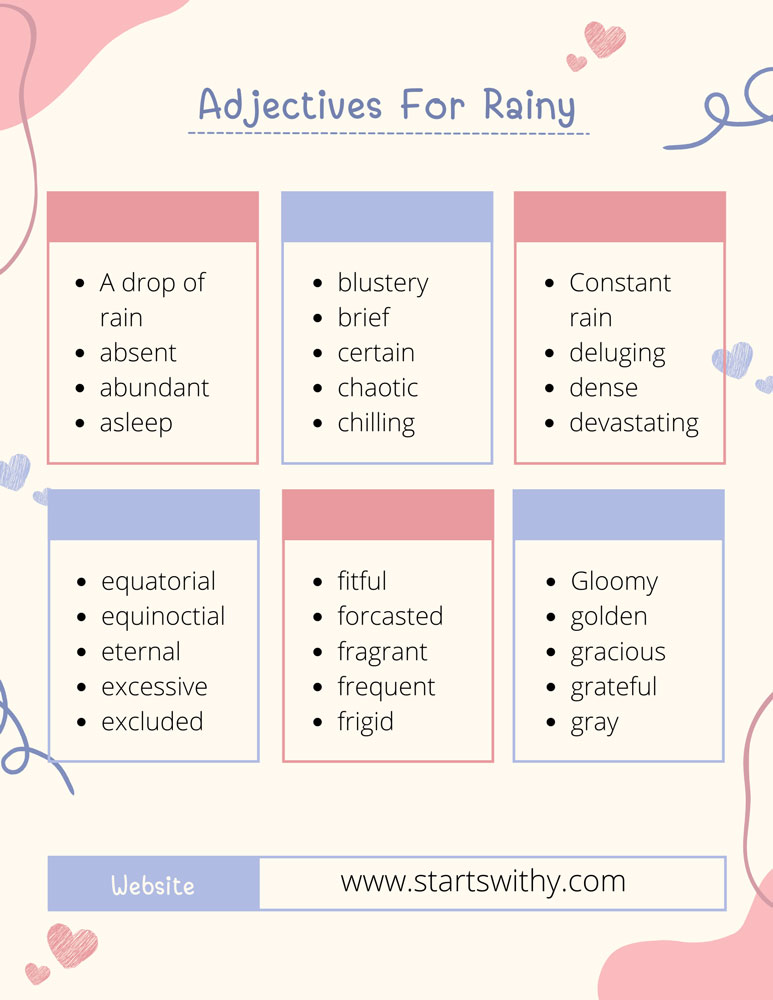
A
A Drop Of Rain
Absent
Abundant
Abyssinian
Accumulate
Acidic
Actual
Alike
Alternate
Ample
Annual
Asleep
Autumnal
Aviary
Awful
B
Beneficent
Beneficial
Bitter
Black
Blustery
Brief
Bright
Brown
Brutal
Bucketing Down
C
Candid
Ceaseless
Certain
Chaotic
Chief
Chilling
Chinese
Clean
Close
Cloudy
Cold
Colored
Combined
Constant
Constant Rain
Continual
Continued
Continuous
Cooled
Copious
Cosmic
Cruel
D
Daily
Damp
Dark
Deadly
Decent
Deficient
Defile
Deluge
Deluging
Dense
Devastating
Diluvian
Dim
Direct
Disagreeable
Dismal
Downpour
Dreadful
Dreary
Dreich
Drenched
Dripping
Drizzle
Drizzly
Dry
Dull
Dusty
E
Earnest
English
Equatorial
Equinoctial
Eternal
Excess
Excessive
Excluded
Extended
Extensive
Extraordinary
Extreme
F
Faintest
Fierce
Fiery
Final
Fine
Fitful
Forcasted
Fragrant
Frequent
Fresh
Frigid
Frozen
Fruitful
Furious
Futuristic
G
Genial
Gentle
Giant
Glad
Gloomy
Golden
Gracious
Grateful
Gray
H
Hard
Harder
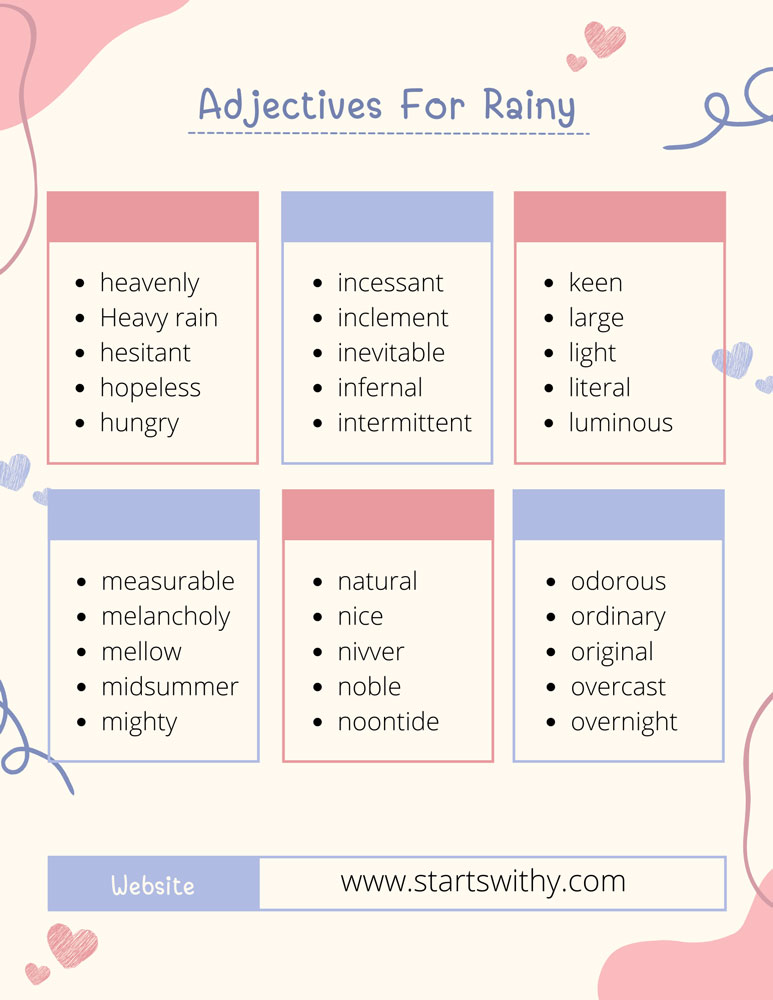
Heavenly
Heavy
Heavy Rain
Hesitant
Hopeless
Hungry
I
Icy
Imaginable
Impounded
In All Weather(S)
Incessant
Inclement
Inevitable
Infernal
Inky
Intense
Intermittent
Isolated
K | L
Keen
Large
Light
Literal
Luminous
M
Major
Massive
Measurable
Melancholy
Mellow
Mere
Midsummer
Mighty
Mild
Minimal
Misty
Mobile
Moderate
Moist
Monsoon
Monsoonal
Monthly
Moody
Murderous
Murky
Mysteriouslythe
N | O
Natural
Nice
Nivver
Noble
Noontide
Normal
Occasional
Odorous
Ordinary
Original
Overcast
Overnight
P
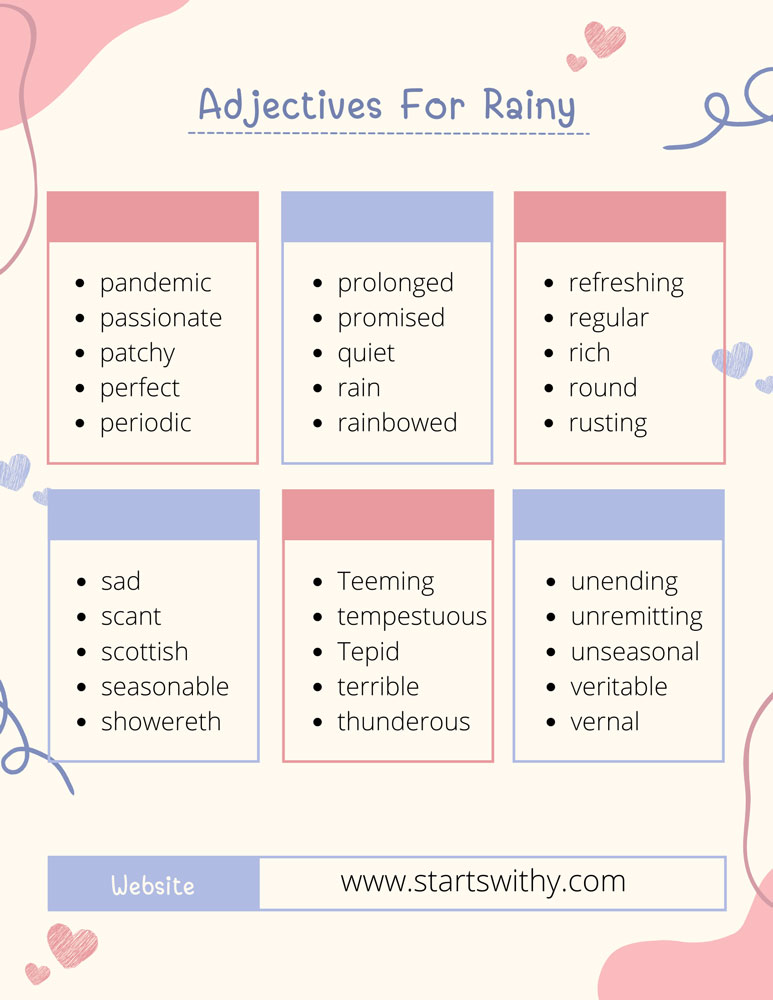
Pandemic
Passionate
Patchy
Pattering
Perfect
Periodic
Periodical
Perpendicular
Perpetual
Persistent
Pitiless
Plentiful
Pounding
Pouring
Pouring Rain
Pre
Present
Prisoned
Prodigious
Prolific
Prolonged
Promised
Purple
Q | R
Quiet
Rain
Rainbowed
Rainfall
Rainstorm
Rainy
Rare
Real
Reasonable
Record
Red
Refreshing
Regular
Rich
Round
Rusting
S
Sad
Scant
Scattered
Scottish
Seasonable
Seasonal
Seldom
Settled
Severe
Sharp
Sheeted
Short
Shower
Showereth
Showery
Sibilant
Significant
Silent
Silky
Silver
Silvery
Simple
Single
Slight
Slow
Soft
Solid
Solstitial
Soothing
Sooty
Sparkling
Specialist
Speedy
Spitting
Sporadic
Steady
Steady Rain
Stinging
Stop
Stormy
Straight
Streaming
Strong
Sudden
Sunshower
Super
Surplus
Sustained
Sweeping
Sweet
Swift
T
Teeming
Tempestuous
Tepid
Terrible
Thick
Thin
Thunderous
Timely
Tipping Down
Torrent
Torrential
Tremendous
Tropic
Tropical
U | V
Uncomfortable
Unending
Unpredictable
Unremitting
Unseasonable
Unseasonal
Unsettled
Unsettling
Untimely
Unwanted
Unwelcome
Useless
Usual
Vast
Veritable
Vernal
Vertical
Vicious
Violent
W | Y | Z
Warm
Wearisome
Weary
Welcome
Wet
Wide
Widespread
Wild
Windless
Winnowing
Yellow
Zis
Final verdict
The article provides a great list of adjectives to describe the rain. The rain can be described as beautiful, calming, refreshing, and even romantic. However, the rain can also be seen as a nuisance, especially when it causes delays or messes up hair and makeup. No matter what your opinion of the rain is, there is an adjective on this list to describe it.
Robin founded StartsWithy in 2022 to make English words easier to understand and use. Robin oversees our 30,000+ guides, checks meanings and grammar against trusted dictionaries such as Cambridge, Oxford Learner’s and Collins, and is accountable for every correction we make.