
Adjectives for situations describe what an event or set of circumstances feels like, how it unfolds, or what effect it has. A tense meeting names the atmosphere; a complicated situation points to its difficulty. Choose a word that fits the evidence, then make clear whether it describes the event, the setting, or someone’s reaction.

At a glance
- Situation is a noun for conditions or circumstances at a particular time; adjectives describe those conditions or their effect.
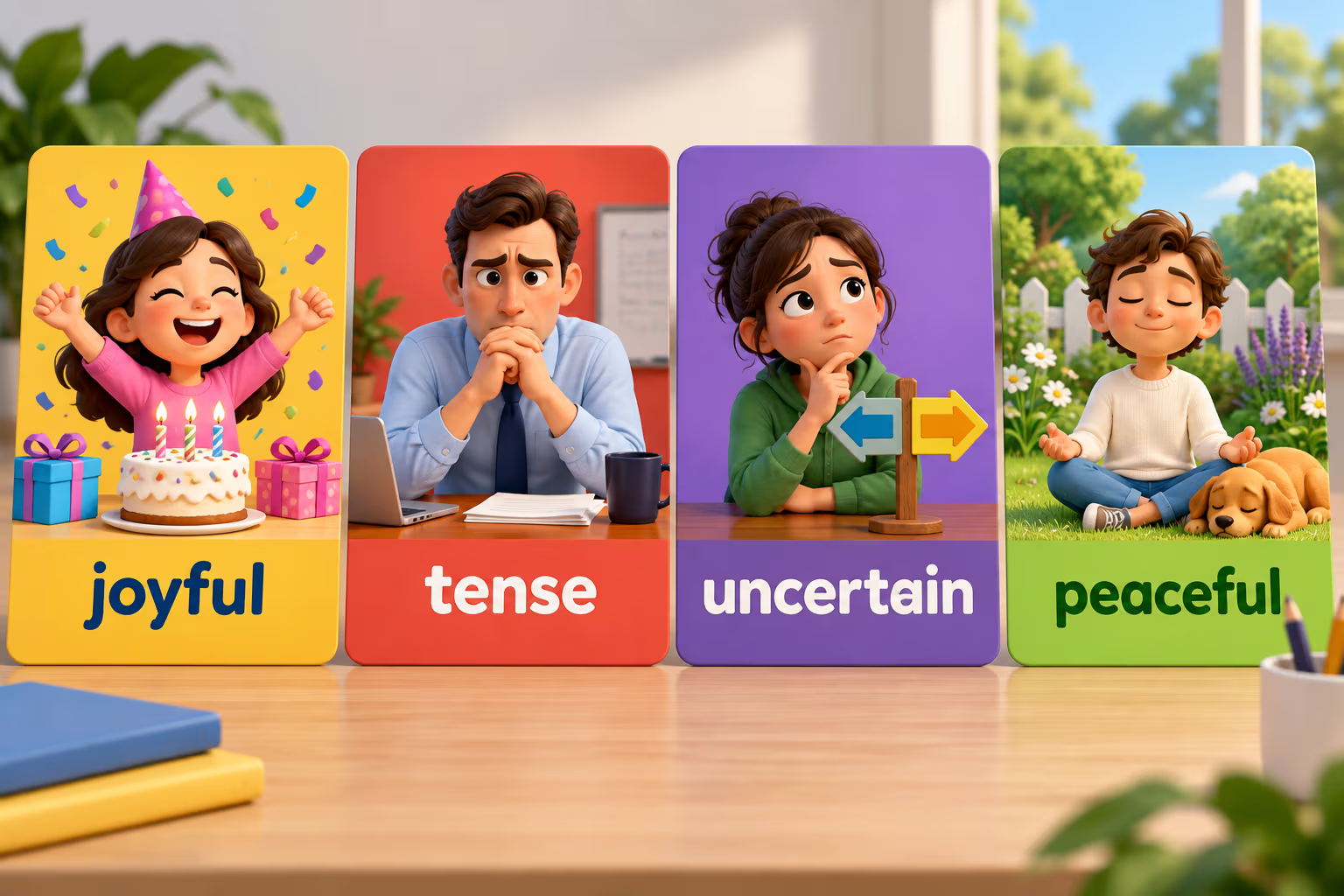
- Joyful, tense, uncertain, and peaceful describe different kinds of atmosphere.
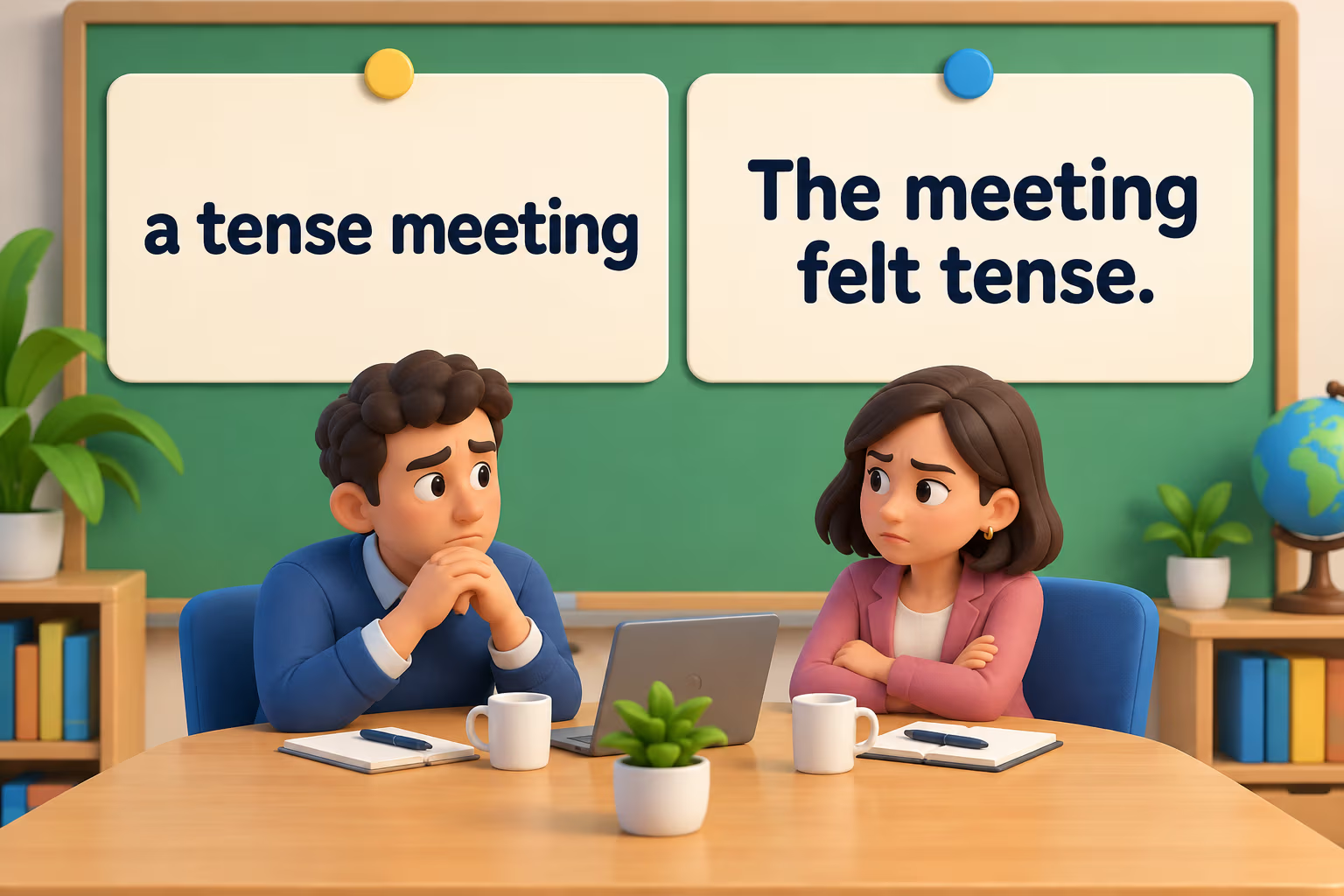
- In “a tense meeting,” the adjective comes before the noun; in “the meeting felt tense,” it follows a linking verb.
- Words such as challenging and dangerous describe different things, so choose based on whether you mean difficulty or risk.
- A concrete detail often makes a description more useful than a stack of synonyms.
What Makes an Adjective Fit a Situation?
A situation is the set of conditions or events that exist at a particular time. An adjective can name its emotional atmosphere, practical difficulty, level of risk, pace, or likely outcome. The best word depends on which feature matters: a delayed train can be frustrating to passengers, disruptive to a schedule, and uncertain for someone waiting to make a connection.
That distinction keeps a description precise. Sad usually describes a person’s feeling, while sorrowful can describe a scene or event that evokes sadness. Chaotic points to disorder; stressful describes the pressure people experience. A sentence can name both, but they are not interchangeable: “The evacuation was chaotic, and the long wait was stressful.”
Useful Adjectives by Situation
Use the categories below as a starting point, not as fixed labels. The same event may feel different to different people, and one adjective rarely captures every part of it.
| What you want to describe | Useful adjectives | Example |
|---|---|---|
| Positive atmosphere | joyful, celebratory, heartwarming, uplifting | The reunion was joyful but a little overwhelming. |
| Calm or stable conditions | peaceful, settled, reassuring, orderly | The handover was orderly, with each task assigned. |
| Uncertainty or change | uncertain, fluid, unpredictable, unsettled | The schedule remains fluid while the venue is repaired. |
| Pressure or difficulty | demanding, complicated, stressful, challenging | It was a demanding week, so we moved the deadline. |
| Risk or urgency | risky, hazardous, urgent, precarious | The icy road made the route hazardous before sunrise. |
| Conflict or tension | tense, contentious, strained, confrontational | The discussion grew tense when the two proposals differed. |
| Humor or surprise | amusing, absurd, unexpected, awkward | An unexpected announcement turned the pause amusing. |
| Loss or disappointment | painful, difficult, disappointing, heartbreaking | The cancellation was disappointing after months of planning. |
How Do You Use Situation Adjectives in a Sentence?
Place an adjective before the noun it describes, or after a linking verb such as be, seem, or feel. Both patterns are standard: “It was a complicated situation” and “The situation seemed complicated.” Cambridge Grammar describes these as adjective-before-noun and adjective-after-linking-verb positions.
- Before a noun: “They faced an uncertain outcome.”
- After a linking verb: “The outcome remained uncertain.”
- With a reason: “The conditions were dangerous because floodwater covered the road.”
- With a contrast: “The process was complicated, but the instructions were clear.”
When several adjectives appear before one noun, keep the phrase short and put opinion words before more factual descriptions in the usual order: “a difficult last-minute decision,” rather than piling on near-synonyms. Cambridge Grammar notes that adjective order is regular but depends on the types of qualities being described.
Which Words Are Most Precise?
Start by asking what you actually know. Dangerous makes a claim about risk; use it when there is a credible hazard. Challenging says something requires effort but does not, by itself, imply danger. Unusual means it differs from what is expected; it does not automatically mean bad. Urgent means it needs prompt attention, not necessarily that it is an emergency.
Also separate the event from people’s reactions. “A tense exchange” describes the interaction; “the exchange left Mara anxious” reports one person’s response. That wording avoids turning a temporary reaction into a sweeping judgment about someone’s character.
Are There Antonyms for “Situation”?
Situation is a noun, so it does not have one direct adjective antonym. Words such as ideal, stable, or resolved may describe a favorable or settled situation, but they are not opposites of the noun situation. Choose an opposite for the quality you mean instead: calm / tense, stable / unstable, or likely / unlikely.
Likewise, a synonym of situation is a noun such as circumstance, condition, or state of affairs. An adjective such as complicated describes a situation; it is not a synonym for the noun itself. This part-of-speech check helps avoid confusing related words with true synonyms or antonyms.
Quick Editing Check
- Name the feature you mean: feeling, difficulty, risk, pace, or outcome.
- Choose one adjective that accurately describes that feature.
- Add a concrete detail or reason if the word expresses an opinion or a serious claim.
- Check that the sentence identifies whose reaction it describes.
For example, replace “It was a terrible situation” with “The power outage closed the clinic for two hours, leaving patients uncertain about rescheduled appointments.” The revised sentence tells readers what happened and why it mattered; uncertain then describes a specific consequence.
Sources for usage: Cambridge Dictionary’s definition of situation; Cambridge Grammar on adjective position; and Cambridge Grammar on adjective order.

Welcome to my article on “Adjectives for situation – Describing Words With Examples”. As an expert blogger, I have years of experience in writing high-quality articles, and today I am excited to share with you some valuable insights into the world of descriptive adjectives for different situations.
In our everyday lives, we encounter a wide range of situations – from joyous celebrations to challenging obstacles. Adjectives play a crucial role in helping us express and communicate our experiences effectively. Whether you’re a writer looking to enhance your storytelling skills or simply someone who wants to expand their vocabulary, this article will provide you with a comprehensive list of adjectives that will bring your descriptions to life.
How to Describe situation? – Different Scenarios
In my experience as an expert blogger, I have found that choosing the right adjectives can make all the difference when it comes to describing situations. By selecting the appropriate adjectives, you can paint a vivid picture and effectively communicate the details and emotions of any scenario. Let’s explore some different scenarios and the descriptive words that best capture their essence.
1. Happy Situations:
- Joyous: Overflowing with happiness and delight.
- Blissful: Feeling perfect peace and contentment.
- Radiant: Glowing with happiness and positivity.
- Jubilant: Feeling triumphant and celebrating success.
- Exhilarated: Feeling energized and thrilled.
- Heartwarming: Evoking feelings of warmth and affection.
- Serene: Peaceful and tranquil.
2. Sad Situations:
- Sorrowful: Filled with deep sadness and grief.
- Despondent: Feeling hopeless and discouraged.
- Languishing: Lacking motivation and enthusiasm.
- Heartbroken: Feeling intense emotional pain due to loss.
- Devastated: Completely overwhelmed by sadness.
- Melancholy: A gentle, pensive sadness.
- Tearful: Full of tears or on the verge of crying.
3. Scary Situations:
- Terrifying: Extremely frightening and causing dread.
- Haunting: Eerie and unsettling.
- Menacing: Threatening and suggesting danger.
- Suspenseful: Building tension and anticipation.
- Petrifying: Turning to stone with fear.
- Ominous: Foreboding and suggesting something bad will happen.
- Spine-tingling: Sending shivers down your spine.
4. Funny Situations:
- Hilarious: Extremely funny and causing uncontrollable laughter.
- Amusing: Entertaining and causing laughter or smiles.
- Whimsical: Playful and lighthearted.
- Absurd: Ridiculous and nonsensical, but in a funny way.
- Witty: Clever and amusing in a quick and insightful way.
- Satirical: Using humor to criticize or make a point.
- Slaphappy: Lighthearted and silly in a carefree way.
5. Exciting Situations:
- Thrilling: Intensely exciting and causing a rush of adrenaline.
- Exhilarating: Energetic and stimulating.
- Breathtaking: Stunning and awe-inspiring.
- Heart-pounding: Causing a rapid heartbeat from excitement.
- Electrifying: Full of energy and excitement.
- Invigorating: Stimulating and refreshing.
- Jaw-dropping: Shocking and amazing in a positive way.
It’s important to choose adjectives that accurately reflect the situation you’re describing. By selecting the appropriate adjectives, you can effectively convey the emotions, atmosphere, and characteristics of any given scenario. Whether it’s a happy, sad, scary, funny, or exciting situation, the right adjectives will help bring your storytelling to life.
Describing Words for situation in English
In this section, I will provide you with a list of describing words that can be used to effectively describe different situations. It’s important to choose the right adjectives to accurately convey the emotions, atmosphere, and characteristics of any given scenario. Here are some examples:
Happy Situations
- joyful
- cheerful
- elated
- ecstatic
- delighted
Sad Situations
- somber
- melancholy
- heartbroken
- crestfallen
- dejected
Scary Situations
- terrifying
- eerie
- spine-chilling
- hair-raising
- chilling
Funny Situations
- hilarious
- comical
- amusing
- entertaining
- laugh-out-loud
- thrilling
- exhilarating
- electrifying
- gripping
- action-packed
Remember, using the right adjectives can bring your storytelling to life and create a vivid picture in the minds of your listeners or readers. With these describing words, you’ll be able to capture the essence of each situation and engage your audience.
Let’s take a closer look at some examples of how these describing words can be used:
| Situation | Describing Word |
|---|---|
| A birthday party | joyful |
| Losing a pet | heartbroken |
| A haunted house | eerie |
| A funny movie | hilarious |
| Riding a rollercoaster | thrilling |
By incorporating these adjectives into your descriptions, you’ll be able to paint a more colorful and engaging picture for your audience.
So, the next time you want to describe a situation, make sure to choose the right adjectives to capture the emotions and atmosphere effectively.
Keep practicing and exploring more adjectives to enhance your storytelling skills. Remember, the right words can make all the difference!
And that’s it – a comprehensive list of describing words for different situations. Experiment with these adjectives, and take your storytelling to the next level!
Adjectives for situation
In this section, I’ll provide a list of adjectives for different situations. Whether you’re writing a story, describing an event, or trying to engage young minds, using the right adjectives can make all the difference. Let’s explore some positive and negative adjectives that can help bring situations to life.
Positive Adjectives for Situation with Example Sentences
- Happy: I felt ecstatic when I won the race.
- Exciting: The rollercoaster ride was thrilling and exhilarating.
- Adventurous: Exploring the jungle was an amazing and daring experience.
- Fun: Playing games with friends at the park was enjoyable and entertaining.
- Peaceful: Sitting by the lake, I felt calm and serene.
- Delicious: The chocolate cake tasted divine and mouthwatering.
- Beautiful: The sunset painted the sky with stunning colors.
- Energetic: The dance class left me feeling lively and energized.
- Brave: Facing my fears and giving a speech was courageous and bold.
- Magical: The fireworks display was enchanting and magical.
- Fascinating: The museum had an intriguing and captivating exhibit.
- Cozy: Snuggling up by the fireplace made me feel warm and cozy.
- Sad: Losing my favorite toy made me feel devastated and heartbroken.
- Scary: Walking through the haunted house was terrifying and chilling.
- Boring: The lecture at school was monotonous and tedious.
- Annoying: The loud construction noises were irritating and bothersome.
- Disappointing: Not winning the game was disheartening and frustrating.
By incorporating these descriptive adjectives into your writing, you can create vivid and engaging descriptions that capture the emotions, atmosphere, and characteristics of different situations. Remember, practice makes perfect, so continue exploring more adjectives to enhance your storytelling skills.
Now that we’ve covered both positive and negative adjectives, let’s move on to the next section to explore some funny and exciting adjectives for situations.
Synonyms and Antonyms with Example Sentences
Synonyms for situation
When it comes to describing different situations, using a diverse range of adjectives can make your writing more engaging and vivid. Here are some synonyms for the word “situation” that you can incorporate into your storytelling:
| Synonym | Definition | Example Sentence |
|---|---|---|
| Circumstance | A fact or condition relevant to an event or action | In this circumstance, we decided to cancel the outdoor activity due to the bad weather. |
| Scenario | A sequence of events that could happen | Let’s consider a worst-case scenario where we run out of food during the camping trip. |
| Backdrop | The environment or setting in which something happens | The beautiful beach served as the perfect backdrop for their romantic dinner. |
| Context | The circumstances that form the setting of an event | Understanding the historical context is crucial to interpreting this ancient manuscript. |
Antonyms for situation
Sometimes, you may need to describe situations that are the opposite of what you would typically expect. Here are some antonyms for the word “situation” that can add depth to your writing:
| Antonym | Definition | Example Sentence |
|---|---|---|
| Stagnation | A state of lack of activity or progress | The economy’s stagnation has led to high unemployment rates. |
| Ideal | Conforming to a standard of perfection or excellence | Everything fell into place, and it was the ideal situation for the team to win the championship. |
| Improvement | The act of making something better or more satisfactory | With her guidance, our sales team has shown significant improvement in meeting their targets. |
| Resolution | A firm decision or determination to do something | Tensions between the two countries were resolved peacefully through diplomatic negotiations. |
By utilizing these synonyms and antonyms, you can enrich your writing and effectively convey different situations. Remember to choose the best adjective that captures the essence of the situation you are describing, ensuring that your readers can visualize and connect with your words.
Conclusion
Choosing the right adjectives to describe different situations is crucial for effective communication. Throughout this article, we have explored a variety of synonyms and antonyms for the word “situation” and provided example sentences for each. By incorporating these descriptive words into our writing, we can create more engaging and vivid descriptions that capture the essence of the situation at hand.
Using the appropriate adjectives allows us to paint a picture with our words, enabling readers to visualize and connect with the content. Whether we are describing a challenging situation, an exciting event, or a peaceful moment, selecting the right adjective can make all the difference in conveying the intended message.
So, next time you find yourself in need of describing a situation, take a moment to consider the various adjectives available to you. Choose the one that best encapsulates the emotions, atmosphere, or characteristics of the situation, and watch as your writing comes to life.
Remember, the power of words lies not only in their meaning but also in how they are used. So, let’s harness the power of adjectives and elevate our writing to new heights.


