How to Choose the Right Adjective for Sunlight
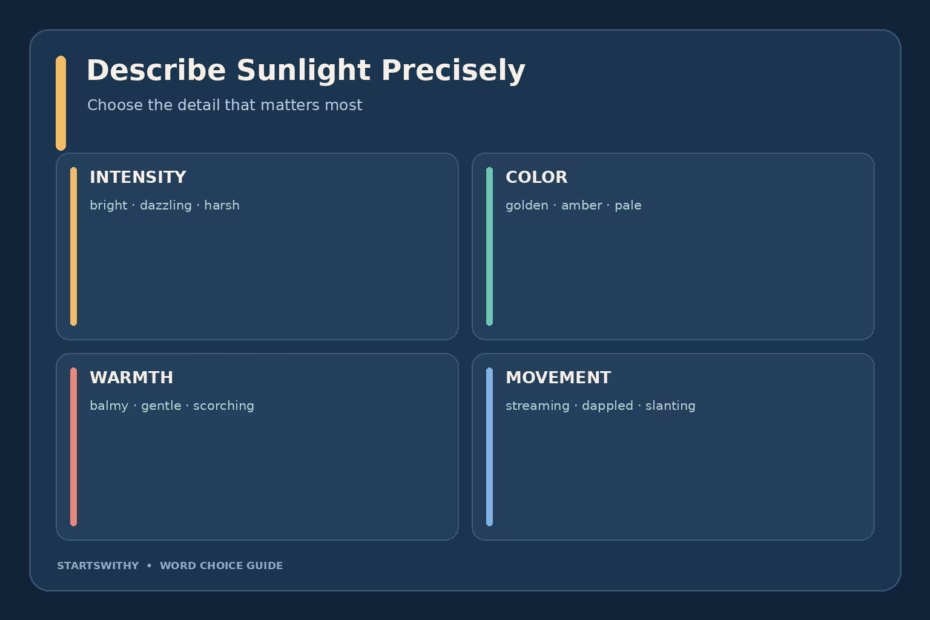
The best adjective for sunlight tells readers what the light looks or feels like in a particular moment. Instead of reaching for a general word such as beautiful, decide whether you mean its intensity, color, warmth, direction, or effect on the scene. A narrow choice makes a description easier to picture: thin sunlight slipped between the blinds gives a different image from harsh sunlight bleached the courtyard.
Sunlight is light that comes from the Sun; words such as ray, beam, and shaft describe a ray or visible path of it. In clear air, light travels directly from the Sun, while the atmosphere also scatters sunlight in many directions. That scattering helps explain why the sky and shaded places receive light even when the Sun is not shining straight on them. NASA describes atmospheric scattering as a cause of blue skies and other changes in the light we see (NASA: Why Is the Sky Blue?). At sunrise and sunset, sunlight passes through more atmosphere, often making the light appear redder or yellower (NASA Earth Observatory: Crepuscular Rays and Light Scattering).
Sunlight adjectives by quality
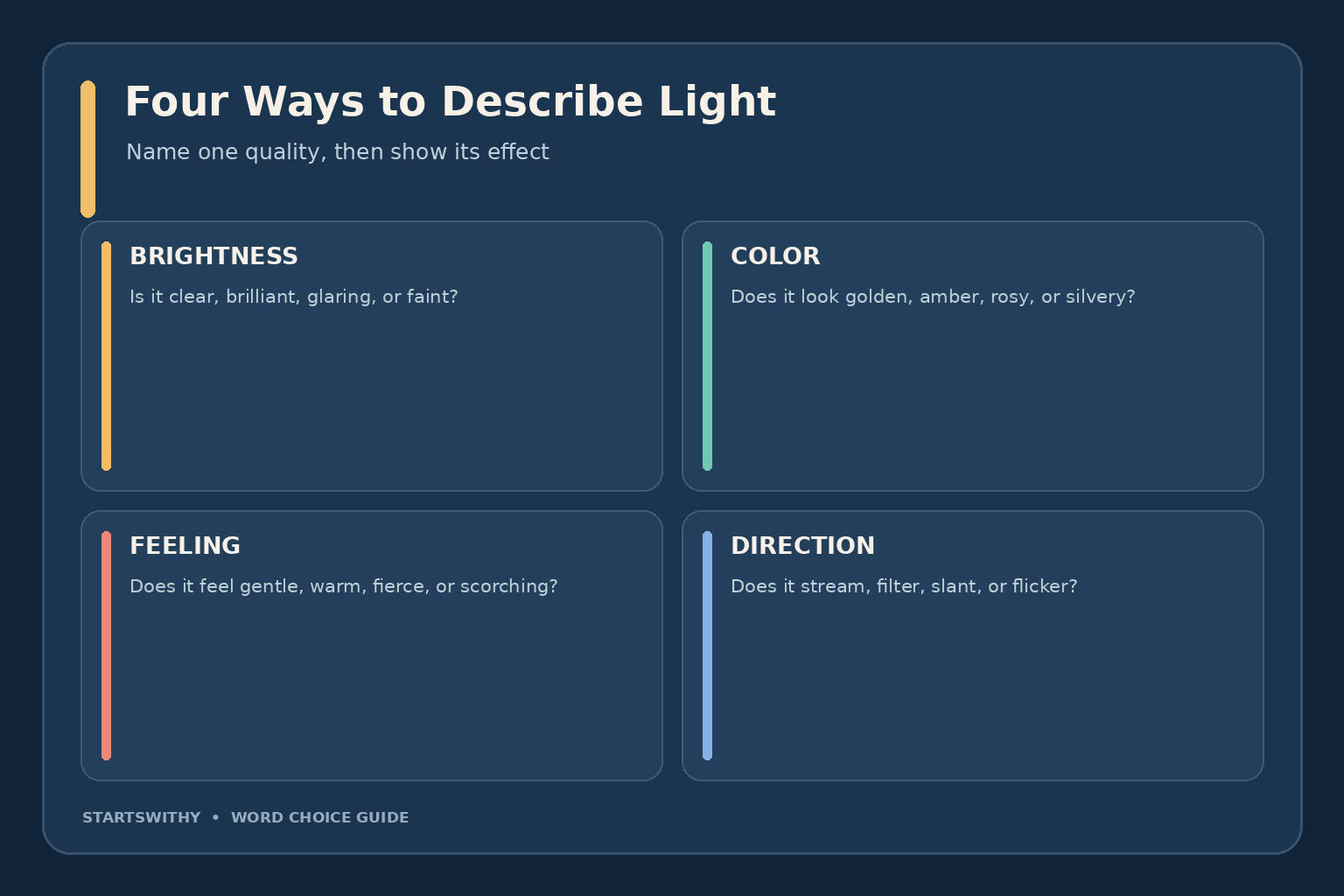
| Quality | Useful adjectives | What they suggest | Example |
|---|---|---|---|
| Brightness | bright, brilliant, dazzling, radiant, glaring, harsh | How much light reaches the scene, and whether it feels comfortable or overwhelming | Brilliant sunlight lit the white sail; glaring sunlight made the screen hard to read. |
| Color | golden, amber, yellow, orange, pale, silvery | The hue the light seems to have, often affected by the time of day and atmosphere | Amber sunlight rested on the brick wall at dusk. |
| Warmth or mood | warm, gentle, soft, cheerful, inviting, comforting | A physical sensation or the emotional tone created by the scene | Gentle sunlight warmed the bench without making the afternoon feel hot. |
| Strength or discomfort | intense, fierce, scorching, searing, unforgiving, oppressive | Strong exposure or a scene where the light contributes to heat and discomfort | Under the fierce sunlight, the pavement shimmered. |
| Amount or filtering | faint, filtered, dappled, diffused, muted, hazy | Light weakened or broken up by clouds, leaves, glass, mist, or shade | Dappled sunlight shifted across the path beneath the maples. |
| Direction or shape | slanting, angled, direct, low, overhead, slantwise | Where the light comes from and how it falls across objects | Low sunlight stretched the fence’s shadow across the lawn. |
A useful list of sunlight adjectives
Use this list as a menu, then check that the adjective matches the details around it. Some words describe the sunlight itself; others describe its effect on people, surfaces, or mood.
- For clear, strong light: bright, brilliant, dazzling, radiant, vivid, direct, intense, piercing, sharp, glaring, glaringly bright, blinding, fierce, powerful, full.
- For gentle or limited light: soft, gentle, mild, faint, pale, delicate, filtered, diffused, muted, veiled, hazy, dappled, intermittent, weak, subdued.
- For color and time of day: golden, amber, honeyed, yellow, orange, red, rosy, coppery, white, silvery, warm, cool, early-morning, midday, late-afternoon.
- For heat or impact: radiant, balmy, comforting, soothing, pleasant, cheerful, invigorating, scorching, searing, hot, relentless, oppressive, unforgiving, dehydrating, drying, sweltering.
- For motion or shape: streaming, pouring, spilling, slanting, angled, slantwise, slivered, flickering, shimmering, glancing, grazing, beaming, shafted, broken, streaked.
Several entries overlap because the surrounding sentence changes their effect. Warm can describe perceived temperature or a yellow-orange cast; sharp can describe a crisp beam or a strong contrast; fierce can imply intensity and discomfort. If the distinction matters, name the evidence: orange light at the horizon, heat on the exposed steps, or hard-edged shadows under the chair.
Examples that make sunlight easier to picture
- Bright: Bright sunlight revealed the pale lettering on the old sign.
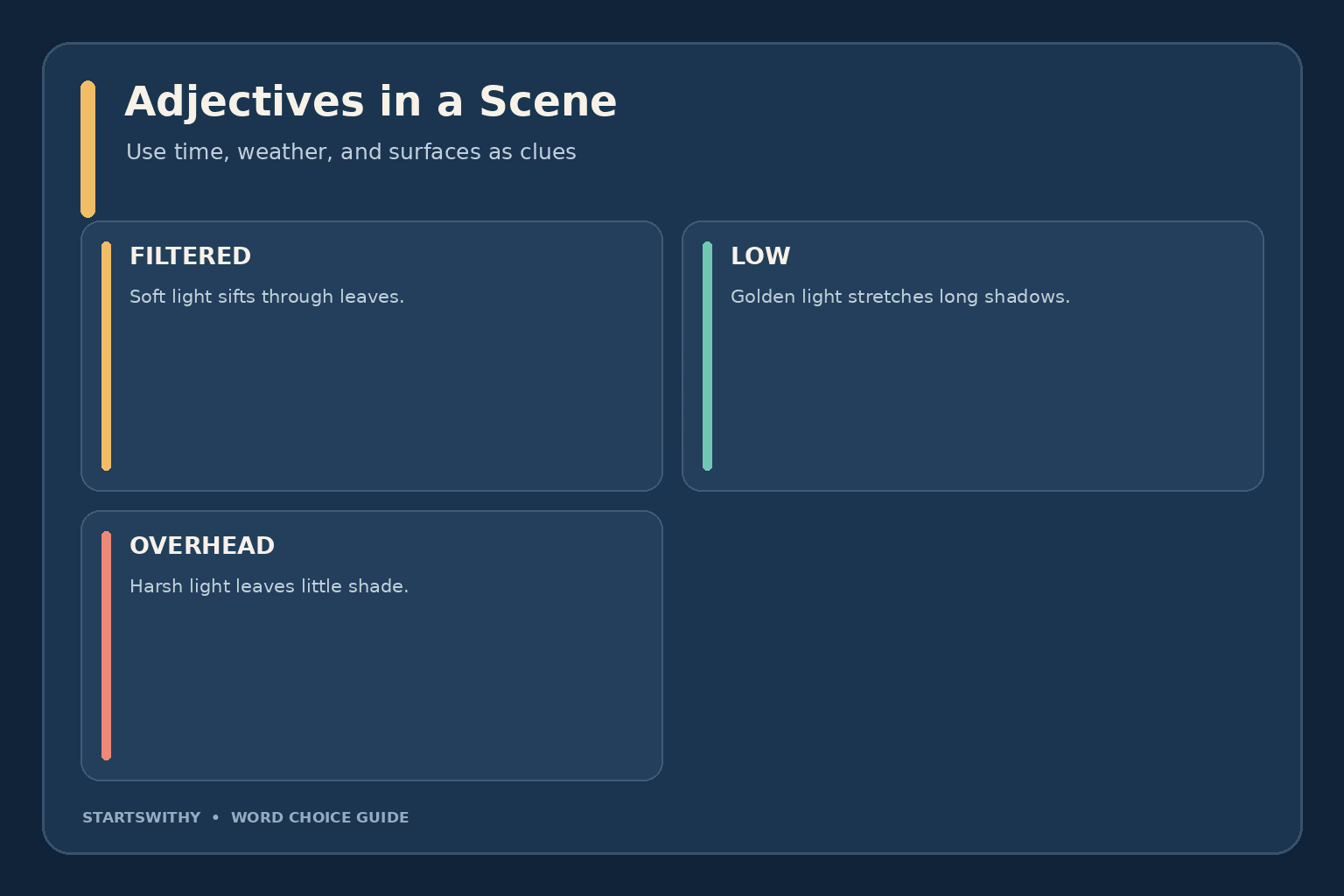
- Dappled: Dappled sunlight moved over the picnic blanket as the branches swayed.
- Golden: Golden sunlight filled the kitchen just before dinner.
- Harsh: Harsh midday sunlight flattened the colors and left almost no shade.
- Filtered: Filtered sunlight softened the room behind the linen curtain.
- Faint: Faint sunlight reached the basement window on a cloudy morning.
- Slanting: Slanting sunlight crossed the platform and caught the dust in the air.
- Scorching: Scorching sunlight beat down on the unshaded road.
- Amber: Amber sunlight gave the wet pavement a copper glow.
- Flickering: Flickering sunlight flashed across the water between the passing clouds.
How to describe sunlight in a sentence
Build a useful description with a simple pattern: adjective + sunlight + specific action or effect. For example, “soft sunlight filtered through the curtain” tells readers about both the quality of the light and what interrupted it. A second pattern puts the light after the setting: “The path lay under dappled sunlight.” To convey a changing scene, pair a verb of movement with a clear source: “Late-afternoon sunlight slanted through the west-facing window.”
For sensory detail, connect the adjective to something observable. Instead of “lovely sunlight filled the room,” try “warm sunlight fell across the wooden floor” if warmth and direction matter. If the scene is uncomfortable, select a word such as glaring or blinding only when the light interferes with seeing; choose scorching when heat is the point. A precise verb—filtered, glinted, flooded, or receded—can do more work than stacking several adjectives.
Common word-choice mistakes
- Using “warm” when you mean “hot” or “golden.” Warm can suggest comfort, temperature, or color. Add a concrete clue if readers need to know which meaning applies.
- Calling every bright scene “dazzling.” Dazzling suggests light so brilliant it can momentarily overwhelm sight. Use bright or clear for ordinary illumination.
- Confusing sunlight with sunshine. Both are commonly used for light from the Sun, but sunshine can also suggest sunny weather or cheerfulness. Sunlight often foregrounds the light itself.
- Using “diffused” as a synonym for “dim.” Diffused light is spread or softened; it can still illuminate a scene strongly.
- Adding mood without a scene detail. Words like cheerful and peaceful are interpretations. Pair them with what produces that mood, such as a quiet room or a bright garden.
Quick revision checklist
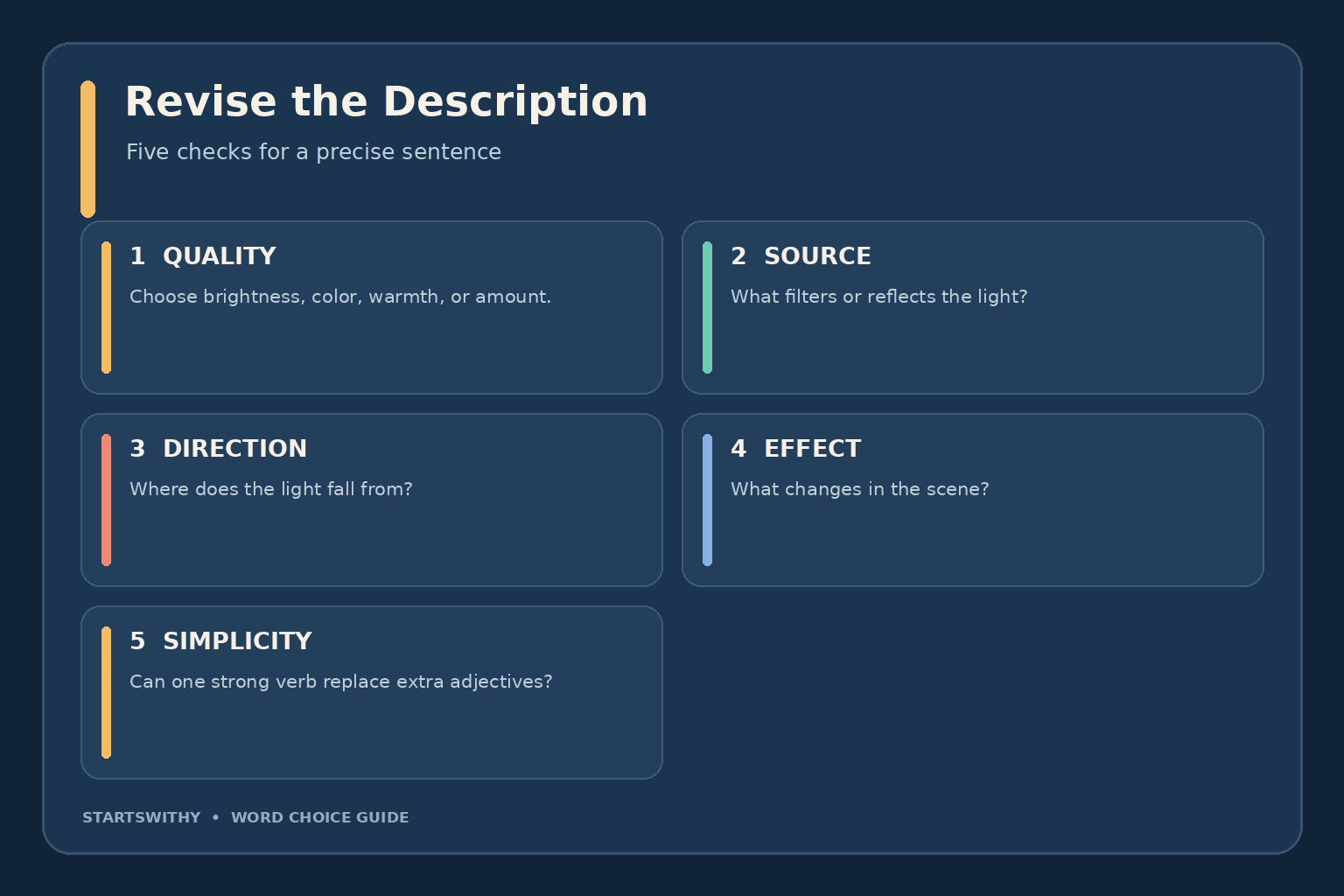
- Which quality matters most: brightness, color, warmth, amount, or direction?
- What does the sunlight pass through or reflect from?
- Where does it fall, and what does it change in the scene?
- Does the adjective describe visible light, felt heat, or your interpretation?
- Can a specific verb replace an extra adjective?
Frequently asked questions
What is a good adjective for sunlight?
Golden, soft, bright, and dappled are useful when they fit the scene. Choose golden for a yellow-orange appearance, soft for gentle illumination, bright for strong light, and dappled for light broken into patches.
What adjective describes sunlight through trees?
Dappled is a strong choice when leaves break the light into patches. You can also describe the action: sunlight filtered through the canopy or flickered across the ground as branches moved.
How do you describe sunlight at sunset?
Try amber, orange, rosy, or low, depending on the detail you want to emphasize. Add a visible effect—long shadows, a colored wall, or a glowing horizon—to make the description concrete.
What is the difference between bright and harsh sunlight?
Bright reports strong illumination. Harsh adds a negative effect, such as hard contrast, glare, or discomfort. Use harsh when the scene supports that judgment.
Can sunlight be described as warm?
Yes. Warm sunlight can mean sunlight that feels pleasantly hot or light that appears yellow or orange. If the intended meaning could be unclear, state a physical or visual clue.
Sources: Cambridge Dictionary, “sunlight”; NASA Space Place, “Why Is the Sky Blue?”; NASA Earth Observatory, “Crepuscular Rays and Light Scattering.”

When it comes to describing the beauty and warmth of sunlight, words often fall short. But as a writer, it is my job to find the right adjectives that can capture the essence of this natural wonder. In this article, I’ll be sharing a curated list of adjectives that perfectly describe sunlight, accompanied by examples that bring these words to life.
Sunlight, with its golden rays, has the power to transform the world around us. It can be radiant, casting a warm glow on everything it touches. It can be dazzling, as it dances through the leaves of a tree or reflects off the surface of a calm lake. Sunlight can also be gentle, softly illuminating a room and creating a cozy atmosphere. In this article, I’ll explore these adjectives and more, providing you with a comprehensive guide to describing sunlight in all its splendor.
So, let’s dive in and discover the perfect words to paint a vivid picture of sunlight. Whether you’re a writer looking to add depth to your descriptions or simply someone who appreciates the beauty of nature, this article is for you. Get ready to explore the world of adjectives that capture the essence of sunlight, and let your words shine as bright as the sun itself.
How to Describe sunlight? – Different Scenarios
When it comes to describing sunlight, there are a myriad of ways to capture its beauty and warmth. Whether it’s the gentle glow of a sunrise or the dazzling rays of a midday sun, each scenario evokes its own unique qualities. Let’s explore how to describe sunlight in different scenarios:
- The Morning Sunlight
- The Midday Sunlight
- The Afternoon Sunlight
- The Sunset
Remember, describing sunlight is about capturing the essence of its beauty and the emotions it evokes. Use these adjectives to enhance your writing and paint a vivid picture of the world bathed in glorious sunlight.
ADJECTIVES FOR SUNLIGHT:
Describing Words for sunlight in English
Sunlight, a magical phenomenon that brings warmth, light, and life to our world. It has the power to lift our spirits and fill us with renewed energy. As a writer, it’s important to be able to capture the essence of sunlight in your writing, using adjectives that evoke its beauty and radiance. Let’s explore some describing words that can help bring sunlight to life in your writing:
- Golden: The early morning sun casts a golden glow across the landscape, painting everything in its path with a warm and inviting hue.
- Warm: The midday sun radiates with warmth, enveloping everything it touches in a comforting embrace. It’s the perfect time to bask in the sun’s rays and soak up its nourishing energy.
- Blazing: As the afternoon sun reaches its peak, it blazes brightly in the sky, casting sharp shadows and infusing the surroundings with an intense heat.
- Dazzling: The sunlight at sunset is a sight to behold, with its dazzling array of colors painting the sky. The warm oranges, vibrant pinks, and fiery reds create a breathtaking spectacle that captivates the senses.
- Gentle: In the early evening, as the sun begins to set, its light becomes more gentle and subdued. It bathes the world in a soft glow, offering a sense of tranquility and calm.
- Radiant: The sunlight streaming through a canopy of leaves creates a radiant effect, casting intricate patterns of light and shadow on the ground below.
- Luminous: The sunlight reflecting off a body of water creates a luminous shimmer, sparkling and dancing with every ripple and wave.
- Invigorating: Stepping outside into the sunlight, you can feel its invigorating energy filling you up, giving you a renewed sense of vitality and zest for life.
- Cheerful: Sunlight has a way of brightening our mood and lifting our spirits. Its cheerful presence can turn a gloomy day into a ray of sunshine.
- Enchanting: Sunlight filtering through a dense forest creates an enchanting effect, illuminating the moss-covered ground and casting a magical glow on everything it touches.
Adjectives for Sunlight
Adjectives for sunlight
When it comes to describing sunlight, there are a variety of adjectives that can help to bring its beauty and radiance to life. In this section, I will provide you with some positive and negative adjectives that can be used to vividly describe sunlight. Let’s dive in!
Positive Adjectives for Sunlight
Using positive adjectives can help create a sense of warmth and positivity when describing sunlight. Here are 12 examples of positive adjectives that can be used:
| Adjective | Example Sentence |
|---|---|
| Golden | The golden sunlight cast a warm glow over the field. |
| Warm | The warm sunlight seeped through the window, filling the room with coziness. |
| Blazing | The blazing sunlight made me reach for my sunglasses. |
| Dazzling | The dazzling sunlight reflected off the water, creating a mesmerizing spectacle. |
| Gentle | The gentle sunlight filtered through the trees, creating a peaceful ambiance. |
| Radiant | The radiant sunlight illuminated the entire garden, making it appear more vibrant. |
| Luminous | The luminous sunlight bathed the landscape in a soft, ethereal light. |
| Invigorating | The invigorating sunlight energized me and lifted my spirits. |
| Cheerful | The cheerful sunlight brightened up the room, bringing a smile to everyone’s face. |
| Enchanting | The enchanting sunlight danced on the ocean waves, creating a magical scene. |
| Serene | The serene sunlight filtered through the curtains, creating a peaceful atmosphere. |
| Blissful | The blissful sunlight warmed my skin and filled me with a sense of contentment. |
Negative Adjectives for Sunlight
Although sunlight is generally associated with positivity, there are also negative adjectives that can be utilized to describe it in different contexts or moods. Here are 5 examples:
| Adjective | Example Sentence |
|---|---|
| Harsh | The harsh sunlight made it difficult for me to see. |
| Blinding | The blinding sunlight made me squint my eyes in discomfort. |
| Scorching | The scorching sunlight made the pavement too hot to walk on barefoot. |
| Glaring | The glaring sunlight reflected off the white sand, making it impossible to look directly. |
| Oppressive | The oppressive sunlight made the air feel heavy and stifling. |
Using these adjectives can help you create engaging and descriptive writing when it comes to capturing the essence of sunlight. Remember to consider the context and the emotions you want to convey, and choose the appropriate adjectives accordingly.
Synonyms and Antonyms with Example Sentences
Synonyms for sunlight
When it comes to describing sunlight in writing, there are several synonyms that can help convey its essence. Here are some alternative words to describe sunlight:
- Golden: The golden sunlight illuminated the room, casting a warm glow on everything it touched.
- Warm: The warm sunlight bathed the garden, creating a tranquil and inviting atmosphere.
- Blazing: The blazing sunlight in the desert was almost unbearable, intensifying the scorching heat.
- Dazzling: The dazzling sunlight reflected off the water, creating a mesmerizing display of shimmering light.
- Gentle: The gentle sunlight streamed through the window, softly illuminating the room with a delicate touch.
- Radiant: The radiant sunlight pierced through the clouds, filling the sky with a burst of vibrant energy.
- Luminous: The luminous sunlight illuminated the forest, revealing the intricate details of the trees and plants.
- Invigorating: The invigorating sunlight energized me, filling me with a sense of vitality and rejuvenation.
- Cheerful: The cheerful sunlight brightened up the room, bringing a sense of joy and positivity to the space.
- Enchanting: The enchanting sunlight bathed the city in a magical glow, transforming it into a captivating sight.
- Serene: The serene sunlight filtered through the leaves, creating a peaceful and tranquil atmosphere.
- Blissful: The blissful sunlight enveloped the beach, creating a perfect backdrop for a day of relaxation and bliss.
Antonyms for sunlight
Sometimes, we may need to describe sunlight in a different context or mood, which calls for the use of antonyms. Here are some contrasting words to describe sunlight:
- Harsh: The harsh sunlight beat down on us, causing us to seek shade and relief from its intense glare.
- Blinding: The blinding sunlight reflected off the snow, making it difficult to see without sunglasses.
- Scorching: The scorching sunlight made the pavement feel like hot coals as we walked barefoot.
- Glaring: The glaring sunlight cast harsh shadows, amplifying the contrast between light and darkness.
- Oppressive: The oppressive sunlight made the air heavy and suffocating, draining us of our energy.
Remember, when choosing adjectives to describe sunlight, consider the context and the emotions you want to convey. These synonyms and antonyms give you a range of options to vividly capture the essence of sunlight in your writing.
Conclusion
Describing sunlight in writing can add depth and vibrancy to your prose. In this article, I have shared a range of adjectives that can be used to vividly describe sunlight and create a sense of warmth and positivity. From golden and warm to dazzling and radiant, these adjectives evoke the beauty and energy of sunlight.
I have also mentioned negative adjectives like harsh and blinding, which can be used to describe sunlight in different contexts or moods. It’s important to consider the emotions and atmosphere you want to convey when choosing the appropriate adjectives.
By providing synonyms and antonyms for sunlight, I have given you a variety of options to enrich your writing. Whether you want to capture the enchanting and serene qualities of sunlight or the oppressive and scorching aspects, these adjectives will help you paint a vivid picture.
Remember, adjectives are powerful tools that can bring your writing to life. So next time you’re describing sunlight, choose your adjectives wisely and watch your words shine.


