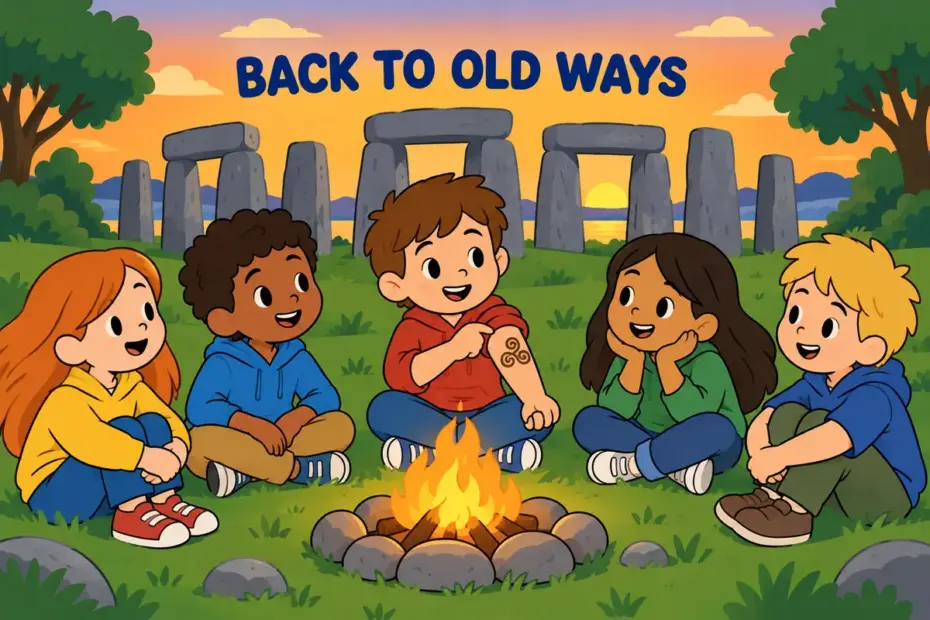
Atavistic describes a trait, impulse or style that reverts to a distant ancestral type rather than belonging to the present. To use atavistic in a sentence, point to the older form it revives: “The crowd felt an atavistic urge to flee.”
Atavistic at a glance
- Atavistic is an adjective; the noun is atavism and the rare adverb is atavistically.
- It means reverting to an ancestral type or to an old, deeply rooted pattern.
- In biology it names a trait that skips generations and then reappears.
- In general prose it describes instinctive, primitive-seeming behaviour or style.
- It is formal and often literary; everyday speech prefers the noun throwback.
- The commonest error is using it to mean merely old-fashioned.
What does atavistic mean?
Atavistic is an adjective meaning reverting to an ancestral type, or resembling something from a much earlier stage of development. The Cambridge entry for atavistic records both the biological sense and the looser sense of a primitive-seeming quality. Biologists separate an atavistic trait from a merely hereditary one, because a hereditary trait appears in every generation while an atavistic one skips many, and they keep it apart from an innate instinct, which is present from birth rather than revived.
| Sense | Plain meaning | Example sentence |
|---|---|---|
| Biological | Reappearance of a trait not seen for generations | The pups showed an atavistic return of the old coat colour. |
| Ancestral behaviour | An instinct that seems older than the person | Panic brought an atavistic rush for the door. |
| Primitive style | A form that revives an earlier, rougher manner | The building has an atavistic heaviness about it. |
| Deeply rooted | A feeling so old it seems inherited | She carried an atavistic distrust of the dark. |
One limitation decides whether the word is used well. Atavistic does not simply mean old or old-fashioned. A fax machine is obsolete or archaic, not atavistic, because nothing ancestral returned. The word needs an idea of reversion: a form or feeling that belongs to an earlier type and has come back. Stretched to cover anything dated, it loses its point and sounds like decoration.
How do you use atavistic in a sentence?
Place the adjective before the noun that names the ancestral thing, or after a verb of feeling such as feel. Five patterns cover most sentences in biology, criticism and reflective writing.
| Pattern | Example | What it signals |
|---|---|---|
| atavistic + noun | an atavistic fear of the dark | The commonest shape; the noun names what is ancestral. |
| feel + atavistic + noun | They felt an atavistic pull toward the fire. | Pairs the adjective with an emotion or a drive. |
| an atavistic streak, urge or impulse | The story stirs an atavistic impulse. | Fixed collocations that sound native to English. |
| the atavistic in + noun | the atavistic in human nature | Nominal use, formal and abstract. |
| more or most atavistic | Of the rituals, this one felt the most atavistic. | Comparative form for ranking degrees of reversion. |
One habit marks a careful writer: the noun after atavistic is usually singular and abstract, as in an atavistic dread or an atavistic loyalty. The adjective rarely describes a person directly, so he is atavistic reads as a category label rather than a description of behaviour.
Atavistic in a sentence: examples across contexts
Atavistic keeps its sense of return as it moves from a laboratory to a film review; only the register changes. Each sentence below names the older form that comes back.
| Context | Example sentence | Why this works |
|---|---|---|
| Biology | The whale’s hind limb was an atavistic feature, a throwback the species had lost long ago. | Names the trait as a reappearance, which is the strict sense. |
| Psychology | The experiment recorded an atavistic reflex that no one had taught. | Ties the adjective to an inherited-seeming instinct. |
| Literature | The novel dwells on an atavistic craving for the hunt. | Uses the emotion noun craving, a natural collocation. |
| Film review | The monster taps an atavistic dread of the dark. | A critical register where the word signals a pre-modern fear. |
| Sports | Under pressure the team fell into an atavistic style of long balls. | Describes a style reverting to an older pattern. |
| Politics | Commentators warned of an atavistic tribalism in the debate. | Applies the word to a social impulse felt to be ancient. |
| Fashion | The collection had an atavistic pull toward heavy wool and hides. | Describes a style reviving a much older mode. |
| Architecture | Its atavistic stone arches recall a fortress rather than an office. | Points to an earlier form the building revives. |
| Personal reflection | Walking at dusk, I felt an atavistic wariness of the woods. | First-person use is common in reflective writing. |
| Science writing | A second toe in the fossil line was an atavistic reversion to an older foot. | Uses reversion explicitly, which keeps the technical sense. |
| Music review | The chorus carries an atavistic drumbeat that belongs to an older tradition. | Applies the adjective to one stylistic element, not the whole song. |
| Conversation | There is something atavistic about the whole thing. | The only shape that survives in speech, and it stays vague. |
Only the last sentence belongs in casual talk; the rest belong to writing that wants a formal, slightly literary tone.
Notice that every example names something specific that returns: a limb, a reflex, a craving, a drumbeat. When the sentence cannot point to the older form, the word is doing decorative work and a plainer term would serve better.
Atavistic vs archaic
Atavistic and archaic both suggest age, and they are not interchangeable. Archaic means old and no longer current; atavistic adds the idea that the old thing has returned. The broader word primitive names an early stage without implying any comeback at all.
| Attribute | atavistic | archaic |
|---|---|---|
| Core idea | A return of something ancestral | Something old and no longer current |
| Time it points to | A distant evolutionary past | An earlier period of a language or custom |
| Implies a return | Yes, the form comes back | No, it simply survives |
| Typical nouns | fear, impulse, trait, style | word, law, spelling, system |
| Tone | Literary, often about instinct | Neutral, about usage or age |
| Usual field | Biology and psychology | Linguistics, law and history |
Verdict: choose atavistic when something ancestral returns, and archaic when something is simply outdated; primitive is the safer word for an early stage when no return is involved.
Word forms and grammar of atavistic
The noun atavism names the trait itself, while the adjective atavistic describes it. The adverb is rare, and the invented noun atavistic-ness is not a word at all.
| Form | Part of speech | Example |
|---|---|---|
| atavism | noun | The extra toe is a rare atavism. |
| atavistic | adjective | It was an atavistic trait. |
| atavistically | adverb, rare | The clan behaved atavistically under stress. |
| atavist | noun, rare | A nineteenth-century atavist argued for the theory. |
| more atavistic | comparative adjective | The older rite felt more atavistic. |
| atavistic-ness | not a word | Use the noun atavism instead. |
Because atavism is a countable noun, a sentence can say the trait is an atavism but not an atavism trait; the adjective form drops the whole noun into the modifier slot. Keep the pair straight and the rest of the grammar follows easily.
Common mistakes with atavistic
- Incorrect:
The office still uses an atavistic filing system.Correct: The office still uses an archaic filing system. Rule: Atavistic needs a return of something ancestral; a merely old system is archaic. - Incorrect:
Her atavistic kindness surprised everyone.Correct: Her instinctive kindness surprised everyone. Rule: Atavistic means reverting to an ancestral type; do not confuse it with altruistic, which means selfless. - Incorrect:
The two species showed atavism features.Correct: The two species showed atavistic features. Rule: Atavism is the noun, so the adjective atavistic is needed before the noun. - Incorrect:
He returned atavistic to his old habits.Correct: He reverted atavistically to his old habits. Rule: The adverb atavistically modifies a verb; the adjective cannot. - Incorrect:
The atavistic building was finished last year.Correct: The building has an atavistic style that recalls an older age. Rule: Atavistic describes a form that revives an earlier type, not the date of construction. - Incorrect:
His temper was very atavistic and quick.Correct: His temper had an atavistic, almost inherited fierceness. Rule: Atavistic needs a noun that names something ancestral; it is not a general intensifier for strong feelings.
Practice using atavistic
Seven items cover the adjective, the noun, the adverb and the confusables, and every answer carries the reason, not only the key.
- Fill the gap: The old story stirred an ______ fear of the sea.
- Choose the better word: The office kept an (atavistic / archaic) filing cabinet full of dust.
- Correct the error: The bird showed an atavism feather pattern.
- Build a sentence: use an atavistic urge about a crowd at a fireworks display.
- Spot the register: which fits a film review, the scene taps an atavistic dread, or the scene is like so atavistic?
- Rewrite with the noun: The extra toe is an atavistic trait. Use atavism instead.
- Correct the error: She acted atavistic when the alarm rang.
- Choose the better word: The clan kept an (atavistic / archaic) custom that had returned after a century.
Answers
- atavistic: the noun fear follows the adjective, and the sense is an old inherited emotion.
- archaic: the cabinet is merely old and unused, with no ancestral return.
- The bird showed an atavistic feather pattern: the adjective, not the noun, comes before a noun.
- Model answer: The crowd felt an atavistic urge to shout as the first rocket climbed.
- The scene taps an atavistic dread: a review keeps the formal collocation and drops casual modifiers.
- The extra toe is an atavism: the noun names the reappearing trait itself.
- She acted atavistically when the alarm rang: a verb needs the adverb, not the adjective.
- atavistic: the custom had returned after a century, so reversion is present, which archaic would not show.
The bottom line
Use atavistic in a sentence when a trait, fear or style reverts to something ancestral rather than merely surviving. The two choices that decide most sentences are whether a return is really happening, because archaic covers plain age, and whether the noun after it names something instinctive. In everyday speech, throwback carries the same idea with far less formality.
Frequently asked questions about atavistic
What does atavistic mean in simple terms?
Atavistic means reverting to an older, ancestral type. In biology it describes a trait that skips generations and then reappears. In general writing it describes a fear, instinct or style that seems to come from a much earlier stage of human life rather than from the present.
Is atavistic the same as old-fashioned?
No. Atavistic requires a return of something ancestral, while old-fashioned and archaic simply describe something outdated. A handwritten ledger is archaic, but a modern office returning to handwritten records could be called atavistic, because an older form has come back.
What is the noun form of atavistic?
The noun is atavism, and it names the reappearing trait or the phenomenon itself. Atavistic is the adjective, and atavistically is a rare adverb. A sentence such as the sixth toe is an atavism uses the noun, while an atavistic feature uses the adjective.
Can atavistic describe people?
It usually describes traits, impulses, fears or styles rather than whole people, though a person’s behaviour can be called atavistic. Saying he is atavistic sounds odd; saying his anger had an atavistic quality is natural, because the adjective points to the ancestral quality of the anger.