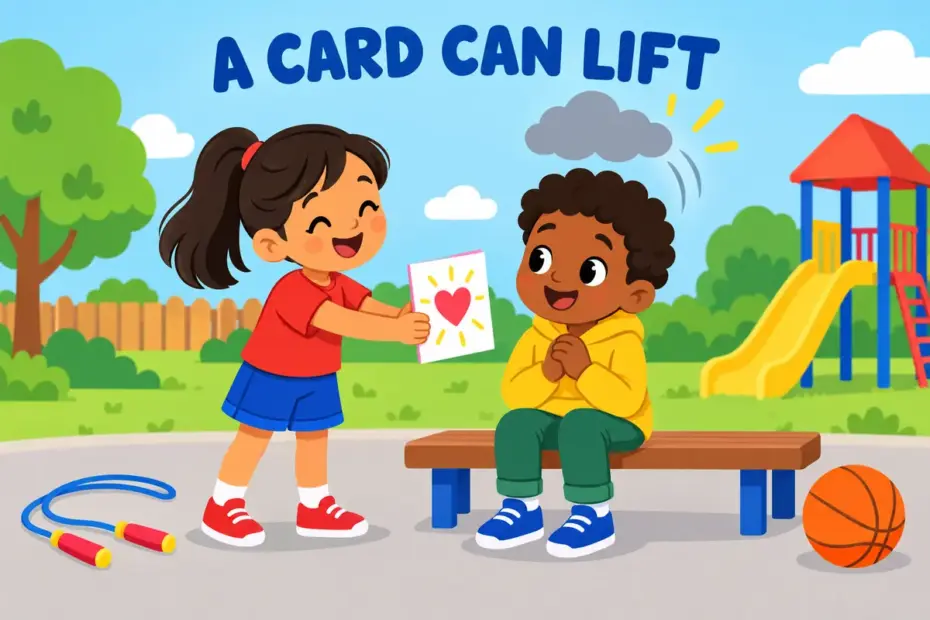
Cheer up is a phrasal verb that means to make someone feel happier, or to become happier yourself. In a sentence it works two ways: you cheer up a friend with kind words, or you tell a downcast person to cheer up. Separable, it puts a pronoun in the middle: cheer her up.
Cheer up at a glance
- Cheer up is a separable phrasal verb; its forms are cheers up, cheered up and cheering up.
- The verb takes a person as its object in the pattern cheer up a friend.
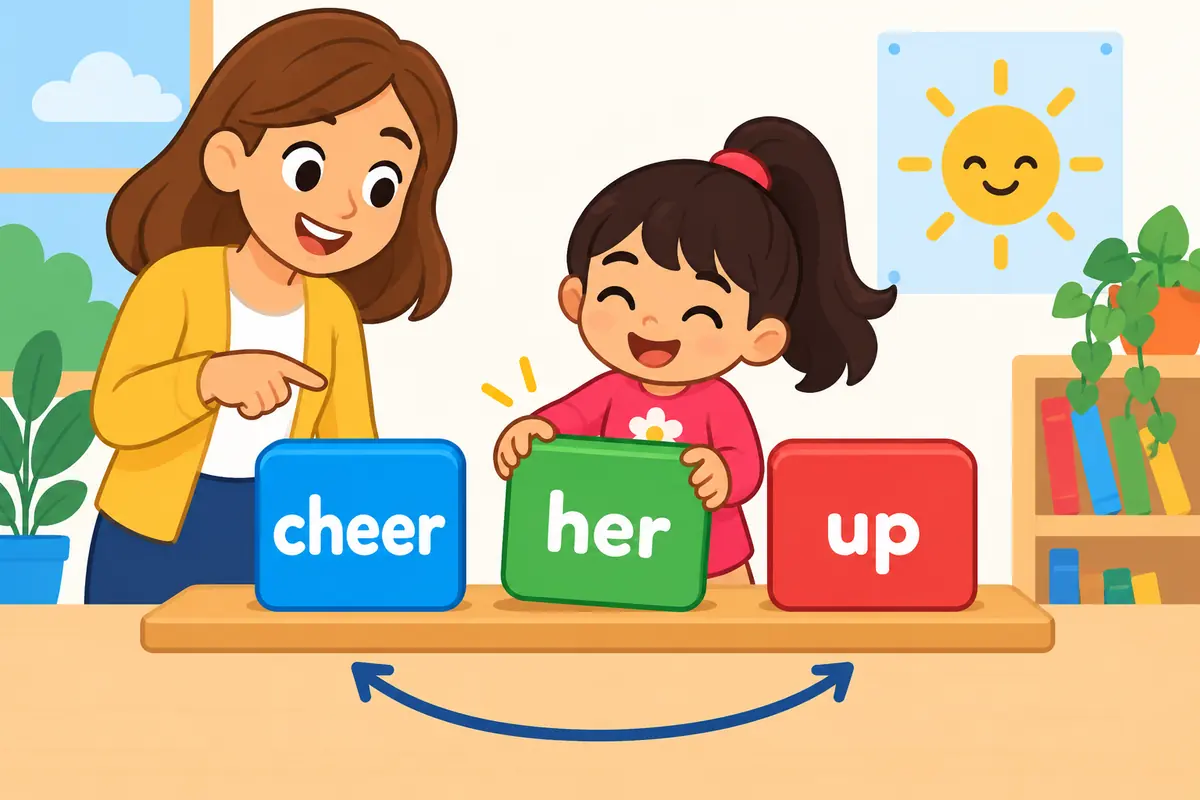
- With a pronoun the object sits between the parts: cheer her up, never cheer up her.
- Cheer up also stands alone as a short instruction: Cheer up, the rain is stopping.
- The commonest error is placing a pronoun after up, as in cheer up her.
What does cheer up mean?
Cheer up is a separable phrasal verb meaning to make somebody feel happier, or to become happier. The Cambridge entry for cheer up records both uses: the transitive pattern with a person, and the short instruction spoken on its own. The two differ in who is addressed, because the first needs an object while the second speaks straight to the listener.
| Sense | Plain meaning | Example sentence |
|---|---|---|
| Make a person happier | Lift someone’s mood | The card cheered up my grandmother. |
| Become happier | Recover your own mood | Cheer up, the exam is over. |
| Liven a place or thing | Add colour or energy to something | A few cushions will cheer up the sofa. |
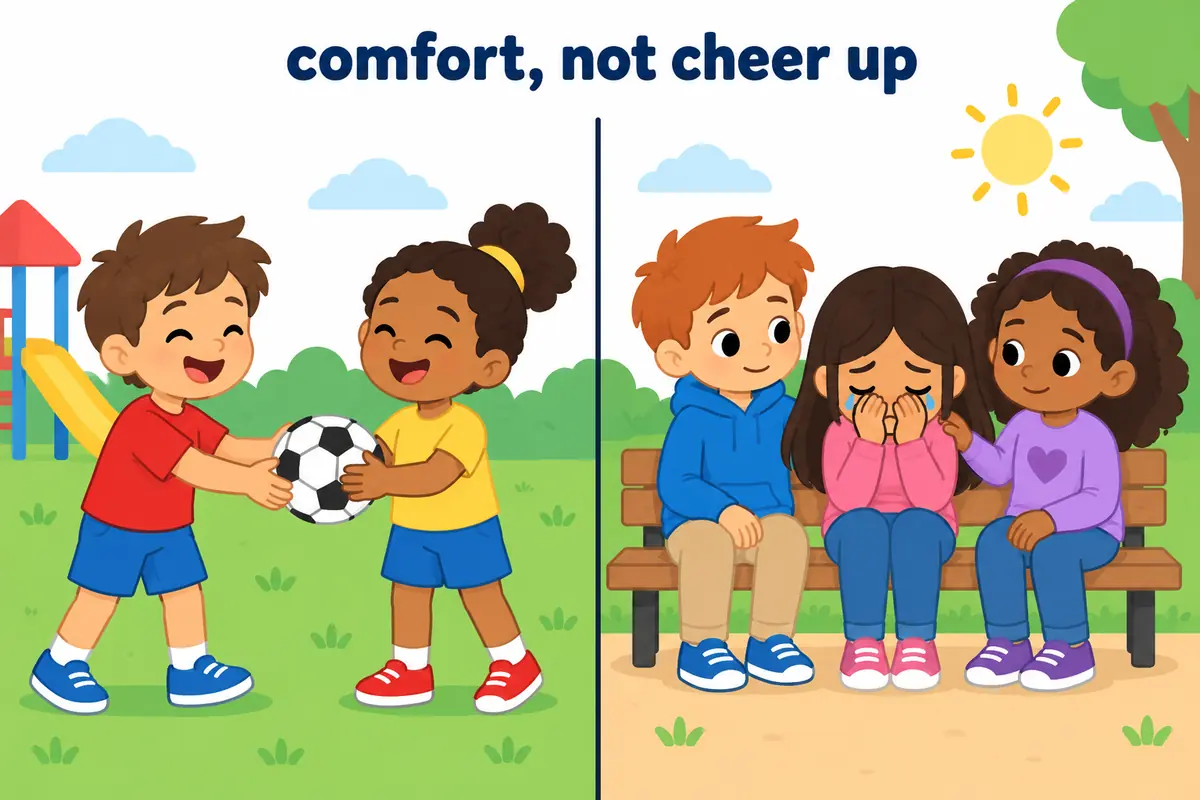
One limitation matters. Cheer up suits everyday conversation and light writing, and it is too casual for a formal condolence. When worry rather than gloom is the problem, reassure a nervous friend may fit better, and when somebody has suffered a real loss, comfort carries a weight that cheer up cannot.
How do you use cheer up in a sentence?
Cheer up is a separable phrasal verb: a noun object may follow the particle or sit between the parts, but a pronoun must sit between them. With no object it is intransitive and reads as an instruction. A coach who encourages a player usually cheers up the whole bench.
| Pattern | Example | What it signals |
|---|---|---|
| cheer + object + up | The nurse cheered the patient up. | Separable with a full noun object; both orders are correct. |
| cheer + up + object | The nurse cheered up the patient. | Also correct because the object is a noun phrase, not a pronoun. |
| cheer + pronoun + up | The nurse cheered her up. | A pronoun can never follow up; it must sit in the middle. |
| cheer up (no object) | Cheer up, we are nearly there. | Intransitive instruction aimed at the listener. |
| cheer up + thing | Plants cheer up a dull corner. | Extends the verb to things that are not people. |
Particle stranding is not possible here, so cheer up her is wrong. The verb also refuses a that-clause: write the good news cheered him up, never the good news cheered up that he had passed.
Cheer up in a sentence: examples across contexts
Cheer up keeps its meaning and shifts its tone as the setting changes. The nine sentences below move from a primary classroom to a home kitchen, and each one names what the cheering does.
| Context | Example sentence | Why this works |
|---|---|---|
| Classroom | The lost hamster turned up, which cheered up the whole class. | A concrete event supplies the lift that the words only describe. |
| Workplace email | A short thank-you note can cheer up a team after a hard week. | Names the mood and the moment rather than a vague sentiment. |
| News report | Volunteers cheered up stranded passengers with hot drinks. | Keeps the helper as the subject, which reporting prefers. |
| Text message | Cheer up, I saved you a slice of cake. | The bare instruction suits a quick, friendly message. |
| Sports commentary | The equaliser cheered up the away supporters at once. | Links a single moment to the mood of a crowd. |
| Customer service | A replacement arrived early, which cheered up the waiting customer. | Reports a result rather than an apology. |
| Academic writing | Regular visits cheered up the residents during the study. | Uses a plain verb inside an otherwise factual sentence. |
| Advertising | New colours cheer up a tired kitchen for very little cost. | Uses the thing-object pattern common in home writing. |
| Conversation | My little brother was glum until the puppy cheered him up. | The pronoun between verb and particle is the spoken pattern. |
Notice how often the lift comes from something small and specific. Cheer up rarely introduces the proof itself; it reports the change that a small event produced.
Cheer up vs comfort
Cheer up overlaps with comfort, console and perk up, and it fits none of their jobs exactly. Comfort and console are for real sadness; perk up suggests renewed energy rather than a lifted mood.
| Attribute | cheer up | comfort |
|---|---|---|
| Core job | Raise ordinary low spirits | Ease real grief or pain |
| Typical moment | A bad day, a lost match | A bereavement, an injury |
| Register | Casual to neutral | Neutral to formal |
| Usual object | A friend, a child, a team | A grieving or hurting person |
| What it implies | Mood can improve quickly | The pain is serious and needs care |
| Misused it sounds | Flippant beside genuine grief | Stiff beside a small disappointment |
Verdict: choose cheer up for a gloomy friend, and comfort or console when the sadness is serious enough that a cheerful word would sound flippant.
Word forms and grammar of cheer up
Cheer up inflects regularly, and its two parts separate in exactly the ways a separable phrasal verb allows. A synonym such as brighten a mood often works when no particular person is named.
| Form | Part of speech | Example |
|---|---|---|
| cheer up | base phrasal verb | Cheer up, we can try again. |
| cheers up | third person singular | A good joke cheers up the whole room. |
| cheered up | past and past participle | The team cheered up after the goal. |
| cheering up | present participle | The song is cheering up the passengers. |
| cheered up | adjective, informal | He left the meeting in a cheered-up mood. |
| cheer-up | attributive, informal | She sent a cheer-up card. |
| cheer up her | non-standard word order | Write cheer her up instead. |
The last row is not a form but a warning: the pronoun slot never shifts to the end.
Common mistakes with cheer up
- Incorrect:
Please cheer up she.Correct: Please cheer her up. Rule: A pronoun object must sit between the verb and the particle. - Incorrect:
The movie cheered up that we were tired.Correct: The movie cheered us up. Rule: Cheer up takes a noun phrase, never a clause beginning with that. - Incorrect:
I want to cheer up with you.Correct: I want to cheer you up. Rule: The person helped is the object, not the object of a with-phrase. - Incorrect:
We hope she will cheer up after the funeral.Correct: We hope she will find comfort after the funeral. Rule: Cheer up is too light for grief; use comfort or console. - Incorrect:
She felt cheer up after the call.Correct: She felt cheered up after the call. Rule: After feel, use the participle cheered up, not the base form.
Practice using cheer up
Work through the six items, then check the reasoning rather than only the answer.
- Fill the gap: The kind message ______ me ______ on a difficult morning.
- Choose the better word: When the neighbour lost her husband, we sat quietly to (comfort / cheer up) her rather than make jokes.
- Correct the error: I tried to cheer up her after the match.
- Build a sentence: use cheer + pronoun + up about a friend who failed a driving test.
- Spot the register: which belongs in a sympathy card — Cheer up, champ! or Thinking of you at this sad time.
- Rewrite with a noun object: The song cheered them up. Put the full noun object after up.
Answers
- cheered … up — the pronoun me must sit between the verb and the particle.
- comfort — a bereavement calls for the heavier verb, not the light instruction to a friend.
- I tried to cheer her up after the match — the pronoun goes in the middle.
- Model answer: We cheered him up after he failed his driving test.
- Thinking of you at this sad time — a card for grief avoids the casual cheer up.
- The song cheered up the whole team — a full noun object may follow the particle.
The bottom line
Use cheer up in a sentence when you want to lift someone’s mood or tell a gloomy friend to brighten. Two details decide most sentences: the verb is separable, so a pronoun belongs in the middle, and it is too light for genuine grief, where comfort or console does the work.
Frequently asked questions about cheer up
Is cheer up one word or two?
Cheer up is always two words. The verb is cheer and the particle is up, and they stay separate in writing even when a pronoun sits between them, as in cheer her up. A one-word noun, cheer-up, exists only in informal compounds such as a cheer-up card.
Can you cheer up yourself?
You can say you cheered yourself up, but the reflexive sounds slightly forced. English usually names the thing that did the lifting: the film cheered me up, or a long walk cheered her up. Keep that activity as the subject where the sentence allows it.
What is a gentler way to tell someone to cheer up?
Lower the volume rather than the meaning. Say I hope things look brighter soon, or I am here if you want to talk. A plain offer of support carries the warmth of cheer up without sounding dismissive when somebody is genuinely sad.
How is cheer up different from cheer on?
Cheer up means to lift someone’s mood. Cheer on means to support a team or competitor by shouting encouragement, as in we cheered on the runners. A supporter cheers someone on during a race; a friend cheers someone up after they lose it.
Do you find yourself in need of a mood boost or seeking to uplift someone else’s spirits? “Cheer up” is a phrase commonly used to encourage positivity or offer comfort during difficult times. It is a simple yet powerful way to convey support and optimism.
When someone tells you to “cheer up,” they are typically expressing a desire for you to feel better, find hope, or see the brighter side of a situation. It can serve as a reminder that challenges are temporary and that there is potential for happiness and improvement ahead.
7 Examples Of Cheer Up Used In a Sentence For Kids
- Smile and cheer up!
- Let’s sing a song to cheer up.
- You can always cheer up your friends.
- Remember to cheer up when you feel sad.
- A big hug can cheer up someone.
- Drawing a picture can help you cheer up.
- Let’s play a game to cheer up!
14 Sentences with Cheer Up Examples
- Cheer up! You can do it, just keep pushing through your exams.
- Don’t worry about that bad grade, cheer up and learn from your mistakes.
- Feeling stressed about assignments? Take a break, go for a walk, and cheer up.
- Cheer up and focus on the positive aspects of college life.
- Joining a club or extracurricular activity is a great way to cheer up and meet new friends.
- Cheer up and remember that it’s okay to ask for help when you need it.
- Did you have a tough day? Cheer up by treating yourself to your favorite food or drink.
- Feeling homesick? Reach out to friends or family for a chat to cheer up.
- Cheer up! Remember, every setback is just a stepping stone to success in college.
- Dealing with a difficult roommate? Take a deep breath and cheer up, communication is key.
- Struggling to balance academics and social life? It’s important to prioritize self-care and cheer up.
- Cheer up and remember, tomorrow is a new day with new opportunities.
- Did your presentation not go as planned? Cheer up and use it as a learning experience for future presentations.
- Cheer up and stay positive, your hard work will pay off in the end.
How To Use Cheer Up in Sentences?
Cheer Up is a versatile phrasal verb that is used to encourage someone or to try to make them feel happier when they are sad or upset.
When using Cheer Up in a sentence, it is important to remember to place it before the person you are trying to encourage. For example, “I tried to cheer up my friend after her bad day at work.”
You can also use Cheer Up by adding the word “it” after in a sentence. For instance, “I attempted to cheer her up by bringing her favorite ice cream.”
Remember that Cheer Up can also be used in an imperative form when addressing someone directly. For example, “Hey, cheer up! Everything will be okay.”
Additionally, Cheer Up can be used to refer to one’s own emotional state. For instance, “I need to cheer up before the party tonight.”
Finally, you can combine Cheer Up with other words or phrases to add more context to the sentence. For example, “I tried to cheer up my sister by sending her flowers.”
Overall, incorporating Cheer Up into your sentences can help spread positivity and encouragement to those around you.
Conclusion
In conclusion, using sentences with “cheer up” can offer comfort, support, and encouragement to those who may be feeling down or discouraged. Whether it’s a friend going through a tough time or a loved one facing challenges, a simple “cheer up” can go a long way in boosting their morale and helping them see things in a more positive light. These sentences can serve as a reminder that tough times are temporary and that better days are ahead, helping to lift spirits and provide hope during difficult moments.
By incorporating sentences with “cheer up” into our daily interactions, we can spread positivity, empathy, and kindness. It is a small but powerful way to show support and empathy towards others, making them feel heard, understood, and cared for. So, let’s continue to use these sentences to spread comfort and positivity, lifting each other up in times of need.


