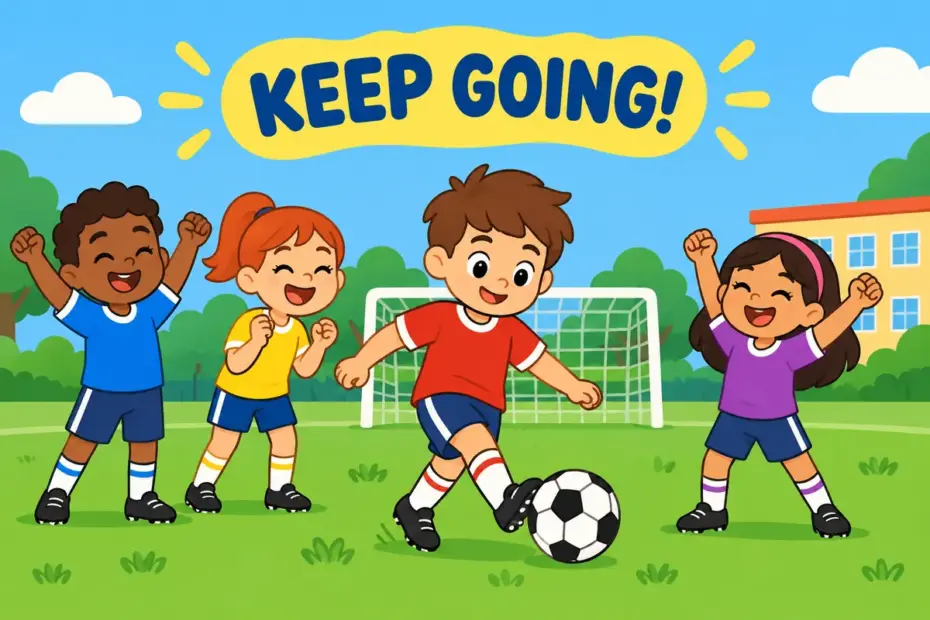
Come on is a phrasal verb with several everyday jobs: it urges someone to try harder, describes work that is progressing, and marks the moment a light or a show starts. In a sentence it stays fixed, so you write come on, never on come, and add to only for the flirtatious phrase come on to someone.
Come on at a glance
- Come on is a phrasal verb, not a single word, and the particle on never separates from come.
- It is intransitive, so it takes no direct object and cannot be made passive.
- Its main jobs are encouraging someone, urging speed, showing progress, and marking a light, machine or broadcast starting.
- The three-part phrase come on to someone means to flirt or make a sexual advance.
- The noun come-on carries a hyphen and means an invitation, a lure or a bargain.
What does come on mean?
Come on is a phrasal verb meaning to make progress, to begin working or appearing, or, as an exclamation, to encourage or hurry someone. The Cambridge entry for come on groups the exclamation and the progress sense, and the split matters: one is a shout and the other is a description. Where a writer means plain physical movement, advance steadily carries the idea without a particle.
| Sense | Plain meaning | Example sentence |
|---|---|---|
| Encouragement | Urge someone to try harder | Come on, you can solve it. |
| Hurry | Tell someone to move faster | Come on, the bus leaves in a minute. |
| Progress | Advance or improve steadily | The repairs are coming on nicely. |
| Start operating | Begin to work or light up | The porch light came on at dusk. |
| Start broadcasting | Begin to be shown or aired | The quiz comes on after the news. |
| Disbelief | Say that something is hard to believe | Come on, nobody runs that fast. |
One limitation is worth stating. Come on is informal in most of its uses, so a report should not say the project came on well when it can say the project progressed. As a call to a person it can also sound impatient, so reach for it only when impatience is the intended tone.
How do you use come on in a sentence?
Come on stays in one piece because it is intransitive: the verb takes no object and the particle cannot move to the front or split away. To encourage someone, use it alone or with a name; to describe progress, add an adverb such as well; to place a broadcast, add at and a time.
| Pattern | Example | What it signals |
|---|---|---|
| come on (standalone) | Come on, keep going. | An imperative cheer; no object follows. |
| be coming on + adverb | The seedlings are coming on well. | Steady progress, common in British English. |
| subject + come on | The heating came on at six. | A machine or light starts working. |
| come on at + time | Her show comes on at eight. | A scheduled broadcast begins. |
| come on to + person | He came on to a colleague. | Flirtation; keep on and to joined to the person. |
Because nothing follows the verb, you cannot passivise it: there is no sentence like the light was come on. If you need an object, choose another verb, such as encourage someone or hurry someone along.
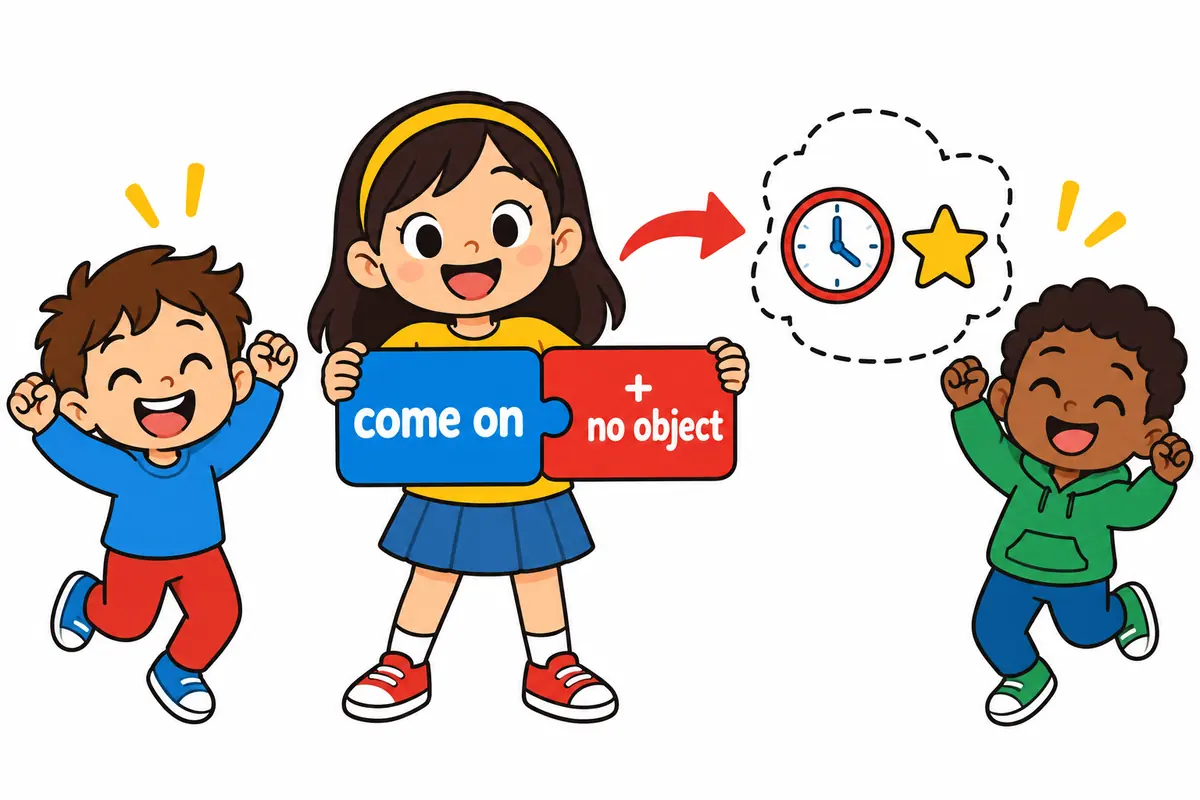
Come on in a sentence: examples across contexts
Come on shifts register without changing shape. The nine sentences below move from a playground to a broadcast schedule, and each one names the situation it belongs to. Verbs such as appear on screen can replace the broadcast sense when a writer wants a neutral verb.
| Context | Example sentence | Why this works |
|---|---|---|
| Playground | Come on, the swing is free now. | A friendly call to a friend, with nothing after the verb. |
| Classroom | Your spelling is coming on well this term. | The progress sense with an adverb, the natural British pattern. |
| Workplace | Come on, we can settle this in one meeting. | Light encouragement, suitable for a team chat. |
| Sports coaching | Come on, keep your eyes on the ball. | The imperative cheer a coach uses, direct and short. |
| Conversation | Come on, that cannot be the whole story. | The disbelief sense, carried by a falling tone. |
| Broadcast listing | The quiz show comes on after the news. | The schedule sense, with at or after and a time. |
| Household | The hallway light comes on at dusk. | A fixture starting, with the thing as subject. |
| Travel | The rain came on just as we reached the gate. | Weather arriving, a common British use. |
| Storytelling | A fresh difficulty came on before the first was solved. | Troubles arriving one after another. |
Come on vs come along
Come on and come along share the verb come, so learners mix them. Come along means to make progress or to accompany someone, while come along also invites company; come on pushes or starts something.
| Attribute | come on | come along |
|---|---|---|
| Main job | Cheer, urge or start something | Join, keep moving or arrive |
| Force | Pushy or excited | Neutral and friendly |
| Takes an object | Never | Never |
| Progress sense subject | Work, repairs, a skill | Work, plans, a guest |
| What it implies | Someone should act now | Someone may come with you |
Verdict: use come on to cheer or to mark a start, and come along to invite company or to describe steady improvement.
Word forms and grammar of come on
Come on inflects with come, and the space disappears only when the noun appears. begin to work is the neutral paraphrase for the machine sense.
| Form | Part of speech | Example |
|---|---|---|
| come on | base phrasal verb | Come on, we are nearly there. |
| comes on | third person singular | The porch light comes on automatically. |
| came on | past tense | The rain came on without warning. |
| coming on | present participle | Her cold is coming on again. |
| come-on | hyphenated noun | The discount was a come-on for new customers. |
| come on to | three-part verb | He came on to a colleague at the party. |
Common mistakes with come on
- Incorrect:
On come, we are late.Correct: Come on, we are late. Rule: The particle on never moves to the front of the verb. - Incorrect:
The rain came on us.Correct: The rain came on. Rule: Come on is intransitive, so no object can follow it; use fall on us instead. - Incorrect:
He came on strongly to me.Correct: He came on strongly. Rule: To mean flirt, use come on to someone and keep on before to. - Incorrect:
The show comes on the TV at eight.Correct: The show comes on at eight. Rule: Come on takes no direct object, only a time phrase. - Incorrect:
That offer is just a come on.Correct: That offer is just a come-on. Rule: Only the noun takes a hyphen; the verb is two words.
Practice using come on
Work through the six items, then check the reasoning rather than only the answer.
- Fill the gap: The kitchen light ______ when the timer reached zero.
- Choose the better word: (Come on / Come along), you have almost finished the puzzle.
- Correct the error: On come, the taxi is waiting.
- Build a sentence: use be coming on about a sick houseplant.
- Spot the register: which suits a sports coach — Come on, push harder! or Would you come on, please.
- Rewrite with the noun: His friendly approach was just an invitation. Use come-on.
Answers
- came on — the light is the subject and no object is needed.
- Come on — it cheers someone on; come along would invite company.
- Come on, the taxi is waiting — the particle cannot move before the verb.
- Model answer: The fern is coming on poorly in that dark corner.
- Come on, push harder! — the cheer fits a coach; the polite request belongs in an email.
- The friendly approach was just a come-on — the noun takes a hyphen.
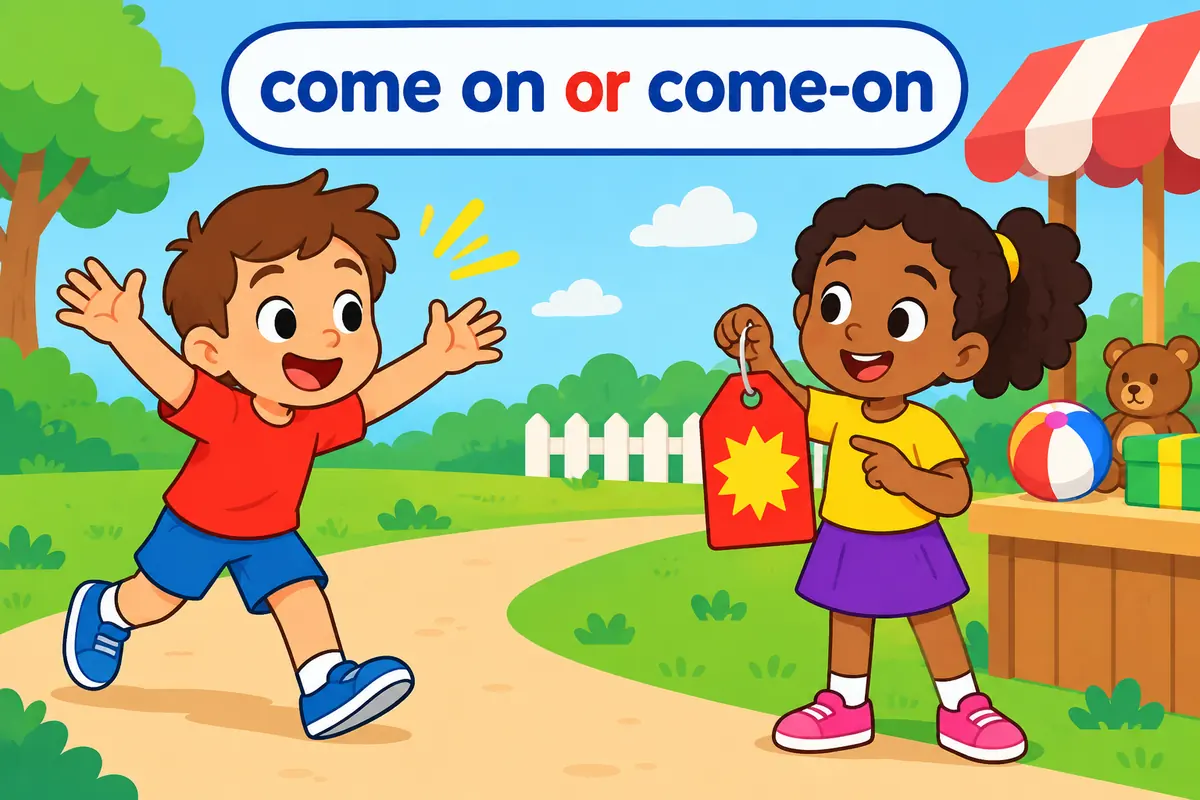
The bottom line
Use come on in a sentence when you want to cheer someone on, push them to act, or mark the start of a light, machine or broadcast. The two facts that decide most sentences are that the phrase is intransitive and inseparable, and that the noun come-on is a different word with a hyphen. Where a neutral verb is needed, progress and begin are the safer choices.
Frequently asked questions about come on
Is come on one word or two?
The verb is always two words, come and on, and they never merge. Only the noun changes: a come-on, with a hyphen, names an invitation or a bargain. Keep that split in mind, because a sentence about flirting or starting uses the verb, while a sentence about a sales lure uses the noun.
Does come on take an object?
No. Come on is intransitive, so nothing can follow it as a direct object and it cannot be turned into a passive. A time phrase such as at eight may follow, but a thing or a person cannot. If you need an object, choose a different verb like encourage or hurry.
What does come on to someone mean?
Come on to someone means to flirt with them or make a sexual advance, and the whole phrase stays joined. This sense is informal and can sound forward, so it belongs in conversation rather than in a report. Do not drop the to, because come on alone means something else entirely.
Why is come-on written with a hyphen?
Come-on is a noun meaning an invitation, a lure or a bargain, and the hyphen marks it as a single word. The verb come on has no hyphen because the two words keep their own jobs. Writing the noun as two words invites readers to read it as the verb, which changes the sentence.
“Come on” is a common colloquial phrase used to convey encouragement, disbelief, or impatience in conversation. This versatile expression can be utilized to urge someone to start a task, to express skepticism, or to prompt a quicker response from others.
In everyday interactions, “come on” serves as a casual way to nudge someone forward, express doubt, or ask for a prompt action. From motivating friends to take a leap of faith to playfully teasing a companion, this simple phrase adds a touch of familiarity and emotion to our everyday conversations.
7 Examples Of Come On Used In a Sentence For Kids
- Come on, let’s practice counting together!
- It’s time for a story, so come on and sit down.
- Come on everyone, let’s sing our ABCs!
- Come on and help me with this puzzle, please.
- Come on and join me for a fun game of hide and seek.
- Come on and let’s learn about colors with our crayons.
- Come on and let’s dance to some music together.
14 Sentences with Come On Examples
- Come on, you can’t skip class again!
- Come on, let’s study together for the upcoming exams.
- Come on, join us for the college festival this weekend.
- Come on, don’t be late for the presentation.
- Come on, you need to submit your assignment before the deadline.
- Come on, it’s time to start working on our group project.
- Come on, we can’t afford to fail this test.
- Come on, attend the career fair to explore job opportunities.
- Come on, you need to participate in the college sports event.
- Come on, let’s find a quiet place to study in the library.
- Come on, we need to prepare for the mock interview session.
- Come on, don’t be afraid to ask questions in class.
- Come on, it’s essential to network with fellow students and professors.
- Come on, time management is crucial for balancing academics and extracurricular activities.
How To Use Come On in Sentences?
Using Come On in a sentence is a common expression that is used to encourage or challenge someone. Here is a helpful guide on how to use this phrase effectively:
-
Encouragement: You can use “Come on” to motivate someone to keep going or to cheer them on. For example, “Come on, you can do it! Keep pushing yourself.”
-
Expressing disbelief: “Come on” can also be used to express disbelief or to challenge someone’s statement. For instance, “Come on, that can’t be true! Are you serious?”
-
Urging someone to hurry: If you want someone to move faster, you can say “Come on, we’re going to be late!” This shows impatience or a sense of urgency.
-
Expressing frustration: “Come on” can be used to express frustration or annoyance with someone or a situation. For example, “Come on, this is taking too long! Let’s speed things up.”
-
Support or solidarity: Using “Come on” can also show support or solidarity with someone. For instance, “Come on, we are in this together. We can get through this.”
Remember that the tone and context in which you use “Come on” can affect how it is interpreted. It’s important to consider the situation and the relationship you have with the person you are speaking to.
Conclusion
In summary, the keyword “sentences with come on” showcases a variety of contexts where this phrase is commonly used. From expressing encouragement like “Come on, you can do it!” to urging someone to hurry up with “Come on, we’re running late!”, this versatile expression is versatile in everyday communication. It can also convey disbelief or disappointment such as “Oh, come on, that’s not fair!” Overall, “come on” is a simple yet powerful phrase that conveys a range of emotions and intentions, making it a common part of our daily conversations.
By examining these examples, it becomes clear that “come on” serves as a multi-functional tool in language, adept at conveying urgency, encouragement, disbelief, and disappointment. Its simplicity makes it a widely understood and easily incorporated element of communication, allowing individuals to express a variety of emotions and intentions effectively in everyday interactions.


