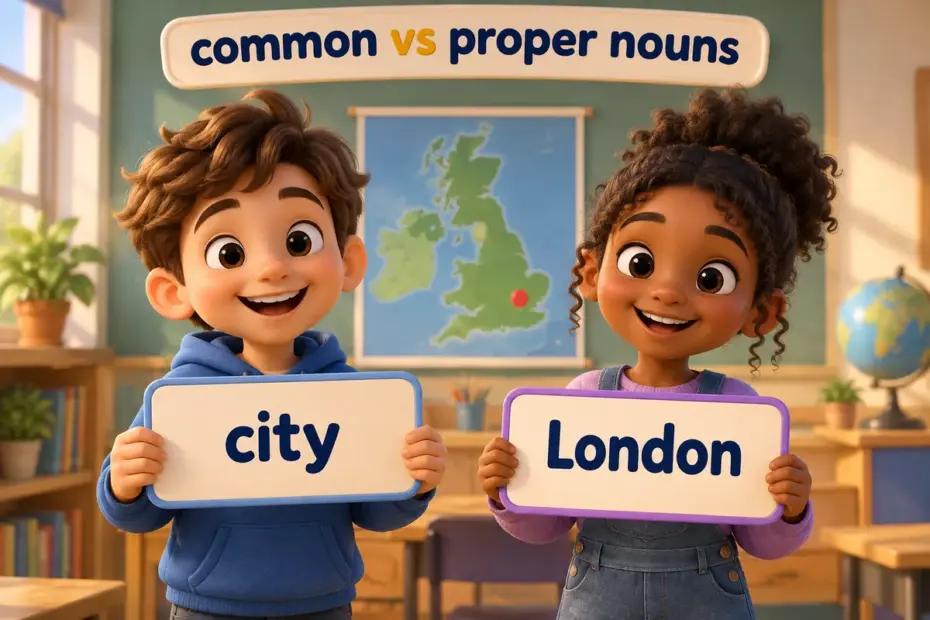
Common nouns vs proper nouns differ in how specific a name is: a common noun labels any member of a group, while a proper noun names one particular thing. The capital letter marks the proper one. “The river runs through town” is common; “the Thames runs through London” is proper.
Common Nouns vs Proper Nouns at a glance
- A common noun names a class of things; a proper noun names one unique thing.
- Proper nouns begin with a capital letter; common nouns stay in lowercase.
- Common nouns take articles easily, as in a boy or the river.
- Proper nouns usually stand without an article, as in Sam or Paris.
- The commonest error is leaving a proper noun in lowercase or capitalizing a common noun.
What do common nouns and proper nouns mean?
A common noun is a noun that names any member of a class, such as boy, river, or city. A proper noun is a noun that names one specific person, place, or thing, such as Sam, the Nile, or Paris. The Cambridge entry for common and the Cambridge entry for proper mark the split, and one line shows it: I visited a museum uses a common noun, while I visited the Louvre names the place.
| Sense | Type | Plain meaning | Example |
|---|---|---|---|
| Any member of a class | common noun | A general person or thing | The city is busy today. |
| One named place | proper noun | A single specific place | London is busy today. |
| A category word | common noun | A lowercase type word | I go to school by bus. |
| A named institution | proper noun | A capitalized title | I study at Oxford University. |
| A general day or month | common noun | Any day of the week | We meet on a Monday. |
What is the difference between common nouns and proper nouns?
The difference is specificity and capitalization together. A common noun labels a whole class, while a proper noun pins down one member of that class and takes a capital, so a pair such as addition vs edition shows the same idea that a small change in form signals a different word.
| Test | Common noun | Proper noun |
|---|---|---|
| Capitalization | lowercase | capitalized |
| Specificity | a class of things | one unique thing |
| Article | takes a, an, or the | usually no article |
| Plural form | pluralizes freely | rarely pluralized |
| Example | river, city, teacher | the Nile, Paris, Ms Lee |
| Quick test | can I add the or a? | does it name one? |
Choose a common noun when you mean any member of a group, and a proper noun when you name one particular member and capitalize it.
How do you use common nouns and proper nouns in a sentence?
Both follow fixed patterns, and the article test is the fastest clue; another letter-level contrast sits in abel vs able, where spelling carries the meaning.
| Pattern | Example | What it signals |
|---|---|---|
| a or an + common noun | She bought a car. | any one of a class |
| the + common noun | The teacher waited. | a specific but unnamed one |
| proper noun alone | Amir called. | one named person |
| the + proper noun (rivers, some places) | The Amazon is long. | a fixed named form |
| proper noun + common noun | We drove along Oxford Street. | a fixed named title |
| plural common noun | The cities grew fast. | a whole class pluralized |

Common nouns and proper nouns in a sentence: examples across contexts
Reading both kinds in different registers makes the choice automatic, and a further easy pair sits in absence vs absents, where one letter changes the word.
| Context | Example sentence | Why this works |
|---|---|---|
| Classroom | The boy opened his book in class. | boy, book, and class are common nouns |
| Workplace email | Please email Frida about the order. | Frida is a proper noun |
| News report | The storm reached the coast near Tampa. | coast is common, Tampa is proper |
| Travel writing | We crossed the river into Paris. | river is common, Paris is proper |
| Everyday speech | My sister lives in a small town. | sister and town are common nouns |
| Academic writing | The study was carried out at Harvard University. | the institution name is proper |
| Science report | The planet Mars has two small moons. | Mars is proper, moons is common |
| Sports writing | The team faces Chelsea on Saturday. | Chelsea is proper, team is common |
| Recipes | Add butter from the shop on Mill Road. | butter is common, the road is proper |
| Narration | Daniel and the dog walked to the park. | Daniel is proper, dog and park are common |
Which should you use?
Match the noun to your meaning: name a class with a common noun and name one particular thing with a proper noun.
| Situation | Use | Example |
|---|---|---|
| Referring to any one of a group | common noun | Pass me a pencil. |
| Referring to one named person | proper noun | Pass it to Maya. |
| Naming a generic place | common noun | We went to the beach. |
| Naming a particular place | proper noun | We went to Brighton. |
Register does not change the rule: a text message and a legal document both capitalize proper nouns and keep common nouns lowercase.
Word forms and grammar of common nouns and proper nouns
| Category | Common noun | Proper noun |
|---|---|---|
| People | teacher, doctor, child | Ms Lee, Dr Ray, Amara |
| Places | city, river, mountain | Paris, the Nile, Everest |
| Organizations | school, bank, club | Oxford University, the Red Cross |
| Time words | day, month, season | Monday, June, Ramadan |
| Plural use | three cities | the two Koreas |
| Article use | a school, the school | school without an article for institutions |
Common mistakes with common nouns and proper nouns
Mistake 1: capitalizing a common noun. Incorrect: I bought Bread at the market. Correct: I bought bread at the market. Rule: ordinary class words stay lowercase unless they begin a sentence.
Mistake 2: leaving a proper noun lowercase. Incorrect: We visited paris in spring. Correct: We visited Paris in spring. Rule: a named place takes a capital letter.
Mistake 3: an article before a bare name. Incorrect: I called the Amara. Correct: I called Amara. Rule: most personal proper nouns take no article.
Mistake 4: pluralizing a proper noun. Incorrect: We met three Marias in the same class, meaning different people named Maria. Correct: We met three girls named Maria. Rule: proper nouns name one thing, so adding a plural changes it.
Mistake 5: a lowercase brand or title. Incorrect: She works at oxford university. Correct: She works at Oxford University. Rule: named institutions and brands are proper nouns.
Practice using common nouns and proper nouns
- Label the noun: in The dog barked at Sam, which word is a proper noun?
- Choose the correct capital: we flew to (paris / Paris) on Friday.
- Correct the error: the River nile is the longest in africa.
- Build a sentence: use one common noun and one proper noun about a trip.
- Spot the type: is university in I study at Harvard University common or proper?
- Fill in the blank: My cousin lives in a small ___ called Riverton.
Answers
- Sam, because it names one particular person.
- Paris, because named places take a capital.
- The River Nile is the longest in Africa; both named items take capitals.
- We drove the car to Brighton.
- proper, because the full title Harvard University names one institution.
- town, because it names a general class of place.

The bottom line
The common nouns vs proper nouns choice turns on specificity and capitalization together: a common noun names any member of a class and stays lowercase, while a proper noun names one particular thing and takes a capital. Use the article test to check, since common nouns accept a or the easily. Names of people, places, and institutions are the ones to capitalize.
Frequently asked questions about common nouns and proper nouns
What makes a noun a proper noun?
A noun is proper when it names one specific person, place, organization, or thing rather than a class of them. It takes a capital letter, as in Amara or Everest, and usually stands without an article. If the word names any member of a group instead, it is a common noun.
Do proper nouns always need capital letters?
Yes, in standard English a proper noun begins with a capital letter wherever it appears. Names of people, places, countries, languages, days, months, and named organizations are all proper. Only brands with unusual styling ignore this, and those follow the company’s own choice rather than the rule.
Why do some proper nouns take the?
Certain proper nouns keep the as part of their fixed name, such as rivers, seas, and plural countries. We say the Nile, the Pacific, and the Netherlands, but Paris and Japan take no article. The article belongs to the name itself, so it must be memorized rather than reasoned out.
Can a common noun become a proper noun?
Yes, and it happens often. When a class word becomes a specific name it gains a capital, as when a general bridge becomes Tower Bridge or a common father becomes a family name, Dad. The reverse also occurs, when a brand such as a hoover turns into a general verb for any vacuuming.