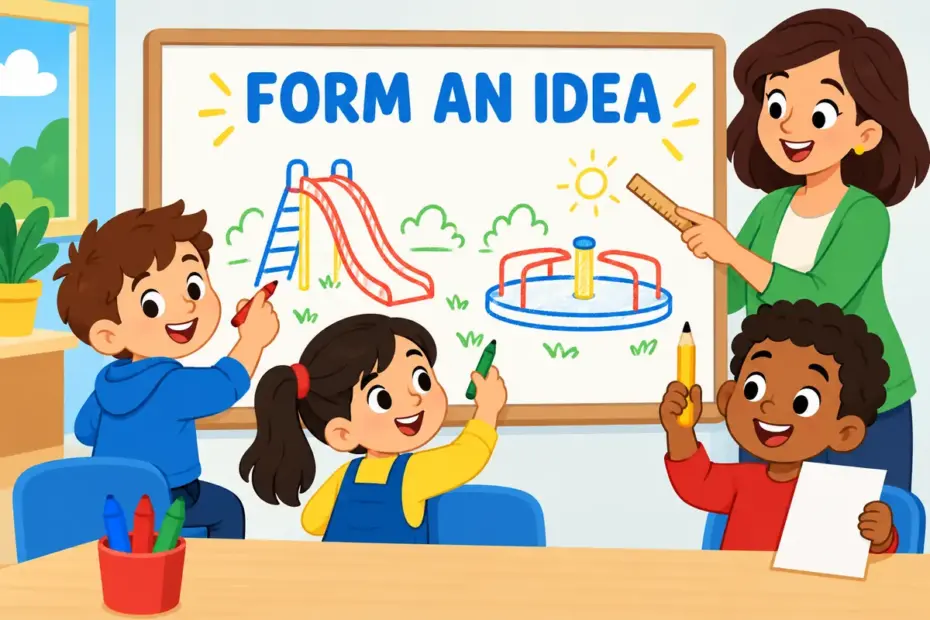
Conceive means to form an idea or plan in the mind, and it can also mean to become pregnant. To use conceive in a sentence, follow the pattern conceive of something when the meaning is imagine: “She could not conceive of leaving,” but drop of before a plan or a child. The preposition decides the sense.
Conceive at a glance
- Conceive is a transitive verb; its forms are conceives, conceived and conceiving.
- The main senses are forming an idea and becoming pregnant.
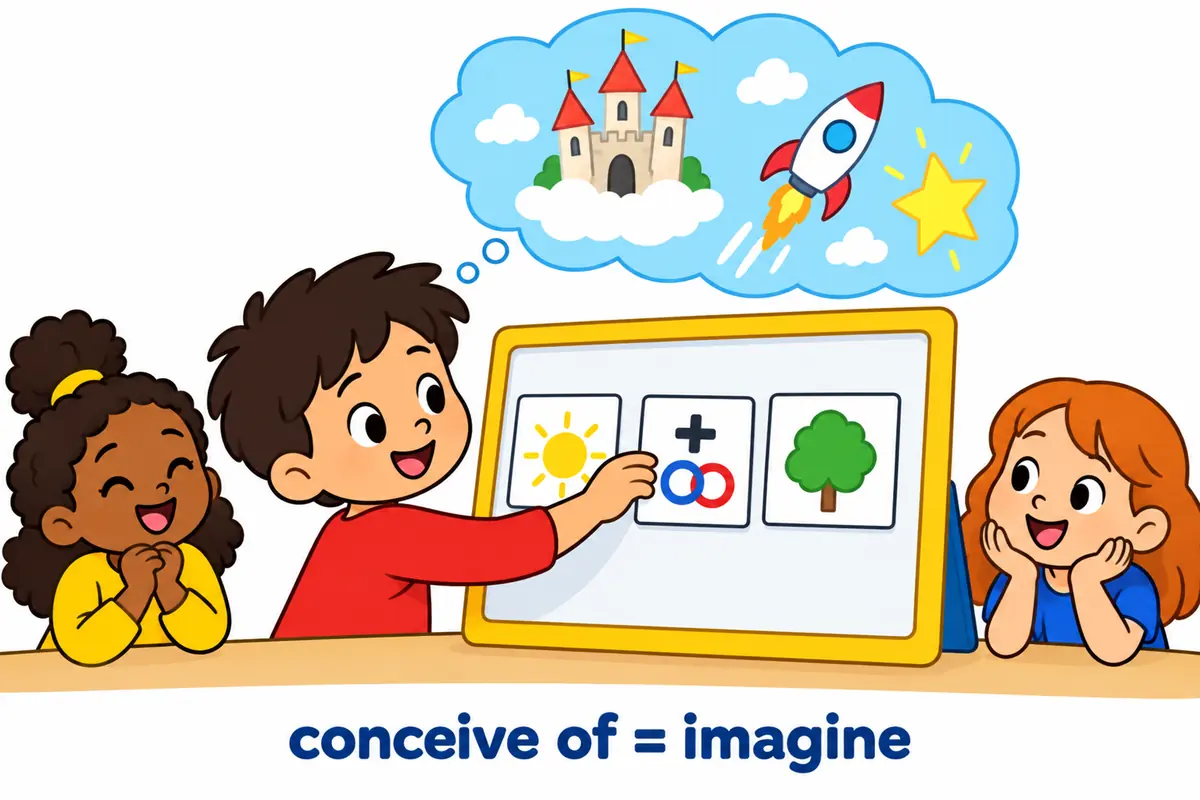
- The phrase conceive of means to imagine or consider something as possible.
- Common objects are a plan, an idea, a scheme, a design and a child.
- The commonest learner error is adding of to the pregnancy sense or dropping it from the imagine sense.
What does conceive mean?
Conceive is a verb meaning to form an idea, plan or design in the mind, or to become pregnant. These two senses are joined by the idea of bringing something new into being. The Cambridge entry for conceive records both, and a third pattern, conceive of, adds the meaning to imagine or consider.
| Sense | Plain meaning | Example sentence |
|---|---|---|
| Become pregnant | To become pregnant with a child | The couple hoped to conceive before spring. |
| Form in the mind | To think of an idea, plan or design | She conceived the scheme on a long walk. |
| conceive of | To imagine or consider something as possible | I cannot conceive of a world without music. |
One honest limitation: conceive is not a general word for believing or understanding. With a plan it carries the extra idea that you originated it; with of it means only that you can picture something. When the point is simply grasping a fact, comprehend is the plainer choice.
How do you use conceive in a sentence?
Conceive needs an object, and whether that object is a plan, a child or an imagined world is what fixes the sense. Five patterns cover almost every real sentence.
| Pattern | Example | What it signals |
|---|---|---|
| conceive + idea / plan / child | The team conceived a bold redesign. | A new thing is originated, so the verb is transitive. |
| conceive of + noun | It is hard to conceive of a fairer rule. | Imagine or consider, and of is required. |
| conceive of + gerund | She could not conceive of moving abroad. | of takes a verb in -ing, never a to-infinitive. |
| be conceived | The project was conceived in 2019. | Dates an origin while hiding the thinker. |
| conceive + how / why clause | Nobody could conceive how the trick worked. | Reports an act of imagining or working out. |
The rule that decides most sentences is this: conceive a thing means you invented it, while imagine a thing only means you can picture it. Adding of moves conceive onto the imagining side.
Conceive in a sentence: examples across contexts
Conceive shifts register with its object, from a hospital ward to a design studio. The ten sentences below keep one verb and change what it produces.
| Context | Example sentence | Why this works |
|---|---|---|
| Family news | The couple conceived their first child after two years. | Uses the pregnancy sense with a clear object. |
| Design studio | The architects conceived a library that floats on stilts. | Shows origination of a fresh design. |
| Business email | The scheme was conceived in a single afternoon. | Passive dates the origin of an idea. |
| Academic writing | The study was conceived as a test of two theories. | Frames a project as deliberately designed. |
| Classroom | Can you conceive of a number smaller than zero? | The of pattern invites imagining. |
| Philosophy | We cannot conceive of time without change. | Names the limit of imagination. |
| Engineering | The bridge was conceived before the motorway existed. | Points to a plan made in advance. |
| Conversation | I never conceived how hard the course would be. | The how clause reports a surprise. |
| History essay | The reform was conceived to prevent a repeat. | Gives the purpose behind the design. |
| Sports report | The coach conceived a plan to tire the champions. | Pairs the verb with a tactic. |
Conceive vs concede
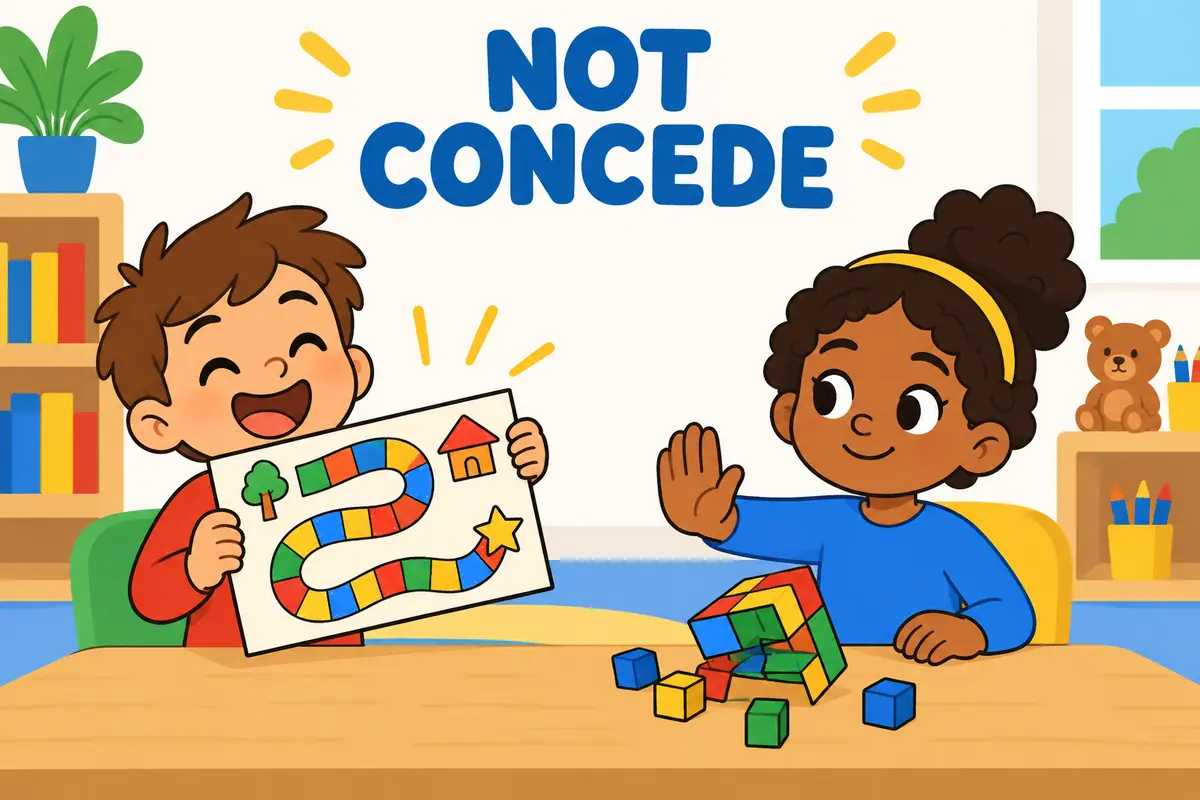
Conceive and concede a point are different in two letters and opposite in meaning, which is why spell-check tools miss the swap.
| Attribute | conceive | concede |
|---|---|---|
| Core meaning | Form an idea, or become pregnant | Admit something, or give something up |
| Direction | Create or imagine something new | Yield ground to an opponent |
| Typical object | A plan, a child, a possibility | A point, defeat, a goal |
| Register | Neutral to formal | Formal |
| Nearby word | concept, conception | concession |
Verdict: use conceive when something is created or imagined and concede when somebody admits or gives up.
Word forms and grammar of conceive
Conceive inflects regularly, and its family splits in two: one branch names creating an idea, the other names an imagined picture.
| Form | Part of speech | Example |
|---|---|---|
| conceive | verb, base form | They conceive new games every summer. |
| conceived | verb, past and past participle | The founder conceived the idea on a train. |
| conceiving | verb, present participle | She is conceiving a plan for the winter fair. |
| conceivable | adjective | Every conceivable route was blocked by snow. |
| conception | noun | The conception of the scheme took one evening. |
| conceit | noun, different meaning | A conceit is an elaborate comparison, not an idea you create. |
Keep the participle separate from the adjective. A result that can be imagined is conceivable, not conceiving, and the word for a lasting notion is conception, not conceivement.
Common mistakes with conceive
- Incorrect:
I cannot conceive to live there.Correct: I cannot conceive of living there. Rule: conceive of takes a noun or a gerund, never a to-infinitive. - Incorrect:
They conceived of a baby.Correct: They conceived a baby. Rule: the pregnancy sense is transitive and takes no of. - Incorrect:
We conceived a world without cars.Correct: We conceived of a world without cars. Rule: imagining a hypothetical needs the of pattern. - Incorrect:
This is a conceiving argument.Correct: This is a conceivable argument. Rule: use the adjective conceivable, not the present participle. - Incorrect:
The idea was conceived by her mind.Correct: She conceived the idea. Rule: the passive already hides the thinker, so naming the mind is redundant.
Practice using conceive
Work through the six items, then check the rule beside each answer.
- Fill the gap: The committee ______ a plan to widen the footpath.
- Choose the better word: After the argument, she refused to (conceive / concede) the point.
- Correct the error: It is hard to conceive to travel so far in one day.
- Build a sentence: use conceive of about an idea that sounds impossible.
- Spot the register: which belongs in a medical note, the patient hoped to conceive, or I can’t conceive of that?
- Rewrite in the passive: The founders conceived the festival in 1998.
Answers
- conceived: a plan is originated, so the verb takes the object directly.
- concede: the refusal is about admitting a point, not inventing one.
- It is hard to conceive of travelling so far in one day: conceive of takes a gerund.
- Model answer: I cannot conceive of a school with no library.
- The patient hoped to conceive: a medical note uses the pregnancy sense with no of.
- The festival was conceived by the founders in 1998: the passive dates the origin.
The bottom line
Use conceive in a sentence when something new is created or imagined, and let the object tell the reader which sense you mean. A plan or a child follows the verb directly, while a hypothetical follows conceive of. Keep the two apart, and choose envisage when you want a formal word for picturing a future.
Frequently asked questions about conceive
Is it conceive or conceive of?
Both are correct, but they mean different things. Conceive a plan or a child is transitive and means to originate or become pregnant. Conceive of something means to imagine or consider it as possible, as in I cannot conceive of such a rule. Choose according to whether you create or picture.
Can conceive mean to become pregnant?
Yes. One of the two main senses of conceive is to become pregnant, as in they hoped to conceive that year. This sense is transitive and never takes of, so the phrase conceive of a baby is a common slip. Context, usually the object, makes the meaning clear.
What is the noun form of conceive?
The noun is conception, as in the conception of the design took months. The adjective is conceivable, meaning able to be imagined, and arguably is a near synonym. Conceit is a different word for an elaborate comparison, so keep it out of this family.
Is conceive the same as perceive?
No. Conceive is about forming or imagining an idea, while perceive is about noticing or becoming aware of something through the senses. You conceive a plan, but you perceive a change in tone. The two share a Latin root but describe different mental events.
What does it mean to conceive a plan or idea? To conceive is to form a mental concept or idea in one’s mind. It involves imagining, creating, or understanding something that may not yet exist in reality. Conceiving often serves as the first step toward bringing an idea to fruition.
When you conceive something, you are using your imagination and intellect to develop a new thought, plan, or vision. It is the foundation upon which innovation, creation, and progress are built. The ability to conceive is a powerful tool that allows individuals to explore possibilities, solve problems, and propel positive change.
7 Examples Of Conceive Used In a Sentence For Kids
- Let’s conceive a story together!
- Can you conceive of a new game to play?
- I conceive of a picture in my mind.
- We can conceive of a beautiful drawing.
- How would you conceive a new song?
- Let’s conceive a plan for our project.
- I can conceive of a fun activity for us to do.
14 Sentences with Conceive Examples
- Conceive creative solutions to complex problems in group projects.
- Encourage your classmates to conceive new ideas for the upcoming event.
- It is important to conceive a solid study plan for your exams.
- Conceive innovative ways to present your research findings.
- Don’t be afraid to conceive unconventional strategies for your startup project.
- Use brainstorming sessions to conceive fresh perspectives on challenging topics.
- Collaborate with your peers to conceive a winning strategy for the competition.
- Conceive diverse viewpoints when analyzing a case study.
- Attend workshops and seminars to conceive potential career paths.
- Encourage your team members to conceive unique designs for the college fest.
- Use mind-mapping techniques to conceive a clear outline for your thesis.
- Challenge yourself to conceive innovative solutions for social issues.
- Conceive different study techniques to maximize learning efficiency.
- Apply critical thinking skills to conceive logical arguments in your essays.
How To Use Conceive in Sentences?
To use Conceive in a sentence, start by identifying a situation where the word fits within the context. For example, “She had been trying to conceive for over a year before finally becoming pregnant.” In this sentence, “conceive” is used to indicate the act of becoming pregnant.
Remember that Conceive primarily refers to the act of becoming pregnant or to form or devise a plan in a creative way. It is important to use the word correctly in a sentence to convey your intended meaning. For instance, “The artist was able to conceive a unique masterpiece that captivated the audience.” In this sentence, “conceive” is used to show the artist’s creative ability.
When incorporating Conceive into a sentence, consider the tense and subject-verb agreement. For example, “They were able to conceive a brilliant marketing strategy that boosted their sales.” In this sentence, “conceive” is used correctly with the subject “They” in past tense.
As you practice using Conceive in sentences, pay attention to how it functions within the sentence structure and enhances the overall meaning. Experiment with different scenarios and contexts to gain a better understanding of when and how to use this word effectively.
Conclusion
In conclusion, the various sentences provided with the keyword “conceive” demonstrate the flexibility and richness of the English language in expressing thoughts, ideas, and concepts. From imagining new possibilities to understanding the creation of new life, the word “conceive” is versatile and can be used in a wide range of contexts. Whether it’s in the realms of creativity, pregnancy, or simply grasping a concept, “conceive” plays a crucial role in communication by conveying the act of forming or comprehending something new.
By exploring the diverse examples of sentences with the keyword “conceive,” one can appreciate how language can capture the complexities of human experiences. It serves as a reminder of the power of words to evoke emotions, spark imagination, and facilitate understanding. Ultimately, the usage of the word “conceive” highlights the depth and breadth of language in enabling us to articulate our thoughts and communicate effectively.