Confused words with meanings are pairs that sound alike but carry different senses, such as affect and effect or advice and advise. The confusion comes from one small difference, a vowel or an ending, and the meaning decides which word is right. One example is “The weather had a big effect on the game.”
Confused words with meanings at a glance
- Confused words sound alike, look alike or differ by one letter.
- Most pairs split between a noun and a verb, or between a word and a contraction.
- A contraction can always be expanded, as it’s becomes it is.
- A -se ending often marks a verb, as in advise and devise.
- The commonest error is writing the noun where the verb belongs.
What are the most confused words with meanings?
Each pair below is given with a short meaning for every member and one line that uses it, so a reader can see the difference at work. Reading the two meanings side by side is the fastest way to fix the pair. A set of lines that shows the words in context sits at the confused sentence page.
| Pair | Meaning | Example |
|---|---|---|
| affect / effect | affect = to influence; effect = a result | The rain affected the match; the effect was small. |
| accept / except | accept = receive or agree; except = apart from | I accept the gift; everyone except Sam came. |
| advice / advise | advice = guidance; advise = to recommend | Take my advice; I advise you to wait. |
| then / than | then = next or at that time; than = comparison | Eat, then rest; taller than me. |
| lose / loose | lose = to misplace; loose = not tight | Do not lose the key; the screw is loose. |
| principal / principle | principal = head or main; principle = a rule | The principal spoke; a moral principle. |
| stationary / stationery | stationary = not moving; stationery = writing materials | The car stayed stationary; buy stationery. |
| complement / compliment | complement = to complete; compliment = praise | The sauce complements the fish; she paid a compliment. |
| desert / dessert | desert = a dry region or to abandon; dessert = sweet course | Cross the desert; save room for dessert. |
| quiet / quite | quiet = little noise; quite = fairly | The room is quiet; it is quite warm. |
| weather / whether | weather = sky conditions; whether = if | The weather is cold; ask whether it is open. |
| cite / site / sight | cite = quote; site = a place; sight = the view | Cite a source; visit the site; a lovely sight. |
| their / there / they’re | their = belonging; there = a place; they’re = they are | Their car; over there; they’re here. |
| its / it’s | its = belonging; it’s = it is | The cat licks its paw; it’s cold. |
| your / you’re | your = belonging; you’re = you are | Your coat; you’re kind. |
| whose / who’s | whose = belonging to whom; who’s = who is | Whose bag is this; who’s calling. |
Some pairs differ by only one letter, so a spelling check catches them, while others differ by word class, so a grammar check catches those. Sorting the pair by its type tells a writer which check to run first, and the meaning follows.
How do you choose the right word?
A reader does not need to memorise every pair if the tests below become habits. Each test checks one feature, such as the word class or the length, and settles the choice in a moment. A set of short lines at the confusable sentence page practises the same habit.
| Test | How it works | Example |
|---|---|---|
| name the word class | a noun names a thing or result | effect is the noun. |
| expand the contraction | replace it with the two words it shortens | it’s becomes it is. |
| check the ending | a -se ending often marks a verb | advise is the verb. |
| read the sentence aloud | the wrong word often sounds slightly off | accept the offer. |
| swap in a plain synonym | if the synonym does not fit, the word is wrong | a result for effect. |
The expansion test works for every contraction, because the apostrophe always stands for missing letters. Saying the two full words aloud confirms the choice, and it also catches the reverse error, where a possessive is written with an apostrophe it does not need.
Why do these words get confused?
The reasons fall into a few clear types, and naming the type points to the fix. A homophone needs a meaning check, while a near-miss look-alike needs a spelling check. A set of lines about the act of mixing words up sits at the confuse sentence page.
| Type | What it is | Example |
|---|---|---|
| homophone | sounds the same, different spelling | their / there / they’re |
| look-alike near-miss | one letter different | affect / effect |
| sound-alike ending | a different final letter changes the class | advice / advise |
| contraction clash | one word is short for two | its / it’s |
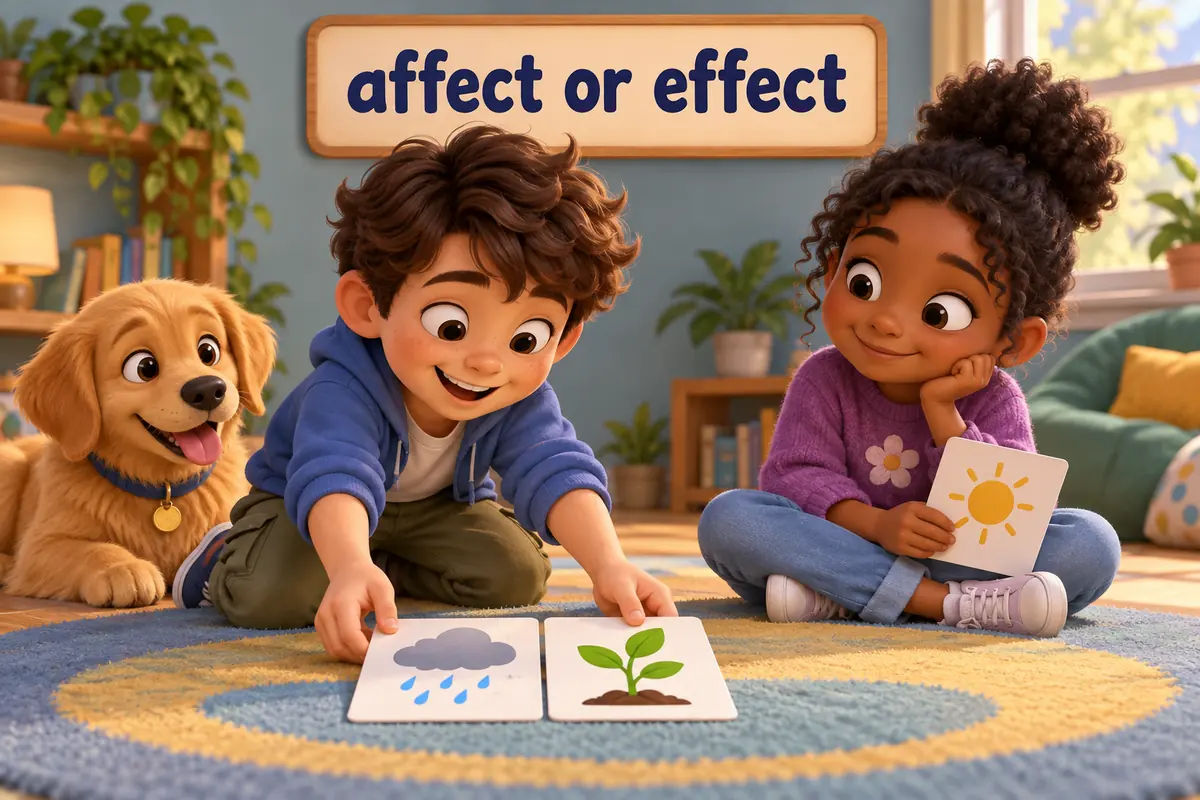
Confused words with meanings across contexts
The pairs appear in every kind of writing, and each setting tests a different one. The table shows nine of them.
| Context | Example sentence | Why this works |
|---|---|---|
| Weather report | The rain affected the harvest. | Affect is the verb of influence. |
| School essay | Take my advice and plan first. | Advice is the noun. |
| Text message | You’re early today. | The contraction means you are. |
| Notice board | Over there is the lost property. | There names a place. |
| Recipe | Save room for dessert. | Dessert is the sweet course. |
| Science report | The side effect was mild. | Effect is the noun for a result. |
| Library | Buy new stationery for the desk. | Stationery means writing materials. |
| Office email | I advise you to wait a day. | Advise is the verb. |
| Travel guide | The car stayed stationary in the heat. | Stationary means not moving. |
| Notice | Please collect your stationery from the desk. | Stationery means writing materials. |
| Sports | They’re playing in the final. | The contraction means they are. |
Noun and verb forms in confused pairs
Many pairs differ only because one member is a noun and the other a verb. The same ending often decides the class, so learning the two forms together keeps the pair apart.
| Form | Part of speech | Example |
|---|---|---|
| advice | noun | Give me some advice. |
| advise | verb | I advise you to wait. |
| effect | noun | The effect was clear. |
| affect | verb | The rain affected the game. |
| device | noun | This device is very small. |
| devise | verb | They devised a clever plan. |
| breath | noun | Take a deep breath. |
| breathe | verb | Breathe slowly and calmly. |
| complement | verb | The salad complements the meal. |
| compliment | noun | She paid a warm compliment. |
Common mistakes with confused words
Most errors come from using the noun where the verb belongs, from missing the apostrophe in a contraction, and from the sound-alike endings.
- Incorrect:
The weather had a big affect on us.Correct: The weather had a big effect on us. Rule: effect is the noun, affect is the verb. - Incorrect:
Please give me some advise.Correct: Please give me some advice. Rule: advice is the noun, advise is the verb. - Incorrect:
Your welcome to stay.Correct: You’re welcome to stay. Rule: you’re means you are. - Incorrect:
Their going home now.Correct: They’re going home now. Rule: they’re means they are. - Incorrect:
The shops are quiet cheap.Correct: The shops are quite cheap. Rule: quite means fairly, while quiet means little noise. - Incorrect:
I want to go to, too.Correct: I want to go too. Rule: too means also, while to is a preposition.
Practice with confused words
Try each item, then read the reason beside the answer.
- Fill in the blank: The storm had a big ________ on the town. (affect / effect)
- Fill in the blank: Please give me some ________ about the course. (advice / advise)
- Choose the better word: ________ going to the park later. (Their / They’re)
- Correct the error: Your welcome to join us.
- Build a sentence: use its and it’s correctly in one line.
- Spot the register: which fits a formal letter, “I advise you to wait” or “wait, ok?”
- Fill in the blank: The train was ________, so we waited. (stationary / stationery)
Answers
- effect: the noun names the result of the storm.
- advice: the noun names the guidance.
- They’re: the contraction means they are, which fits the verb.
- You’re welcome to join us: you’re means you are.
- Sample: The dog wagged its tail because it’s happy. Its shows belonging and it’s means it is.
- The first: a formal letter keeps the verb advise.
- stationary: the word means not moving, which fits a waiting train.

The bottom line
Confused words with meanings become easy once each pair is split by its word class. Check whether the sentence needs a noun or a verb, expand every contraction, and read the line aloud. Effect and affect, advice and advise, and their and they’re then fall into place, because the meaning points to the form.
Frequently asked questions about confused words
What are confused words?
Confused words are pairs or groups that sound alike or look alike but mean different things, such as affect and effect, or their, there and they’re. They cause errors because the ear cannot tell them apart, so a writer must rely on meaning and grammar rather than sound.
How do you remember affect and effect?
Remember that affect is the verb and effect is the noun, as in the rain affected the match and the effect was small. One memory hook is that affect starts with a for action and effect starts with e for the end result. Check the word class and the choice is clear.
What is the difference between their, there and they’re?
Their shows belonging, as in their car. There names a place or introduces a clause, as in over there. They’re is short for they are, as in they’re here. Expanding the apostrophe form is the surest test between the three.
What are homophones?
Homophones are words that sound the same but differ in spelling and meaning, such as sea and see, or right and write. They belong to the wider set of confused words. Because the sound gives no clue, a reader judges the correct spelling from the meaning and the grammar of the sentence.