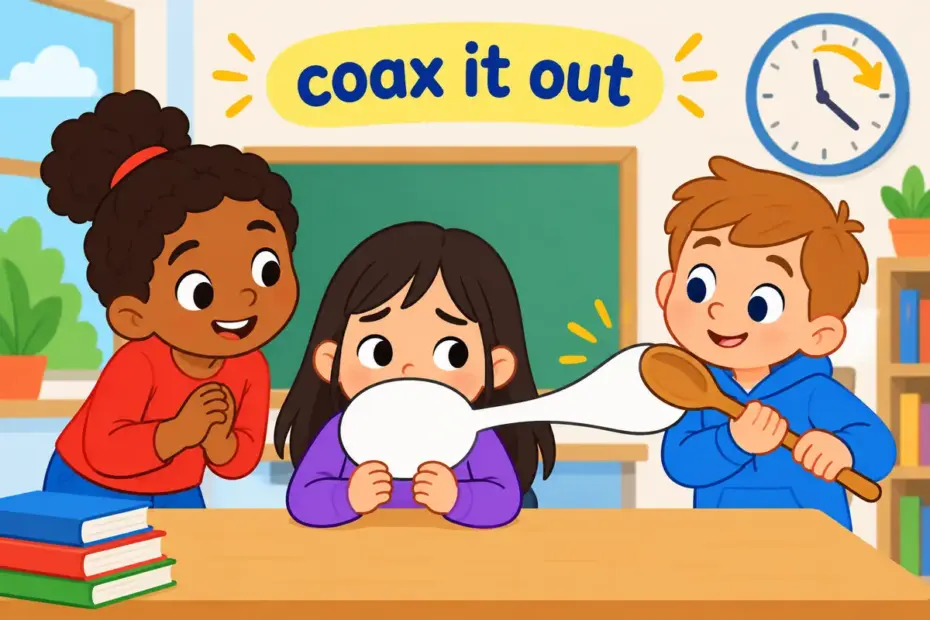
Draw out is a separable phrasal verb meaning to make something last longer or to coax a person into speaking. To use draw out in a sentence, put a pronoun before the particle and a noun after it: “The teacher drew the shy boy out.” These transitive senses always need somebody or something to work on.
Draw out at a glance
- Draw out is a phrasal verb with several senses, from prolonging a meeting to gently persuading someone to talk.
- It is separable: draw the story out and draw out the story are both correct, but a pronoun must sit between the verb and out.
- It is transitive in the main senses, so it normally needs an object; the daylight sense is the intransitive exception.
- The past tense is drew out, not drawed out, and the past participle is drawn out, also used as the hyphenated adjective drawn-out.
- The commonest error is putting a pronoun after the particle, as in draw out him instead of draw him out.
What does draw out mean?
Draw out is a phrasal verb whose core image is pulling something from where it was hidden or keeping it going longer than expected. The Cambridge entry for draw out separates the sense of making something last longer from the sense of persuading someone to talk, and the Merriam-Webster entry for draw out records both plus the flat withdraw sense. The six rows below keep the senses apart, because the object changes with each one.
| Sense | Plain meaning | Example sentence |
|---|---|---|
| To prolong | Make something last longer than expected | The debate drew out until midnight. |
| To coax speech | Gently persuade someone to talk or open up | The interviewer drew the witness out at last. |
| To obtain by coaxing | Get information or a feeling from someone slowly | She drew the whole story out over tea. |
| To withdraw | Take money out of a bank account | He drew out fifty pounds at the counter. |
| To take out | Pull something from a pocket or drawer | She drew out a folded letter. |
| To lengthen (no object) | Of daylight, to become longer | The evenings draw out after the solstice. |
Two limits are worth stating. First, draw out is not a synonym for extract in every sentence: you draw a person out, but you usually extract a tooth or a mineral. Second, the withdraw sense is standard in British English, where people draw out cash, while American speakers more often say take out or withdraw. The other senses travel everywhere.
Where the point is simply to make something longer, prolong a visit is the plainer and more formal choice. Draw out adds the idea that the lengthening happens gradually, often against the wishes of the people involved.
How do you use draw out in a sentence?
Draw out is separable, which means the particle out may move. A noun object can go either side of out, but a pronoun must go between the verb and the particle. In the passive, out may be stranded at the end of the clause, as in the details were drawn out over weeks.
| Pattern | Example | What it signals |
|---|---|---|
| draw + noun + out | The nurse drew the patient out. | The object sits between verb and particle; the commonest order. |
| draw + out + noun | The nurse drew out the patient. | Also correct, and preferred before a long noun phrase. |
| draw + pronoun + out | She drew him out gently. | The pronoun must precede out; draw out him is wrong. |
| be drawn out (passive) | The details were drawn out over weeks. | Keeps attention on the information, not on who obtained it. |
| draw out, no object | The summer evenings drew out. | The daylight sense lengthens by itself, so no object is needed. |
One practitioner rule sorts the senses quickly: if you can replace the phrase with make it last longer, draw out is correct; if you can replace it with get them to talk, add a person as the object and put any pronoun first. The same shape appears in other separable phrasal verbs, such as when you ask someone out and keep the pronoun before the particle.
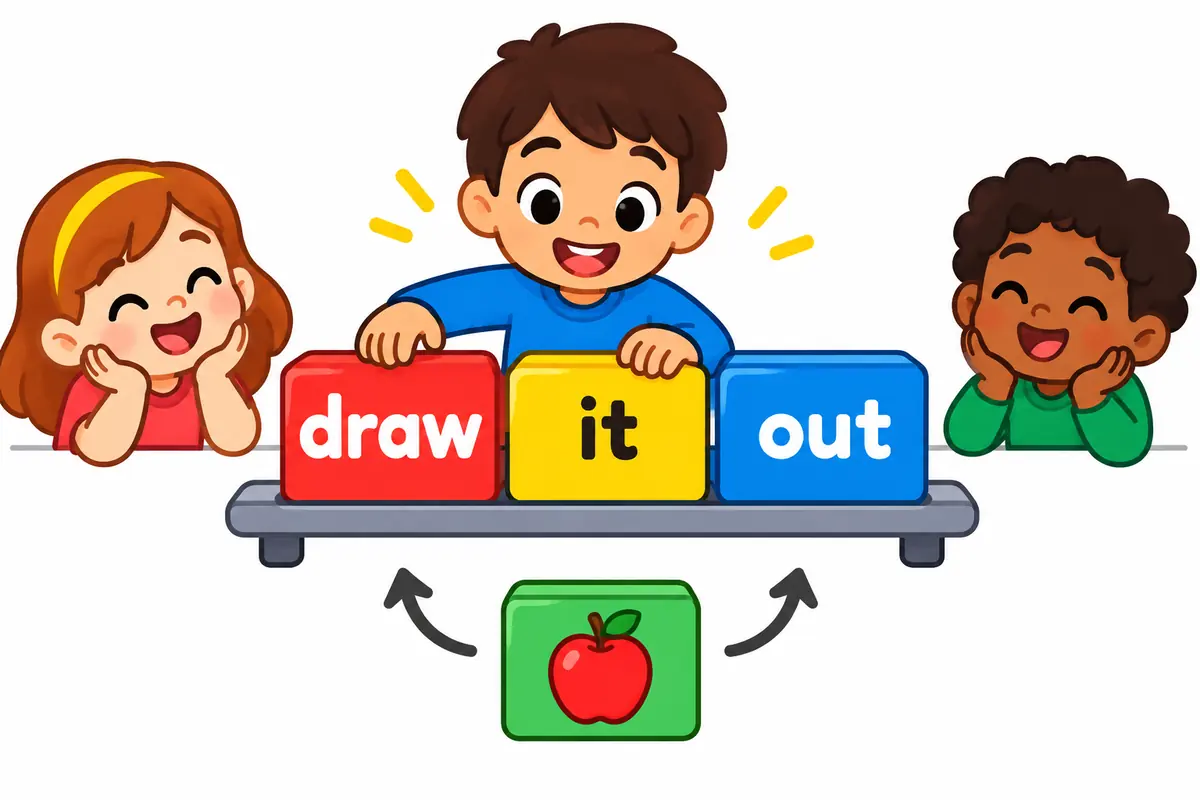
Draw out in a sentence: examples across contexts
Draw out moves easily between registers because it carries several senses. The nine sentences below keep the same phrasal verb while moving from a classroom to a bank counter, and each one shows which sense is in play.
| Context | Example sentence | Why this works |
|---|---|---|
| Classroom | The tutor drew the quiet student out with an easy first question. | Uses the coaxing sense with a person as the object. |
| Workplace email | Let us not draw the meeting out beyond the hour we booked. | Uses the prolong sense with a scheduled event. |
| News report | The chair drew the chief witness out over a full afternoon. | Names a formal setting and the reluctant speaker. |
| Legal writing | The cross-examination drew out a detail the earlier witness had missed. | The object is a piece of information, not a person. |
| Everyday conversation | My aunt can draw anyone out in five minutes flat. | Shows the idiom in speech with an indefinite object. |
| Banking, British | I drew out enough cash for the whole trip. | Uses the withdraw sense common in British English. |
| Fiction | He drew out a creased photograph and set it on the table. | Uses the take-out sense with a concrete object. |
| Nature writing | After the solstice the evenings slowly drew out. | Uses the intransitive daylight sense with no object. |
| Academic writing | The researcher drew the participants out about their earliest memories. | Pairs the coaxing sense with an abstract topic. |
The bank and nature examples are the two that most often confuse learners. One is transitive and British; the other has no object at all and simply means the daylight lengthens.
Draw out vs elicit and prolong
Draw out overlaps with two plainer words and is interchangeable with neither. elicit a response is the neutral verb for getting a reaction to something, while prolong a stay means to stretch something deliberately.
| Attribute | draw out | elicit | prolong |
|---|---|---|---|
| Core job | Make last longer, or coax a person to speak | Obtain a response to a stimulus | Make something last longer |
| Typical object | A person, a story, a meeting, cash | A reply, a laugh, a reaction | A life, a debate, an agony |
| Effort implied | Often, because the person is reluctant | Little; the stimulus does the work | Deliberate and sustained |
| Separable | Yes — draw her out | No, it is a single verb | No, it is a single verb |
| Register | Neutral; very common in speech | Neutral to formal | Neutral, often negative |
| Example | The coach drew the rookie out. | The joke elicited a laugh. | They prolonged the talks. |
Verdict: choose draw out when a person needs coaxing or when something drags on gradually, choose elicit when a stimulus produces a response, and choose prolong when something is stretched deliberately. Where the stretching is deliberate and the speaker disapproves, protract a dispute is the sharper verb. Only draw out can split around its object, which is the grammatical test that separates it from the other two.
Word forms and grammar of draw out
Draw out follows the irregular verb draw, so the past tense is drew out and the participle is drawn out. The participle also becomes the hyphenated adjective drawn-out, which describes something long and tedious.
| Form | Part of speech | Example |
|---|---|---|
| draw out | phrasal verb, base form | Try to draw the new pupil out. |
| draws out | verb, third person singular | She always draws him out at parties. |
| drew out | verb, past tense | He drew the shy child out with a story. |
| drawn out | verb, past participle | The details were drawn out over weeks. |
| drawing out | verb, present participle | Drawing out a timid student takes patience. |
| drawn-out | adjective, hyphenated | It was a drawn-out negotiation. |
| drawed out | non-standard past tense |
Two spelling traps live in this table. The past tense drew has no -ed, and the adjective drawn-out is hyphenated, so a drawn-out meeting is different in writing from the meeting was drawn out. A related verb form, withdraw a request, uses a different base verb and means to remove or retreat rather than to coax.
Common mistakes with draw out
- Incorrect:
She drew out him about the argument.Correct: She drew him out about the argument. Rule: A pronoun object must sit between the verb and the particle. - Incorrect:
The meeting drawn out for two hours.Correct: The meeting drew out for two hours. Rule: Drawn is the participle and needs have or be; the simple past is drew. - Incorrect:
He drawed out a notebook.Correct: He drew out a notebook. Rule: Draw is irregular, so the past tense is never drawed. - Incorrect:
The teacher drew out.Correct: The teacher drew the visitor out. Rule: The transitive senses need an object, unlike the daylight sense. - Incorrect:
The evenings are drawing out longer.Correct: The evenings are drawing out. Rule: The daylight sense already means lengthen, so longer repeats it. - Incorrect:
I drew out money of the bank.Correct: I drew out money from the bank. Rule: The withdraw sense takes from, never of.
Practice using draw out
Try the six items, then read the reason beside each answer rather than only the key.
- Fill the gap: The counsellor managed to draw the boy ______ about his week.
- Choose the better word: The joke (drew out / elicited) a loud laugh from the class.
- Correct the error: The committee drawn out the discussion for three hours.
- Build a sentence: use draw + pronoun + out about a shy new classmate.
- Spot the register: which belongs in a news report — the chair drew the witness out slowly, or she got him chatting eventually?
- Rewrite in the passive: The reporter drew out the full story over many calls.
Answers
- out — the boy is the object and out is the particle that finishes the phrasal verb.
- elicited — a joke produces a laugh, while draw out needs a person to coax or an event to stretch.
- The committee drew out the discussion for three hours — the simple past is drew, not drawn.
- Model answer: The tutor drew her out with a question about her dog.
- The chair drew the witness out slowly — a report keeps the formal phrasal verb and avoids got chatting.
- The full story was drawn out over many calls — the passive strands out at the end.
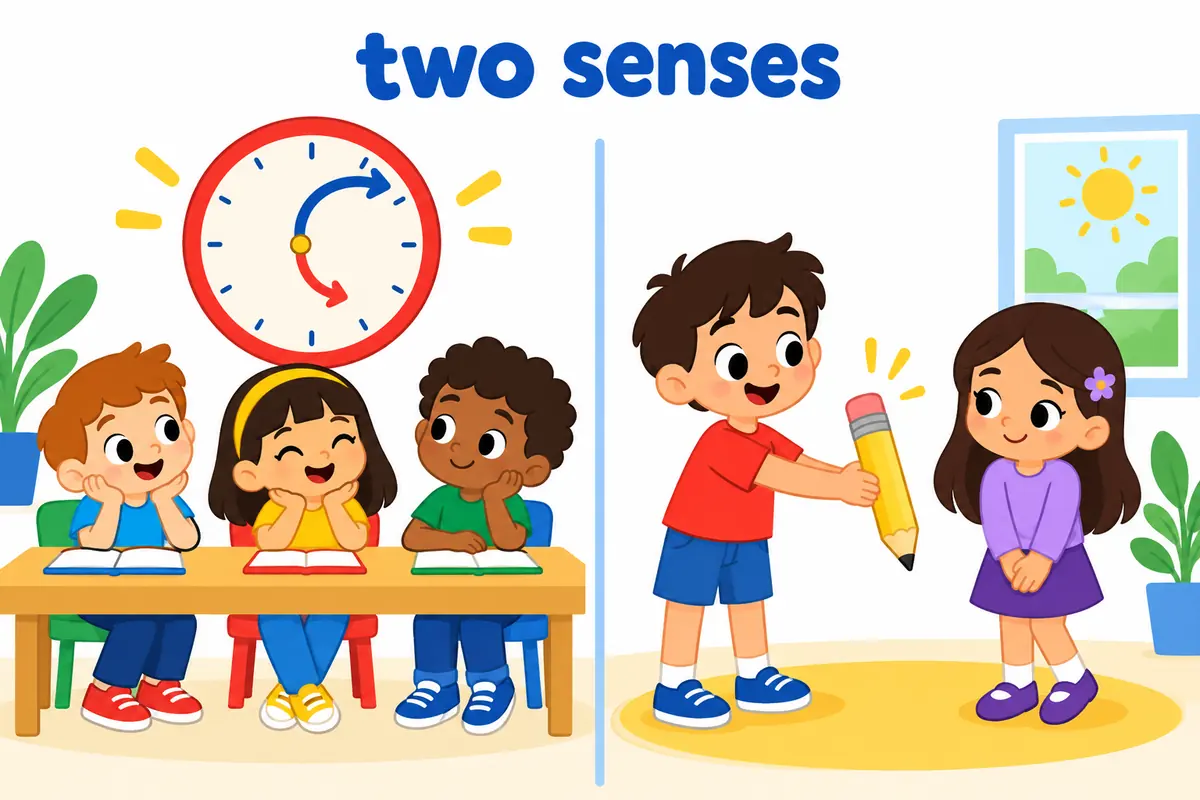
The bottom line
Use draw out in a sentence to say that something lasts longer than expected or that someone is gently coaxed into speaking, and remember that the pronoun object goes between the verb and out. The two points that settle most choices are these: the phrasal verb is separable, and it is transitive except in the daylight sense. Where a stimulus simply produces a response, evoke a memory or elicit is the more precise verb.
Frequently asked questions about draw out
Is draw out a separable phrasal verb?
Yes. You can write draw the story out or draw out the story, and both are correct. The one fixed rule concerns pronouns: they must sit between the verb and the particle, so draw him out is right and draw out him is wrong. In the passive, out may strand at the end.
What does it mean to draw someone out?
To draw someone out is to gently persuade them to talk, especially when they are shy or reluctant. The image is of pulling speech from a guarded person rather than demanding it. An interviewer draws a nervous guest out with easy questions, and a teacher draws a quiet pupil out with a friendly subject.
Is drawn-out written with a hyphen?
When drawn-out is an adjective before a noun, it takes a hyphen, as in a drawn-out meeting. When it is part of the verb, it does not: the meeting was drawn out. The hyphen appears only when the two words act together as a single describing word, which is the same rule that governs other compound adjectives.
What is the difference between draw out and take out?
Draw out and take out overlap only in the sense of removing something or getting cash. British speakers draw out money at a bank counter, while American speakers take out or withdraw it. To draw someone out means to coax them to talk, a sense that take out never carries, so the two are not interchangeable.