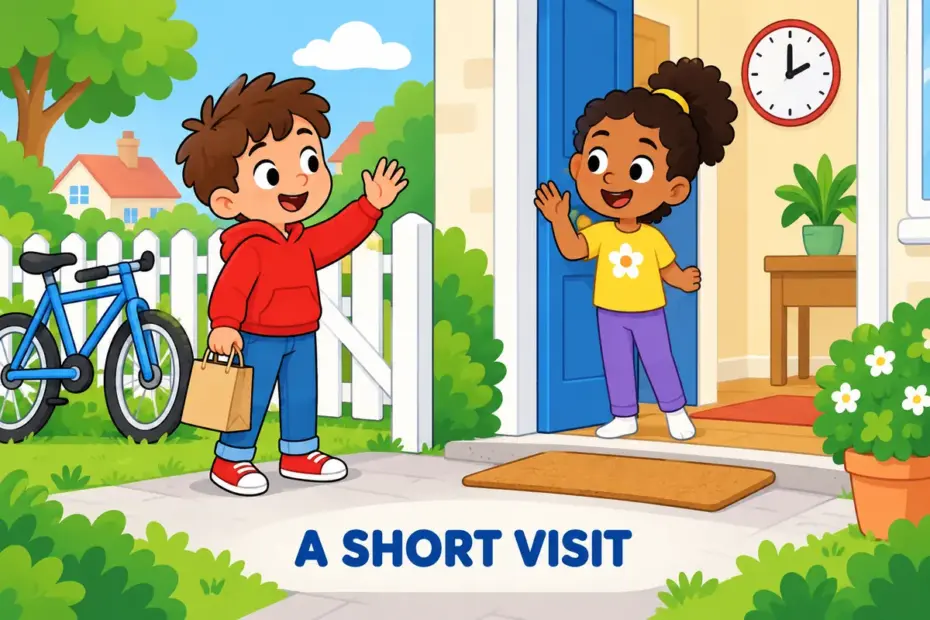
Drop by means to visit someone or somewhere briefly and without much planning. To use drop by in a sentence, name the place or person visited after the phrase: “I will drop by the office after lunch.” The phrase is intransitive, so it takes no direct object; a place follows as an adverbial.
Drop by at a glance
- Drop by is an intransitive phrasal verb meaning to make a short, casual visit.
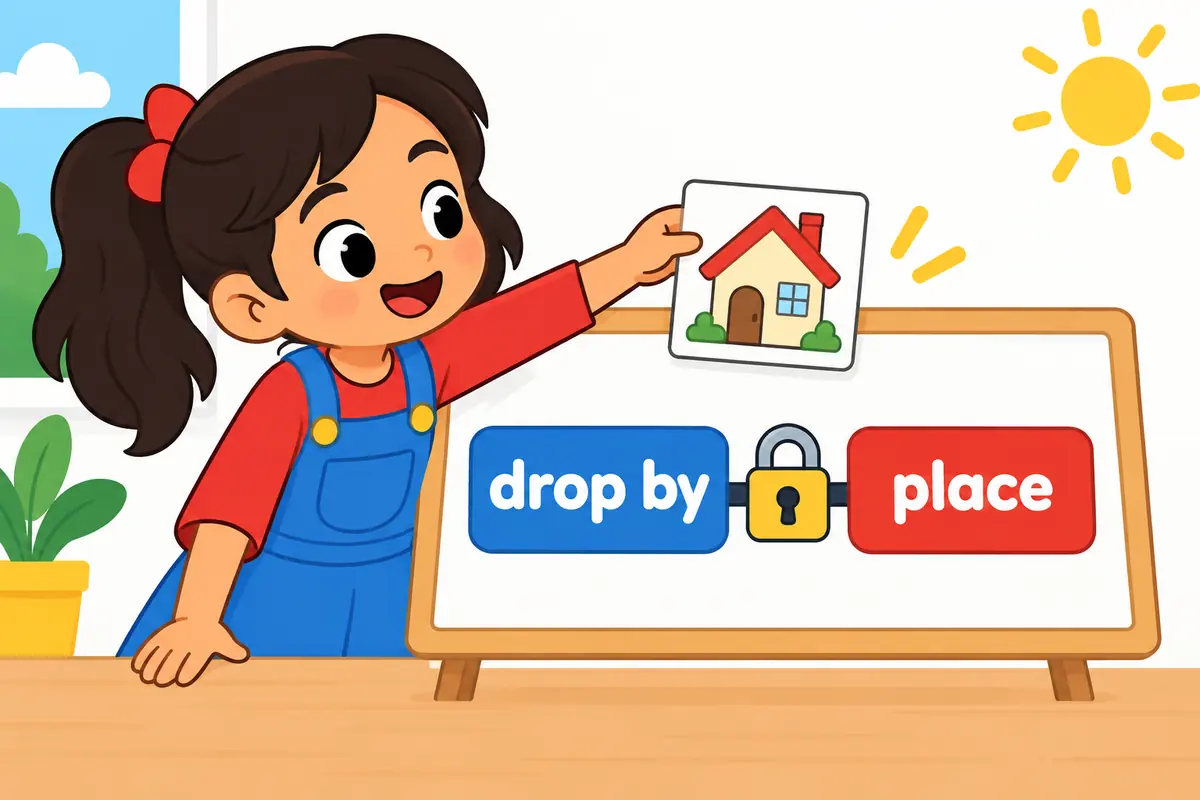
- The particle by stays fixed and cannot be separated: drop by the shop, never drop the shop by.
- A place or a person may follow as an adverbial, often with at, on or for.
- It suits friendly, informal arrangements more than formal appointments.
- The commonest error is confusing drop by with drop in, drop off and drop out.
- The visit sense never takes a number, unlike drop plus by in sales dropped by five per cent.
What does drop by mean?
Drop by is an intransitive phrasal verb meaning to visit someone or some place briefly and informally. The Cambridge entry for drop by records that casual quality, and it is what separates the phrase from a planned visit. Where the visit is on business and scheduled, visit a client is the more neutral choice.
| Sense | Plain meaning | Example sentence |
|---|---|---|
| Visit a person | Pay a brief, friendly call | Her aunt dropped by on Sunday. |
| Visit a place | Stop somewhere for a short time | Let us drop by the gallery before dinner. |
| Call in passing | Break a journey to see someone | We dropped by the farm on the way north. |
One trap deserves noting. In the sentence sales dropped by five per cent, drop by is not this phrasal verb at all: drop is a change verb and by introduces the amount. The visit sense never takes a number after it.
How do you use drop by in a sentence?
Drop by takes no object, and by is a fixed particle, so nothing can be placed between the two words. A place or a person usually follows as an adverbial phrase, and the phrase often partners with at, on or for. The table shows the patterns that sound native.
| Pattern | Example | What it signals |
|---|---|---|
| drop by | Drop by whenever you like. | The bare intransitive use, common as an invitation. |
| drop by + place | She dropped by the bakery on her way home. | A place follows as an adverbial, not an object. |
| drop by + on + person | We dropped by on Grandma after church. | On introduces the person visited. |
| drop by + at + time | Drop by at six and we will eat together. | Names the time of the casual visit. |
| drop by + to + verb | He dropped by to return the book. | States the short purpose of the visit. |
| drop by + for + noun | They dropped by for a coffee. | States what the visit is for. |
The close cousin drop in on a neighbour puts the person after on, while drop by accepts a place just as readily.
Drop by in a sentence: examples across contexts
Drop by keeps its friendly, unhurried sense wherever it appears, and the register decides only how much business is involved. Each sentence below shows the phrase with a place, a person or a purpose, so the intransitive shape stays visible.
| Context | Example sentence | Why this works |
|---|---|---|
| Neighbourhood | Drop by the community hall on Saturday for the fair. | A place plus purpose, the classic invitation. |
| Workplace | I will drop by your desk before the meeting. | Casual, colleague-to-colleague register. |
| Family | Her cousins dropped by after lunch and stayed an hour. | Brevity is implied without being stated. |
| Retail | We dropped by the new bookshop on the way home. | A passing visit with a place adverbial. |
| News feature | Volunteers drop by the shelter each evening. | The habitual sense, marked by each evening. |
| Travel | They dropped by the ruins before heading north. | A sightseeing detour with a clear place. |
| Conversation | Drop by if you are free this evening. | The familiar informal invitation. |
| Academic | The supervisor asked the student to drop by during office hours. | Polite but still informal. |
| Phone call | I will drop by on my mother after work. | Shows on with a person as the adverbial. |
| Story | A stranger dropped by the farm and asked for water. | A narrative past use with a place. |
| Sports club | Old players drop by the ground to watch training. | Routine, repeated visits with a purpose clause. |
| Feel free to drop by the studio any afternoon. | An invitation given in writing. | |
| Community notice | Residents may drop by the library desk for help with forms. | A place plus a purpose, typical of a public notice. |
Drop by vs drop in
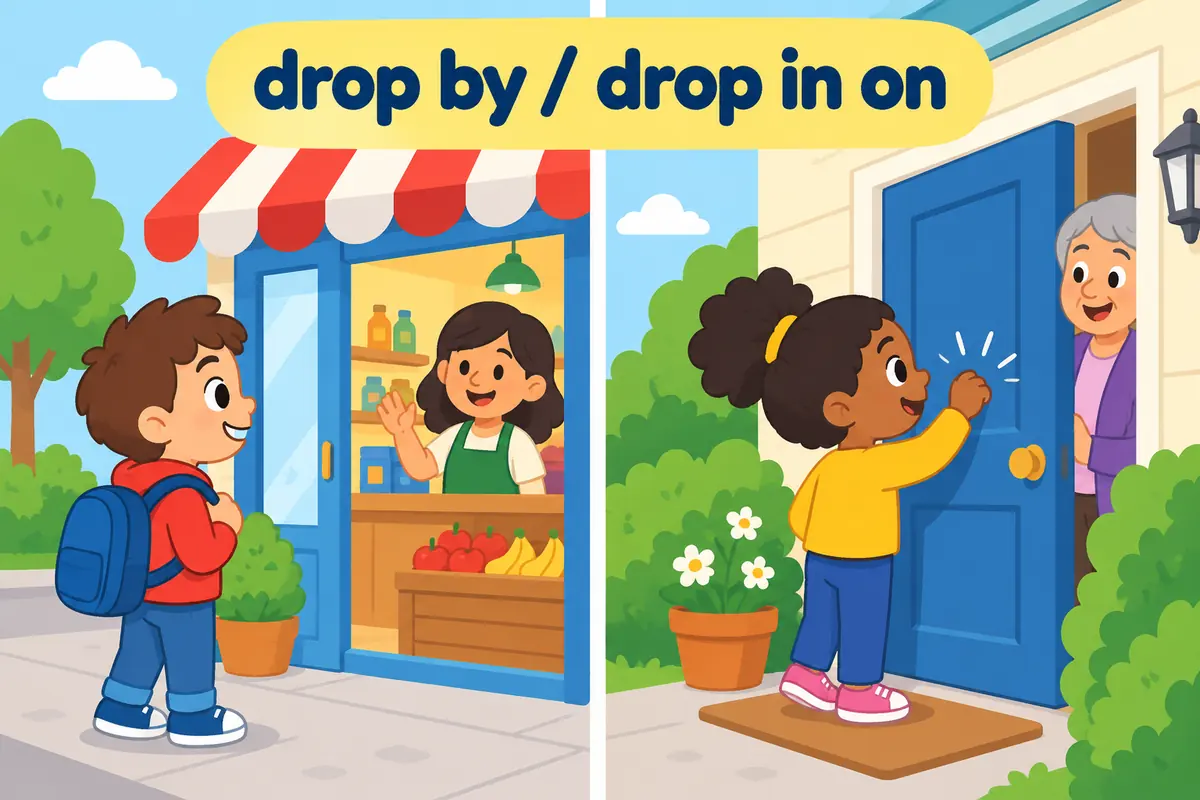
Drop by and drop in are close enough to puzzle learners, but they take different complements. drop in on a neighbour centres on the person, while drop by centres on the place. A third cousin, drop out of a course, means to quit and belongs to a different meaning altogether.
| Attribute | drop by | drop in |
|---|---|---|
| Commonest complement | A place: drop by the shop | A person: drop in on Sam |
| Emphasis | Passing somewhere briefly | Calling on someone at home |
| With a place | Natural | Less common |
| With on + person | Possible but rarer | Standard |
| Separability | Fixed | Fixed |
| Best register | Informal | Informal |
Verdict: choose drop by when a place or a quick stop is the point, and drop in on when the person is the point.
Word forms and grammar of drop by
Drop is a regular verb, and the phrase carries its -s, -ed and -ing endings on drop. The table also separates the phrasal verb from three look-alikes that share the same base verb.
| Form | Part of speech | Example |
|---|---|---|
| drop by | phrasal verb, base form | Drop by at noon. |
| drops by | third person singular | She drops by every Friday. |
| dropped by | past and past participle | They dropped by on Tuesday. |
| dropping by | present participle | Thanks for dropping by. |
| drop-in | noun or adjective | The clinic runs a drop-in session. |
| drop off | phrasal verb, different meaning | Drop off the parcel at reception. |
The trio to keep apart is pass by a shop, which means to go past without stopping, drop off, which means to deliver, and drop by, which means to stop for a short visit.
Where drop by sits between formal and casual
Drop by is informal by nature, so it fits friendly arrangements better than scheduled business. The table maps each register to the form that sounds right and the alternative to consider.
| Register | Natural form | Alternative |
|---|---|---|
| Invitation to a friend | Drop by any time. | Come over. |
| Email to a colleague | I will drop by your desk later. | I will stop by your desk later. |
| Semi-formal note | You are welcome to drop by during office hours. | You are welcome to visit. |
| Business appointment | too casual | We have scheduled a meeting. |
| News feature | Volunteers drop by the shelter each evening. | Volunteers visit the shelter each evening. |
Common mistakes with drop by
- Incorrect:
Drop by me tomorrow.Correct: Drop by on me tomorrow. Rule: A bare person object is unusual; use on or a place. - Incorrect:
She dropped by the office it.Correct: She dropped by the office. Rule: Drop by is intransitive and takes no object pronoun. - Incorrect:
I will drop the shop by.Correct: I will drop by the shop. Rule: The particle is fixed and never separates. - Incorrect:
We dropped by in Grandma.Correct: We dropped by on Grandma. Rule: Use on, not in, before a person. - Incorrect:
He dropped by for seeing us.Correct: He dropped by to see us. Rule: Purpose after drop by uses to plus a verb, not for plus -ing. - Incorrect:
Sales dropped by to five per cent.Correct: Sales dropped by five per cent. Rule: That structure is drop plus by, not the visit phrase.
Practice using drop by
Work through the six items, then check the reasoning rather than only the answer.
- Fill the gap: I will ______ the bakery on my way home. (two words)
- Choose the better phrase: We (dropped by / dropped in on) Grandma after church.
- Correct the error: Please drop the office by before noon.
- Build a sentence: use drop by + to + verb about returning a book.
- Spot the register: which belongs in a friendly invitation — Drop by whenever you like, or You are required to attend?
- Rewrite with drop in: We visited our neighbour for a few minutes. Keep the casual sense.
Answers
- drop by — the place follows the fixed phrase as an adverbial.
- dropped in on — when the person is the point, drop in on is the standard phrase.
- Please drop by the office before noon — the particle never separates from drop.
- Model answer: I dropped by the library to return the book.
- Drop by whenever you like — an invitation is friendly and informal.
- We dropped in on our neighbour for a few minutes — drop in on takes the person.
The bottom line
Use drop by in a sentence to describe a short, friendly visit, and let the place or person follow as an adverbial rather than an object. The two details that decide most sentences are these: the phrase is intransitive and its particle never separates, and the person takes on, as in drop by on a friend. Where the person, not the place, is the point, drop in on fits more exactly.
Frequently asked questions about drop by
What does drop by mean?
Drop by means to visit someone or some place briefly and casually, often without a firm arrangement. It suggests a short, friendly call rather than a long stay. You might drop by a friend on your way home or drop by a shop to look at something quickly.
Is drop by transitive or intransitive?
Drop by is intransitive, so it takes no direct object. A place or a person can follow as an adverbial phrase, as in drop by the market or drop by on Sam. You cannot place a bare object straight after the verb, and the particle by never separates from drop.
What is the difference between drop by and drop in?
Both describe a casual visit, but drop by usually takes a place, as in drop by the office, while drop in usually takes a person after on, as in drop in on a neighbour. A place can follow drop in and a person can follow drop by with on, but each phrase has its preferred complement.
Can drop by mean something decreases?
Not as this phrasal verb. In a sentence such as sales dropped by five per cent, drop is a change verb and by introduces the amount of the fall. That is a different structure from the visit sense, which describes a brief call and never takes a number after it.