Elide in a Sentence: Meaning and Examples
Elide means to leave a sound, syllable or detail out, so the word covers both how speakers drop sounds and how writers quietly omit facts. To use elide in a sentence, give it a direct object: “Speakers elide the second vowel in camera.” The omission is usually smooth and deliberate rather than a plain mistake.
Elide at a glance
- Elide is a transitive verb; its forms are elides, elided and eliding.
- The noun is elision, which names the omission itself.
- Elide has a phonetic sense (dropping a sound) and a general sense (leaving out a detail).
- The object is usually a sound, syllable, word, fact or clause.
- The commonest error is confusing elide with elite, a word for a privileged group.
What does elide mean?
Elide is a transitive verb meaning to leave out a sound, a syllable or a piece of information, usually smoothly rather than by blunt removal. The Cambridge entry for elide records both the phonetic sense and the broader sense of passing something over. When the omission is simply a careless gap, omit is the plainer verb.
| Sense | Plain meaning | Example sentence |
|---|---|---|
| Drop a sound | Leave out a sound or syllable in speech | Speakers elide the t in often. |
| Omit a detail | Leave information out, often to avoid awkwardness | The summary elided the failed quarter. |
| Merge two things | Blend separate items into one | The plan elides two schemes into one. |
Elide is not a synonym for every kind of removal. It implies a smooth, often convenient omission, so a blunt deletion or an accidental gap is better described with cut, delete or omit. Where a writer means to glide past an awkward fact, gloss over names the habit more sharply than elide.
Two everyday kinds of elision are worth separating. Phonetic elision happens without thought, as when speakers smooth camera into camra or drop the t in often. Rhetorical elision is a choice: a summary leaves out the dull quarter, or a reference passes over a resignation. The first belongs to how language sounds, the second to what a writer decides a reader needs, and elide covers both.
How do you use elide in a sentence?
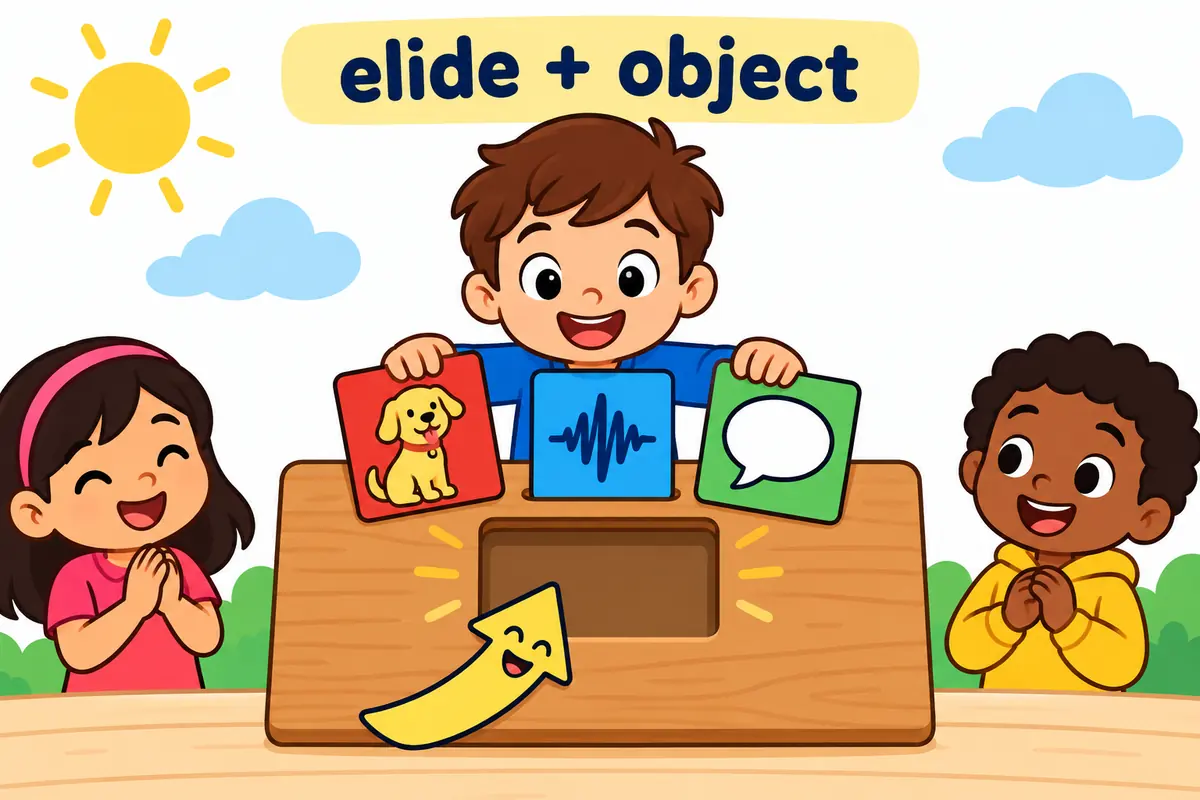
Elide is transitive, so it always needs an object, and it works in the passive when the omitted item matters more than the person who left it out. Five patterns cover the everyday uses.
| Pattern | Example | What it signals |
|---|---|---|
| elide + sound object | Speakers elide the t in often. | The phonetic sense: a sound disappears. |
| elide + detail object | The summary elided the delay. | A fact is quietly left out. |
| be elided (passive) | The final syllable is elided. | Focus falls on the omitted item. |
| elide A into B | The plan elides two schemes into one. | Merging rather than deleting. |
| elide over + object | The report elided over the losses. | Gliding past something awkward. |
The passive matters because readers often care more about the missing item than about the person who removed it. A clause was elided tells us the gap exists, while the editor elided the clause names an actor. Choose the active voice when responsibility is the point.
Elide in a sentence: examples across contexts
| Context | Example sentence | Why this works |
|---|---|---|
| Linguistics lecture | English speakers elide the middle vowel in camera every day. | The technical phonetic sense with a clear object. |
| News analysis | The official account elided the months before the collapse. | Shows a deliberate omission in reporting. |
| Editing note | The editor elided two clauses to tighten the paragraph. | An everyday editorial use with a concrete object. |
| Academic writing | Most histories elide the role of unpaid labour. | Formal register and a broad subject. |
| Legal writing | The contract was elided from the public record. | Passive voice foregrounds the missing document. |
| Conversation | He elided the part where he forgot the tickets. | Warm, spoken use for a skipped detail. |
| Product review | The brochure elides the battery limits of the device. | Critical use about convenient omission. |
| Classroom | Fast speech elides the d in sandwich for many speakers. | A familiar example of a dropped sound. |
| Literary criticism | The novel elides the trial and moves straight to the verdict. | Describes a narrative gap. |
| Policy briefing | The briefing elided the cost of the new timetable. | Names an omission that matters to readers. |
| Historical writing | Many accounts elide the years of quiet rebuilding. | Shows omission across a long span of time. |
| Job reference | The reference elided the reason for his departure. | A diplomatic omission with real consequences. |
| Scriptwriting | The scene elides the journey and opens on the arrival. | Describes a deliberate narrative jump. |
| Translation note | English elides the article the original repeats. | Shows a small, systematic omission. |
Nearby verbs divide the work: slur describes running sounds together in speech, while merge stresses joining two things rather than dropping one.
Elide vs elite
| Attribute | Elide | Elite |
|---|---|---|
| Part of speech | Verb | Noun and adjective |
| Core meaning | Leave a sound or detail out | A privileged or dominant group, or the best of a set |
| Pronunciation | i-LYDE, stress on the second syllable | e-LEET, stress on the second syllable |
| Spelling trap | Ends in -ide | Ends in -ite |
| Typical sentence | The editor elided the clause. | The elite controlled the board. |
| Register | Formal and technical | Neutral, common in news |
Choose elide when something has been left out, and elite when a small powerful group is meant; the two differ by one letter and by the whole shape of a sentence. A third lookalike, chide, means to scold gently and never belongs in a discussion of omission.
Sound is the surest guide. Elide ends with the same sound as provide and collide, while elite ends with the -eet of sweet. If a sentence needs an action, the verb elide is the one; if it needs a group of people or a description of the best, the noun or adjective elite is the one, and no context makes them interchangeable.
| Near-synonym | What it adds | Example |
|---|---|---|
| omit | A plain, neutral leaving out | She omitted the last line. |
| suppress | Omission by force or authority | The office suppressed the figures. |
| gloss over | Passing quickly over something awkward | He glossed over the delay. |
Elide sits between omit and gloss over: more deliberate than a plain omission, less forceful than suppression, and more specific than a vague glide. A writer who elides a detail may still be honest about the rest of the account, whereas suppression removes material on purpose and often against the reader’s interest.
None of these words is a perfect swap. Elide keeps a note of smoothness, so it fits a quiet editorial choice better than a clumsy gap; omit is neutral and safe; suppress adds force and blame. A writer choosing between them is really choosing how much responsibility to assign for what is missing.
Word forms and grammar of elide
| Form | Part of speech | Example |
|---|---|---|
| elide | verb, base form | Speakers elide unstressed vowels. |
| elides | verb, third person singular | She elides the final consonant. |
| elided | past tense and past participle | The clause was elided from the draft. |
| eliding | present participle | Eliding details weakens the account. |
| elision | noun | The elision of that vowel is standard. |
| elisioned | non-standard | The noun has no verb form of its own; use elided. |
Only the verb elide and the noun elision are standard; there is no adjective elidive and no verb elision, so writers who build those forms are inventing words.
Case is simple. The verb takes a direct object, so we say the editor elided the clause and never the editor elided. In the passive the omitted item becomes the subject: the clause was elided. The noun elision, in turn, can be countable or uncountable, so a writer may note the elision of a vowel or count several elisions in one paragraph.
Common mistakes with elide
Incorrect: The report elided on the missing funds. Correct: The report elided the missing funds. Elide is transitive and takes a direct object, so it needs no on.
Incorrect: He was a member of the elide. Correct: He was a member of the elite. The group takes the noun elite, not the verb elide.
Incorrect: The editor made an elide of the paragraph. Correct: The editor made an elision of the paragraph. The noun is elision; elide is the verb.
Incorrect: She elisioned the awkward sentence. Correct: She elided the awkward sentence. There is no verb elision; the action verb is elide.
Incorrect: The sound was elided of the word. Correct: The sound was elided from the word. The passive takes from to name the source, not of.
Practice using elide
- Fill in the blank: Fast speakers ______ the t in the word often.
- Fill in the blank: The summary ______ the cost of the scheme.
- Correct the error: The manager elisioned the bad news.
- Choose the better word: The most powerful families formed the ______ (elide / elite).
- Build a sentence: use be elided about a clause removed from a contract.
- Spot the register: which sentence belongs in a linguistics essay, “speakers elide the final vowel” or “speakers drop the last sound”?
- Rewrite in the passive: The editor elided two paragraphs.
- Correct the error: The report elided on the delays.
Answers
- elide — the verb takes the sound as its object.
- elided — past tense marks an omission already made.
- The manager elided the bad news — the verb is elide, not elision.
- elite — a powerful group is the elite, a noun.
- Two clauses were elided from the contract — the passive foregrounds the omitted material.
- The first — a linguistics essay prefers the precise technical verb elide.
- Two paragraphs were elided by the editor — the passive takes by for the agent.
- The report elided the delays — drop on, because the verb is transitive.

The bottom line
To use elide in a sentence, give it a direct object and decide whether a sound or a fact is being left out. The verb is more precise than delete because it implies a smooth, deliberate omission rather than a blunt cut. Keep it apart from elite and chide, and use omit for a neutral gap and suppress when force is involved. Mastering elide gives writers a single word for the quiet space where something should have been.
Frequently asked questions about elide
Does elide mean the same as delete?
Elide is narrower than delete. It means to leave something out smoothly, often because saying it would be awkward, slow or unnecessary. In speech, elide describes sounds that disappear in natural pronunciation. In writing, it describes details quietly passed over, whereas delete simply means removing something completely and deliberately.
What is elision in speech?
Elision is the noun for a sound or syllable that speakers drop, and for the process of dropping it. Familiar English examples include the missing t in often and the squeezed middle vowel in camera, which can sound like camra. Fast, relaxed speech elides more than careful speech does.
How do you pronounce elide?
Elide is pronounced i-LYDE, rhyming with provide, with the stress on the second syllable. The noun elision is pronounced i-LIZH-un, and the past form elided is i-LY-did. Keeping the forms apart helps listeners, because elide and elision do not share the same rhythm.
Is elide a transitive verb?
Elide is transitive, so it needs a direct object: you elide a sound, a syllable, a word or a detail. The passive is common when the omitted item matters more than the writer, as in the clause was elided from the final draft. Without an object the verb is incomplete.