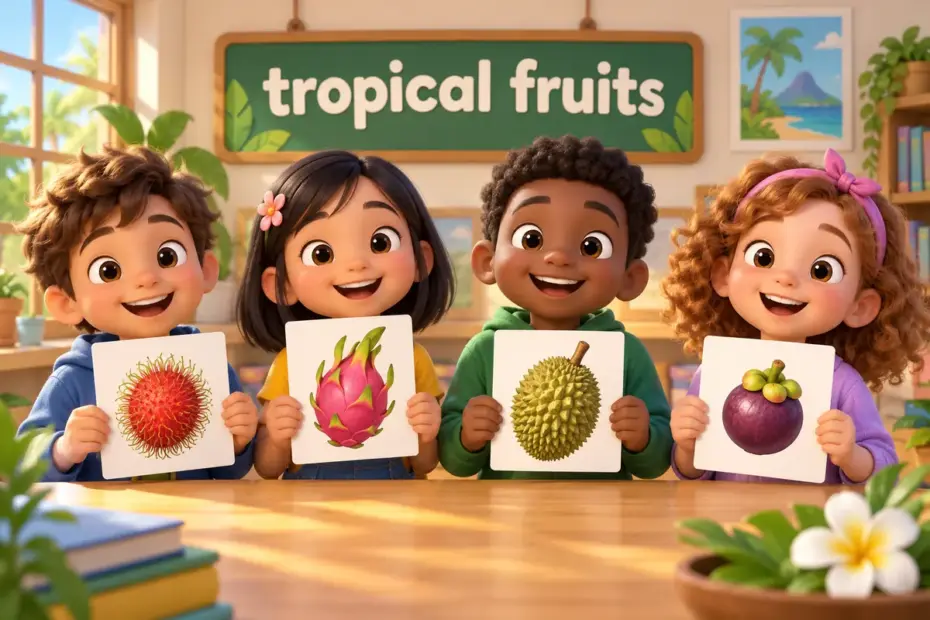
Exotic fruits with pictures make unfamiliar produce easy to name, from the spiky red rambutan to the green, scaly durian. Most grow in tropical or subtropical climates, so a shopper in a temperate city may meet them only in a market or a recipe. Each one earns its place by a distinct colour, shape and flavour.
exotic fruits with pictures at a glance
- Exotic fruits grow mainly in tropical and subtropical regions far from temperate farms.
- Names such as rambutan, mangosteen and lychee come from the languages of the regions that grow them.
- Many exotic fruits carry two spellings, so lychee also appears as litchi and lichee.
- Flavours run from the mouth-puckering sour tamarind to the sweet, custard-like cherimoya.
- The commonest mistake is calling every small exotic fruit a berry.
What are exotic fruits with pictures?
An exotic fruit is a fruit that grows mainly in a tropical or subtropical region and is uncommon in temperate markets, so the label describes availability rather than biology. A picture helps because the name rarely matches the look: a lychee is lumpy and pink, while a dragon fruit is bright pink with green scales. The same fruit may also be known by its local name, which is why one fruit often fills two places in a market list. Names travel widely, and the fruits that start with a range from the common apple to the rarer ackee.
| Category | Recognised by | Example fruits |
|---|---|---|
| Tropical stone fruit | one large stone inside soft flesh | lychee, rambutan, mangosteen |
| Tropical berry | soft segments around many small seeds | dragon fruit, passion fruit, miracle fruit |
| Heavy tree fruit | thick skin and a strong scent | jackfruit, durian, breadfruit |
| Sour pod | long brown pods with sticky pulp | tamarind |
| Creamy fruit | soft flesh with a mild, sweet flavour | cherimoya, sapodilla, papaya |
| Cactus fruit | grows on a desert cactus | prickly pear, dragon fruit |
One honest limit sits beside the label. The word exotic is a marketing term, not a scientific one, so it can feel dated or vague in careful writing. A fruit is exotic only relative to where it is sold: the mango is ordinary in one country and exotic in another, and a trader may call a familiar fruit exotic when it appears in an unusual colour.
Because the label is loose, a useful list groups the fruits by how they look and taste rather than by paperwork. A reader scanning a stall needs to connect a shape to a name, and the shape is the fastest clue: spiky red means rambutan, green scales mean durian, and a smooth purple oval means passion fruit. Grouping by appearance also makes a long list easier to remember.
How do you name an exotic fruit in a sentence?
Most sentences either identify the fruit, describe its taste or place it in a dish, and everyday examples of fruits in a sentence show all three frames at work.
| Pattern | Example | What it signals |
|---|---|---|
| the + fruit + is + description | The rambutan is a small red fruit with soft spines. | identifying the fruit |
| a + fruit + tastes of + noun | A passion fruit tastes of sharp citrus and honey. | describing flavour |
| fruit + such as + name | Tropical fruit such as lychee grows in warm, humid air. | giving an example |
| you can + verb + the fruit | You can scoop dragon fruit flesh with a spoon. | describing use |
| fruit + of + region | The durian is a fruit of Southeast Asia. | naming the region |

Exotic fruits with pictures: examples across contexts
The same fruit names move from a market label to a recipe, a school project and a travel diary, and each setting asks for a different sentence. To see the general word at work, read exotic in a sentence.
| Context | Example sentence | Why this works |
|---|---|---|
| Market stall | The dragon fruit is ripe when the skin gives a little. | a buying tip |
| Recipe | Fold diced mango and passion fruit into the yoghurt. | an instruction |
| School project | Our chart of exotic fruits with pictures shows ten tropical kinds. | a display note |
| Travel diary | I first ate rambutan at a busy street market. | a personal memory |
| Classroom | Name the fruit on each card out loud. | a task |
| Cooking show | Slice the jackfruit and cook it like a vegetable. | an instruction |
| Grocery email | We now stock fresh lychee and mangosteen. | a stock notice |
| Menu | Chilled papaya with lime makes a light dessert. | a dish |
| Fruit stall sign | Prickly pear: sweet, seedy and best served cold. | a short label |
| Children’s book | The spiky rambutan looked like a tiny red sea urchin. | a simple image |
Which exotic fruit should you try first?
Match the fruit to your taste rather than to its fame, because the strongest flavours divide eaters most sharply.
| Situation | Pick | Example |
|---|---|---|
| First try | lychee | Lychee has a gentle floral sweetness. |
| Want tart | passion fruit | Passion fruit is sharp and fragrant. |
| Want creamy | cherimoya | Cherimoya flesh is soft like custard. |
| Want a big fruit | jackfruit | Jackfruit is mild and meaty. |
| Want a bold smell | durian | Durian is known for its strong aroma. |
Lychee is the safest first choice because its flavour is mild and sweet, while durian divides people most sharply, so taste a small piece before buying a whole one.
Word forms and grammar of exotic fruit names
Fruit names raise two grammar questions: whether to add an s, and how to spell the plural. For a contrast, the fruits that start with b place the familiar banana beside the rarer bael.
| Form | Part of speech | Example |
|---|---|---|
| fruit | noun (uncountable) | Fruit is part of a healthy diet. |
| fruits | plural noun | These fruits ripen in the heat. |
| exotic | adjective | An exotic fruit often travels far. |
| lychee | noun | One lychee holds a single stone. |
| lychees | plural noun | A punnet holds about twenty lychees. |
| mangoes | plural noun | Mangoes turn sweet near the end of summer. |
| tropical | adjective | Durian grows in tropical climates. |
Common mistakes with exotic fruit names
Mistake 1: the plural of mango. Incorrect: I bought three mangos for the salad. Correct: I bought three mangoes for the salad. Rule: mango, like many nouns ending in a consonant plus o, adds -es for the plural.
Mistake 2: fruit versus fruits. Incorrect: The stall sold many fruit from the tropics. Correct: The stall sold many fruits from the tropics. Rule: use fruits when you count distinct kinds and fruit for the food in general.
Mistake 3: calling any small fruit a berry. Incorrect: The rambutan is a berry because it is small. Correct: The rambutan is a tropical fruit with soft spines. Rule: berry is a botanic word, so it is not a general label for small fruit.
Mistake 4: mixing spellings. Incorrect: The menu listed lichee and litchi on the same page. Correct: The menu listed lychee twice, spelled in one consistent way. Rule: choose one accepted spelling and keep it through a list.
Mistake 5: the wrong article. Incorrect: I ate an tropical fruit at the fair. Correct: I ate a tropical fruit at the fair. Rule: use a before a consonant sound and an before a vowel sound.
Practice using exotic fruits with pictures
- Fill in the blank: The ___ has pink skin and green scales.
- Choose the better word: A (lychee / durian) is known for a strong smell.
- Correct the error: I ate three mangos.
- Build a sentence: use such as to give one example of an exotic fruit.
- Spot the register: which line suits a menu, (a) Grab that weird spiky thing, or (b) Chilled rambutan with lime is served as a light dessert?
- Fill in the blank: Unlike an orange, a ___ has a spiky red skin.
Answers
- dragon fruit, because its pink skin carries green scales.
- durian, because durian is famous for its strong aroma.
- I ate three mangoes; nouns ending in a consonant plus o add -es.
- An exotic fruit such as rambutan grows in warm, humid air.
- (b), because a menu uses precise, polite wording.
- rambutan, because its red skin is covered in soft spines.

The bottom line
Exotic fruits with pictures connect an unfamiliar name to a shape you can recognise in seconds, and the picture does most of the teaching. Learn the skin, taste and region for each fruit, use fruits when you count kinds, and write mangoes rather than mangos. When you meet a new name, group it by look and flavour instead of reaching for a vague label such as berry.
Frequently asked questions about exotic fruits
What makes a fruit exotic?
A fruit is called exotic when it grows mainly in a tropical or subtropical region and is uncommon where it is sold. The label describes availability and fashion rather than botany, so the same mango is ordinary in one country and exotic in another.
Which exotic fruits are easy to find?
Lychee, mango, papaya, passion fruit, dragon fruit and guava now appear in many supermarkets. Tinned lychee and frozen passion fruit pulp are common too, so a reader can often try several kinds without visiting a specialist market. Even small shops usually stock one or two, so a first taste rarely needs a special trip.
Are exotic fruits always sweet?
No. Tamarind is sharply sour, and several exotic fruits sit between sweet and tart. Passion fruit is both, and durian is sweet with a smell many people find strong, so taste is not a reliable way to guess what a fruit will be like.
How do you spell lychee?
Lychee is the most common English spelling, while litchi and lichee are accepted variants. Choose one form and keep it consistent through a list, because mixing three spellings for one fruit looks careless to a careful reader. All three forms are understood, so follow the spelling your dictionary uses.