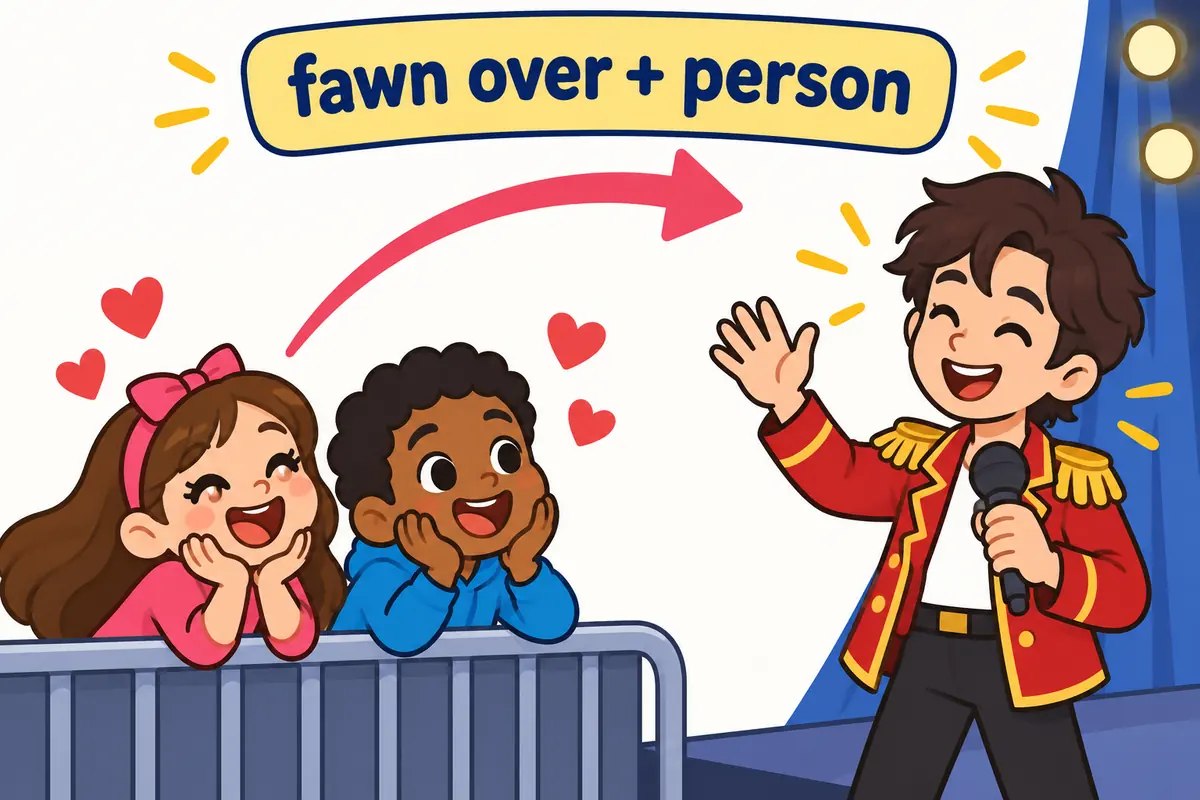
Fawn over means to praise or admire someone in an exaggerated, eager way. To use fawn over in a sentence, put the person or thing being admired after the particle: fans fawned over the singer, colleagues fawned over the new manager. The expression is inseparable, so the object never sits between fawn and over.
Fawn over at a glance
- Fawn over is a transitive phrasal verb, and its object always follows over.
- Its forms are fawn over, fawns over, fawned over and fawning over.
- It is inseparable, so the pattern fawn somebody over is not English.
- The particle can still strand in a relative clause, as in the star everyone fawned over.
- The tone usually criticises the admirer, because the praise is excessive.
- The subject is often a group or a junior, and the object is the person receiving the attention.
What does fawn over mean?
Fawn over is a phrasal verb meaning to show someone exaggerated praise or eager attention in order to please them. The Cambridge entry for fawn over records the flattery sense, and the extra intensity is what separates the phrase from plain praise.
| Sense | Plain meaning | Example sentence |
|---|---|---|
| Admire excessively | Show eager, over-the-top admiration | Reporters fawned over the young champion. |
| Flatter to please | Praise someone in order to win favour | Waiters fawned over the regular customers. |
| Serve devotedly | Attend to someone with servile eagerness | Assistants fawned over the visiting director. |
The base verb fawn once described the eager behaviour of a dog, which is why the phrase still suggests a follower at someone heels. That history is useful to remember, because it explains the faint note of criticism the phrase carries even when the scene is friendly.
One limitation matters: fawn over is not the same as love or respect. It nearly always implies that the admiration is excessive, and often that the person doing the fawning wants something in return. When the admiration is sincere and mutual, admire or praise fits better, and when it is mild affection, dote is the plainer verb.
How do you use fawn over in a sentence?
Fawn over is inseparable, so the object stays after the particle rather than moving between the verb and over. It is transitive, which means the person or thing being admired cannot be left out. The particle can strand only in a relative clause, where over lands at the end of the clause.
| Pattern | Example | What it signals |
|---|---|---|
| subject + fawn over + object | Fans fawned over the actor outside the theatre. | The default order, with over keeping its object after it. |
| subject + fawn over + object, present | The interns fawn over every visiting director. | Present tense marks a habit rather than one event. |
| be + fawning over | The whole office is fawning over the new recruit. | The continuous form stresses ongoing behaviour. |
| object relative clause | She is the chef that critics fawn over. | The particle strands, so over ends the clause. |
| fawn over, on or upon variant | Courtiers once fawned upon the monarch. | A formal variant, where on and upon are interchangeable. |
Fawn over in a sentence: examples across contexts
Fawn over keeps the same shape while the scene changes from a red carpet to a staff room. Each sentence below names who admires and who is admired, which is what the inseparable phrase requires.
| Context | Example sentence | Why this works |
|---|---|---|
| Conversation | My cousins fawn over every new phone their father buys. | Everyday exaggeration, the commonest spoken use. |
| Workplace email | Several colleagues fawned over the proposal, but nobody tested it. | Mild criticism delivered through the choice of verb. |
| News report | Crowds fawned over the returning athletes at the airport. | Neutral reporting of public enthusiasm. |
| Sports writing | Commentators fawn over a striker after one good season. | Suggests the praise has arrived too early. |
| Restaurant review | Staff fawn over regulars while new diners wait. | Captures uneven, performative service. |
| Celebrity journalism | Bloggers fawn over the couple at every red-carpet event. | Implies uncritical coverage. |
| Academic prose | Reviewers should not fawn over fashionable methods. | Formal register with a cautious tone. |
| Business writing | Suppliers fawn over the largest client and ignore the rest. | Names the self-interest behind the praise. |
| Parenting | Grandparents fawn over the new baby all afternoon. | An affectionate, low-stakes use of the phrase. |
| Social media | Followers fawn over an influencer holiday photos. | Online admiration, often read as ironic. |
| Literature discussion | Courtiers fawn over the king in the opening scene. | Historical and formal, close to the older sense. |
| Classroom | Pupils fawn over the visiting author at the book fair. | A school setting where the praise is benign. |
Two details separate a natural sentence from a translated one. English speakers keep over next to fawn even when the object is long, so the crowd fawned over the retiring captain sounds native while the crowd fawned the retiring captain over does not. The second detail is the verb choice, because colleagues who merely agree are not fawning, so the phrase implies visible eagerness such as crowding, gushing or competing for attention.
The object does not have to be a person. A new phone, a rare car or a fashionable theory can all be fawned over, and the verb then criticises the enthusiasm of the crowd rather than the thing itself.
Fawn over vs flatter
Fawn over and flatter both describe praise, and they divide the work by intensity and grammar. Flatter is the general transitive verb, while fawn over is a phrasal verb that pictures visible, eager admiration. Flatter is the general verb for praise, while fawn over adds eagerness and excess.
| Attribute | fawn over | flatter |
|---|---|---|
| Core meaning | Admire or praise excessively and eagerly | Praise, often insincerely, to please |
| Grammar | Phrasal verb, object after over | Single transitive verb |
| Typical object | A person or a thing admired | A person only |
| Tone | Mildly disapproving of the admirer | Neutral to negative |
| Typical subject | Fans, followers, staff, juniors | A person with a motive |
| Intensity | Strong and performative | Moderate, sometimes a small compliment |
Grovel goes further, because it suggests a humiliating attempt to please. Verdict: use flatter for an insincere compliment and fawn over when the admiration is loud, public and over the top.
Worship suggests deep reverence, which is stronger and usually sincere, so it belongs to a different family altogether. Meanwhile butter up is a close informal synonym, used when someone is being softened for a favour rather than admired for their own sake.
Word forms and grammar of fawn over
The phrase inflects on the verb and never on the particle, so over stays fixed while fawn carries the tense. The table below lists the forms readers will meet, including the adjective that drops the particle. Not every over word is admiring, because bowl over means to surprise or delight rather than to flatter.
| Form | Part of speech | Example |
|---|---|---|
| fawn over | phrasal verb, base form | Fans fawn over the singer. |
| fawns over | phrasal verb, third person singular | He fawns over anyone famous. |
| fawned over | phrasal verb, past and participle | The crowd fawned over the winner. |
| fawning over | phrasal verb, present participle | They spent the evening fawning over the coach. |
| fawning | adjective | His fawning tone embarrassed the team. |
| to fawn on or upon | phrasal verb, formal variant | Courtiers fawned upon the queen. |
Because the phrase describes behaviour rather than a single act, the continuous form is unusually common. A sentence such as the office is fawning over the new recruit reports a mood that lasts, not a single compliment.
Common mistakes with fawn over
- Incorrect:
She fawned her boss over.Correct: She fawned over her boss. Rule: Fawn over is inseparable, so the object follows over. - Incorrect:
He fawning over the actor when I arrived.Correct: He was fawning over the actor when I arrived. Rule: The participle needs an auxiliary, so use was fawning. - Incorrect:
I fawned over that she won.Correct: I fawned over her win. Rule: Fawn over takes a noun phrase, never a that-clause. - Incorrect:
They fawn over to the manager.Correct: They fawn over the manager. Rule: Over introduces the object directly, with no to after it. - Incorrect:
The fans fawned over with the singer.Correct: The fans fawned over the singer. Rule: Over carries the object on its own, so with is not used. - Incorrect:
He is fawn over the new phone.Correct: He is fawning over the new phone. Rule: After be, use the participle fawning, not the base form.
Practice using fawn over
Work through the six items, then check the reasoning rather than only the answer.
- Fill the gap: The whole team ______ over the guest speaker after the talk.
- Choose the better word: The agent tried to (fawn over / dote on) the client into signing.
- Correct the error: The reporters fawned the winner over.
- Build a sentence: use fawn over with the present participle about an office and a new manager.
- Spot the register: which belongs in a news report, crowds fawned over the returning medalists or everyone was totally fawning over the medalists?
- Rewrite with a formal variant: The courtiers fawned over the king. Use fawned upon instead.
Answers
- fawned, because the past form matches the finished event and the object follows over.
- fawn over, because the agent wants to please the client rather than show fond affection.
- The reporters fawned over the winner, because the object must follow over in an inseparable phrasal verb.
- Model answer: The whole office is fawning over the new manager, which shows the continuous mood.
- Crowds fawned over the returning medalists, because a neutral report avoids totally and keeps the simple past.
- The courtiers fawned upon the king, because upon is the formal variant of over in this fixed sense.
The bottom line
Use fawn over in a sentence when the admiration is eager, visible and more than the person deserves, and let the object follow the particle. Two nuances decide most sentences: the phrase is inseparable and transitive, so somebody or something must be fawned over, and it carries a faint criticism of the admirer. When the reverence is deep and sincere, worship is the stronger verb.
Frequently asked questions about fawn over
Is fawn over one word or two?
It is always two words, fawn plus the particle over, and it works as a single phrasal verb. You never write fawnover as one word, and you never treat over as a separate preposition with its own meaning. The pair moves together through the sentence as a unit.
Can you say fawn over someone?
Yes, that is the standard pattern, with the person following over. Fans fawn over the singer and assistants fawn over the director are both correct. Because the verb is transitive and inseparable, you cannot move the person between fawn and over.
What is a stronger word than fawn over?
Grovel is stronger and more humiliating, because it adds the idea of lowering yourself before someone. Worship is stronger in reverence but is usually sincere. Butter up is similar in meaning but informal and focuses on winning a favour rather than on admiration.
Is fawn over positive or negative?
It is usually mildly negative, because it presents the admiration as excessive and often self-interested. Even in a friendly sentence, the verb hints that the admirer is trying too hard. For purely positive admiration, praise or admire carries no such edge and reads more warmly.