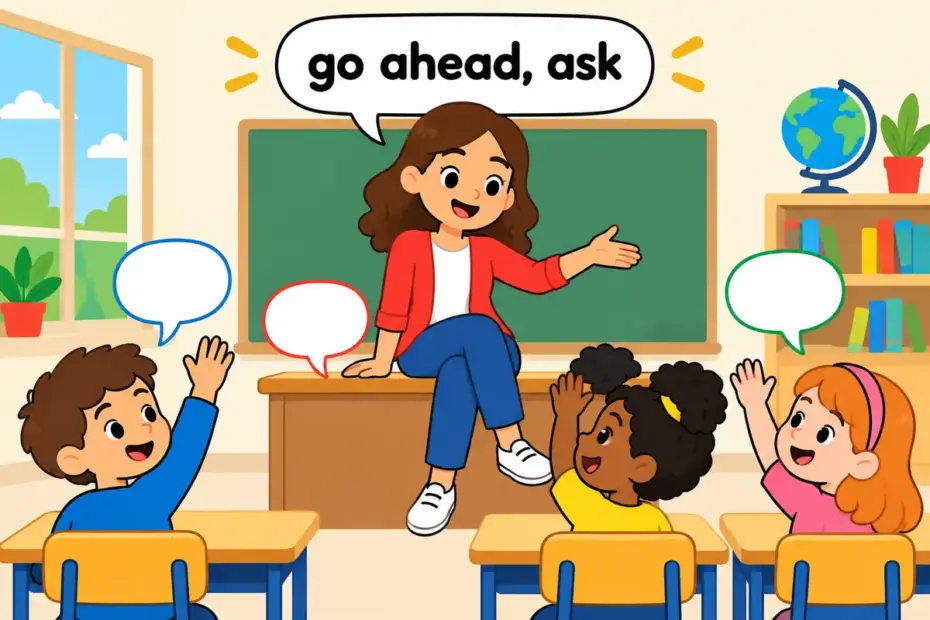
Fire away is an informal phrasal verb that tells someone to go ahead and ask their questions or speak freely. To use fire away in a sentence, say it as a short invitation: “I have time, so fire away.” The phrase is intransitive, usually imperative, and belongs in relaxed conversation rather than formal writing.
Fire away at a glance
- Fire away is an intransitive phrasal verb; its forms are fires away, fired away and firing away.
- It means go ahead, typically inviting questions or open comment.
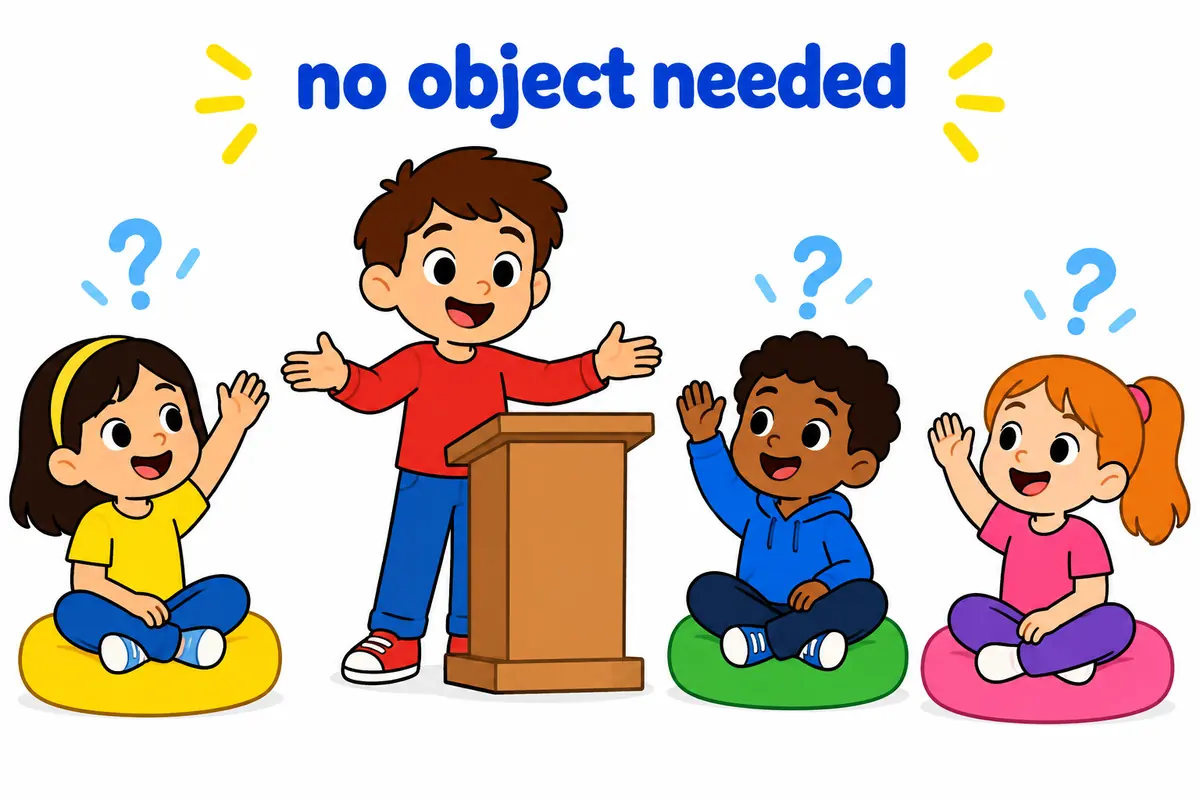
- The phrase stands alone as a short command and takes no object.
- It is informal and spoken, and it also has a literal sense of continuing to shoot.
- The commonest error is adding an object, as in fire away your questions.
What does fire away mean?
Fire away is a phrasal verb meaning go ahead and ask or speak, used as a warm invitation. The Cambridge entry for fire away records this informal use, and the same words also describe a literal burst of shooting. A host who tells a guest to ask a question and an officer ordering gunners to keep firing are using one phrase in two senses.
| Sense | Plain meaning | Example sentence |
|---|---|---|
| Invite questions | Give permission to start asking | I have read the plan, so fire away. |
| Invite speech | Encourage someone to say what they think | You disagree? Fire away. |
| Keep shooting (literal) | Continue firing a weapon | The gunners fired away at the target. |
One limitation is worth stating plainly. Fire away is informal and can sound brisk, so it is the wrong choice for a formal interview, where please go ahead reads better. The literal sense belongs only in descriptions of shooting, and it should never be used when the subject is an ordinary conversation.
How do you use fire away in a sentence?
Fire away is intransitive, so it takes no object and never splits. Five patterns cover the real uses, and the standalone command is by far the most common.
| Pattern | Example | What it signals |
|---|---|---|
| fire away (standalone imperative) | Fire away, I am listening. | The whole phrase acts as a short command. |
| subject + fire away | The gunners fired away for an hour. | Literal, intransitive use with no object. |
| fire away + at + target | The squad fired away at the cans. | Names what is being shot at in the literal sense. |
| fire away + with + noun | Fire away with your questions. | Names what the person will start to produce. |
| no object, no separation | You cannot say fire your questions away. | Shows the phrase cannot take or split an object. |
When a host gives the floor, go ahead is the neutral twin of the same invitation. A chair who wants to sound organised would say proceed with your questions instead.
Fire away in a sentence: examples across contexts
Fire away keeps its invitation force while the setting changes. The ten sentences below move from a classroom to a radio studio, and each one shows who is being encouraged to speak.
| Context | Example sentence | Why this works |
|---|---|---|
| Classroom | I have finished the topic, so fire away with your questions. | A teacher hands the floor to the class. |
| Job interview | That is my background, so fire away. | A candidate invites the panel to ask more. |
| Customer service | You have my full attention, so fire away. | A helper invites a long list of concerns. |
| Radio studio | Our guest is ready, so fire away. | A host hands over to callers and texts. |
| Team meeting | I have shared the draft, so fire away with your doubts. | A manager invites open, friendly challenge. |
| Family dinner | You wanted to ask me something, so fire away. | A warm, informal invitation at home. |
| Live event | The panel is here, so fire away. | Opens a question-and-answer session to the room. |
| Podcast | Ask me anything, fire away. | Pairs a plain instruction with the idiom. |
| Casual chat | Fire away, I am not in a rush. | Signals the listener has plenty of time. |
| Debate club | State your case, then fire away at mine. | Keeps the energetic, almost sporty tone. |
Notice that the phrase almost never appears in the past tense when it means invite a question. The imperative is the form that survives, and it usually follows a short reason, as in I have time, so fire away. To talk it through is what the listener then does.
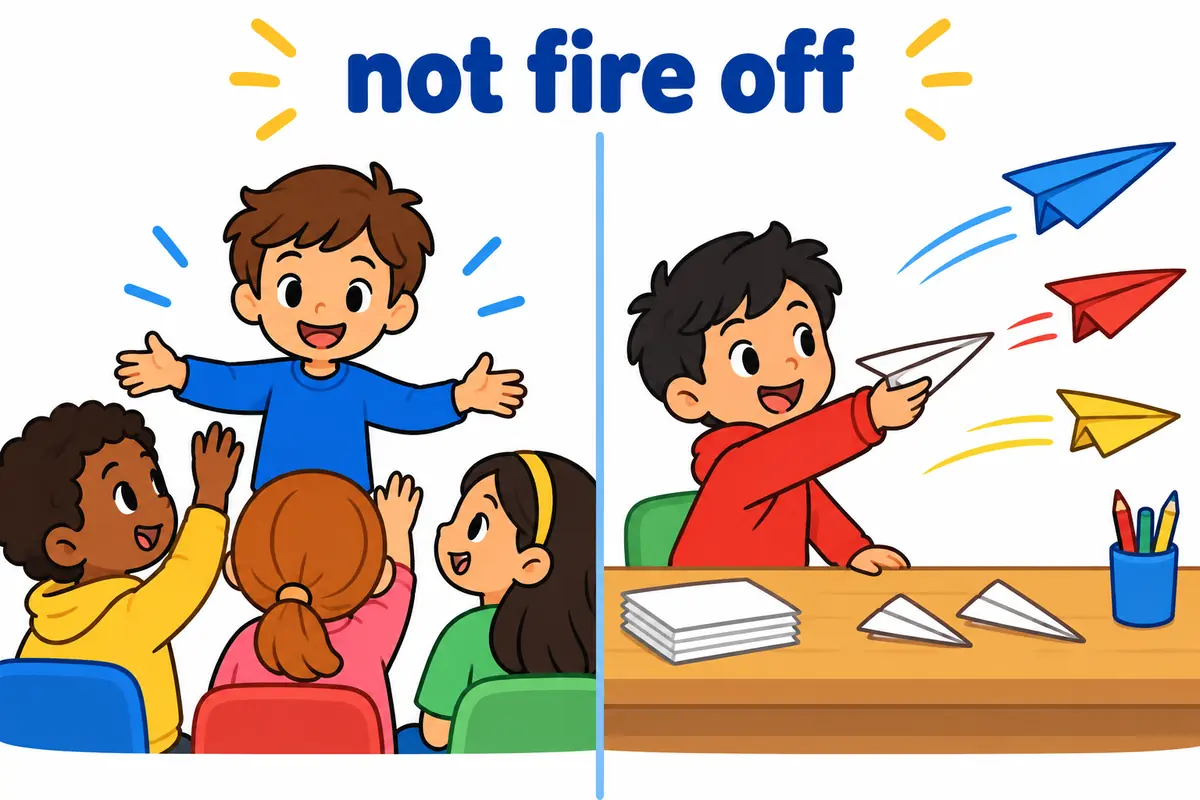
Fire away vs fire off
Fire away and fire off both borrow the image of shooting, yet only one of them invites a person. To shoot at the cans keeps the literal picture alive in the background of the comparison.
| Attribute | fire away | fire off |
|---|---|---|
| Core idea | Invite someone to begin | Send something quickly |
| Grammar | Intransitive, takes no object | Transitive, always takes an object |
| Typical object | None at all | An email, a message, a question |
| Meaning | Go ahead and ask or speak | Dispatch fast and without delay |
| Register | Spoken and friendly | Neutral, often written |
| Example | Fire away, I am ready. | She fired off three emails. |
Verdict: say fire away to invite a person to speak, and use fire off to describe sending something fast. The two phrasal verbs share a particle-sized image but not a grammar, which is why they cannot be swapped.
Word forms and grammar of fire away
Fire away changes tense for the literal sense but stays fixed for the invitation. The table also shows the with pattern that appears when the speaker names what will follow.
| Form | Part of speech | Example |
|---|---|---|
| fire away | phrasal verb, base and imperative | Fire away, I am ready. |
| fires away | third person singular | He fires away with questions every week. |
| fired away | past and past participle | The squad fired away for an hour. |
| firing away | present participle | She kept firing away at the target. |
| fire away! | interjection | Fire away, the floor is yours. |
| fire away with | pattern with with | Fire away with anything you need to ask. |
The phrase carries no passive and no noun form of its own. Its only close relative in the same family is the verb fire, which takes an object in the literal sense, as in fire a shot, and that difference is the source of most learner errors. To chip away at a task is patient, steady work, which is the opposite mood to an eager fire away.
Common mistakes with fire away
- Incorrect:
Fire away your questions.Correct: Fire away with your questions. Rule: Fire away is intransitive and cannot take a direct object. - Incorrect:
She fired away an email.Correct: She fired off an email. Rule: Fire off is the transitive phrasal verb; fire away is not. - Incorrect:
The manager said fire away in the formal review.Correct: The manager said please go ahead in the formal review. Rule: Fire away is conversational and too brisk for a formal meeting. - Incorrect:
Fire away to me.Correct: Fire away, or ask me anything. Rule: The phrase takes no preposition when it stands alone. - Incorrect:
He was fired away.Correct: He kept firing away. Rule: Fire away is intransitive and has no passive.
Practice using fire away
Work through the six items, then read the answers for the reasoning rather than only the key.
- Fill the gap: I have read your plan, so ______ away.
- Choose the better phrase: She (fired away / fired off) three quick emails before lunch.
- Correct the error: Fire away your questions and I will answer.
- Build a sentence: invite a classmate to ask about a project, using fire away.
- Spot the register: which fits a formal interview, please fire away or please go ahead?
- Rewrite for the literal sense: The soldiers kept shooting at the target. Use fire away at.
Answers
- fire — the invitation phrase always keeps the two words fire away.
- fired off — emails are the object of a quick dispatch, so fire off is required.
- Fire away with your questions — an object can only follow with, never the bare phrase.
- Model answer: The draft is ready, so fire away with anything you want to change.
- Please go ahead — a formal interview avoids the breezy idiom.
- The soldiers fired away at the target — the literal sense takes at before the target.
The bottom line
Use fire away in a sentence when you invite someone to begin asking or speaking, and let the phrase stand alone because it takes no object. The two details that decide most sentences are these: it is intransitive, so it never takes or splits an object, and it is conversational, so a formal meeting prefers go ahead.
Frequently asked questions about fire away
Is fire away rude?
Fire away is friendly rather than rude, because it gives somebody the floor and invites them to speak. The image of shooting can feel abrupt in writing, where tone is harder to read. In an email, go ahead is safer, and in speech a warm voice makes fire away perfectly relaxed.
What does fire away mean in a meeting?
In a meeting it means the speaker has finished and is ready for questions. A presenter might say that is the plan, so fire away. The phrase signals openness and a little energy, and it often follows a short statement about having time for a full discussion.
Can fire away be literal?
Fire away has a literal sense of continuing to shoot, as in the gunners fired away at the target. That sense takes at before the thing being hit. In everyday use the invitation meaning dominates, so readers understand fire away as go ahead unless the sentence clearly describes weapons.
Is it fire away or fire off?
They are different phrasal verbs. Fire away invites a person to ask or speak and takes no object, as in fire away, I am listening. Fire off means send something quickly and always takes an object, as in she fired off a reply. Choose the one that matches the action.