
Furious means extremely angry, and it also describes something unusually strong or fast, such as a furious storm. To use furious in a sentence, say who feels the anger and add the preposition that names the cause: She was furious about the delay. The adjective most often follows the verb be.
Furious at a glance
- Furious is an adjective; its forms are furious, furiously and the noun fury.
- Its two main senses are extremely angry and remarkably strong or fast.
- The usual patterns are be furious about, be furious with, be furious at and furious that.
- Furious is stronger than angry and appears in both speech and formal writing.
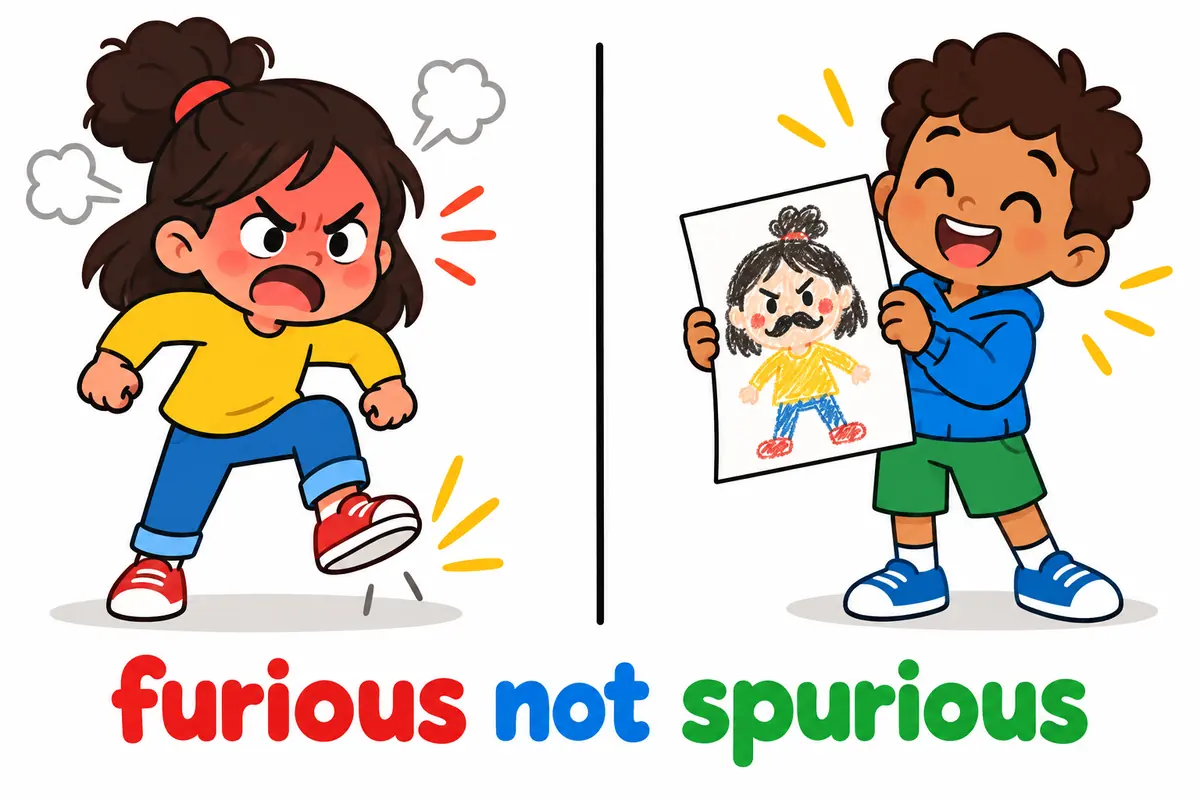
- The commonest error is confusing furious with spurious, which means false or fake.
What does furious mean?
Furious is an adjective meaning extremely angry, or very strong and intense. The Cambridge entry for furious records the anger sense and the intensity sense. The anger sense always involves a person who feels the emotion, while the intensity sense describes a storm, a pace or a debate with no person involved. Where the anger is mild, angry about a delay is the steadier choice, because furious sits near the top of the scale.
| Sense | Plain meaning | Example sentence |
|---|---|---|
| Extremely angry | Very angry about something | The coach was furious about the late arrival. |
| Very strong or violent | Used of storms, speed or force | A furious wind tore at the tents. |
| Intense or determined | Used of activity, effort or debate | The plan met furious opposition. |
One limitation is worth stating plainly. Furious reports a high degree of anger, so it can sound exaggerated when the cause is small. A person who is mildly annoyed is not furious, and a furious storm is not angry at all; the word simply borrows the force of anger for the weather.
How do you use furious in a sentence?
Furious is a descriptive adjective, so it either follows be and other linking verbs or stands directly before a noun. The preposition after it changes the target of the anger, and the choice is not random.
| Pattern | Example | What it signals |
|---|---|---|
| be + furious + about + noun | She was furious about the delay. | Names the event that caused the anger. |
| be + furious + with + person | Dad was furious with me. | Names the person the anger is aimed at. |
| be + furious + at + person or thing | They were furious at the ruling. | Common with institutions and decisions. |
| furious + that + clause | He was furious that the meeting was cancelled. | States the fact that provoked the anger. |
| furious + noun | A furious row broke out. | Describes the intensity of the thing itself. |

Furious in a sentence: examples across contexts
Furious keeps its intensity as it moves between registers, but the cause changes from a lost toy to a court ruling. The nine sentences below show which preposition and which subject each setting prefers.
| Context | Example sentence | Why this works |
|---|---|---|
| Classroom | Maya was furious with her group for losing the model. | A person is the target, so with fits. |
| Workplace email | Managers were furious about the missed deadline. | An event is the target, so about fits. |
| News report | Residents were furious at the sudden closure. | An institution or decision follows at. |
| Sports commentary | The captain was furious that the foul was not given. | A clause states the fact that caused the anger. |
| Conversation | I was furious when they cancelled the trip. | When-clause is natural in casual speech. |
| Travel writing | A furious gale kept the ferries in port. | The intensity sense describes the weather. |
| Academic writing | The proposal drew furious criticism from historians. | Intensity sense applied to debate, not people. |
| Public statement | Shareholders were furious about the hidden costs. | Formal cause named after about. |
| Children’s story | The giant was furious that his garden was bare. | That-clause drives a simple narrative. |
The intensity sense never takes a person as its target. A furious wind has no feelings, and a sentence that says the wind was furious with the town is treating the weather as a character.
Furious vs angry
Angry and furious describe the same emotion at different strengths, and English uses them in different places. seething with anger and furious both sit near the top of the scale, while angry covers the whole range from mild to serious. enraged by a decision is the most formal of the group and belongs in reports and statements.
| Attribute | furious | angry | enraged |
|---|---|---|---|
| Strength | Very strong | Mild to strong | Extremely strong |
| Register | Neutral to formal | Neutral, also casual | Formal and journalistic |
| Typical cause | A serious event or injustice | Any irritation | A perceived outrage |
| Common pattern | furious about, with, at, that | angry about, with, at | enraged by, at |
| Other senses | Also means strong or fast | No second sense | No second sense |
Verdict: choose angry for ordinary irritation, furious when the anger is intense or the storm is violent, and enraged when a formal report needs the strongest available word.
Word forms and grammar of furious
Furious is a gradable adjective, so it takes more and most rather than the endings -er and -est. Its adverb and noun are common, and one near form is a frequent spelling trap.
| Form | Part of speech | Example |
|---|---|---|
| furious | adjective | The crowd grew furious. |
| more furious | adjective, comparative | He became more furious with every reply. |
| most furious | adjective, superlative | That was the most furious argument of the night. |
| furiouser | adjective, non-standard | Use more furious; furiouser is not standard. |
| furiously | adverb | She shook her head furiously. |
| fury | noun | His fury faded by morning. |
The adverb furiously often describes speed rather than anger, as in typing furiously, so check which sense the sentence carries.
Common mistakes with furious
- Incorrect:
She was furious of the noise.Correct: She was furious about the noise. Rule: Furious takes about, with or at, never of. - Incorrect:
He was furious on his brother.Correct: He was furious with his brother. Rule: A person follows with, not on. - Incorrect:
The report was furious.Correct: The report was spurious and misleading. Rule: Furious means angry or intense; spurious means false, and the two are different words. - Incorrect:
They were furious at about the decision.Correct: They were furious about the decision. Rule: Use one preposition, not two. - Incorrect:
The wind was furious with the town.Correct: A furious wind battered the town. Rule: The intensity sense never takes a person as its target.
Practice using furious
Work through the six items, then read the reason for each answer.
- Fill the gap: The team was ______ about the postponement.
- Choose the better word: The editor was (furious / spurious) when the story was cut.
- Correct the error: The passengers were furious of the long wait.
- Build a sentence: use be furious with about a friend who forgot a promise.
- Spot the register: which belongs in a news report, the residents were furious at the closure or everyone was, like, so mad?
- Rewrite with the noun: The coach was furious. Use fury instead.
Answers
- furious – an event follows about, which fits a postponement.
- furious – the editor felt anger; spurious would mean the editor was fake.
- The passengers were furious about the long wait – furious takes about, not of.
- Model answer: Nina was furious with Tom for forgetting her birthday.
- The residents were furious at the closure – a report avoids the casual phrasing.
- The coach was filled with fury – the noun needs a verb to carry it.
The bottom line
Use furious in a sentence when the anger is intense or when something is remarkably strong, such as a storm or a pace. The preposition decides the target, so about names an event, with names a person and at usually names a decision or body. When the feeling is calm rather than hot, calm after an argument is the natural opposite to reach for.
Frequently asked questions about furious
Is furious stronger than angry?
Yes. Angry covers a wide range from mild irritation to serious rage, while furious means extremely angry and sits near the top of that scale. Choosing furious for a small problem can sound exaggerated, so reserve it for strong anger. Enraged is the only common adjective that goes further still.
What is the difference between furious and spurious?
Furious is an adjective meaning extremely angry or very strong, as in a furious storm. Spurious is a different adjective meaning false or not genuine, as in a spurious claim. They are close in spelling but unrelated in meaning, so a furious email is angry while a spurious email is fake.
What preposition goes after furious?
About usually names an event or situation, with names a person, and at often names a decision, ruling or institution. A that-clause can follow furious without any preposition, as in furious that the game was stopped. The preposition is never of or on, which are common learner errors.
Can furious describe the weather?
Yes. Furious has an intensity sense that describes storms, winds, paces and debates rather than angry people. In this sense it means very strong, violent or fast. The intensity sense never takes a person as its target, so the wind was furious with the town mixes two incompatible patterns.
Have you ever struggled to express intense anger or frustration in your writing? When it comes to conveying strong emotions like fury, choosing the right words is essential. “Furious” is an adjective that describes powerful feelings of anger or intense passion.
When crafting sentences with “furious,” it’s crucial to evoke the forcefulness and intensity of the emotion being described. Whether depicting a character’s rage in a story or venting frustration in a personal journal entry, using “furious” can add depth and vividness to your writing.
7 Examples Of Furious Used In a Sentence For Kids
- The lion was furious when the cheeky monkey stole its banana.
- The mother was furious when her child refused to eat his vegetables.
- The teacher was furious when the students were making too much noise in class.
- The dog was furious when the cat kept stealing its toys.
- The farmer was furious when the naughty goats escaped from their pen.
- The queen was furious when her crown went missing.
- The witch was furious when her spell didn’t work.

14 Sentences with Furious Examples
- Furious with the slow internet speed during online classes.
- Submitting an assignment at the last minute made me feel furious.
- Furious about the sudden change in the exam schedule.
- Group members not contributing equally in a project left me feeling furious.
- Furious with the high cost of textbooks.
- The long queues at the college canteen made students furious.
- Furious about the lack of transparency in the grading system.
- Being asked to redo an entire assignment made me furious.
- Furious with the constant power cuts during important lectures.
- Furious when classmates copied my ideas without giving credit.
- Furious about the unavailability of study materials in the library.
- The unresponsive attitude of the administration towards student grievances left everyone feeling furious.
- Furious with the frequent rescheduling of exams.
- Furious with the noise pollution in the dormitories during exam season.

How To Use Furious in Sentences?
Furious means showing extreme anger or intense energy.
When using Furious in a sentence, it is important to provide context to clearly convey the meaning. For example, “She was furious at her brother for breaking her favorite toy.” In this sentence, the word furious is used to describe the intense anger the girl felt towards her brother.
You can also use furious to describe someone’s actions or behavior. For instance, “The storm grew stronger, with the wind howling and the waves crashing against the shore in a furious display of nature’s power.” Here, furious is used to paint a vivid picture of the intense energy of the storm.

Another way to use furious is to describe rapid or fast-paced movement. For example, “The car raced down the track at a furious speed, leaving a trail of dust behind.” In this sentence, furious is used to emphasize the rapid and intense speed of the car.
Remember, it is important to use furious in a way that accurately reflects its meaning of extreme anger or intense energy in order to effectively communicate your message.
Conclusion
In conclusion, the sentences that were crafted using the keyword “furious” conveyed a strong sense of anger and intensity. These sentences effectively portrayed emotions of extreme displeasure, rage, and outrage towards a particular situation or individual. The word “furious” added a powerful and emotive tone to the sentences, making them impactful and vivid in illustrating the intense feelings being expressed.
By utilizing the keyword “furious,” a clear image of intense anger and frustration was vividly depicted throughout the sentences. This keyword served as a powerful tool in conveying the emotional state of the characters or individuals being described, leaving a lasting impression on the reader.


