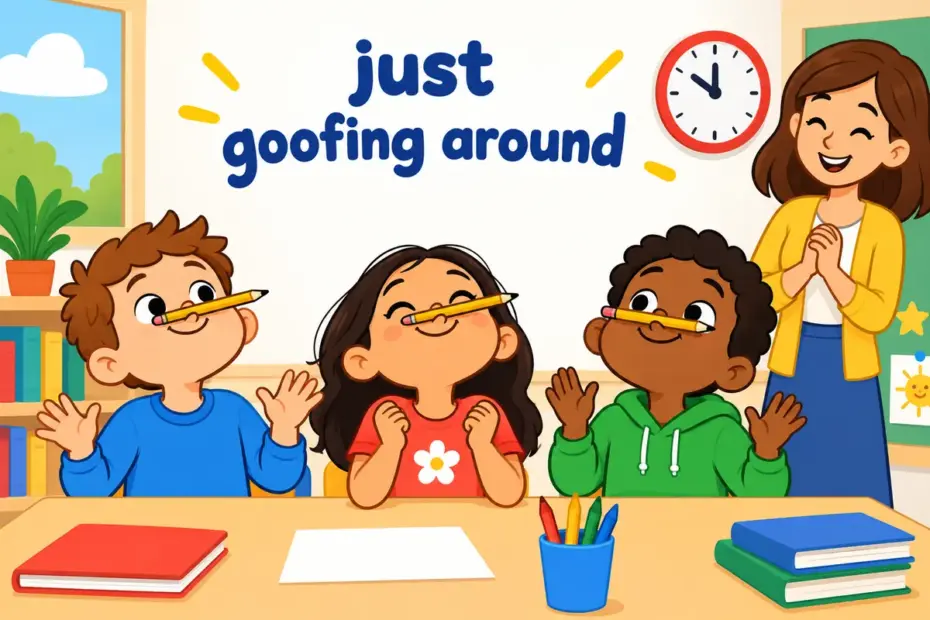
Goof around means to spend time being silly or playful instead of serious, and it never takes an object. To use goof around in a sentence, pair it with a place or a company: “The children goofed around in the garden.” The verb is intransitive, so you goof around with a friend, not goof around a friend.
Goof around at a glance
- Goof around is an intransitive phrasal verb, so it never takes a direct object.
- Its forms are goof around, goofs around, goofed around and goofing around.
- The tone is informal and usually affectionate rather than critical.
- It often follows a place phrase such as in class or a company phrase such as with friends.
- The commonest error is confusing it with goof off, which means avoiding work.
What does goof around mean?
Goof around is a phrasal verb meaning to behave playfully and waste time on purpose, with no harm intended. The Cambridge entry for goof around treats the phrase as informal, which explains why it suits a chat about friends but not a formal review. The silliness is the point, not a failure.
| Sense | Plain meaning | Example sentence |
|---|---|---|
| Play the fool | Act silly to amuse others | The cousins goofed around at the table. |
| Pass time idly | Spend time without a serious aim | We goofed around until rehearsal began. |
One limitation is worth stating. Goof around is not an insult, and it does not describe deliberate time-wasting at work, which belongs to goof off. A person who goofs around may still be liked and productive, while goofing off carries a quiet criticism. Register matters as much as meaning here. The phrase also leans on continuous forms, so a single moment of silliness is usually goofing around rather than a completed action.
How do you use goof around in a sentence?
Goof around is intransitive, so it takes no object and its particle stays put. Add detail with a prepositional phrase: goof around in the corridor, at rehearsal, with a classmate, or for an hour. The verb is happiest in continuous forms, as in they were goofing around. Although it needs no object, it rarely stands alone; a place or a companion is what makes the sentence sound finished.
| Pattern | Example | What it signals |
|---|---|---|
| goof around + place | They goofed around in the hallway. | Names where the play happens. |
| goof around + with + person | She goofs around with her cousins. | Company rather than an object. |
| goof around + time phrase | We goofed around for an hour after lunch. | Duration or a routine. |
| stop + goofing around | Stop goofing around and start the task. | The gerund after another verb. |
| be + goofing around | They were goofing around during the break. | Continuous form, the natural choice. |
Notice that the particle never moves and no pronoun can be inserted: unlike cut down or flip over, goof around is not separable. A learner who writes goof it around has borrowed the pattern of a different verb entirely.

Goof around in a sentence: examples across contexts
The phrase keeps its warm, informal sense across scenes. The thirteen sentences below move from a playground to a reunion, and each row shows what the surrounding phrase is doing.
| Context | Example sentence | Why this works |
|---|---|---|
| Playground | The children goofed around on the climbing frame. | A place phrase replaces the object. |
| Classroom | The pair goof around at the back of the room. | Present simple shows a habit. |
| Sports practice | The team goofed around before the serious drills began. | Contrasts play with work inside one sentence. |
| Text message | We were just goofing around, nothing serious. | The continuous softens the meaning. |
| Family reunion | The cousins goof around with old board games all evening. | The with phrase adds company. |
| Music lesson | The band goofed around until the teacher arrived. | A time clause frames the play. |
| Office break room | We goof around for five minutes between calls. | Keeps the action short and harmless. |
| Memoir | My brother and I goofed around through every rainy holiday. | The past simple carries a warm memory. |
| Advice column | It is fine to goof around, as long as the work still gets done. | Conditions the permission rather than banning it. |
| Conversation | I goof around with my neighbour while we garden. | The first person suits a casual anecdote. |
| Music rehearsal | The drummer goofed around with a pair of brushes between songs. | An instrument supplies a prop, not an object. |
| Video call | We goofed around for a minute before the meeting began. | A short duration keeps the play harmless. |
| Library | Two friends goofed around quietly until a stern glance silenced them. | Shows the phrase can be restrained without losing its warmth. |
Every row keeps the two words together, and none of them puts a noun directly after the verb. That fixed shape, rather than the meaning, is what separates goof around from most other verb-and-particle pairs.
Goof around vs fool around and goof off
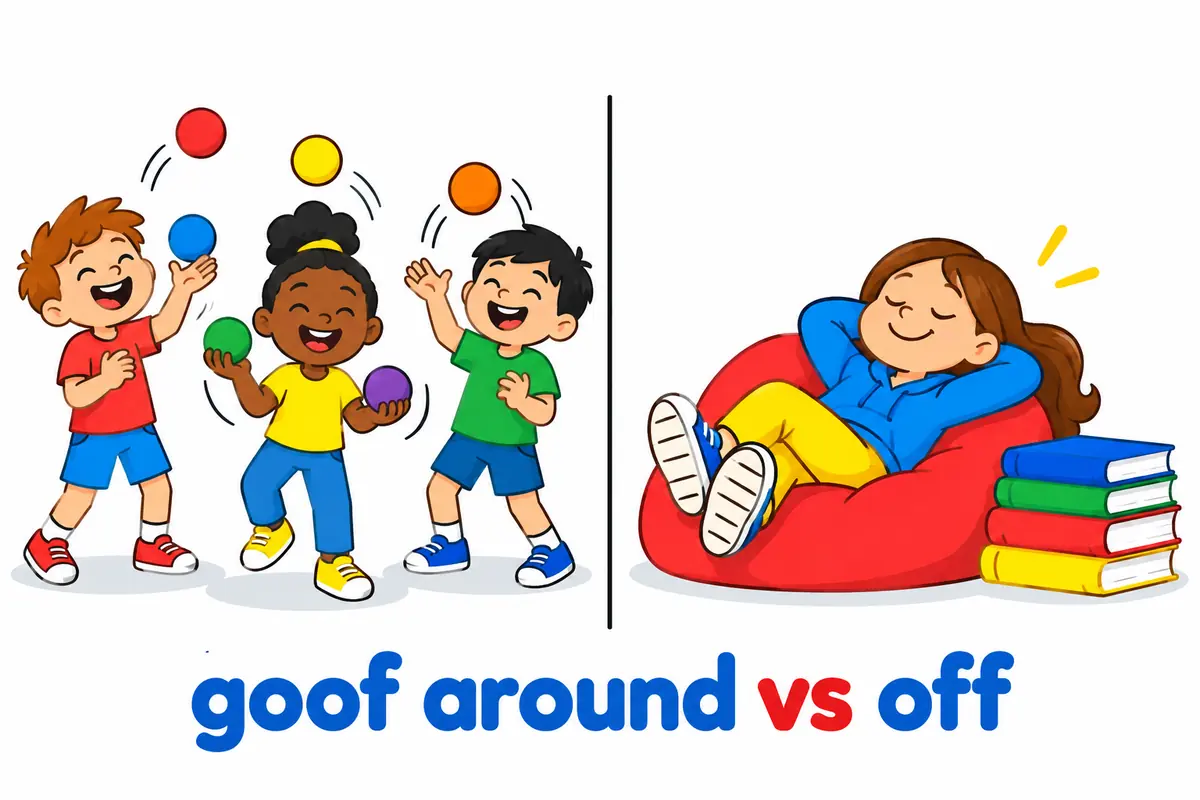
Goof around overlaps with two phrases and matches neither. fool around can mean the same harmless play but also carries other, less innocent senses, while goof off means avoiding work you are supposed to do. The three phrases share a casual tone, but they sort by intent and by how much harm the behaviour does.
| Attribute | goof around | fool around | goof off |
|---|---|---|---|
| Core sense | Play the fool harmlessly | Behave idly or, sometimes, unfaithfully | Avoid required work |
| Criticism | Little | Depends on context | Direct |
| Object | None | None | None |
| Typical place | Break, play, rehearsal | Anywhere, often ambiguous | Work, school, a task |
| Register | Informal, warm | Informal, sometimes loaded | Informal, mildly disapproving |
Verdict: choose goof around for gentle play, clowning around when the fooling is performative, and goof off when the point is shirking. The shared goof links the last two, but only the particle tells them apart. If a colleague is avoiding a task, the sentence needs goof off even when the mood looks playful, because the effect on the work is what that phrase measures.
Word forms and grammar of goof around
Goof around inflects as a regular verb and keeps its particle fixed, so goofing around is the continuous form and goofs around the third person. The table also places it beside an innocent neighbour, hanging around the shops, which shares the particle but not the silliness, and goof up a task, which shares the base verb but means making a mistake. The phrase is intransitive in every sense, so no form of it ever accepts a direct object.
| Form | Part of speech | Example |
|---|---|---|
| goof around | phrasal verb, base form | They goof around after lunch. |
| goofs around | phrasal verb, third person singular | He goofs around during every break. |
| goofed around | phrasal verb, past and past participle | We goofed around all afternoon. |
| goofing around | phrasal verb, present participle | They are goofing around in the yard. |
| goof off | different phrasal verb | He goofed off instead of filing the forms. |
| get around | different phrasal verb | She got around to the repairs at last. |
Common mistakes with goof around
- Incorrect:
They goofed around the lesson.Correct: They goofed around during the lesson. Rule: The verb is intransitive, so a time phrase needs during, not a bare object. - Incorrect:
He goofed around his homework.Correct: He goofed off instead of doing his homework. Rule: Avoiding work is goof off, a different phrasal verb. - Incorrect:
We goof around it every Friday.Correct: We goof around every Friday. Rule: There is no object, so there is no pronoun to place. - Incorrect:
The manager goofed around the report.Correct: The manager made an error in the report. Rule: For a mistake, use goof up or a neutral phrase, not goof around.
Practice using goof around
Work through the seven items, then read the answers for the reason behind each one.
- Fill the gap: The pupils ______ in the playground until the bell rang.
- Choose the better word: He lost the contract because he (goofed around / goofed off) all morning.
- Correct the error: They goofed around the whole film.
- Build a sentence: use goof around with about two friends in a kitchen.
- Spot the register: which belongs in a school report – the class goofed around before the bell, or the class engaged in unstructured play?
- Rewrite in the past continuous: The boys goof around in the shed.
- Rewrite with a companion phrase: We goof around. Add “with our cousins”.
Answers
- goofed around – the place phrase replaces the object.
- goofed off – losing a contract means work was avoided, not playful fun.
- They goofed around during the whole film – no direct object is allowed.
- Model answer: The two friends goofed around with a wooden spoon while the soup simmered.
- The class engaged in unstructured play – a formal report avoids the informal phrasal verb.
- The boys were goofing around in the shed – the continuous carries the ongoing action.
- We goof around with our cousins – a companion phrase replaces the object the verb cannot take.
The bottom line
Use goof around in a sentence for playful, harmless silliness, and keep it object-free because the verb is intransitive. The two details that settle most sentences are the fixed particle and the informal, affectionate tone, which suits a chat but not a report. Where work is being avoided, turning things around is a different matter entirely, and goof off is the sharper phrase. A short burst of silliness before a task is goofing around; the same behaviour during the task is goofing off.
Frequently asked questions about goof around
Is goof around the same as goof off?
No, and the particle carries the difference. Goof around means playful silliness that harms nobody, while goof off means avoiding work you should be doing. A team that goofs around before practice is bonding; a team that goofs off during a drill is shirking.
Can goof around take an object?
No. Goof around is intransitive, so it never takes a direct object. A sentence needs goof around with a friend or goof around in the yard rather than goof around a friend. Any noun after the verb belongs to a preposition, not to the verb itself.
Is goof around rude?
It is informal but rarely rude. The word usually signals warmth and mild amusement, so it can tease without wounding. It still suits conversation better than a formal report, where unstructured play or off-task behaviour would carry the same meaning more neutrally.
What is the difference between goof around and fool around?
Goof around is the safer phrase, because it only means harmless play. Fool around can mean the same thing but also has other, more loaded meanings, so it can create an unintended suggestion. When the sense is simply friends being silly, goof around is the clearer choice.