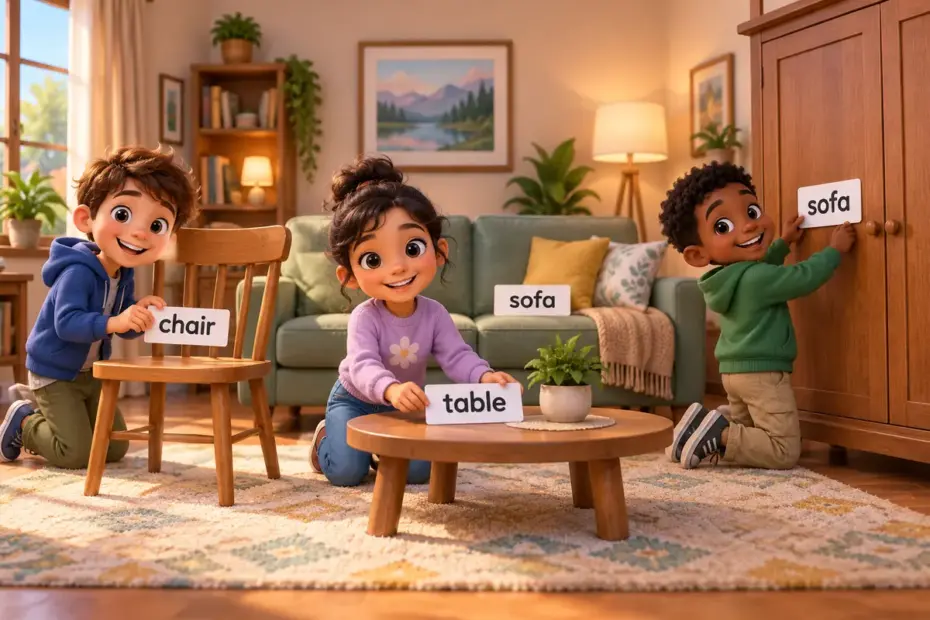
A list of furniture items names groups the objects in a room by the job each one does, such as a chair for sitting, a table for working and a wardrobe for storing clothes. Most names combine a short describing word with a base noun, and one example shows the pattern: a coffee table sits in front of a sofa.
List of furniture items names at a glance
- Furniture names sort by function: seating, tables, storage, beds, and support pieces.
- Furniture itself is uncountable, but each item, such as a chair, is a count noun.
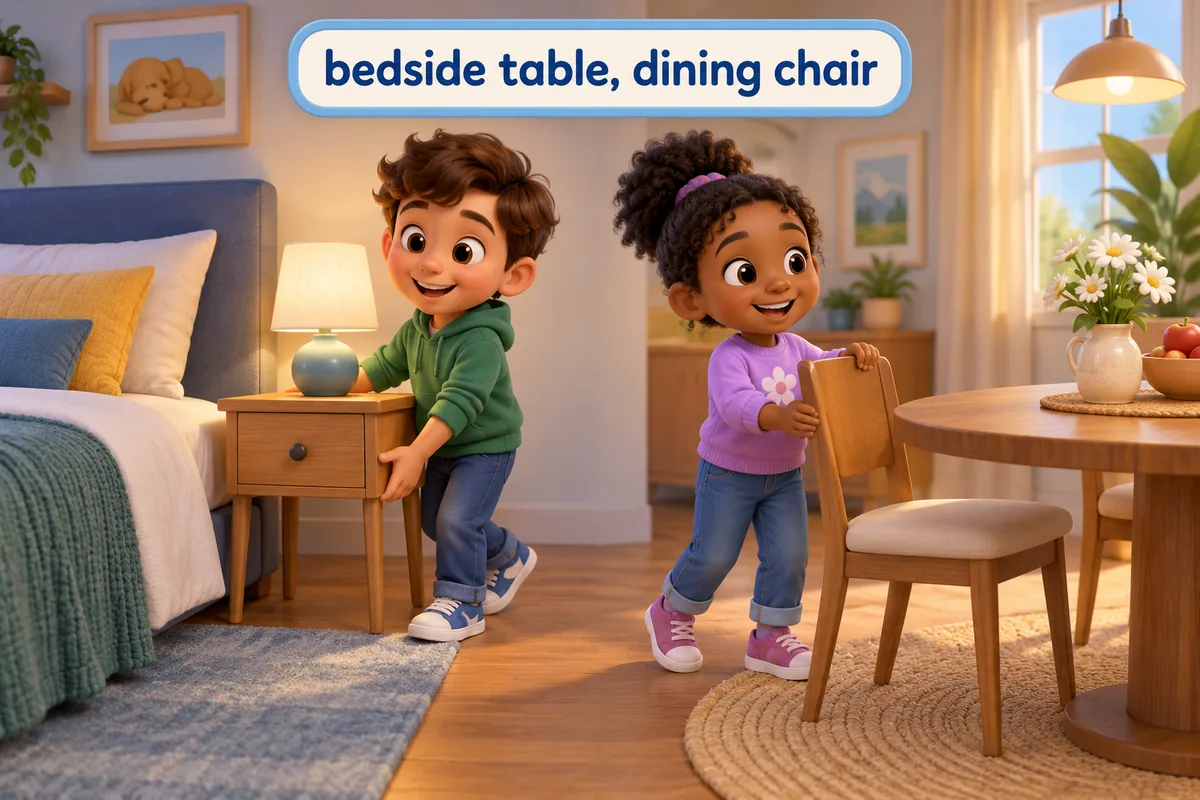
- Many names combine a room or a use with a base noun, as in bedside table or dining chair.
- The same object often has two names, such as sofa and couch or wardrobe and closet.
- The commonest error is writing furnitures, a form English does not use.
What are furniture items?
Furniture items are the movable objects that make a room usable, and the names divide by what each piece helps you do. The describing words that often sit before these nouns are gathered in adjectives for furniture. A useful test is to ask whether the object is fixed to the building: a built-in cupboard or a fitted wardrobe counts as a fixture, while a chair or a table can be carried to another room, which is what makes it furniture.
| Function group | Job in the room | Common names |
|---|---|---|
| Seating | support a seated person | chair, armchair, sofa, bench, stool, ottoman |
| Tables and surfaces | hold work, food or display | dining table, coffee table, desk, side table |
| Storage | hold clothes and objects | wardrobe, dresser, chest of drawers, cabinet, bookshelf |
| Beds | support sleep | bed, bunk bed, cot, futon, daybed |
| Support and display | hold or divide things | shelf, sideboard, screen, coat stand |
How are furniture names built?
Most furniture names are compounds, and the first word usually tells you the room, the material or the use while the second word names the piece. The same building habit appears among more adjectives for furniture.
| Pattern | Example | What it signals |
|---|---|---|
| room + base noun | bedside table | the place the piece belongs |
| use + base noun | dining chair | the task the piece serves |
| material + base noun | oak chest | the substance it is made of |
| shape or size + base | armchair, bunk bed | a defining feature |
| base noun alone | desk | the whole piece in one word |
List of furniture items names across contexts
The names appear in shops, home plans and descriptions, and the register decides how much detail you give. Small items that belong to a nursery follow the same naming habit, as shown in baby items that start with C.
| Context | Example sentence | Why this works |
|---|---|---|
| Furniture shop | This oak sideboard has two drawers and a shelf. | names material and features |
| Home plan | The bedroom holds a double bed and a tall wardrobe. | lists pieces by room |
| Classroom | Each pupil needs a desk and a chair. | two basic count nouns |
| Moving list | Pack the small furniture before the heavy sofa. | furniture used as a mass noun |
| Interior blog | A low bench suits a narrow hallway. | a piece plus a size word |
| Office email | We ordered a new desk and a filing cabinet. | named office pieces |
| Estate agent | The dining table seats six comfortably. | a piece described by its capacity |
| Hotel review | The room had a firm bed and a small writing desk. | one comfort word per piece |
| Nursery guide | A cot and a changing table fit a small room. | smaller items named together |
| Story | He sank into the worn armchair by the window. | a vivid single piece |
Which word should you use?
Several pairs name the same object, and the choice usually depends on region, size or formality. Household lists that name smaller objects also sit under baby items that start with B, and the same base-noun logic applies.
| Pair | Usual difference | Example |
|---|---|---|
| sofa and couch | sofa is the fuller, more formal word; couch is casual | We bought a three-seat sofa. |
| wardrobe and closet | wardrobe is the piece; closet is a small room | Hang the coat in the wardrobe. |
| dresser and chest of drawers | dresser often adds a mirror on top | The dresser holds folded shirts. |
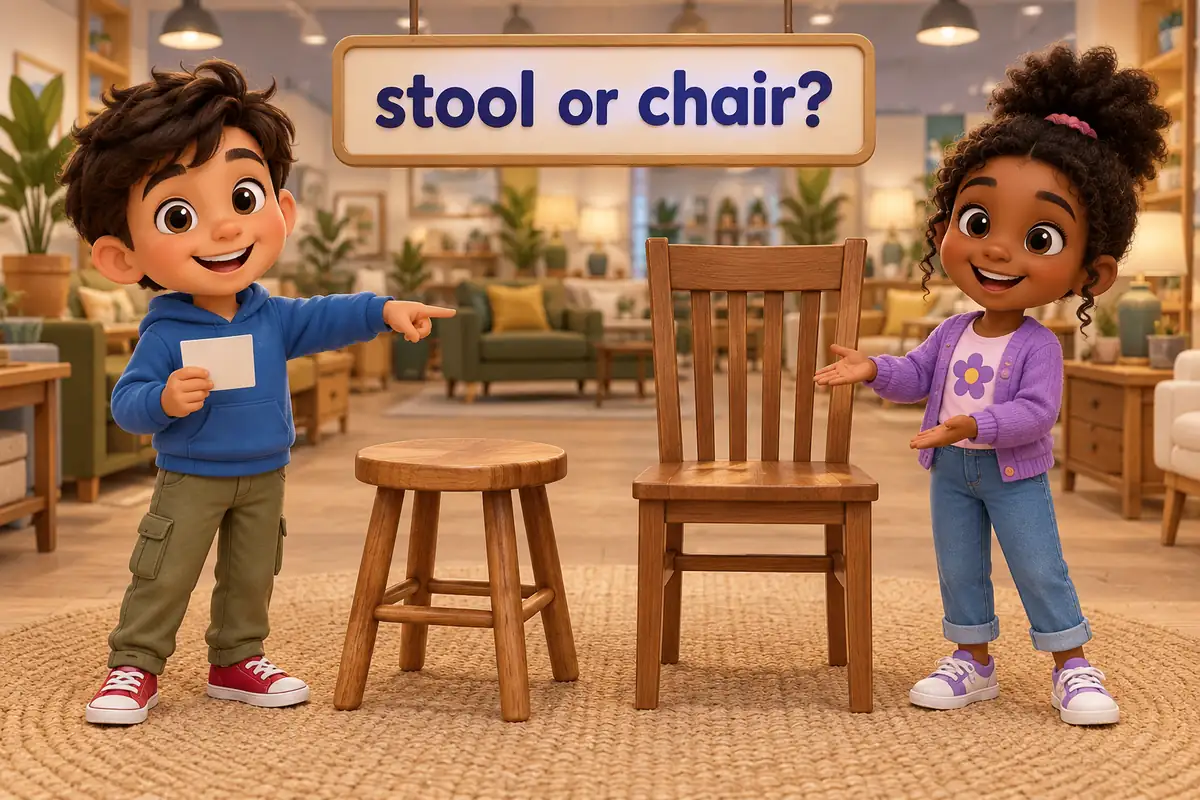
| stool and chair | a stool has no back, a chair does | Pull up a stool to the counter. |
| cot and crib | cot is British for a baby bed; crib is American | The cot stands beside the bed. |
Choose the shorter, plainer name unless a shop label or a plan needs the precise word. Region decides cot against crib and wardrobe against closet, so pick the term that matches your readers rather than treating one as more correct.
Word forms and grammar of furniture names
One word for the whole group is uncountable, while every individual piece is countable, and that split controls the verb.
| Form | Part of speech | Example |
|---|---|---|
| furniture | uncountable noun | The furniture is made of oak. |
| chair | count noun | One chair is short of the table. |
| chairs | count noun, plural | The chairs are stacked in the corner. |
| a piece of furniture | partitive phrase | That stool is a fine piece of furniture. |
| furnish | verb | They furnished the flat cheaply. |
| furnished | adjective | We rented a furnished room. |
| upholstered | adjective | The sofa is upholstered in linen. |
Furniture takes a singular verb and never a plural s, so write the furniture is heavy, not the furnitures are heavy. To count, use a partitive such as a piece of furniture or three items of furniture, and keep the count noun for the individual object.
Common mistakes with furniture items names
Mistake 1: furniture given a plural. Incorrect: The furnitures were delivered on Friday. Correct: The furniture was delivered on Friday. Rule: furniture is uncountable and takes a singular verb.
Mistake 2: a number directly before furniture. Incorrect: We bought three furnitures. Correct: We bought three pieces of furniture. Rule: an uncountable noun needs a partitive before a number.
Mistake 3: stool and chair treated as the same. Incorrect: He leaned back in the stool. Correct: He leaned back in the chair. Rule: a stool has no back to lean against.
Mistake 4: wardrobe called a room. Incorrect: Walk into the wardrobe for your coat. Correct: Open the wardrobe for your coat. Rule: a wardrobe is a piece of furniture, while a closet or a walk-in is a small room.
Mistake 5: desk and table swapped. Incorrect: She wrote the essay at the dining table. Correct: She wrote the essay at her desk. Rule: a desk is built for work, a dining table for meals, and the name follows the use.
Practice using furniture items names
- Fill in the blank: The nursery holds a cot and a changing ___.
- Choose the better word: He pulled up a (stool / sofa) to the kitchen counter.
- Correct the error: The furnitures were delivered today.
- Build a sentence: use bedside table to describe a lamp beside a bed.
- Spot the register: which suits an estate agent, (a) Nice couch thing, or (b) A three-seat sofa with a wooden frame?
- Fill in the blank: Hang your coat in the ___ beside the door.
Answers
- table, because a changing table is the fixed name for the nursery piece.
- stool, because a counter seat with no back is a stool.
- The furniture was delivered today; furniture is uncountable and takes a singular verb.
- She set the lamp on the bedside table beside her bed.
- (b), because an estate agent uses a precise name and a material.
- wardrobe, because a wardrobe is the piece that stores coats.
The bottom line
A list of furniture items names is easiest to learn by function, because each group names the job the piece does. Seating, tables, storage and beds carry most of the everyday words, and a room word or a use word plus a base noun builds most of the rest. Remember that furniture is uncountable, and that each single piece is a count noun.
Frequently asked questions about furniture items
Why is furniture an uncountable noun?
Furniture names a whole set of movable objects rather than one item, so English treats it like water or luggage and gives it no plural form. It takes a singular verb, as in the furniture is new. To count individual objects, add a partitive such as a piece of furniture.
What is the difference between a sofa and a couch?
Both name a long padded seat for two or more people, and the words overlap in everyday use. Sofa is the more formal, standard term in shops and plans, while couch is casual and slightly older. Choose sofa for a catalogue or a plan and couch for relaxed speech.
Is a desk just a table?
A desk is a table built for work, with features such as drawers, a writing surface at the right height or a cut-out for a chair. A dining table is built for meals and is usually larger and shared. The name follows the use, not the shape alone.
What is the difference between a wardrobe and a closet?
A wardrobe is a free-standing piece of furniture with doors that hold clothes. A closet is a small built-in space or room, common in American English. British speakers often say walk-in wardrobe where Americans say walk-in closet, and both describe the same storage space.