
A list of kitchen utensils names gathers the hand tools used to prepare, cook and serve food, such as a knife for cutting, a whisk for beating and a ladle for serving soup. Most names pair a small describing word with a base noun, and one example sets the pattern: a wooden spoon.
List of kitchen utensils names at a glance
- Kitchen utensils sort by task: cutting, mixing, measuring, cooking and serving.
- A utensil is a hand tool you hold; a pot or a pan is cookware, not a utensil.
- Many names open with a material or shape word, as in wooden spoon or slotted spoon.
- Utensil is a count noun, while cookware and cutlery are uncountable.
- The commonest error is calling an electric mixer a utensil.
What are kitchen utensils?
Kitchen utensils are the small hand tools you pick up and hold while cooking, and the names divide by the task each tool performs. A utensil is held in the hand, while an appliance has a motor or a plug; a wider browse of kitchen vocabulary appears in kitchen items from A to Z. A knife, a spoon and a whisk are utensils, but a blender, a kettle and a toaster are appliances, and pots, pans and trays are cookware.
| Task group | Job in the kitchen | Common utensil names |
|---|---|---|
| Cutting and preparing | chop, peel and slice food | knife, paring knife, peeler, grater, chopping board |
| Mixing and stirring | combine and beat ingredients | whisk, spoon, wooden spoon, spatula, mixing bowl |
| Measuring | give an exact quantity | measuring cup, measuring spoons, kitchen scale |
| Cooking and draining | turn, lift and drain food | tongs, turner, ladle, colander, strainer |
| Serving | carry food to the table | serving spoon, slotted spoon, cake slice |
How are kitchen utensil names built?
Most utensil names are compounds, and the first word usually names the material, the shape or the job while the base noun names the tool. The describing words that often precede these nouns are gathered in adjectives for kitchen.
| Pattern | Example | What it signals |
|---|---|---|
| material + base noun | wooden spoon | the substance it is made of |
| shape or feature + base | slotted spoon | a hole or notch it carries |
| job + base noun | paring knife | the task the tool performs |
| size + base noun | measuring spoon | that it gives an exact amount |
| base noun alone | whisk | the whole tool in one word |

List of kitchen utensils names across contexts
The names appear in recipes, lessons and shopping lists, and the register decides how much detail each name carries. A plain use of the room word itself appears in kitchen in a sentence.
| Context | Example sentence | Why this works |
|---|---|---|
| Recipe | Whisk the eggs until they turn pale. | names the tool by its job |
| Classroom | A colander drains the water from cooked pasta. | defines a tool by its task |
| Shopping list | Buy a new peeler and two wooden spoons. | count nouns with quantities |
| TV cookery | Fold the flour in with a spatula. | a soft tool for a gentle action |
| Home blog | A sharp paring knife makes quick work of the fruit. | a trait plus a specific tool |
| Cafe menu | The soup is served with a ladle into warm bowls. | the serving tool named |
| Baking class | Level the flour with the back of a knife. | an improvised measuring trick |
| Safety note | Keep the grater’s sharp face turned away. | a hazard phrased plainly |
| Gift guide | A good kitchen scale suits a keen baker. | one measuring tool praised |
| Story | She stirred the stew with a worn wooden spoon. | a vivid single utensil |
Which word should you use?
Several names are close in meaning, and the choice depends on whether the item is held, plugged in or set on the heat. A related pair about fixed fittings appears in kitchen sink in a sentence. Where these tools end up is shown in kitchen table in a sentence, the surface they are set down on.
| Pair | Usual difference | Example |
|---|---|---|
| utensil and appliance | a utensil is held; an appliance has power | Use a whisk, not the electric mixer. |
| utensil and cookware | cookware is pots, pans and trays | Heat the oil in the pan. |
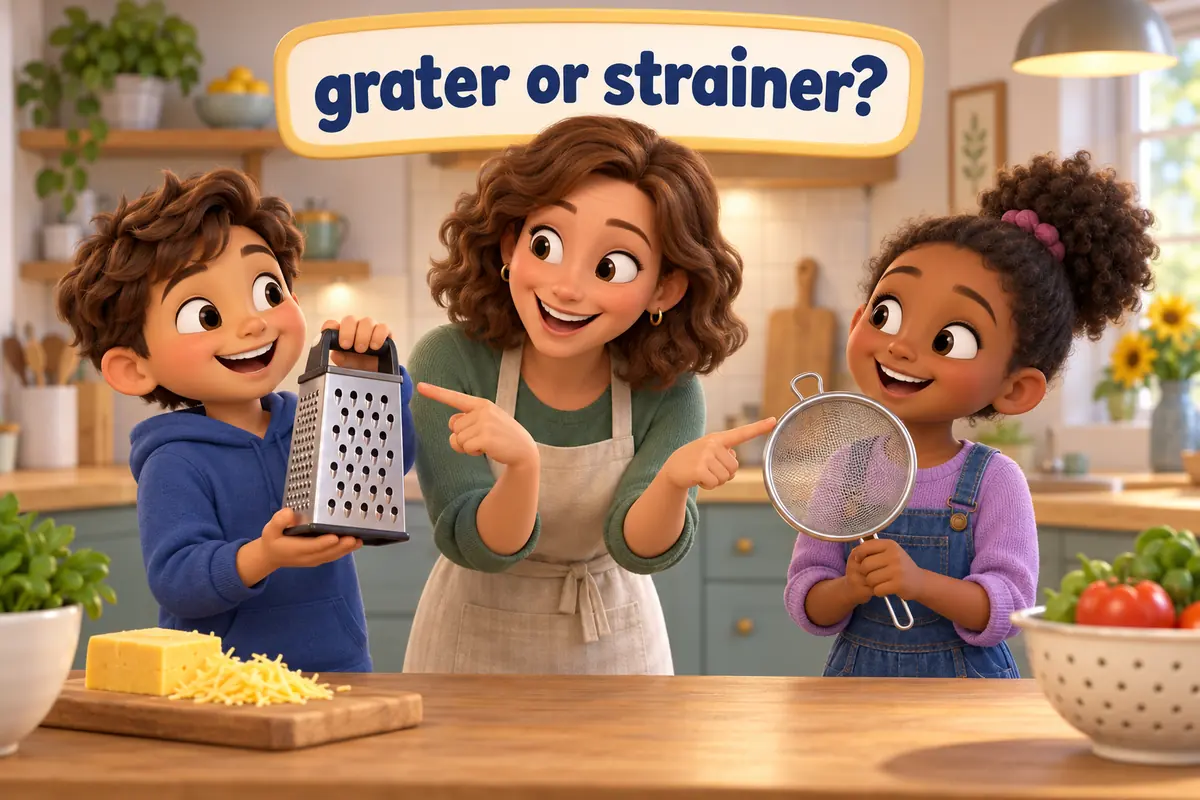
| colander and strainer | a colander is a large bowl; a strainer is fine-meshed | Drain the rice in the colander. |
| pot and pan | a pot is deep; a pan is shallow | Boil the water in the pot. |
| spatula and turner | a spatula scrapes; a turner flips | Flip the pancake with the turner. |
Choose the plain base noun unless a recipe needs precision, because a cook understands whisk, ladle and grater at once. Add the describing word only when it changes the tool, as when a wooden spoon and a slotted spoon are genuinely different objects.
Word forms and grammar of kitchen utensil names
Utensil is countable and takes a plural, while the group words cookware and cutlery are uncountable, and that split controls the verb.
| Form | Part of speech | Example |
|---|---|---|
| utensil | count noun | This utensil is easy to grip. |
| utensils | count noun, plural | The utensils dry in the rack. |
| cookware | uncountable noun | The cookware is stored in the drawer. |
| cutlery | uncountable noun | The cutlery is polished for dinner. |
| grate | verb | Grate the cheese finely. |
| whisk | noun or verb | Whisk the batter smooth. |
| measure | verb | Measure the sugar first. |
Cookware and cutlery take a singular verb and never a plural s, so write the cutlery is clean, not the cutleries are clean. When you need to count, add a partitive such as an item of cookware or a piece of cutlery.
Common mistakes with kitchen utensil names
Mistake 1: an appliance called a utensil. Incorrect: Plug in the utensil to blend the soup. Correct: Plug in the blender to blend the soup. Rule: a utensil is held by hand, while a blender is an appliance.
Mistake 2: cutlery given a plural. Incorrect: The cutleries are in the drawer. Correct: The cutlery is in the drawer. Rule: cutlery is uncountable and takes a singular verb.
Mistake 3: colander and strainer treated as one. Incorrect: Sift the flour through the colander. Correct: Sift the flour through the strainer. Rule: a colander has large holes for draining, a strainer has fine mesh for sifting.
Mistake 4: pot and pan swapped. Incorrect: Boil the pasta in a shallow pan. Correct: Boil the pasta in a deep pot. Rule: a pot is deep for boiling, a pan is shallow for frying.
Mistake 5: missing plural after a number. Incorrect: Wash three wooden spoon. Correct: Wash three wooden spoons. Rule: a number greater than one takes the plural count noun.
Practice using kitchen utensil names
- Fill in the blank: Drain the pasta in the ___.
- Choose the better word: Beat the cream with a (whisk / colander).
- Correct the error: The cutleries are on the table.
- Build a sentence: use peeler to describe preparing a potato.
- Spot the register: which suits a recipe, (a) Grab that spinny thing, or (b) Whisk the mixture for one minute?
- Fill in the blank: Lift the eggs from the pan with the ___.
Answers
- colander, because a colander is the wide bowl with holes for draining.
- whisk, because a whisk is the tool for beating air into cream.
- The cutlery is on the table; cutlery is uncountable and takes a singular verb.
- She reached for the peeler to strip the potato skin.
- (b), because a recipe uses a precise tool name and a clear action.
- turner, because a turner slides under food and flips it.
The bottom line
A list of kitchen utensils names is easiest to learn by task, because every group names the job the tool performs. Cutting, mixing, measuring, cooking and serving carry most of the everyday words, and a material or shape word plus a base noun builds most of the rest. Keep utensil for hand tools, and reserve cookware, cutlery and appliance for their own groups.
Frequently asked questions about kitchen utensil names
What counts as a kitchen utensil?
A kitchen utensil is a hand tool you hold while cooking, such as a knife, a whisk, a spoon or a peeler. Items with a motor or a plug, such as a blender or a kettle, are appliances instead. Pots, pans and baking trays are cookware, a separate group.
Is cookware the same as utensils?
No. Utensils are the small tools you hold, while cookware is the pots, pans and trays that sit on the heat. The two work together, since you stir with a utensil inside a piece of cookware, but the words name different groups and appear on different shop signs.
Why is cutlery uncountable?
Cutlery names a whole set of knives, forks and spoons rather than one specific item, so English treats it like furniture or silverware and gives it no plural. It takes a singular verb, as in the cutlery is clean. To count, say a piece of cutlery.
What is the difference between a colander and a strainer?
A colander is a large bowl with wide holes, used to drain water from pasta or vegetables. A strainer is smaller and has a fine mesh, used to sift flour or strain liquid. The size of the holes, not the handle, is what separates the two names.