
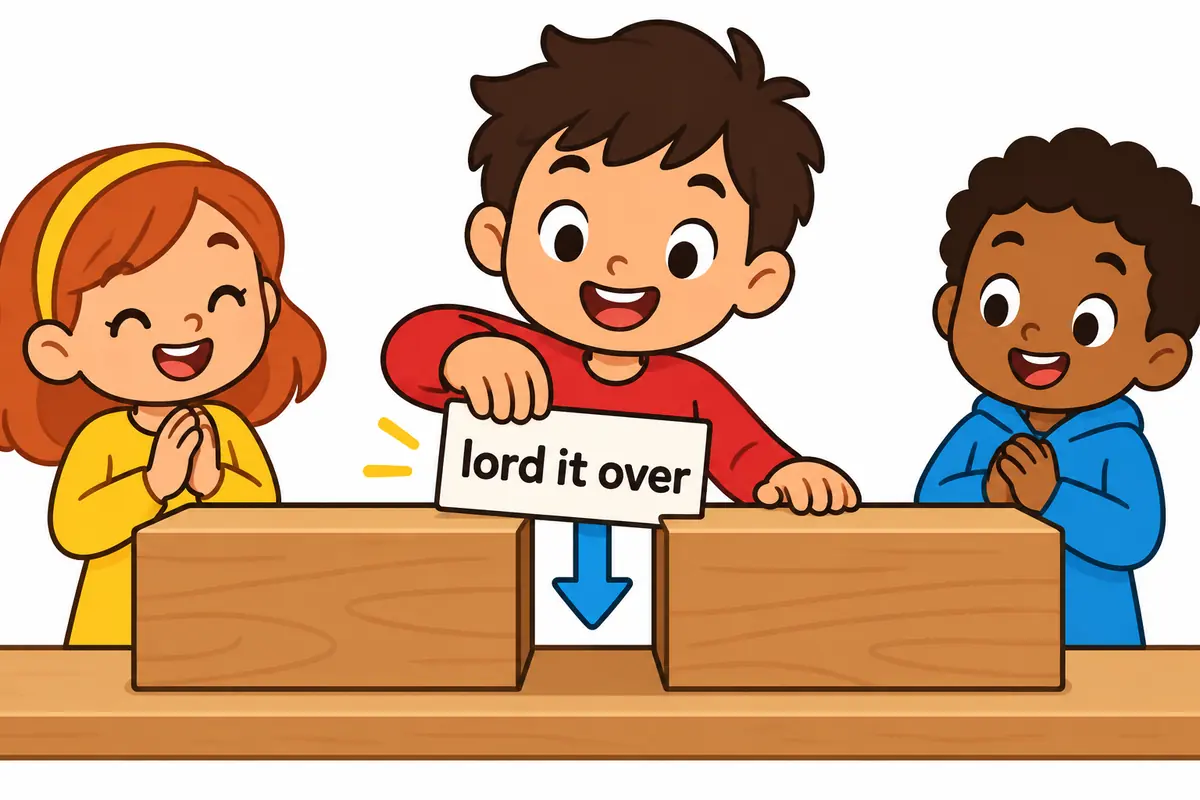
Lord over means to act as though you are superior to somebody, or to hold power over a place or group. To use lord over in a sentence, add the pronoun it: “He lords it over the new players.” The phrase is a phrasal verb, and the object of over names the person who is dominated.
Lord over at a glance
- Lord over is a phrasal verb; its forms are lords over, lorded over and lording over.
- The everyday phrase carries a fixed pronoun: lord it over somebody.
- The object follows the preposition over, so lord over is transitive through that preposition.
- Typical subjects are managers, older siblings and anyone with a little more power than the group.
- The commonest error is dropping it from lord it over, which makes the sentence sound incomplete.
What does lord over mean?
Lord over is a phrasal verb meaning to behave in a proudly superior way toward somebody, or, in a literary register, to hold authority over a place or group. The Cambridge entry for lord over records the domineering sense, which is the one almost every modern sentence needs. A related idea appears in earlier history writing, where a noble family might lord over a valley, but the modern use is about attitude rather than territory.
| Sense | Plain meaning | Example sentence |
|---|---|---|
| Domineer | Act superior and order people about | He lords it over the interns whenever the manager is away. |
| Rule | Hold authority over a place or group, literary | The old duke lorded over the valley for decades. |
One limitation is worth stating plainly. Lord over is never a compliment and rarely neutral, so it is the wrong choice when plain authority is all that needs saying. A team leader who simply sets tasks does not lord over anyone; the phrase implies that the power is enjoyed too much. It also sounds boastful if you use it about yourself.
How do you use lord over in a sentence?
The common phrase is fixed around a pronoun: lord it over somebody. That it is a dummy object, not a reference to anything, and it stays between the two halves of the phrasal verb. The object of over names the person or group being dominated, and the joined order lord over somebody is possible but reads more like ruling than boasting.
| Pattern | Example | What it signals |
|---|---|---|
| lord it over + someone | She lords it over her classmates. | The fixed it marks the everyday phrase. |
| lord over + someone | The manager lorded over the whole team. | Drops it and sounds more like ruling. |
| lord it over + someone + with + noun | He lords it over them with his new title. | Names the thing he is proud of. |
| be lorded over | The village was lorded over by one family. | Passive, formal and literary. |
| lord over + place | A single company lords over the market. | Extends the phrase to power rather than people. |
The fixed pronoun is the part learners drop most often, so treat lord it over as one unit even though the object can change. A rival phrase, bully, is harsher still because it names repeated cruelty rather than mere smugness.
Lord over in a sentence: examples across contexts
Lord over suits situations where a small amount of power goes to somebody’s head. Each example below names the person or group on the receiving end and shows why the phrase fits.
| Context | Example sentence | Why this works |
|---|---|---|
| Classroom | The oldest pupil lords it over the group during every project. | Small, familiar power shows the everyday sense. |
| Workplace email | Since the promotion, he has lorded it over the whole department. | Names the trigger, which explains the new behaviour. |
| News report | The report describes a coach who lorded it over young athletes. | Reported speech keeps the judgement factual. |
| Family conversation | Stop lording it over your little sister. | The imperative is common and takes a direct object. |
| Sports reporting | The champions lorded it over the league for a decade. | Extends the phrase to collective dominance. |
| Business writing | A single supplier lorded over the market and set every price. | Applies the ruling sense to a company. |
| History essay | One family lorded over the province for three centuries. | The literary ruling sense fits long perspective. |
| Online review | The head waiter lorded it over the new staff. | First-hand detail makes the criticism concrete. |
| Academic writing | The study asks why small committees let one member lord it over the rest. | An impersonal frame supports the formal register. |
| Volunteer group | A single committee member lorded it over every decision at the meeting. | Shows the phrase in a setting with no formal rank at all. |
| Podcast discussion | The hosts joke about colleagues who lord it over the shared kitchen. | A light, everyday topic keeps the tone informal. |
| Diary entry | I refuse to let one loud voice lord it over the whole class. | The first person shows the phrase used as a personal complaint. |
Lord over vs tyrannize
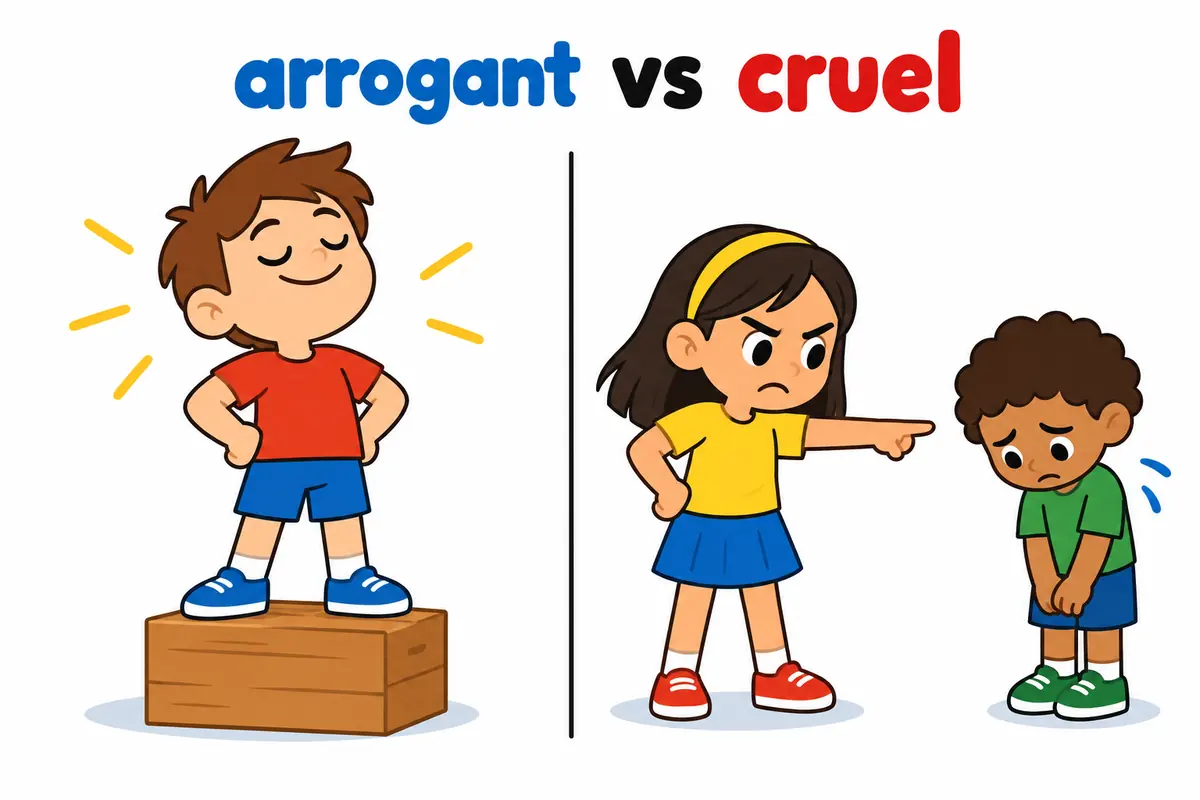
tyrannize is the nearest serious rival. Both describe wielding power badly, but lord over stays close to arrogance and petty authority, while tyrannize names cruelty and oppression. A classmate who lords it over a project group is being insufferable; a ruler who tyrannizes a population is doing something far worse. For plain authority, command and control carry no such accusation.
| Attribute | lord over | tyrannize |
|---|---|---|
| Core meaning | Act superior and domineering | Rule with cruelty and oppression |
| Severity | Arrogant and annoying | Harsh and abusive |
| Typical object | Colleagues, classmates, siblings | Subjects, citizens, workers |
| Fixed pronoun | Keeps it in the common phrase | Uses no fixed pronoun |
| Register | Informal to literary | Formal and serious |
| What it implies | Smugness and entitlement | Systematic abuse of power |
Verdict: choose lord over for someone whose small power goes to their head, and tyrannize only when the power is used to harm.
Word forms and grammar of lord over
Lord over inflects through its base verb, so only lord changes. The common phrase keeps the same fixed it in every tense. The particle over is shared with other phrasal verbs such as carry over, but there it means to transfer rather than to dominate.
| Form | Part of speech | Example |
|---|---|---|
| lord over | phrasal verb, base | Do not lord it over the beginners. |
| lords over | phrasal verb, third person singular | He lords it over everyone. |
| lorded over | phrasal verb, past and past participle | The captain lorded it over the squad. |
| lording over | phrasal verb, present participle | She is always lording it over her cousins. |
| lord it over | fixed phrase | They lord it over the new recruits. |
| carry over | different phrasal verb | We can carry over the balance to next month. |
Common mistakes with lord over
- Incorrect:
He lords over his little brother.Correct: He lords it over his little brother. Rule: The everyday phrase keeps the pronoun it. - Incorrect:
She is lording it on her friends.Correct: She is lording it over her friends. Rule: The fixed preposition is over. - Incorrect:
The manager lorded his team.Correct: The manager lorded over his team. Rule: Lord over needs the preposition over before its object. - Incorrect:
They were lording over by one family.Correct: They were lorded over by one family. Rule: The passive uses the past participle lorded. - Incorrect:
Stop lording it above me.Correct: Stop lording it over me. Rule: English uses over, not above, in this phrase.
Practice using lord over
Work through the seven items, then read the reasoning rather than only the answer.
- Fill the gap: Since he became captain, he has ______ it over the whole team.
- Choose the better word: The small clerk enjoys (lording it over / tyrannizing) the new starters.
- Correct the error: She is always lording over her younger cousins.
- Build a sentence: use lord it over about an older sibling and a shared game.
- Spot the register: which belongs in a formal report — the supervisor lorded it over the trainees, or the boss totally lords it over everyone?
- Rewrite with a neutral verb: The champions lorded it over the league for a decade. Replace the phrase with a word that means simple dominance.
- Correct the error: One family lorded the province for centuries.
Answers
- lorded — the present perfect uses the past participle lorded.
- lording it over — the clerk is smug rather than cruel, so the milder phrase fits.
- She is always lording it over her younger cousins — the fixed it cannot be dropped.
- Model answer: My brother lords it over me whenever we play chess.
- The supervisor lorded it over the trainees — a report avoids the slang intensifier totally.
- The champions dominated the league for a decade — dominated states the fact without the sneer.
- One family lorded over the province for centuries — the preposition over is required.
The bottom line
Use lord over in a sentence when somebody with a little power behaves as though everyone else is beneath them, and keep the fixed pronoun in the everyday phrase: lord it over. The two details that settle most sentences are these: the pronoun it never disappears from the common use, and the phrase carries a judgement, so a neutral description of authority needs a different verb.
Frequently asked questions about lord over
Is it lord over or lord it over?
Both exist, but they lean in different directions. Lord it over is the everyday idiom for acting superior to a person, and it keeps a fixed pronoun that refers to nothing. Lord over without it sounds more literary and usually means to rule a place or group. For a colleague or classmate, the phrase with it is the natural choice.
What does lording it over someone mean?
Lording it over someone means treating that person as if you were their superior, usually by giving orders and showing off a little authority. The behaviour is smug rather than violent, so the phrase fits a boastful captain or an older sibling. It always carries criticism, which is why nobody uses it about themselves.
Is lord over a formal expression?
Lord over sits between informal and literary. In a conversation it sounds natural as lord it over; in a history essay the ruling sense, as in one family lorded over the province, fits a formal register. For neutral business writing, dominated or managed avoids the built-in criticism.
Can you lord over a place rather than a person?
Yes. Without the pronoun it, lord over can take a place or a market as its object, as in a single company lords over the market. That use leans toward the older sense of holding authority rather than showing off. It is perfectly grammatical, though less common than the personal idiom.