
The adjective monetary means related to money or expressed in money. It fits phrases such as monetary value, monetary reward, and monetary policy. Use it when the money connection matters; because coins are already money, “monetary coins” is usually redundant. This guide gives natural examples and clearer alternatives for awkward wording.
Quick guide
- Monetary is an adjective: it modifies a noun, as in monetary value.
- Money is a noun; monetarily is an adverb.
- Monetary aid is useful when the aid is specifically money; aid alone can include other help.
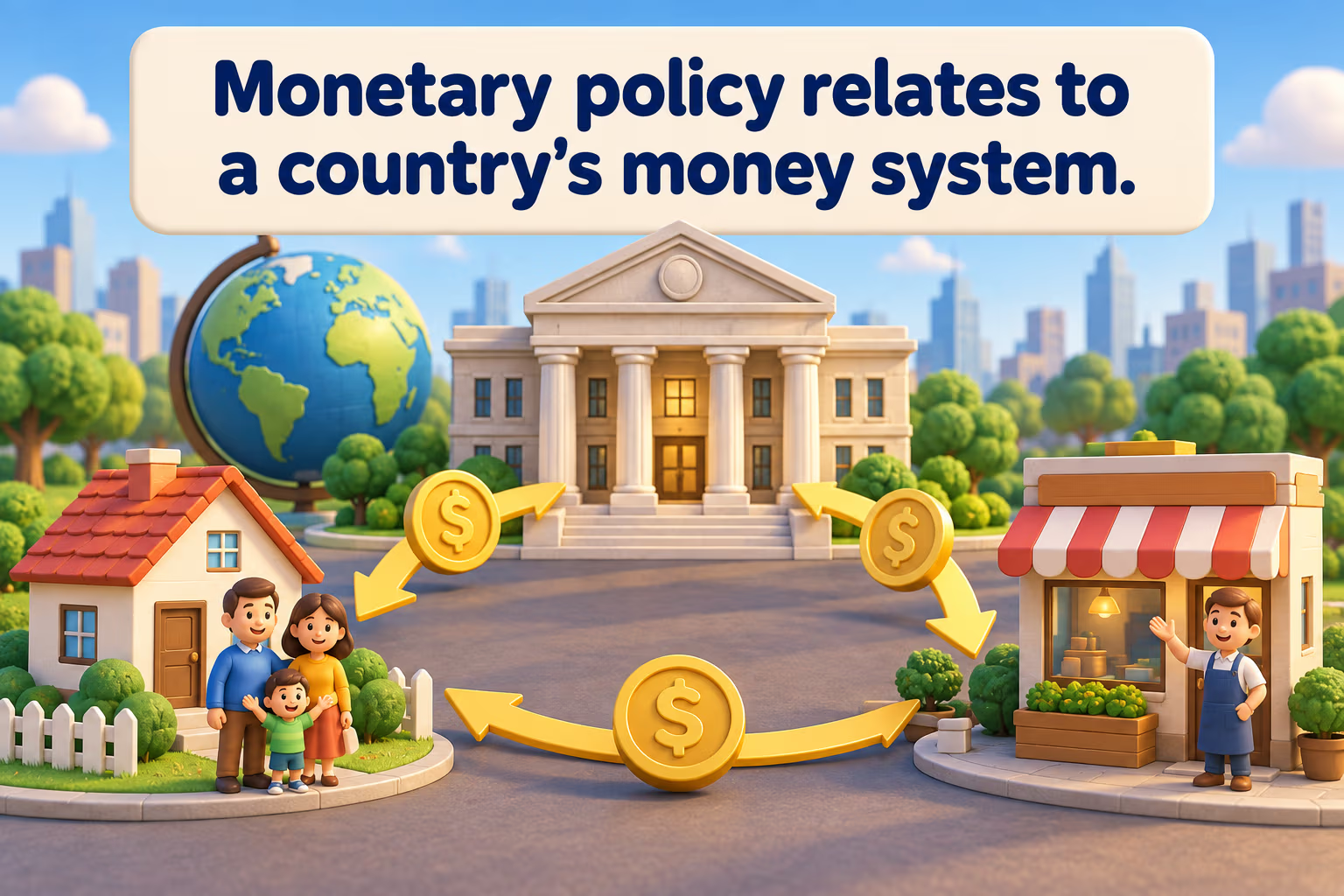
- Monetary policy concerns a country’s money system; it is a technical economics phrase.
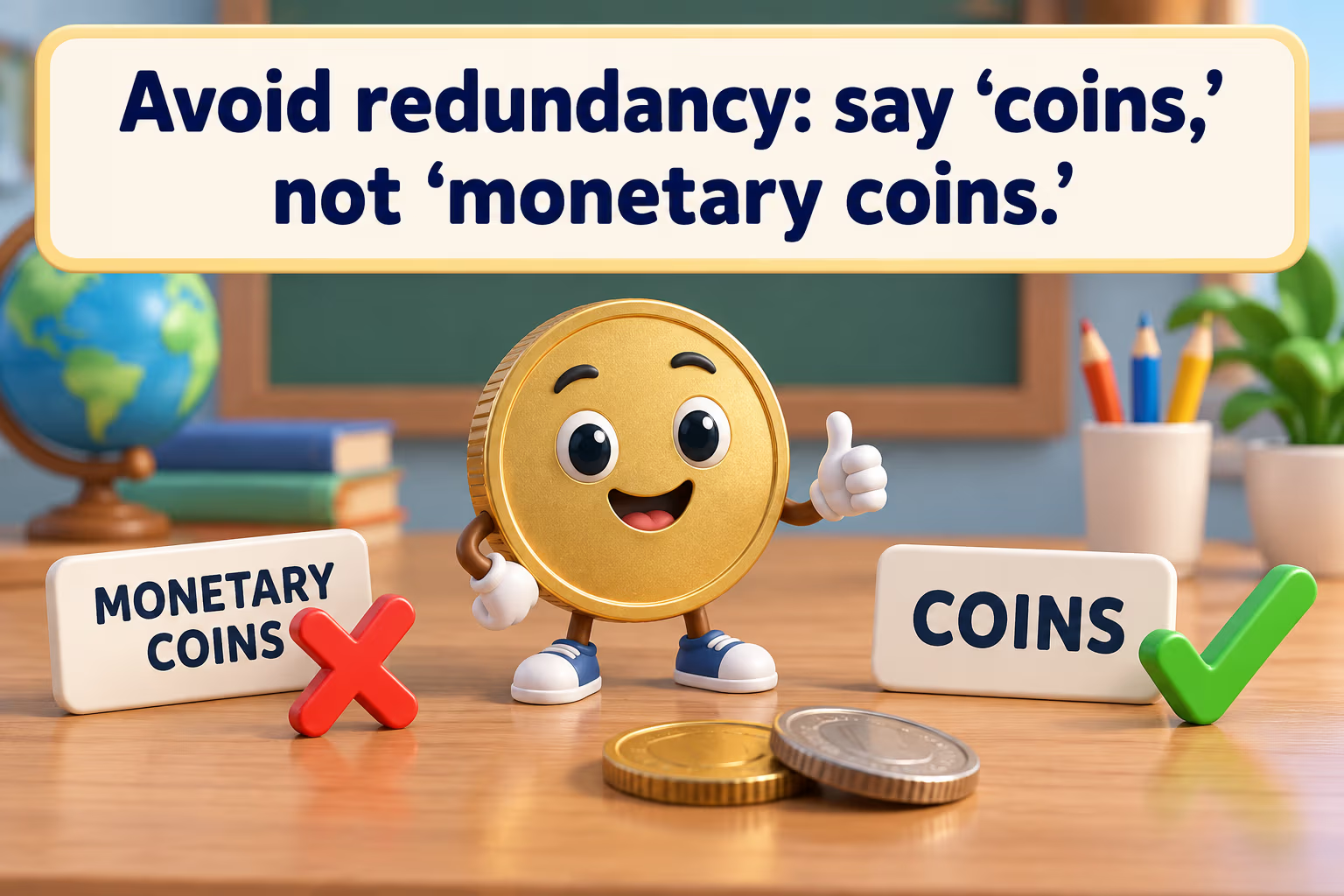
- Prefer simple wording when monetary adds no meaning: say coins, not monetary coins.
What Does Monetary Mean in a Sentence?
Monetary has two closely related uses: it can describe something connected with the money system of a country, or something related to money or expressed as money. Cambridge gives examples such as monetary policy, monetary unit, monetary gain, and monetary value in its dictionary entry for “monetary”.
For example, “The receipt lists the monetary value of the donated books” uses the adjective to specify value measured in money. “The club offered a monetary reward” means the reward is money, while “The report discusses monetary policy” uses the broader economic sense.
Is Monetary a Noun or an Adjective?
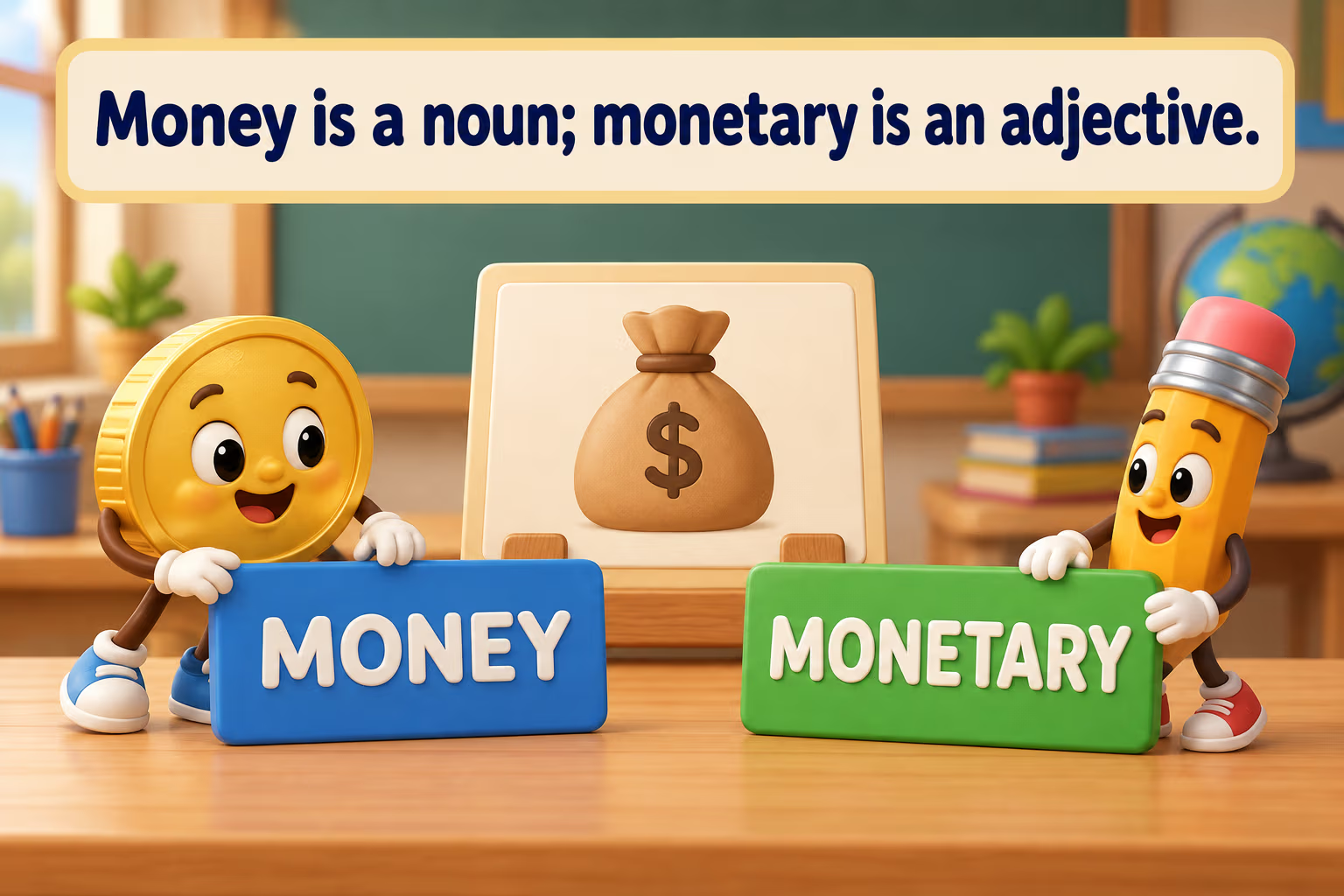
Monetary is an adjective, while money is a noun. In “a monetary reward,” monetary tells what kind of reward; in “the reward was money,” money names the thing. The adverb monetarily means with respect to money, though it is more formal and less common.
Place monetary before a noun it describes: monetary support, monetary amount, or monetary transaction. If a sentence needs a noun, use money, funds, or payment instead. For instance, “They need monetary” is incomplete; “They need money” is grammatical.
When Does Monetary Sound Natural?
Monetary sounds natural when the sentence needs to identify money as the type, measure, or subject. These common combinations show what it modifies.
| Phrase | Example sentence | What it means |
|---|---|---|
| Monetary value | “The catalog lists the monetary value of each item.” | Value expressed as an amount of money. |
| Monetary reward | “The contest offered a monetary reward to the winner.” | A reward paid in money. |
| Monetary aid | “The program provided monetary aid for school supplies.” | Help given as money; other forms of aid may be non-cash. |
| Monetary transaction | “The receipt records the monetary transaction.” | An exchange involving money. |
| Monetary policy | “The central bank published an explanation of its monetary policy.” | Economic policy relating to a country’s money and borrowing conditions. |
The Bank of England’s explanation of monetary policy describes actions a central bank or government can take to influence the amount of money in an economy and the cost of borrowing. That is a specific economic use; an everyday sentence about money does not automatically describe policy or the work of a central bank.
When Should You Revise a Monetary Phrase?
A phrase can be grammatically possible but still vague or repetitive. Before using monetary, ask whether it clarifies that something is about money, or whether the noun already makes that obvious. The source examples below remain unchanged; the notes after them explain where a shorter or more specific option reads better.
The full original examples follow for reference. The corrections later in this guide are additive notes, not replacements for the source wording.
Do you know what the term “monetary” means? Simply put, “monetary” relates to money or currency, involving the use or control of funds or financial resources.
Understanding the monetary system is crucial in both personal and global financial management. From budgeting at home to analyzing economic policies on a national level, the concept of monetary transactions impacts various aspects of our daily lives.
7 Examples Of Monetary Used In a Sentence For Kids
- He needs monetary help to buy new toys.
- Monetary donations can help those in need.
- We can save our monetary rewards for a special treat.
- The bank takes care of monetary transactions.
- My piggy bank is filled with monetary coins.
- We should always be careful with our monetary resources.
- Learning about monetary value is important for our future.
14 Sentences with Monetary Examples
- Monetary issues can often arise when managing a tight budget as a college student in India.
- It is important for college students to prioritize their expenses and make wise monetary decisions.
- Saving money and being mindful of monetary spending can help college students navigate their financial responsibilities.
- Many college students take on part-time jobs to supplement their monetary needs for books, food, and other essentials.
- Seeking monetary assistance through scholarships and grants can alleviate the financial burden on college students.
- Budgeting software and apps can be useful tools for college students to track their monetary transactions.
- College students should explore different monetary resources available on campus such as financial aid offices and student support services.
- Learning about investments and financial planning early on can benefit college students in their future monetary decisions.
- Understanding the importance of building a strong monetary foundation can empower college students to make informed financial choices.
- Participating in monetary workshops and seminars can help college students enhance their financial literacy skills.
- Collaborating with classmates on monetary projects can provide valuable insights and perspectives for college students.
- Donating to monetary charity drives organized by college student bodies can contribute to social causes and community development.
- Leveraging monetary resources to support student-led initiatives can foster an entrepreneurial spirit among college students.
- Engaging in monetary competitions and challenges can be a fun way for college students to showcase their financial knowledge and expertise.
How To Use Monetary in Sentences?
When Monetary is used in a sentence, it refers to anything related to money or currency. You can use Monetary as an adjective to describe things that involve finances or financial transactions.
Here are some examples of how to use Monetary in a sentence:
- “They received a monetary reward for their hard work.”
- “The company’s goal is to achieve monetary stability.”
- “She donated a large sum of monetary aid to the charity.”
To use Monetary correctly, remember that it is typically used to describe things that are related to money or finances. It can be used in various contexts, such as economics, business, or personal finances.
When constructing a sentence with Monetary, make sure to consider the context in which you are using the word. Ensure that Monetary is used appropriately to convey the intended meaning related to financial matters.
Overall, using Monetary in a sentence is a simple way to describe anything that involves money or financial aspects. Practice using Monetary in different sentences to become more comfortable with its usage and to enhance your understanding of financial terms.
Conclusion
In conclusion, the various examples of sentences with the keyword “monetary” illustrate its role in describing financial matters or activities related to money. Whether discussing budgeting, investments, or economic policy, the use of this word serves to highlight the financial aspect of the subject being discussed. From monetary policy decisions by central banks to personal financial planning advice, understanding the implications of monetary matters is essential for making informed decisions in both individual and organizational contexts.
Ultimately, the sentences featuring the keyword “monetary” emphasize the significance of financial considerations in a wide range of situations. By recognizing the importance of monetary factors and their impact on various aspects of life, individuals can better navigate financial challenges and opportunities, leading to more sustainable financial well-being and economic stability.
How Can You Improve the Original Monetary Examples?
The original list is retained in full above. These alternatives clarify awkward or broad phrases without changing those examples. Some phrases are acceptable when the writer intends a special contrast; the suggested edits focus on concise, natural wording.
| Original phrase | Clearer option | Why |
|---|---|---|
| Monetary coins | Coins or coins in the piggy bank | Coins are already a form of money, so monetary adds no useful distinction. |
| Monetary spending | Spending, expenses, or money spent | Spending already involves money. Name the expense or decision if the sentence needs more detail. |
| Monetary needs | Funds for books and meals or financial needs | The original phrase is understandable but broad; a concrete purpose makes the example easier to picture. |
| Monetary charity drives | Charity drives that collect donations or fundraising drives | The revised phrase identifies the activity. Monetary more clearly modifies the donation or support itself. |
| Monetary workshops and seminars | Financial-literacy workshops or workshops about money | The event teaches a subject; the revised noun phrase names that subject directly. |
| Monetary resources on campus such as financial-aid offices | Campus financial resources, including the financial-aid office | An office is a source of help, not money itself. The edit separates the funds from the service that explains them. |
| Monetary foundation | Financial foundation or a specific phrase such as understanding money | Financial foundation is the more usual expression for a broad base of financial knowledge or support. |
Monetary aid, monetary reward, monetary value, and monetary transactions are clear when money itself is the point. Monetary resources and monetary decisions can also work, but readers may benefit from knowing which funds or decisions the sentence means.
How Is Monetary Different from Financial or Fiscal?
Monetary, financial, and fiscal overlap, but they do not fit every sentence equally. Choose by the part of money or finance you mean.
| Word | Typical focus | Example |
|---|---|---|
| Monetary | Money itself, an amount expressed in money, or a country’s money system. | monetary value; monetary policy |
| Financial | Broader matters involving money, costs, income, debts, or financial management. | financial aid; financial records |
| Fiscal | Often public money, government revenue and spending, or a budget period. | fiscal policy; fiscal year |
Cambridge describes fiscal in relation to public money and government finance, while its entry for monetary includes both money generally and a country’s money system. The terms can meet in public policy discussions, so use the surrounding sentence—not a rigid one-word rule—to determine the best fit.
More Monetary Example Sentences
- “The receipt shows the monetary value of the donated books.”
- “The school’s award includes a small monetary prize.”
- “The organization offered monetary support for the project.”
- “The article compares two approaches to monetary policy.”
- “The clerk recorded each monetary transaction in the report.”
For related vocabulary describing money itself, see our adjectives for money guide. This is an English-usage lesson; its examples explain word choice rather than recommend financial decisions.
Frequently Asked Questions About Monetary
What does monetary mean?
Monetary means connected with money or expressed in money. In economics it can describe a country’s money system, as in monetary policy; in everyday use it can describe an amount or reward, as in monetary value or monetary gain. The noun it modifies helps readers identify the intended sense.
How do you use monetary in a sentence?
Use monetary before a noun when you mean that the thing is about money or measured in money: “The receipt lists the monetary value of the books.” It also appears in established economic phrases such as “monetary policy.” Place the adjective directly before the noun it describes.
Is “monetary coins” correct?
The phrase is understandable, but it is usually redundant because coins are already a form of money. In most sentences, write “coins.” Keep monetary when you need to distinguish money from non-cash help or describe a measured value, reward, transaction, or policy.
Is monetary the same as financial?
The meanings overlap, but financial often covers broader matters such as income, costs, records, or management. Monetary focuses more directly on money itself or a country’s money system. Compare financial aid with monetary value; the best choice depends on the noun and intended meaning.
What does monetary policy mean?
Monetary policy refers to actions a central bank or government can take to influence how much money is in an economy and how much it costs to borrow. It is an economics term, not a general label for every household purchase or financial decision.


