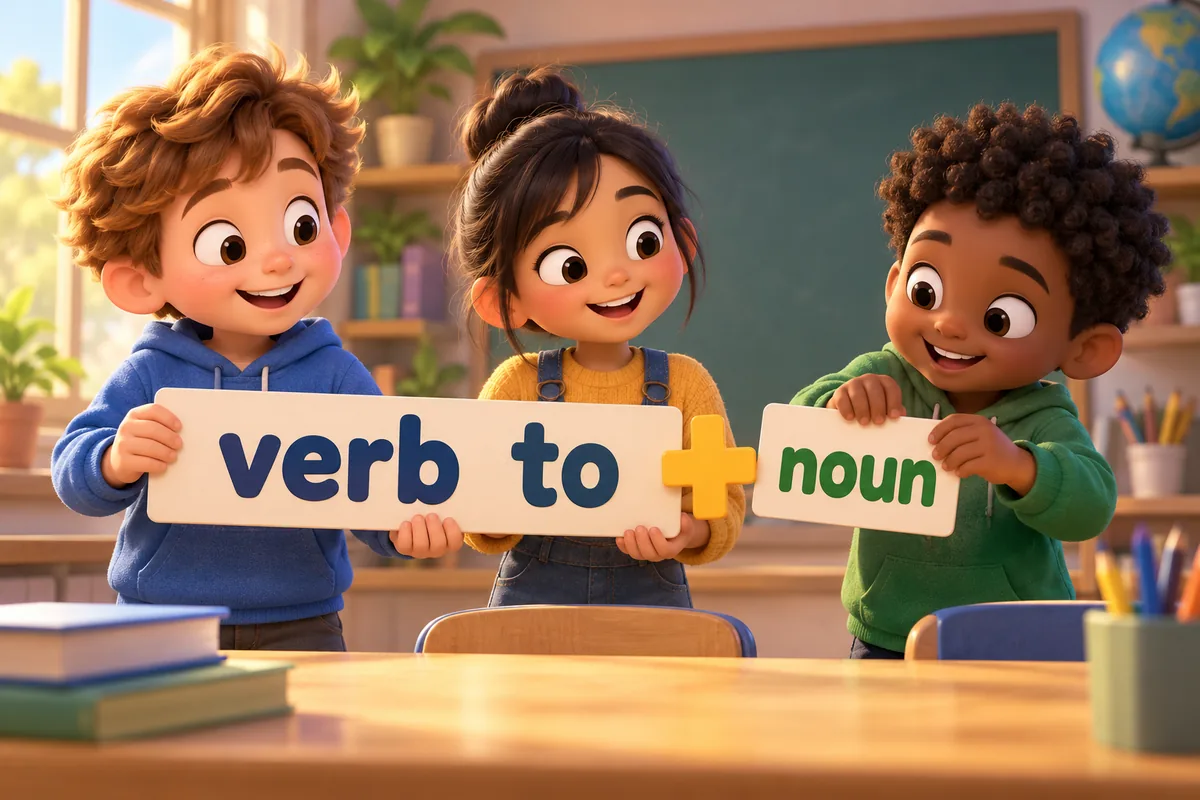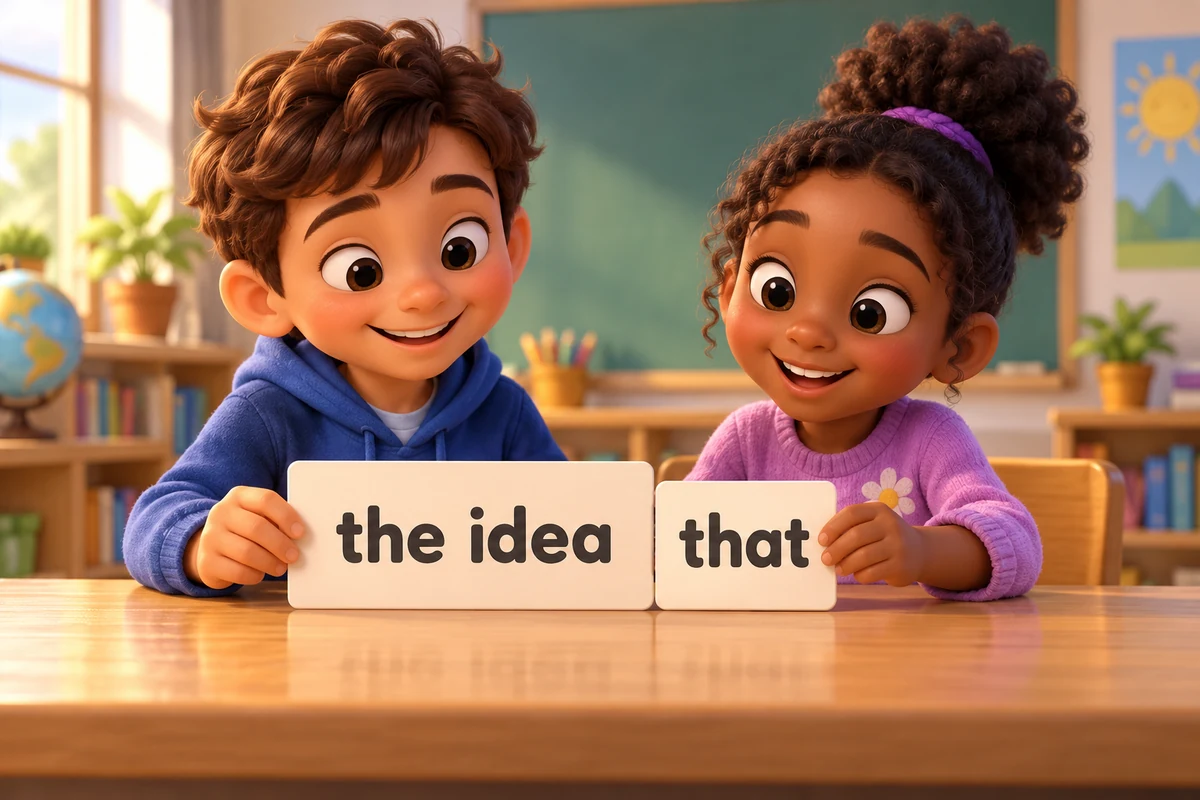
Noun phrases in English are groups of words built around a noun, so the tall girl in the red coat is one phrase with girl at its centre. The noun at the heart is called the head, and the words around it are determiners, adjectives and postmodifiers. A quiet room on the top floor is one more example.
Noun phrases in English at a glance
- A noun phrase is built around a head noun.
- Determiners come first, then adjectives, then the head.
- Postmodifiers such as phrases come after the head noun.
- A noun phrase can be a subject, an object or a complement.
- A single noun or pronoun can form a whole noun phrase.
What are noun phrases in English?
Noun phrases in English are groups of words that work together as a single noun, with one word as the head and the rest adding to it. The head cannot be removed without breaking the phrase, while most modifiers can. A simple noun used in a sentence is itself a short noun phrase, and adding words around it is what makes the longer kind.
| Slot | Typical words | What it does |
|---|---|---|
| Determiner | the, a, my, three | Fixes which one is meant. |
| Premodifier | tall, small, wooden | Describes the head before it. |
| Head noun | girl, room, birds | Carries the core meaning. |
| Postmodifier | in the red coat | Adds detail after the head. |
The slots appear in a fixed order, so a writer builds a phrase from the outside in: determiner, then adjectives, then the head, then any phrase or clause that follows. A page of abstract nouns used in sentences shows the same frame holding ideas such as honesty and progress.
How do you build a noun phrase in a sentence?
The head noun decides what can attach to it, and the table shows the common shapes from a bare noun to a phrase with a clause after it. Short phrases name things plainly, while longer ones narrow the meaning to one exact thing.
| Shape | Example | What it adds |
|---|---|---|
| simple | a bird | One head with a determiner. |
| compound head | a bus stop | Two nouns form one head. |
| with adjectives | a small wooden bench | Adjectives describe the head. |
| with a phrase after | the road to the coast | A phrase modifies the head. |
| with a clause after | the book that I lost | A clause modifies the head. |
Postmodifiers are the part learners leave out, and they do the heaviest work. A prepositional phrase such as on the top floor, a relative clause such as that I lost and an infinitive such as to read all pin the head to one particular thing, and the adjective phrases used in sentences show how the same modifying job works from the other direction.
Noun phrases across contexts
The phrase shifts with the setting because each register narrows the head in its own way, and the table gives one sentence from each context. Every row shows how the modifiers pin the head to one exact thing.
| Context | Sentence | Why this works |
|---|---|---|
| Classroom | The quiet pupil in the back row raised a hand. | The phrase names one exact person. |
| Work email | Our new finance system saves time. | Adjective and noun build one head. |
| News report | A large crowd near the square watched. | The postmodifier locates the crowd. |
| Academic writing | The theory of language shapes the study. | The phrase names the concept. |
| Conversation | That little cafe on the corner is great. | The phrase points to one place. |
| Story | A tall stranger with grey eyes entered. | Two modifiers sharpen the picture. |
| Menu | A fresh bowl of soup is served. | The postmodifier names the contents. |
| Travel guide | The winding road to the valley is scenic. | The phrase describes the route. |
| Science lesson | A small sample of water was tested. | The phrase defines the sample. |
| Business | Our newest client from Berlin signed today. | The modifiers pin down the client. |
Prepositions inside the phrase are fixed by habit, and the phrases that pair adjectives with prepositions make that precision easy to copy. A phrase such as good at maths or ready for change keeps its preposition no matter how the rest of the sentence moves.
Length is a style choice as much as a grammatical one. A news report packs several modifiers into one phrase to name a thing exactly, while a story spreads the same detail across several sentences to keep the pace. A writer who knows the slots can choose either, because the parts are the same and only their arrangement changes.
Which order should the words go in?
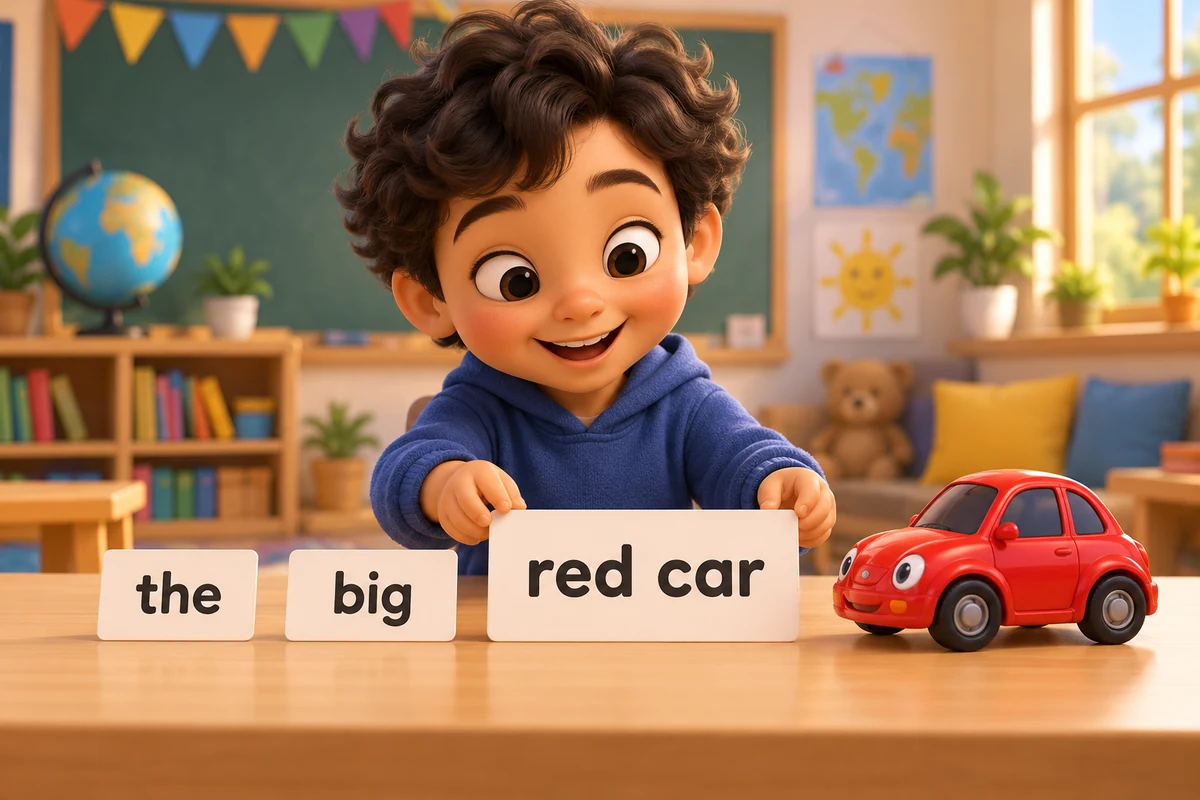
When several adjectives modify one head, English puts them in a set order, and the table shows the usual sequence from opinion to purpose. A phrase such as a lovely big old round wooden table follows that order and sounds right, while a wooden big old table does not.
| Adjective type | Example | Position |
|---|---|---|
| Opinion | a lovely garden | Comes first. |
| Size | a huge garden | Comes after opinion. |
| Age | an old garden | Comes after size. |
| Shape | a round table | Comes after age. |
| Colour | a red car | Comes after shape. |
| Material | a wooden box | Comes after colour. |
The safest test for the order is to say the phrase aloud and move one adjective at a time. If the phrase still sounds natural, the adjectives can swap, and if it sounds wrong, the usual order holds. The guide to adjectives in sentences and phrases works through that sequence with more examples.
Word forms and grammar of noun phrases
A noun phrase can be as short as one word or as long as a clause, and the table gives a range so a writer can see the same frame at different lengths.
| Noun phrase | Type | Example |
|---|---|---|
| a book | noun phrase | A book fell off the shelf. |
| my two brothers | noun phrase | My two brothers arrived. |
| the girl in blue | noun phrase | The girl in blue waved. |
| something useful | noun phrase | Something useful came up. |
| the idea that we wait | noun phrase | The idea that we wait is wise. |
The head noun can sometimes be a pronoun or a gerund rather than an ordinary noun. A phrase such as something useful has a pronoun head, and the endless waiting has a gerund head, yet both work as noun phrases and can be a subject or an object. Recognising the head, whatever its class, is the single skill that makes the phrase easy to analyse.
Common mistakes with noun phrases
- Incorrect:
She bought car yesterday.Correct: She bought a car yesterday. Rule: a singular countable noun needs a determiner. - Incorrect:
He drove a red big van.Correct: He drove a big red van. Rule: size comes before colour in the usual order. - Incorrect:
All the students passed.Correct: All the students passed. Rule: this is correct, and the order the all students is the error to avoid. - Incorrect:
The house on the hill it is old.Correct: The house on the hill is old. Rule: the head noun already supplies the subject, so no extra pronoun is needed. - Incorrect:
I met a girl she wore a blue hat.Correct: I met a girl who wore a blue hat. Rule: a relative clause needs a relative pronoun.
Practice building noun phrases
- Fill the gap: She adopted ______ small brown dog. (a / the)
- Choose the natural order: a (wooden old / old wooden) chair.
- Correct the error: He read book about the sea.
- Expand the head into a noun phrase: house.
- Build a sentence with a noun phrase that has a postmodifier.
- Spot the register: which fits a news report, (a) A large crowd near the square watched, or (b) Loads of people were there?
Answers
- a, because a singular countable noun needs a determiner before its adjectives.
- old wooden, because age comes before material in the usual adjective order.
- He read a book about the sea, because a singular countable noun needs a determiner.
- The old house near the river, because a determiner, an adjective and a postmodifier expand the head house.
- The cafe on the corner serves great cake, because the phrase uses a postmodifier.
- (a) A large crowd near the square watched, because a packed noun phrase suits a report.

The bottom line
Noun phrases in English are built around a head noun and shaped by determiners, adjectives and postmodifiers, in that order. The head decides what can attach, and the modifiers narrow the meaning to one exact thing. Learn the slots, keep the adjective order, and remember that a singular countable noun needs a determiner to make the phrase complete.
Frequently asked questions about noun phrases
What is a noun phrase with an example?
A noun phrase is a group of words built around a noun. In the small garden behind the house, the head is garden, and the words around it narrow which garden is meant. A single noun such as flowers is also a noun phrase, just a very short one.
What is the head of a noun phrase?
The head is the noun (or pronoun) that the phrase is built around, and it cannot be removed. In a quiet room on the top floor, the head is room. Everything before and after it adds information, but the head carries the core meaning that makes the phrase a noun phrase.
What is the difference between a noun phrase and a clause?
A noun phrase names something and contains no verb of its own. A clause contains both a subject and a verb, as in the house stood on the hill. Remove the verb and the clause becomes a noun phrase, such as the house on the hill.
Can a noun phrase be a single word?
Yes. A bare noun such as children or a pronoun such as they is a complete noun phrase, because the head is present and nothing else is required. Longer phrases simply add determiners, adjectives and postmodifiers around that same head noun.