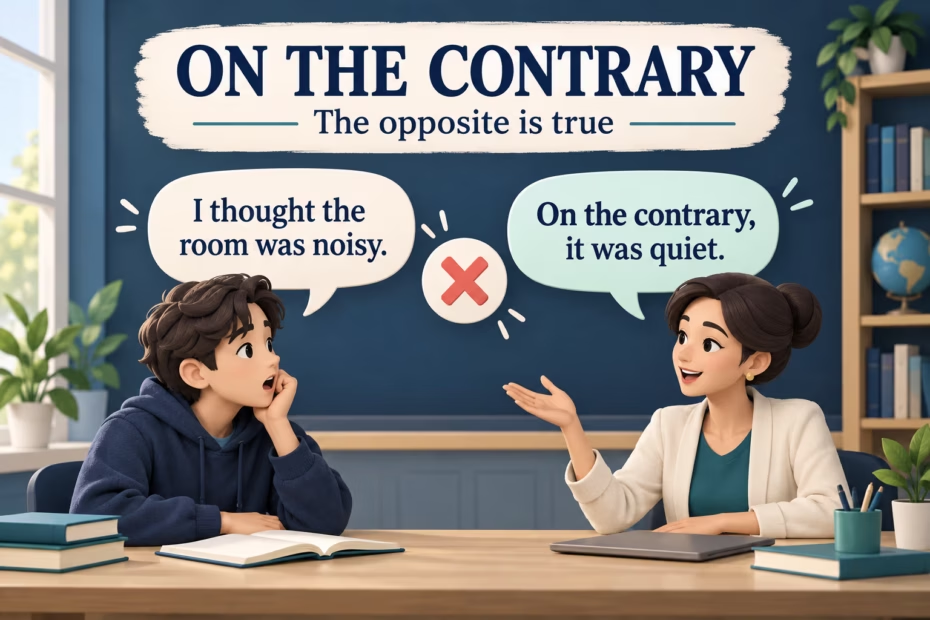
What Does “On the Contrary” Mean?
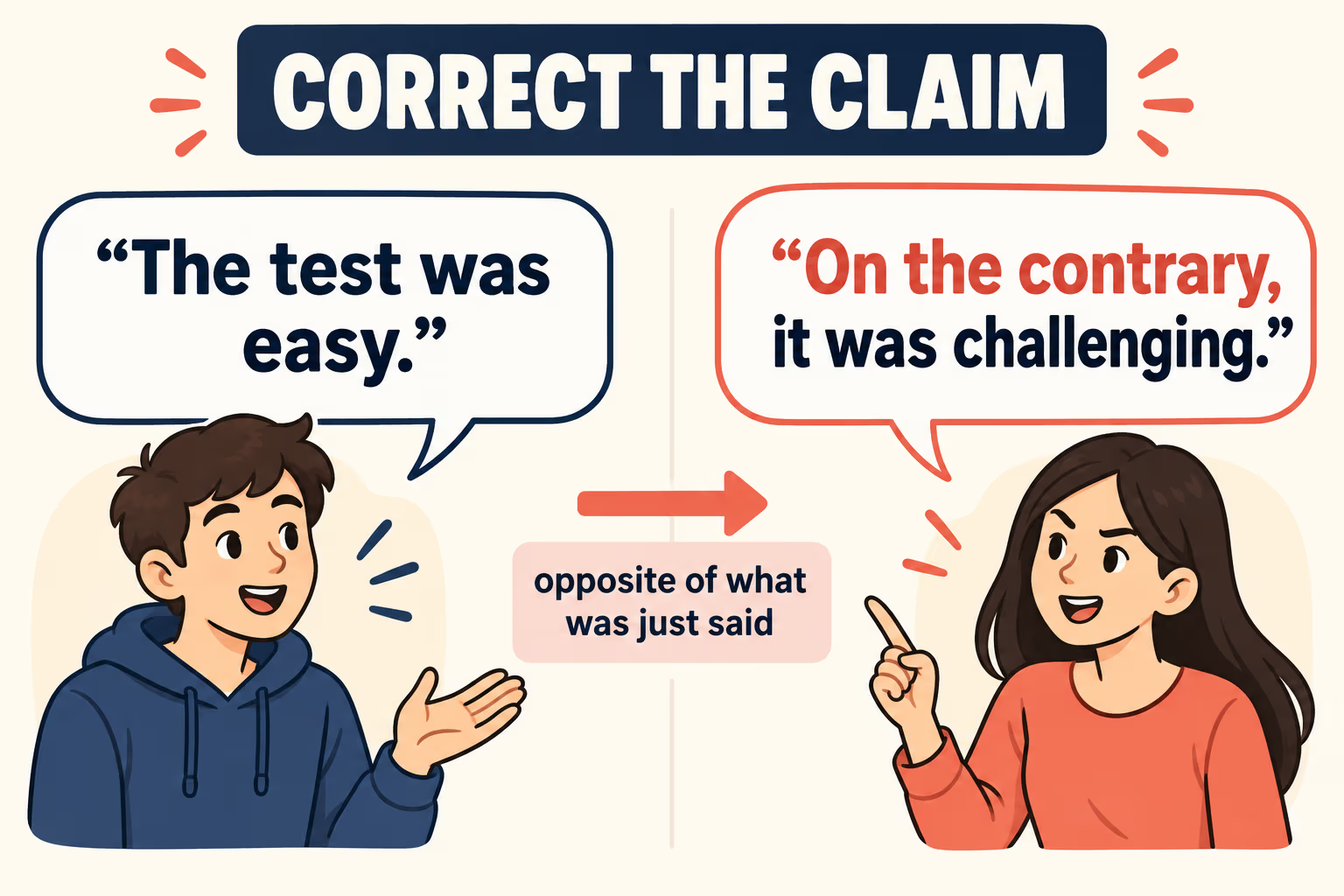
On the contrary means that the opposite of a preceding statement is true. A speaker uses it to reject, correct, or strongly qualify an idea that someone has just expressed. It does not simply introduce any second point that happens to be different.
Quick answer: “The forecast looked gloomy.” “On the contrary, the afternoon was bright and sunny.” The reply directly reverses the expectation of gloomy weather. If you are simply comparing two true things, use on the other hand, by contrast, or however instead.
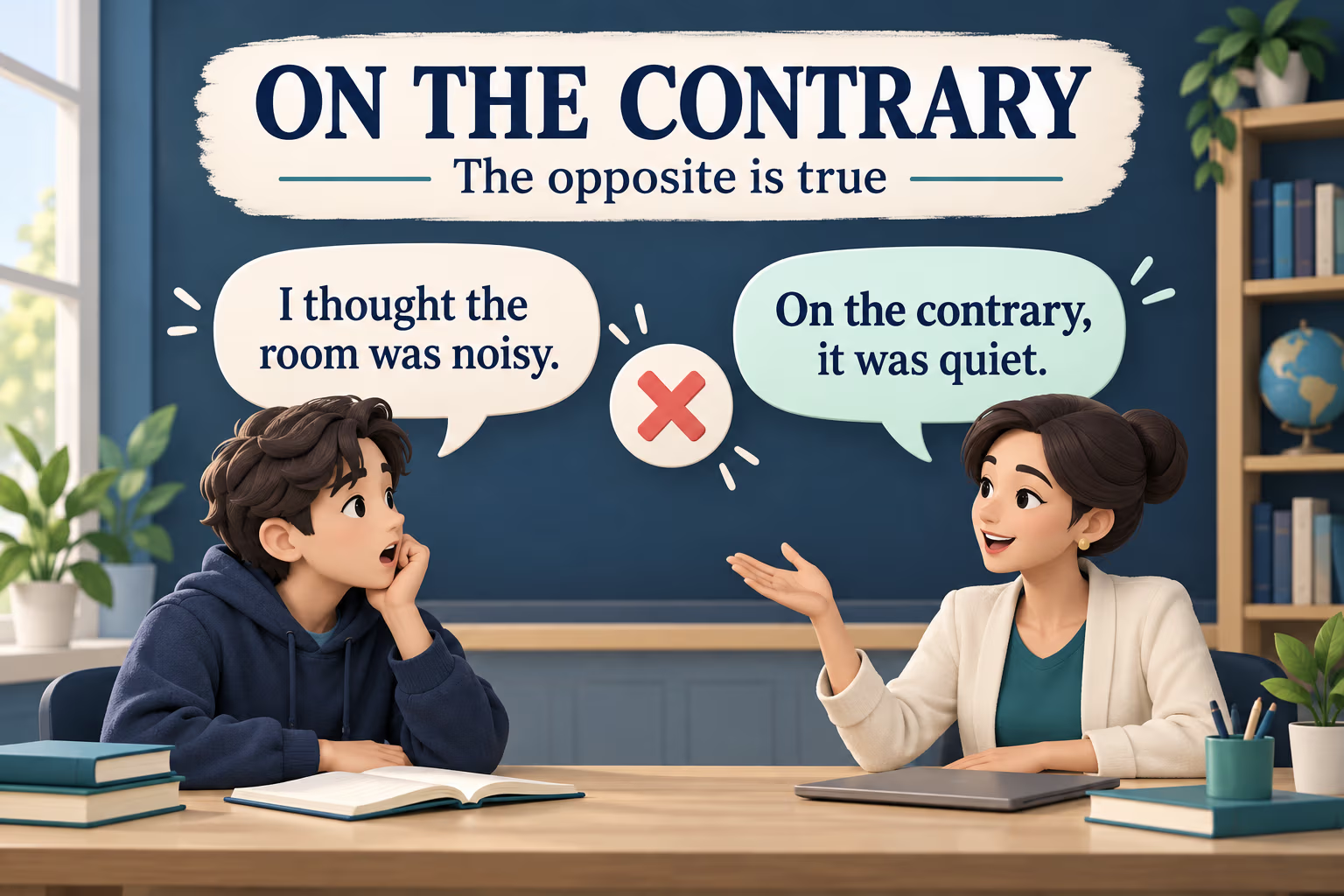
The expression is a conjunctive adverbial phrase. It links a response to the thought before it, and often has a corrective or emphatic tone. It is common in formal and semi-formal writing, but it also appears in conversation, especially in replies such as “On the contrary!” The phrase does not mean that a person is contrary or difficult; here, contrary means opposite.
How to Use “On the Contrary” Correctly
- Identify the claim or assumption. Decide which statement you are responding to.
- Check that your point reverses it. The next idea should show that the earlier claim is wrong, incomplete, or opposite to the facts.
- Give the correction. Follow the phrase with a clear statement that explains what is actually true.
For example: “Mina assumed the library would be closed. On the contrary, it stayed open until nine.” The second sentence corrects the assumption about the closing time. If the speaker only wanted to add that the library was quiet, on the other hand would fit better because quietness does not reverse the closing-time claim.
“On the Contrary” vs. Similar Transitions
Choose a transition by asking how the second idea relates to the first. Is it the opposite, a different side, or just a qualification?
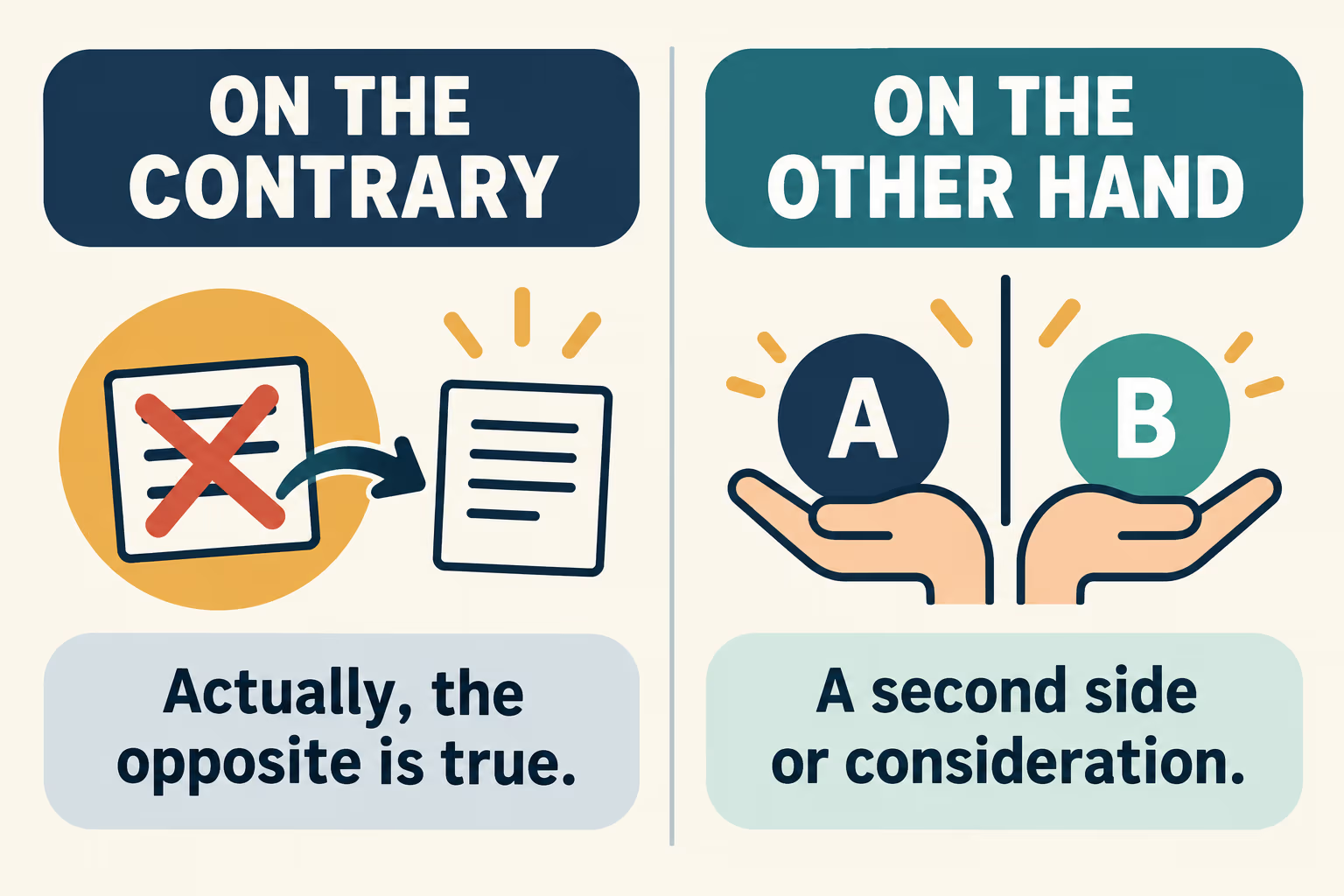
- On the contrary corrects an earlier claim: “I thought the door was locked.” “On the contrary, it was wide open.”
- On the other hand introduces another side of a discussion, and both sides can be true: “The apartment is small. On the other hand, it is close to work.”
- By contrast compares different people or things: “The first route is scenic; by contrast, the second is faster.”
- However marks a qualification or unexpected turn: “The recipe is simple; however, it takes several hours to chill.”
- Conversely presents a corresponding opposite relationship, often in an explanation: “When demand rises and supply stays fixed, prices may rise; conversely, lower demand can ease price pressure.”
These transitions are not interchangeable in every sentence. Cambridge Grammar Today makes the same distinction: on the contrary states the opposite of what was just said, while by contrast is used to compare things that differ. For a balanced discussion of two genuine advantages and disadvantages, on the one hand … on the other hand is usually the clearer pairing.
Sentence Examples of “On the Contrary”
- “You thought I disliked the proposal?” “On the contrary, I support it.”
- The report was expected to be brief. On the contrary, it ran to more than 100 pages.
- People assumed the old bridge was unsafe, but engineers found that, on the contrary, its structure remained sound.
- “The hike was exhausting.” “On the contrary, I found the steady pace relaxing.”
- The instructions do not forbid questions; on the contrary, they encourage readers to ask for clarification.
- “Wasn’t the shop closed?” “On the contrary, it had just opened.”
- Contrary to the initial forecast, rainfall did not decrease; on the contrary, it increased through the evening.
- She did not ignore the feedback. On the contrary, she used it to revise the draft.
- The plan was not overly complicated. On the contrary, its steps were unusually clear.
- “I hear you are worried about the change.” “On the contrary, I welcome it.”
In each example, the phrase points back to a claim, expectation, or implication and then supplies a direct correction. In the conversation examples, it can sound emphatic. If you want a softer response, state the correction directly: “Actually, I support it.”
Punctuation and Placement
When on the contrary opens a sentence, it is normally followed by a comma: “On the contrary, we have plenty of time.” When it interrupts a clause, set it off with commas: “The second option, on the contrary, costs less.” When it joins two independent clauses, a semicolon before the phrase and a comma after it is a standard pattern: “He was not behind schedule; on the contrary, he had arrived early.”
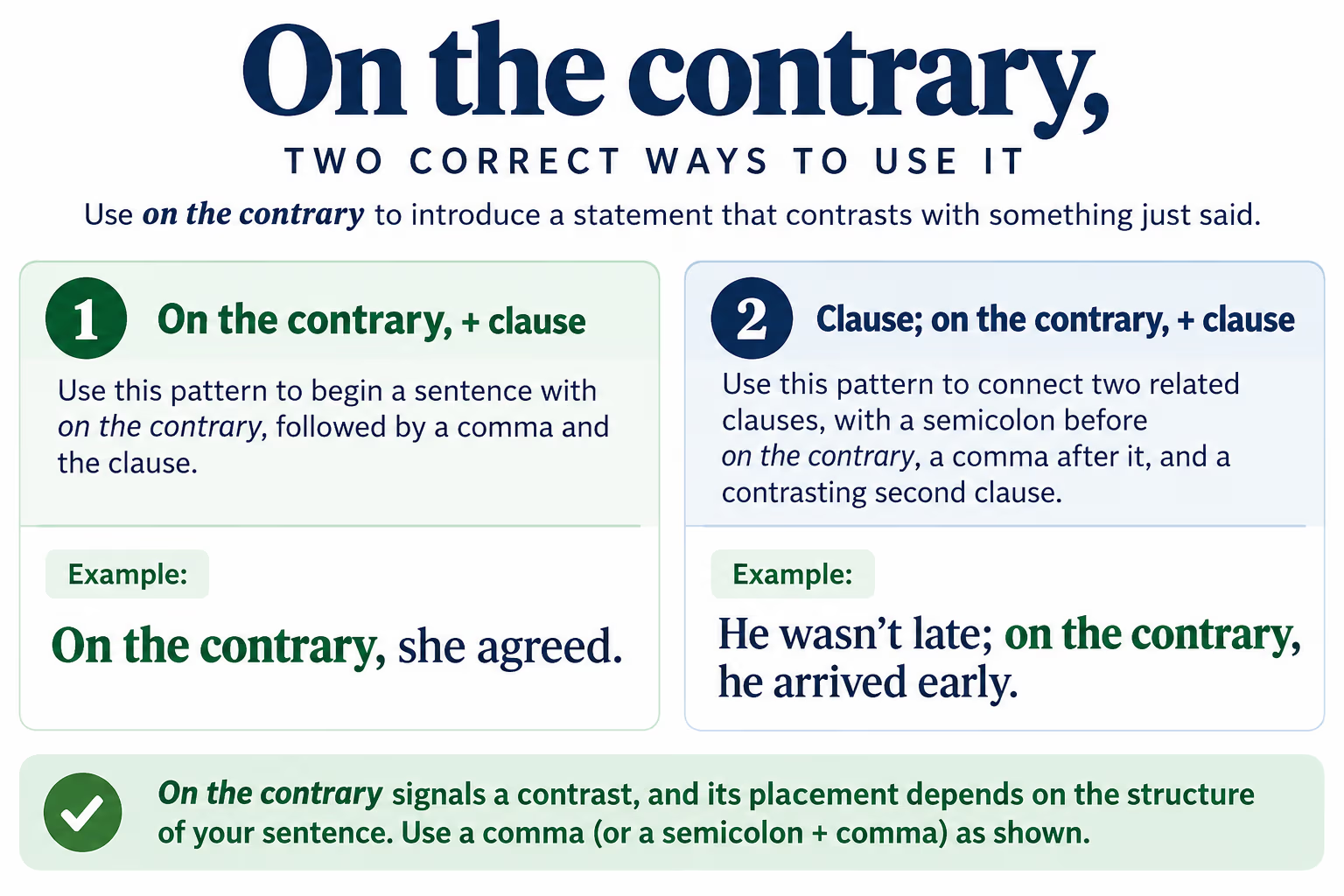
A semicolon is not required in every case. A period works when you want two separate sentences: “The room was not cold. On the contrary, it was warm.” Avoid joining complete sentences with only a comma, which creates a comma splice: The room was not cold, on the contrary, it was warm. Rewrite with a semicolon, a period, or a coordinating conjunction.
Common Mistakes to Avoid
- Using it for any contrast. “I prefer tea. On the contrary, my brother prefers coffee” is a comparison, not a correction. Write “By contrast, my brother prefers coffee” or “On the other hand, my brother prefers coffee.”
- Using it when the second point adds information. “The room is bright. On the contrary, it is spacious” does not reverse the first claim. Use also or in addition if the second point is simply another benefit.
- Leaving the earlier idea unclear. The phrase needs a point of reference. A reader should be able to tell which claim is being corrected.
- Overusing it for a mild qualification. If the second clause only limits the first, choose however or although.
- Misplacing punctuation. When it connects two complete clauses, do not place only a comma between them.
Frequently Asked Questions
Does “on the contrary” always disagree with someone?
No. It can correct your own earlier statement or an assumption, not just another person’s words. The important point is that the following idea reverses what came before.
Can “on the contrary” begin a sentence?
Yes. It often begins a corrective response and is followed by a comma: “On the contrary, the evidence supports the claim.”
Is “on the contrary” formal?
It is more common in formal writing than in casual speech, though it is natural in conversation when someone deliberately emphasizes a correction. In a relaxed reply, actually may sound less emphatic.
What is the difference between “on the contrary” and “to the contrary”?
On the contrary introduces a statement that gives the opposite of an earlier idea. To the contrary often appears after a noun such as evidence or proof: “We have no evidence to the contrary.” The latter means evidence that would show the opposite.
Usage Note on the Examples Above
The original example lists below contain useful sentence practice, but several use on the contrary merely to compare different study habits, choices, or preferences. That is broader than the phrase’s precise meaning. For those examples, by contrast or on the other hand is generally more natural unless the second clause explicitly corrects the first. For instance, replace “Some students prefer to study alone; on the contrary, group sessions can help” with “Some students prefer to study alone; on the other hand, group sessions can offer a different perspective.” This note preserves those original examples while identifying the more accurate transition for readers who want to use the phrase precisely.
Reliable references: Cambridge Grammar Today: “on the contrary” or “by/in contrast”; Cambridge Grammar Today: Contrasts; Cambridge English Dictionary: on the contrary.
Original Sentence Examples and Explanation

When we want to express contrast or show a different perspective, we often use the phrase “on the contrary.” This expression is used to introduce an opposing or contrasting point to the one previously mentioned in a conversation or text.
In English language, “on the contrary” is a powerful tool to articulate contradictions or provide an alternative viewpoint, allowing for clearer communication and a more nuanced understanding of complex ideas.
7 Examples Of On The Contrary Used In a Sentence For Kids
- I thought it would rain today. On the contrary, it’s a sunny day.
- My brother said he didn’t like ice cream. On the contrary, he loves it!
- I thought the dog was scary. On the contrary, it’s very friendly.
- My friend said she couldn’t swim. On the contrary, she’s a great swimmer.
- I thought the cake would be sour. On the contrary, it’s sweet and delicious.
- I thought the movie would be boring. On the contrary, it was very exciting.
- I thought the puzzle was easy. On the contrary, it’s quite challenging.
14 Sentences with On The Contrary Examples
- On the contrary, joining extracurricular activities can help build your resume and make you stand out to potential employers.
- It may seem like skipping lectures will give you more free time, but on the contrary, you’ll miss out on important information that may come in handy during exams.
- On the contrary, taking short breaks while studying can actually improve your focus and productivity.
- While some may think that pulling an all-nighter is the best way to study for exams, on the contrary, getting enough sleep is crucial for retaining information.
- Many students believe that cramming for exams at the last minute is effective, but on the contrary, studying consistently over time leads to better results.
- On the contrary, asking questions in class not only helps you understand the material better but also shows your professors that you are engaged and committed to learning.
- While some students prefer to study alone, on the contrary, group study sessions can provide different perspectives and help you learn in a more interactive way.
- It may seem like buying textbooks is a waste of money, but on the contrary, having your own copy can be beneficial for reference and studying.
- On the contrary, learning to manage your time effectively in college can lead to better academic performance and reduced stress levels.
- While some students believe that skipping meals is a good way to save time, on the contrary, eating balanced meals is essential for maintaining energy levels and concentration.
- On the contrary, taking care of your mental health is just as important as focusing on your academics in college.
- It may seem like partying every weekend is a rite of passage in college, but on the contrary, there are plenty of other ways to have fun and socialize without compromising your studies.
- While some students may think that seeking help from professors is a sign of weakness, on the contrary, it shows initiative and a desire to improve.
- On the contrary, taking advantage of internship opportunities can provide you with valuable real-world experience and help you explore potential career paths.
How To Use On The Contrary in Sentences?
On The Contrary is a phrase used to express a different opinion or perspective. Contrary indicates opposition to a previous statement. To use this phrase correctly in a sentence, follow these steps:
- Identify the statement or belief you are disagreeing with.
- Use the phrase On The Contrary to introduce the contrasting viewpoint.
- Provide your alternative perspective that contradicts the previous statement.
For example:
- Original statement: “This movie is boring.”
-
On The Contrary, I found the movie to be captivating and full of suspense.
-
Original statement: “I think it’s too late to start a new project.”
- On The Contrary, I believe there’s no better time than now to begin something new.
Remember that On The Contrary is typically used in a formal or semi-formal context to politely disagree with someone else’s opinion or provide a different viewpoint. It adds a level of sophistication to your response while clearly indicating your opposing stance.
By incorporating On The Contrary in your sentences, you can effectively communicate your differing perspective in a clear and concise manner. Practice using this phrase in conversations or writing to express your disagreement or offer a contrasting opinion.
Conclusion
In conclusion, sentences with “on the contrary” are used to show a contrast between two ideas or perspectives. This phrase is commonly employed to emphasize a contradiction or to bring attention to a different viewpoint that goes against the one previously mentioned. By using “on the contrary,” writers and speakers can clearly indicate a shift in direction or provide a counterargument to enhance the complexity and depth of their communication.
Overall, sentences containing “on the contrary” are valuable tools for highlighting differences and presenting a nuanced understanding of a topic. They help to create a more dynamic and engaging discourse by challenging assumptions, introducing alternative viewpoints, and encouraging critical thinking by prompting readers and listeners to consider differing perspectives.


