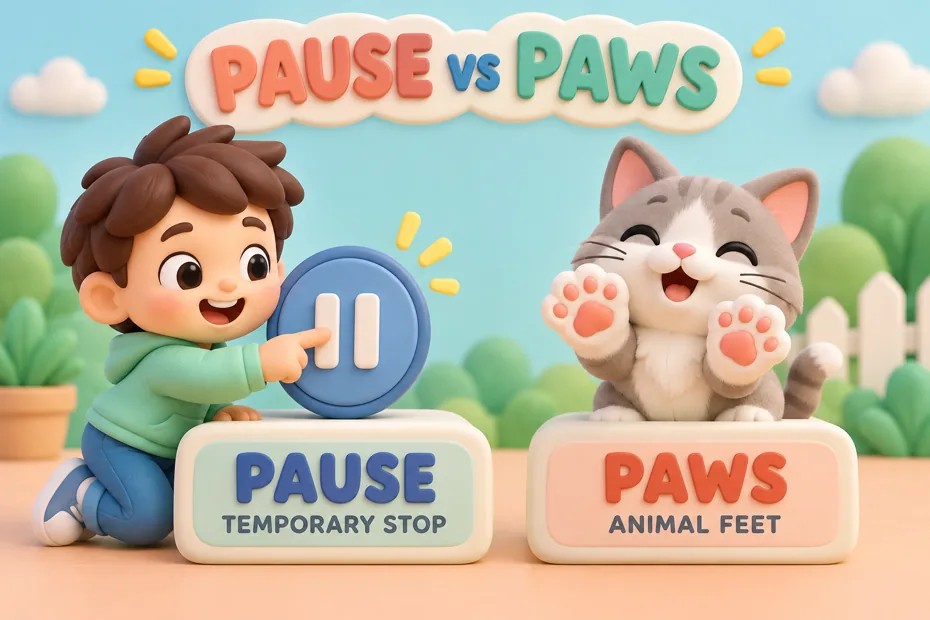
Pause versus paws: the quick answer
Pause names a temporary stop or means to stop temporarily. Paws is the plural of paw, an animal’s foot, and can also be a verb form: “the kitten paws at the toy.” Write “pause the video” for stopping and “the dog’s paws” for feet. Both commonly sound alike.
Clarification for the older guide below: pause is both a noun and a verb, rather than exclusively one or the other. Paws can be a plural noun or the present-tense form used with he, she, or it. The distinction is about meaning and grammatical role, not a universal noun-versus-verb rule.
Key facts and comparison table
| Form | Meaning | Grammar | Original example |
|---|---|---|---|
| pause | A temporary stop | Noun | A short pause followed the question. |
| pause | Stop temporarily | Verb | Please pause the recording. |
| paws | More than one paw | Plural noun | The cat cleaned its paws. |
| paws | Touches or strikes with a paw | Verb form | The cat paws at the ribbon. |
Merriam-Webster’s pause entry includes the temporary-stop noun and verb. Its paw entry records the animal-foot noun and pawing action. A spellchecker may accept both spellings, so the whole sentence must tell you which meaning fits.
Pause as a noun: a brief break
“There was a pause before the answer” names a break in the conversation. “The speaker took a short pause” also uses a noun. You can often recognize the noun after a or the, although that grammatical clue does not determine every possible sentence. The meaning remains a temporary interruption.
Collins’s pause entry describes stopping briefly and the corresponding break. “After a pause, the narrator continued” makes the sequence clear: speech stops and later resumes. It does not need an exact number of seconds for pause to be the right word.
The phrase give someone pause means cause a person to stop and reconsider. “The unexpected cost gave us pause” concerns hesitation or reflection, not a gift of animal feet. If the idiom may be unfamiliar to your readers, “The unexpected cost made us reconsider” states the intended meaning directly.
Pause as a verb: stop temporarily
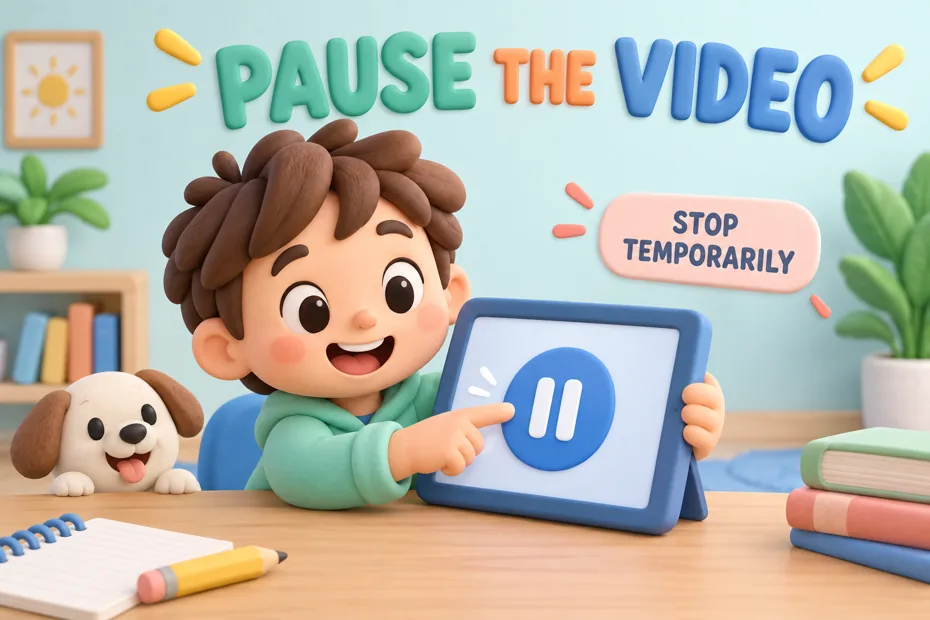
“We paused to read the sign” describes the action of stopping briefly. “She paused the audio” describes causing the recording to stop. These original examples show that pause can work with or without a direct object. The spelling does not change because the subject is a person, device, or group.
The word forms are pauses, paused, and pausing. Drop the final e before ing: pausing, not pauseing. “The player pauses the video” has a singular present-tense verb; “the players pause the video” uses the base form after a plural subject. Paws would suggest a different action, so it is not a substitute.
A pause generally presents the stop as temporary. “The class paused the discussion” differs in emphasis from “the class ended the discussion.” In a media interface, a pause button suggests the option to resume. Use the word that expresses the kind of interruption you actually intend.
Paws as a plural noun or a verb
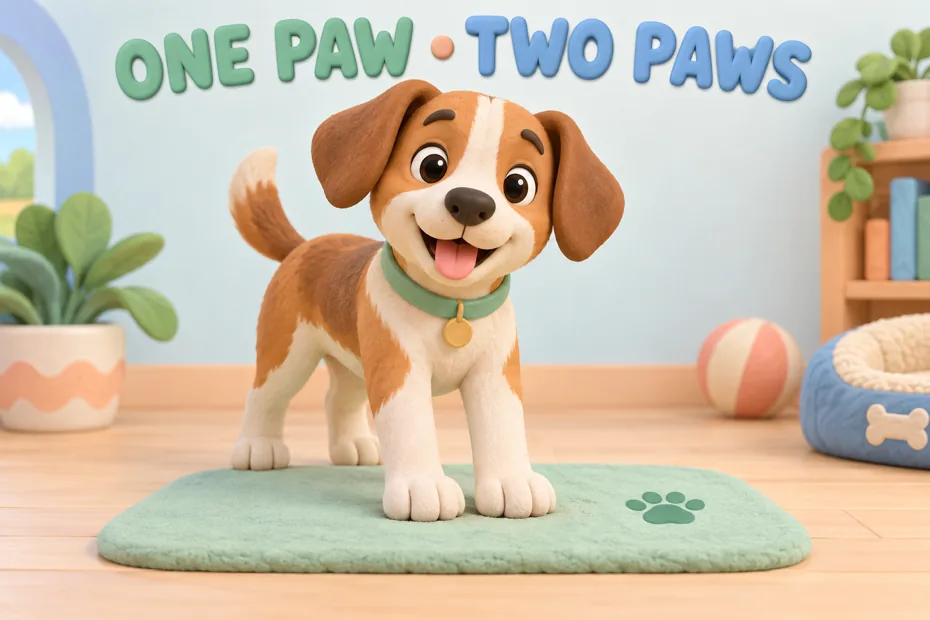
One paw becomes two paws. “The puppy’s paws were muddy” names the feet and uses were with the plural noun. “The puppy paws at the door” uses a singular subject and an action verb. Identical spelling can therefore perform two grammatical jobs within the animal-related word family.
Collins’s paw entry records the noun and verb, including broader touching or searching uses. “He pawed through the box” can describe rough or careless searching. That figurative action does not mean he paused or briefly stopped; it belongs to paw even without a literal animal subject.
For a dog’s feet, write “the dog’s paws.” For several dogs’ feet, write “the dogs’ paws.” The apostrophe identifies possession, while the s on paws makes the feet plural. A sentence about a video stop, however, requires pause regardless of how many animals are present in the scene.
A simple sentence test
Try substituting temporary stop or stop temporarily for pause. “We need a temporary stop” helps explain “we need a pause.” Try feet for a noun use of paws: “The cat’s feet were wet.” For a verb use, look for an action such as touching with a paw rather than treating every s ending as plural.
These original sentences use both families: “Pause the video when the dog lifts its paws.” “The cat pauses, then paws at the toy.” The first combines a media command with a plural noun. The second combines two singular action verbs. Sound alone cannot settle the spelling; the different actions do.
Frequently asked questions
Is pause always a verb?
No. Pause is a noun in “a pause in the conversation” and a verb in “pause the recording.” Both concern a temporary stop. When editing, identify whether the word names the break or describes the stopping action. Either role keeps the spelling pause, rather than the animal-related paws.
Can paws be a verb?
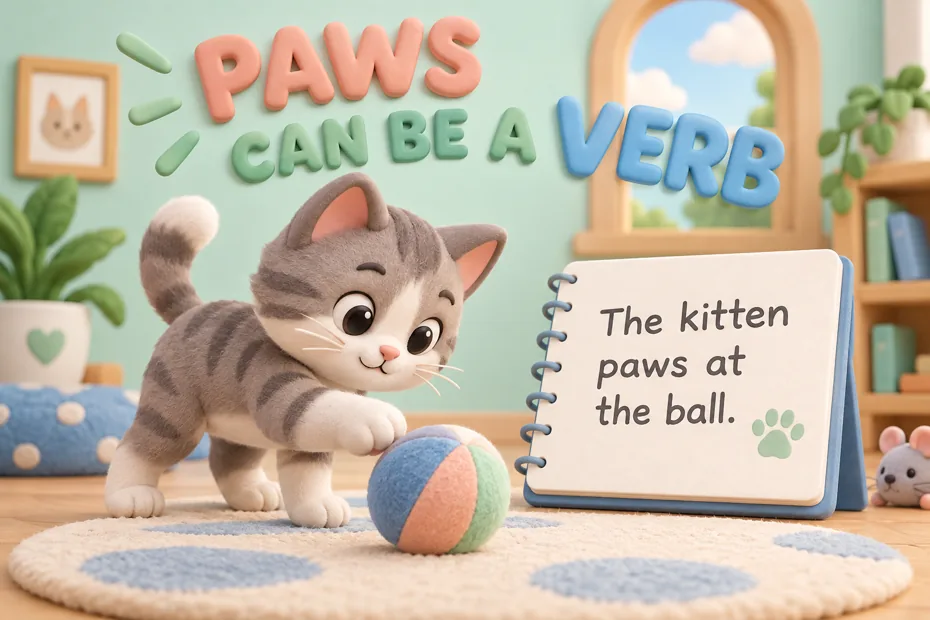
Yes. “The kitten paws at the ball” uses paws as the present-tense verb with a singular subject. “The kitten’s paws are small” uses the same spelling as a plural noun. Read the sentence’s structure and intended action; the s ending alone does not prove it must be a noun.
What is the ing form of pause?
It is pausing. Drop the final e before adding ing, as in “She is pausing the recording.” Paw forms pawing without that e change. These spellings follow separate word families: paused and pausing concern stopping temporarily, while pawed and pawing concern the paw-related action.
How can I remember the difference?
Imagine a pause button with two vertical bars for a temporary stop and a pawprint for paws. Then test the whole sentence: “The dog pauses before lifting its paws.” The first word describes stopping; the second names feet. The visual cues help recall meaning without relying on the shared sound.
Hey there! Have you ever found yourself in a situation where you weren’t sure whether to hit the pause button or unleash your inner animal with some paws action? Well, you’re not alone! In this text, I’ll guide you through the subtle yet significant difference between “pause” and “paws” and how to use them appropriately in various contexts.
We’ll explore the meanings and usages of these two words, along with some common misconceptions that often lead to confusion. Whether you’re a language enthusiast or just someone looking to enhance their communication skills, understanding the nuances of “pause” and “paws” is essential. So, let’s immerse and unravel the secrets of these words to ensure you never mix them up again! Get ready to unleash your linguistic prowess and discover the power of using “pause” and “paws” appropriately.
Key Takeaways
- “Pause” refers to a temporary break or interruption in speech, music, or any ongoing activity, while “paws” specifically refers to the feet of animals.
- Use “pause” to convey a momentary stop or create emphasis, such as in speeches or music compositions.
- “Paws” can be used as a noun to describe the feet of animals or as a verb to indicate an animal using its paws to touch or grip something.
- Differentiating between “pause” and “paws” is crucial to avoid confusion and ensure clear communication.
- Avoid common misconceptions, such as interchanging “pause” and “paws” or thinking that “paws” can refer to a temporary break or interruption.
- Understand the correct usage of “pause” and “paws” to enhance your communication skills and accurately convey your message.
What is “pause”?
As a language enthusiast, I find it fascinating how different words can sound similar but have entirely different meanings. In this section, we’ll explore the meaning and usage of the word “pause” to avoid any confusion.
Definition of “pause”
To put it simply, a pause is a temporary break or interruption in speech, music, or any ongoing activity. It’s a moment of silence or a brief halt in the flow of words or action.
Examples of “pause”
Here are a few examples to illustrate the use of “pause” in different contexts:
- While delivering a speech, it’s important to use appropriate pauses to emphasize important points and allow the audience to absorb the information.
- In music, a well-timed pause can create suspense and add impact to the composition.
- During a conversation, we may pause to gather our thoughts or let the other person speak.
Difference between “pause” and “paws”
Let’s clarify an important distinction to avoid potential confusion. The word “paws” refers to the feet of certain animals, such as cats and dogs, while “pause” relates to a temporary break or interruption.
I hope this clarifies the meaning of “pause” and how it differs from “paws.” The next section will investigate into the definition and usage of “paws” in more detail. So, let’s continue our exploration.
What is “paws”?
When it comes to the words “pause” and “paws,” it’s important to understand their distinct meanings and how to use them correctly in different contexts. While we’ve previously discussed what “pause” means, let’s now shift our focus to the word “paws.”
“Paws” is a noun that refers to the feet of certain animals, typically those with claws, such as cats, dogs, or bears. Animals use their paws for various purposes, including walking, running, climbing, and even hunting. The word “paws” is commonly associated with the image of adorable fluffy creatures, with their soft and cushioned feet leaving imprints on the ground.
It’s worth noting that “paws” is a versatile term that can also be used as a verb, particularly when an animal uses its paws to touch or grip something. For example, a playful kitten might “paw” at a ball of yarn or a curious dog may “paw” at its owner for attention.
Now that we have a clearer understanding of the definition of “paws,” let’s take a moment to compare it to the word “pause” to further highlight the difference between these two commonly confused words.
- “Pause” is a verb that means to momentarily stop or interrupt a speech, a song, or any ongoing activity.
- “Paws,” on the other hand, is a noun that refers to the feet of animals.
It’s easy to see how these words can sometimes be mistaken for one another, especially when spoken. But, mastering their correct usage can greatly enhance your communication skills and help you convey your intended message accurately.
Understanding the Difference
When it comes to mastering the English language, understanding the difference between certain words can be a challenge. One such pair that often causes confusion is “pause” and “paws.” Let me break it down for you.
What is a “pause”?
A “pause” refers to a temporary break or interruption in speech, music, or any ongoing activity. It’s like pressing the pause button when you need a moment to gather your thoughts or take a breath. It’s important to remember, “pause” is a noun, used to describe a specific moment of interruption or silence.
On the other hand, “paws” are the word we use to refer to the feet of certain animals, like cats, dogs, or bears. They are essential for these creatures to walk, run, and interact with the world around them. But, “paws” can also be used as a verb, indicating that an animal is using its paws to touch, feel, or grip something.
The Difference Between “Pause” and “Paws”
The main difference between “pause” and “paws” lies in their meaning and usage. While “pause” relates to a temporary break or interruption in speech or an activity, “paws” are specifically the feet of animals. It’s crucial to keep this in mind when using these words to avoid any confusion or misunderstanding in written or spoken communication.
To further illustrate these differences, here are a few examples:
- When the speaker paused, the audience held their breath in anticipation.
- My dog loves to play by pawing at his toys.
By understanding the correct usage of these words, you can enhance your communication skills and accurately convey your intended message.
Remember, “pause” is a noun representing a temporary interruption, while “paws” can be either the feet of animals or a verb describing their actions. Taking the time to understand and differentiate between these words will go a long way in sharpening your language skills.
Stay tuned for more helpful tips on exploring the English language and mastering the nuances of commonly confused words.
Using “pause” Appropriately
When it comes to mastering the English language, it is crucial to understand the difference between similar-sounding words. One such pair that often causes confusion is “pause” and “paws.” In this section, I will focus on explaining the appropriate usage of “pause.”
Definition of “Pause”:
“Pause” is a noun that refers to a temporary break or interruption in speech, music, or any ongoing activity. It is essential to use “pause” correctly to convey your message effectively.
- During my speech, I took a brief pause to gather my thoughts.
- Let’s hit the pause button and take a break before continuing the meeting.
- The music had a momentary pause before the beat dropped again.
Differentiating from “Paws”:
It is important to note that “pause” and “paws” are homophones but have entirely different meanings. While “pause” refers to a break or interruption, “paws” refers to the feet of certain animals.
To use “pause” appropriately, remember the following:
- Use “pause” to indicate a momentary stop or interruption in speech or activity.
- Consider using “pause” when there is a need to create emphasis, give the listener or reader time to process information, or create dramatic effect.
To conclude, mastering the correct usage of “pause” is essential to improve your language skills. By understanding its definition and appropriate usage, you can effectively communicate your thoughts and ideas. Avoiding confusion with words like “paws” will ensure that your message is clear and concise. So remember to hit the pause button when needed, and let your words make an impact.
Remember:
- “Pause” is a noun that refers to a temporary break or interruption.
- Use “pause” to convey a momentary stop or create emphasis.
- Differentiate between “pause” and “paws” to avoid confusion and ensure clear communication.
Let’s move on to understanding the correct usage of “paws” in the next section.
Using “paws” Appropriately
When it comes to the word “paws,” it’s important to understand its proper usage to avoid any confusion. Let’s jump into the definition and different contexts in which we can appropriately use “paws.”
What is a “Paw”?
The word “paw” refers to the feet of certain animals, such as dogs, cats, and bears. It’s a term commonly used to describe the soft pads and claws that help these animals walk, run, and climb. So when we talk about “paws,” we are specifically referring to the feet of these furry creatures.
Using “Paws” as a Verb
Did you know that “paws” can also be used as a verb? When an animal uses its paws to touch or grip something, we can say that it’s “pawing” at it. This action is commonly seen when animals play or interact with objects in their environment. For example, a cat might paw at a ball of yarn or a dog might paw at its owner’s leg to seek attention.
Differentiating “Pause” and “Paws”
It’s crucial to differentiate between “pause” and “paws” to ensure clear communication. While “pause” refers to a temporary break or interruption in speech, music, or any ongoing activity, “paws” specifically refers to the feet of animals or their action of using their paws.
Here are a few examples to help clarify the difference:
- I paused for a moment to catch my breath.
- The music paused briefly before resuming.
- The dog’s paws left muddy footprints on the floor.
- The kitten playfully pawed at the string.
As you can see, “pause” is used to indicate a temporary stop or interruption, while “paws” refers to the feet of animals or their action of using their paws.
By understanding and using “paws” appropriately, you can avoid any confusion and effectively communicate when referring to the feet of animals or their actions. Remember, clarity in language is vital for effective communication!
Common Misconceptions
There are often misconceptions when it comes to using similar words in the English language. One such pair of words that are frequently confused is “pause” and “paws.” Let’s clear up the confusion and understand the difference between these two words.
Pause: First, let me define what a “pause” is. A pause is a temporary break or interruption in speech, music, or any ongoing activity. It denotes a momentary stop or interruption to create emphasis, add suspense, or allow for a brief rest. When speaking or writing, using a pause effectively can enhance communication and engage the listener or reader.
On the other hand, paws refer to the feet of certain animals, such as cats, dogs, or even bears. They are used for walking, climbing, digging, and grasping objects. “Paws” can also be used as a verb, describing when an animal uses its paws to touch or grip something.
Let’s address some common misconceptions when it comes to these words:
- Misconception 1: “Pause” and “paws” are interchangeable: This is a common mistake that arises from the similarity in pronunciation. But, it is essential to understand that “pause” and “paws” have entirely different meanings and usages. Interchanging them can lead to confusion and miscommunication.
- Misconception 2: “Paws” can refer to a temporary break or interruption: While “pause” can refer to such a break or interruption, “paws” specifically refers to the feet of animals. It is crucial to use the correct word depending on the context to ensure clarity and convey the intended meaning.
- Misconception 3: “Paws” is only a noun: As mentioned earlier, “paws” can also be used as a verb when describing an animal’s action of using its paws. This usage adds another layer of meaning and versatility to the word.
By understanding these common misconceptions, we can avoid confusion and use these words appropriately in our communication. Remember, using the correct word not only improves our language skills but also ensures effective conveyance of our thoughts and ideas.
Now that we have clarified the difference between “pause” and “paws” and debunked these misconceptions, let’s move on to exploring more about the proper usage of these words and some helpful tips to enhance your English language skills.
Conclusion
Understanding the difference between “pause” and “paws” is crucial for effective communication. By knowing the meanings and usages of these words, we can avoid confusion and convey our thoughts and ideas accurately.
“Pause” refers to a temporary break or interruption in speech, music, or any ongoing activity. It is important to note that “paws” are the feet of certain animals, and can also be used as a verb when an animal uses its paws to touch or grip something.
It is a common misconception that “pause” and “paws” are interchangeable, or that “paws” can refer to a temporary break or interruption. But, understanding that “paws” is specific to animal feet and can be used as a verb adds another layer of meaning and versatility to the word.
Using the correct word not only improves our language skills, but also ensures that our thoughts and ideas are effectively conveyed. So, remember to pause when you need a break, and appreciate the adorable paws of our furry friends.
Frequently Asked Questions
Q: What is the difference between “pause” and “paws”?
A: “Pause” refers to a temporary break or interruption in speech, music, or any ongoing activity. On the other hand, “paws” refers to the feet of certain animals. It can also be used as a verb when an animal uses its paws to touch or grip something.
Q: Can “pause” and “paws” be used interchangeably?
A: No, “pause” and “paws” cannot be used interchangeably. They have different meanings and are used in different contexts. “Pause” is used to refer to a temporary break or interruption, while “paws” specifically refers to the feet of animals or the action of an animal using its paws.
Q: Can “paws” also mean a temporary break or interruption?
A: No, “paws” does not mean a temporary break or interruption. It specifically refers to the feet of animals or the action of an animal using its paws. The word “pause” is the correct term to use when referring to a temporary break or interruption in speech, music, or any ongoing activity.
Q: Why is it important to use the correct word?
A: Using the correct word is important because it helps improve language skills and effectively conveys thoughts and ideas. Misusing words like “pause” and “paws” can lead to confusion and miscommunication. Understanding the meanings and correct usage of words ensures clear and concise communication.


