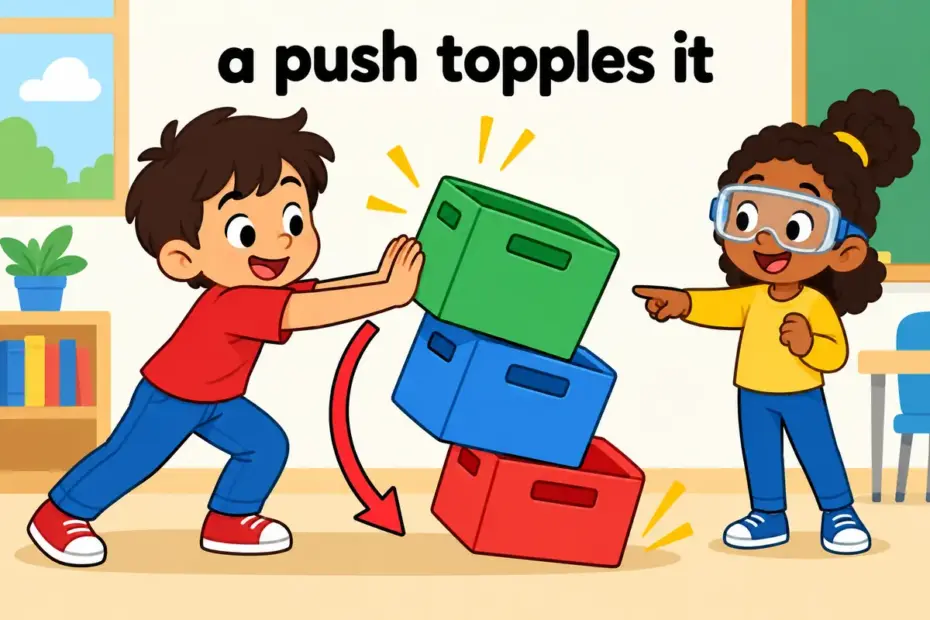
To push over is to make something or someone fall by pushing. In a sentence the verb is transitive and separable: you can push over a stack of boxes or push a stack of boxes over, but a pronoun must sit inside, as in push it over. The phrase stays physical.
Push over at a glance
- Push over is a transitive phrasal verb; its forms are pushes over, pushed over and pushing over.
- It is separable, so an object may follow over or sit between push and over.
- A pronoun object always goes in the middle: push it over, never push over it.
- The one-word noun pushover means an easy opponent or a person easily persuaded.
- The commonest error is missing the object, as in the child pushed over.
What does push over mean?
Push over is a phrasal verb meaning to make a person or object fall by pushing it off balance. The Cambridge entry for push over keeps the sense physical, and the verb usually names a firm, deliberate action rather than a gentle nudge. It overlaps with topple, which also means to fall or make something fall, but topple can be intransitive, while push over always needs an object and a push. A wave can upset the box by knocking it sideways, which shows how many words English keeps for the same small accident.
| Sense | Plain meaning | Example sentence |
|---|---|---|
| Topple an object | Push something so it falls flat | He pushed over the stack of crates. |
| Knock a person down | Make someone fall to the ground | The crowd pushed the steward over at the gate. |
| Spill by pushing | Push a container until it tips | She pushed over the paint tin by mistake. |
One limitation matters. Push over describes a physical fall; it does not mean to defeat a rival or to convince a stubborn person. When a team beats a weak opponent, the verb is beat or overwhelm, and when someone is easily persuaded, the word is the noun pushover, not the verb. Mixing the two is the error readers notice first.
How do you use push over in a sentence?
Push over is transitive, so it always needs an object, and it is separable, so the object may go before or after over. The particle stays close to the verb, which keeps the two-word unit intact, and a pronoun object is forced into the middle slot. The five patterns below cover nearly every natural sentence.
| Pattern | Example | What it signals |
|---|---|---|
| push over + object | The gust pushed over the sign. | The commonest form; the object follows over. |
| push + object + over | The gust pushed the sign over. | Separable form, usual for a short object. |
| push it / them over | Do not push it over; it is still wet. | A pronoun must sit between push and over. |
| be pushed over | The barricade was pushed over by the crowd. | Passive voice, common in accident reports. |
| push + object + over + with | They pushed the wall over with a beam. | Names the tool that does the pushing. |
The preposition with often follows to name the instrument, and by follows the passive to name the person. That pairing is a small signal of fluency: pushed over with a pole reads as native, while pushed over using a pole sounds translated.
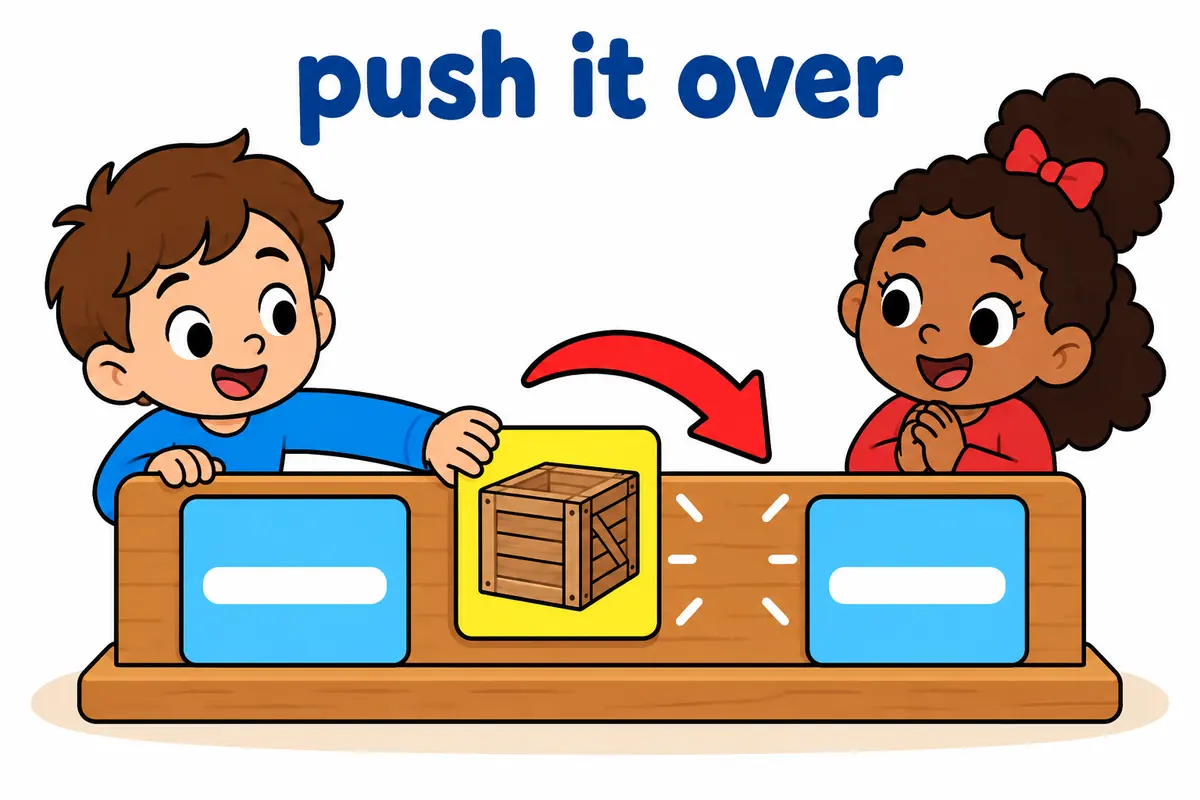
Push over in a sentence: examples across contexts
Push over keeps one meaning everywhere, but the register moves from a playground accident to a formal incident report. Each sentence names the object that falls.
| Context | Example sentence | Why this works |
|---|---|---|
| Playground | A boy pushed over the tower of blocks and helped rebuild it. | The object is a thing, so the verb stays literal. |
| Classroom | Mind the easel; do not push it over. | The pronoun sits between push and over. |
| Health and safety | Stack no more than four high, or the load may push over. | Shows the object doing the toppling, a common notice pattern. |
| Sports report | The winger pushed the defender over on the edge of the box. | Names a person as the object, so the fault is clear. |
| News report | Crowds pushed over barriers before the gates were opened. | Passive-friendly reporting uses a firm plural subject. |
| Warehouse note | Do not push over the pallets; use the trolley instead. | The imperative shows a direct instruction. |
| Fiction | He pushed over the kitchen chair and left without a word. | The prop action shows temper without naming it. |
| Incident report | A trolley was pushed over by a reversing van. | Passive voice keeps attention on the damage. |
| Conversation | The wind nearly pushed me over at the corner. | The first person makes the near miss vivid. |
Two neighbours are worth knowing. To shove something is to push it roughly and hard, often without making it fall, and to tip the stool is to tilt it on one edge. Push over is the stronger, final action: the object ends up down.
Push over vs knock down and topple
Push over overlaps with knock down and topple, but the three differ in how the fall happens. Knock down needs a blow; topple can happen on its own; push over needs a steady push.
| Attribute | push over | knock down | topple |
|---|---|---|---|
| Core meaning | Make something fall by pushing | Make something fall by hitting | Lose balance and fall |
| Force involved | A firm, steady push | A sharp impact | A gentle loss of balance |
| Can it be intransitive? | No, it needs an object | No, it needs an object | Yes, a tower can topple |
| Typical object | A box, a sign, a person | A wall, a door, a rival | A government, a stack, a tree |
| Example | She pushed the cone over. | The ball knocked the vase down. | The filing cabinet toppled. |
Verdict: choose push over for a deliberate push that ends in a fall, knock down for a blow that fells something, and topple when the thing loses balance and goes down by itself. The related phrase bowl over is figurative, meaning to surprise or knock a person off their feet emotionally.
Word forms and grammar of push over
Push over inflects like a regular verb and keeps its object throughout. The noun pushover is a separate word, spelled as one unit, and the verb phrase push around contains the same base verb with a different particle and a different meaning.
| Form | Part of speech | Example |
|---|---|---|
| push over | phrasal verb, base | Do not push over the display. |
| pushes over | verb, third person singular | The wind pushes over the light signs. |
| pushed over | verb, past and past participle | Someone pushed over the milk crate. |
| pushing over | verb, present participle | They are pushing over the old fence. |
| pushover | noun, one word | He is no pushover in a debate. |
| push around | phrasal verb, different meaning | Do not let them push around the new staff. |
The contrast with push around is a useful check: to push around means to order someone about or bully them, and its object is always a person, while push over can take a person or a thing and always ends in a fall.
Common mistakes with push over
- Incorrect:
The toddler pushed over.Correct: The toddler pushed over the tower. Rule: Push over is transitive, so it needs an object; without one it is incomplete. - Incorrect:
Please push over it to the other side.Correct: Please push it over to the other side. Rule: A pronoun object must sit between push and over. - Incorrect:
Our team pushed over the champions.Correct: Our team beat the champions. Rule: Push over is physical, not figurative; use beat or overthrow for a defeat. - Incorrect:
She is a push over when you ask nicely.Correct: She is a pushover when you ask nicely. Rule: The noun meaning an easily persuaded person is one word. - Incorrect:
The leaders pushed over the small nations.Correct: The leaders pushed around the small nations. Rule: Bullying or bossing is push around, not push over.
Practice using push over
Work through the six items, then read the reasons rather than only the answers.
- Fill the gap: The goat ______ the water bucket again.
- Choose the better word: The referee let the play continue after the defender was (pushed over / pushed around).
- Correct the error: The guard pushed over it without looking.
- Build a sentence: use push + object + over about a gust and a road sign.
- Spot the register: which fits an incident report — a trolley was pushed over by a van, or a van, like, totally floored the trolley?
- Rewrite with the noun: Nobody thinks she is easy to persuade. Use pushover.
Answers
- pushed over — the object follows over, and the past tense matches the story.
- pushed over — the defender physically fell; push around would mean he was bullied.
- The guard pushed it over without looking — a pronoun sits between push and over.
- Model answer: A sudden gust pushed the road sign over.
- A trolley was pushed over by a van — a report keeps the passive and avoids slang.
- Nobody thinks she is a pushover — the noun is a single word and needs an article.
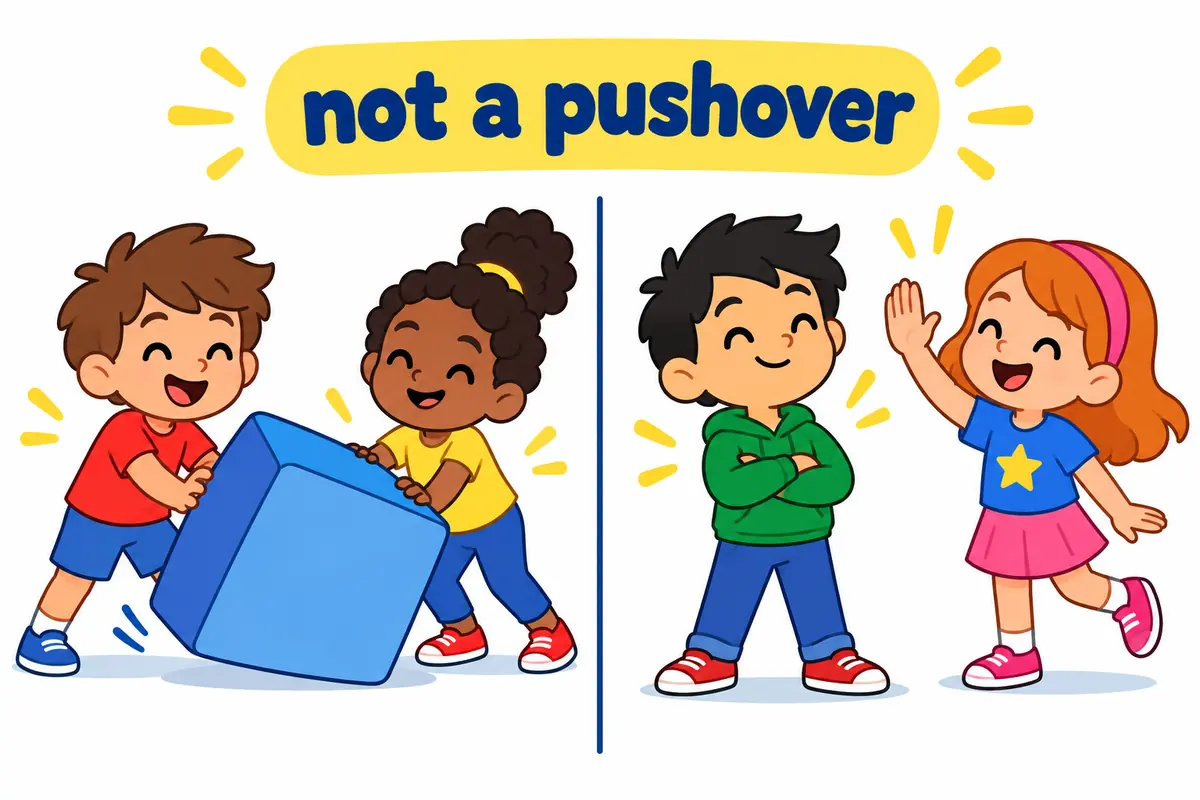
The bottom line
Use push over in a sentence to describe making a person or object fall by pushing it, and keep the verb transitive and separable so the object is always named. Two nuances settle most sentences: it describes a physical fall rather than a defeat, and the noun for an easily persuaded person is the separate word pushover. For a blow rather than a push, knock down is the exact verb.
Frequently asked questions about push over
Is push over one word or two?
The verb is always two words, as in the wind pushed the sign over. It is separable, so the object may sit before or after over. The unrelated noun pushover is a single word meaning an easy opponent or an easily persuaded person, so spelling them alike is a real error.
Can push over take a person as its object?
Yes. A crowd can push a steward over, which means the person physically fell. The verb keeps its literal sense even when the object is human, so it describes a fall and not an insult. For bossing or bullying someone, the phrase is push around instead.
What is the difference between push over and knock down?
Push over uses a steady push, while knock down uses a sharp blow or hit. A person pushes a crate over with their hands, but a ball knocks it down on impact. Both need an object, and both end with the thing on the ground, so the type of force is the deciding detail.
Can push over mean to defeat a rival?
No. Push over stays physical, so it cannot replace beat or overthrow in a sentence about winning. Saying our team pushed over the champions sounds wrong because nothing physically fell. Reserving the verb for real falls keeps the meaning clear for readers.