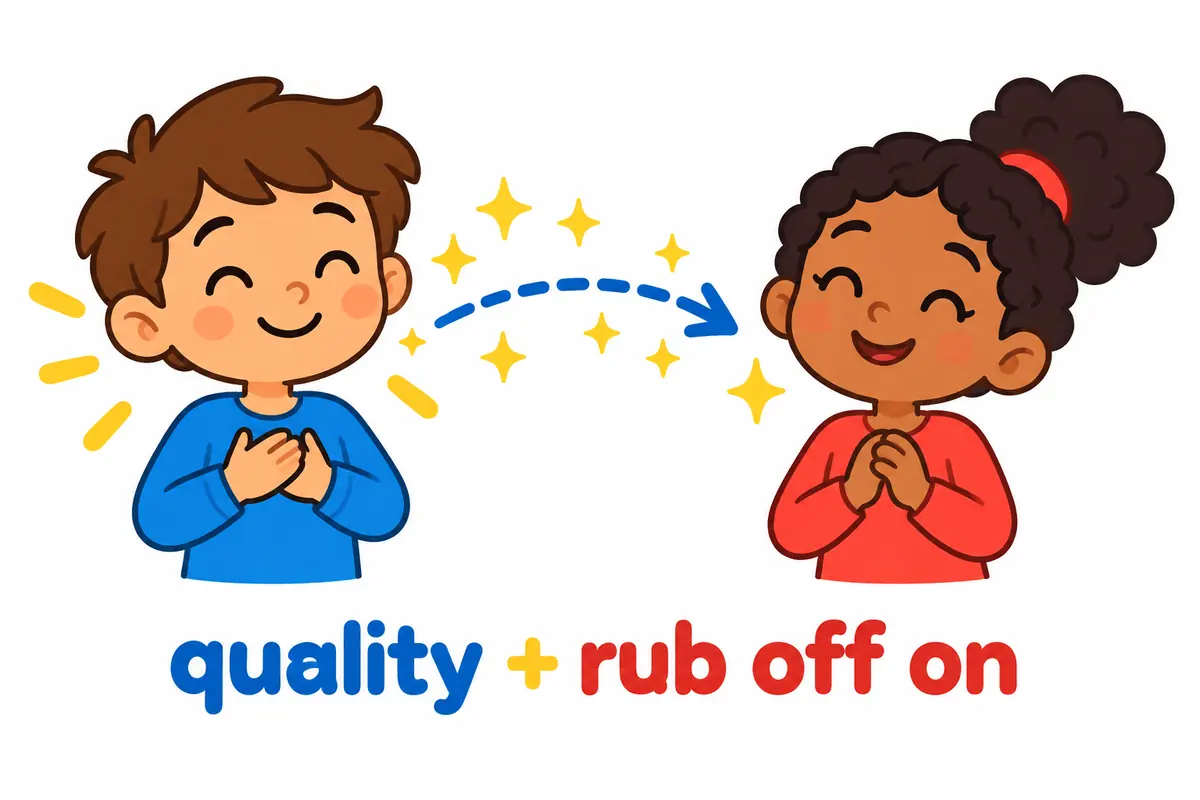
Rub off on means to pass a quality, habit or mood to someone through close contact, usually without intending to. To use rub off on in a sentence, make the quality the subject and the person the object: “Her calm rubbed off on the whole team.” The phrase is fixed, so on never drops.
Rub off on at a glance
- Rub off on is a fixed phrase built from the verb rub and two particles, off and on.
- It means that a quality, habit or mood passes to someone through contact or association.
- The subject is the quality itself, and the person who changes follows on.
- The influence is usually gradual and unplanned rather than taught.
- The phrase is not separable, so rub someone off on is impossible.
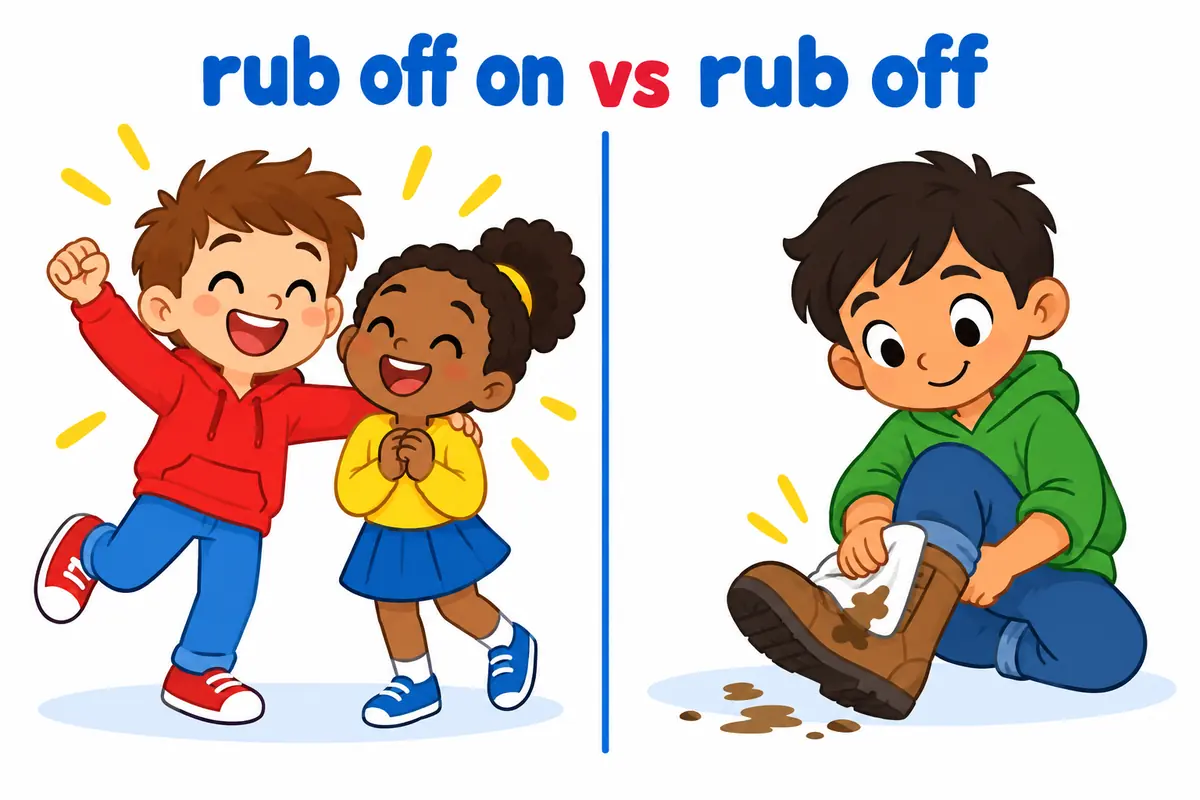
- Its nearest confusable is rub off, which means a mark removed by friction.
What does rub off on mean?
Rub off on is a fixed phrase meaning to pass a quality, habit or mood to someone through close contact, usually without deliberate effort. The Cambridge entry for rub off on records the sense of a characteristic spreading from one person to another. The image is literal: something on one surface is transferred to another by rubbing, and the figurative use keeps that idea of contact.
| Sense | Plain meaning | Example sentence |
|---|---|---|
| Literal transfer | A mark or substance is transferred by rubbing | The wet paint rubbed off on my sleeve. |
| Figurative influence | A quality or mood passes to someone nearby | His patience rubbed off on the new recruits. |
| Spreading habit | A way of behaving spreads through a group | Her tidy habits rubbed off on the whole office. |
Rub off on describes influence by exposure, not teaching. A lesson is taught, but a habit is caught, and the transfer is often slow and unplanned. Where the influence is deliberate, use teach, train or influence instead, and where someone holds out against it, they resist the mood around them.
How do you use rub off on in a sentence?
Rub off on is transitive and fixed: the subject is the quality, the object is the person, and the two particles never move. Five patterns cover most sentences.
| Pattern | Example | What it signals |
|---|---|---|
| [quality] rub off on [person] | Her optimism rubbed off on everyone. | The quality is the subject. |
| [mood] rub off on [person] | The team’s nerves rubbed off on the keeper. | A negative mood can transfer too. |
| some of + noun + rub off on | Some of his discipline rubbed off on me. | The hedge softens the claim. |
| rub off on + pronoun | It rubbed off on them quickly. | The pronoun follows on as the object. |
| be rubbed off on | Good habits can be rubbed off on a newcomer. | Rare passive, used for emphasis. |
The subject is almost never a person doing the rubbing; it is the quality itself. That is why the phrase sounds impersonal, and why influence is the plain paraphrase when a writer wants a single verb. The exception is the literal sense, where an object does the transferring.
Rub off on in a sentence: examples across contexts
Rub off on keeps the same shape whether the setting is a classroom or a newsroom. The ten sentences below change the quality and the person, not the phrase.
| Context | Example sentence | Why this works |
|---|---|---|
| Classroom | The teacher’s curiosity rubbed off on the quietest pupil. | A positive quality spreads to one named person. |
| Family | Grandad’s love of gardening rubbed off on my sister. | A lasting habit passes between generations. |
| Workplace | Her calm under pressure rubbed off on the whole shift. | A mood spreads through a team. |
| Sports writing | The captain’s energy rubbed off on the younger players. | Names the source of a team’s lift. |
| News feature | The volunteers’ optimism rubbed off on the whole street. | Extends the influence to a community. |
| Conversation | Some of your patience has rubbed off on me. | The hedge makes the claim modest and warm. |
| Music | Her sense of rhythm rubbed off on the rest of the band. | A skill spreads by playing together. |
| Academic prose | Enthusiasm can rub off on students in small seminars. | Conditions the claim with can and a setting. |
| Volunteering | The group’s good humour rubbed off on the new helpers. | A tone spreads to newcomers. |
| Travel writing | The ease of the island rubbed off on us within days. | An atmosphere, not a person, is the subject. |
Moods are easy to catch by contact, which is why the phrase appears so often in teams and families. Notice that only one row uses the passive, and even that is rare; the active form with the quality as subject is the natural choice. The phrase also rewards a hedge such as some of, because influence by contact is rarely total, and a flat claim that a mood rubbed off on a whole group can overstate what anyone observed.
Rub off on vs rub off and influence
Rub off on is close to rub off in form and close to influence in meaning, so all three get mixed up.
| Attribute | rub off on | rub off | influence |
|---|---|---|---|
| Core sense | A quality passes to a person | A mark is removed by friction | Change someone or something |
| Subject | A quality, habit or mood | A mark, paint or ink | A person, event or idea |
| Object | A person | A surface or object | A person, decision or outcome |
| Intention | None, by contact | None, physical | Often deliberate |
| Grammar | Fixed, on required | No object needed | Ordinary transitive verb |
| Speed | Gradual and unnoticed | Instant, physical | Variable |
Verdict: choose rub off on for a quality that spread by contact, rub off for a mark removed by friction, and influence when the effect is deliberate or wide-ranging. A good mood can affect a room, but only the mood itself rubs off on the people in it.
Word forms and grammar of rub off on
The verb rub changes its tense, but the two particles stay locked in place. The phrase also has a literal cousin, rub off, which behaves differently.
| Form | Part of speech | Example |
|---|---|---|
| rub off on | phrase, base form | Good habits rub off on new colleagues. |
| rubs off on | phrase, third person | Her cheerfulness rubs off on everyone. |
| rubbed off on | phrase, past and participle | His patience rubbed off on me. |
| rubbing off on | phrase, present participle | The mood is rubbing off on the crowd. |
| rub off | phrase, literal | The label rubbed off in the wash. |
The related noun transfer captures the same idea without the particles, as in a transfer of confidence from one player to another. What may vary inside the phrase is only the tense of rub, so the two particles are safe in every sentence.
Common mistakes with rub off on
- Incorrect:
The teacher rubbed off her good habits on the class.Correct: Her good habits rubbed off on the class. Rule: The quality is the subject, not the person who has it. - Incorrect:
His enthusiasm rubbed on the team.Correct: His enthusiasm rubbed off on the team. Rule: The full phrase needs off as well as on. - Incorrect:
Some of her calm rubbed off at me.Correct: Some of her calm rubbed off on me. Rule: The person affected follows on, never at. - Incorrect:
The paint rubbed off on the wall.Correct: The paint rubbed off the wall. Rule: The literal sense of removal takes no on, because on marks the person who receives a quality. - Incorrect:
I rubbed my patience off on him.Correct: My patience rubbed off on him. Rule: The phrase is fixed and cannot be split or made reflexive.
Practice using rub off on
- Fill the gap: Her steady confidence soon ______ the new intern.
- Choose the better phrase: The ink (rubbed off / rubbed off on) the page in the rain.
- Correct the error: The coach rubbed off his discipline on the squad.
- Build a sentence: use some of + noun + rub off on about a friend’s tidiness.
- Spot the register: which belongs in a team report — the captain’s focus rubbed off on the squad, or I got the captain’s focus all over me?
- Rewrite with influence: The older pupils’ calm rubbed off on the newcomers. Use influence instead.
Answers
- rubbed off on — the quality is the subject and the intern is the person affected.
- rubbed off — a mark removed by friction takes no on.
- The coach’s discipline rubbed off on the squad — the quality must be the subject.
- Model answer: Some of my friend’s tidiness has rubbed off on me.
- The captain’s focus rubbed off on the squad — a report keeps the impersonal pattern.
- Model answer: The older pupils’ calm influenced the newcomers — the single verb suits formal writing.
The bottom line
Use rub off on in a sentence when a quality, habit or mood passes to someone through contact rather than instruction, and make that quality the subject. The two details that decide most sentences are these: the phrase is fixed, so both particles stay put, and the person who changes follows on while the thing that changes is the subject. You cannot ignore a mood that rubs off on you, which is exactly why the phrase fits teams and families so well.
Frequently asked questions about rub off on
Does rub off on mean the influence is deliberate?
Usually not. The phrase describes a quality or mood spreading through contact, so it suits slow, unplanned influence rather than teaching. A coach can deliberately train a squad, but the captain’s calm rubs off on them without anyone arranging it. Where intention matters, influence or teach is the clearer choice.
Is rub off on a separable phrase?
No. The two particles off and on stay locked together, so the phrase cannot be split and the object never slides between them. You cannot say rub someone off on, and the quality must remain the subject. Only the tense of rub changes, giving rubs off on and rubbed off on.
What is the difference between rub off on and rub off?
Rub off on means a quality passes to a person, as in her calm rubbed off on me. Rub off without on means a mark is removed by friction, as in the paint rubbed off the door. The first needs a person after on, while the second needs no object at all.
Can a bad quality rub off on someone?
Yes. The phrase is neutral about whether the quality is welcome, so impatience, panic and bad habits can rub off on a group just as easily as patience and good humour. In practice it appears more often with positive qualities, but a careful writer can use it to describe a mood spreading in either direction.