
Tenacity in a sentence: meaning and examples
Tenacity is persistence or determination that helps someone continue with a difficult task. In a sentence, it often names the quality behind repeated, focused effort: “After two prototypes failed, Priya’s tenacity helped her test a simpler design.” The noun usually describes how someone keeps working, not a guarantee that they will succeed.
Quick answer: use tenacity as a noun in patterns such as “show tenacity,” “tenacity in revising,” and “with tenacity.” It is close in meaning to persistence and perseverance, but the best word depends on tone and context.
How do you use tenacity correctly?
Tenacity is normally an uncountable noun, as shown in the Cambridge Dictionary entry. Write “She showed tenacity,” not usually “She showed a tenacity.” The adjective is tenacious (“a tenacious student”), and the adverb is tenaciously (“he worked tenaciously”).
| Sentence pattern | Example | What it emphasizes |
|---|---|---|
| show / demonstrate tenacity | The team showed tenacity after its first proposal was rejected. | The quality someone displayed |
| tenacity in + noun or -ing form | Her tenacity in revising the report made the final argument clearer. | The activity where persistence appears |
| with tenacity | He approached the repair with tenacity, checking each connection in turn. | The manner of continuing |
| the tenacity of + person or thing | The tenacity of the climber impressed the rescue team. | Who or what possesses the quality |
| tenacious + noun | A tenacious reader returned to the difficult chapter the next day. | The adjective describing a person, effort, or hold |
Cambridge defines the noun as determination to continue what you are doing and labels it uncountable. Its entry lists perseverance and persistence as near alternatives. The pronunciation is roughly tuh-NASS-uh-tee, with the main stress on the second syllable; Cambridge’s UK and US pronunciations differ slightly in the final part of the word.
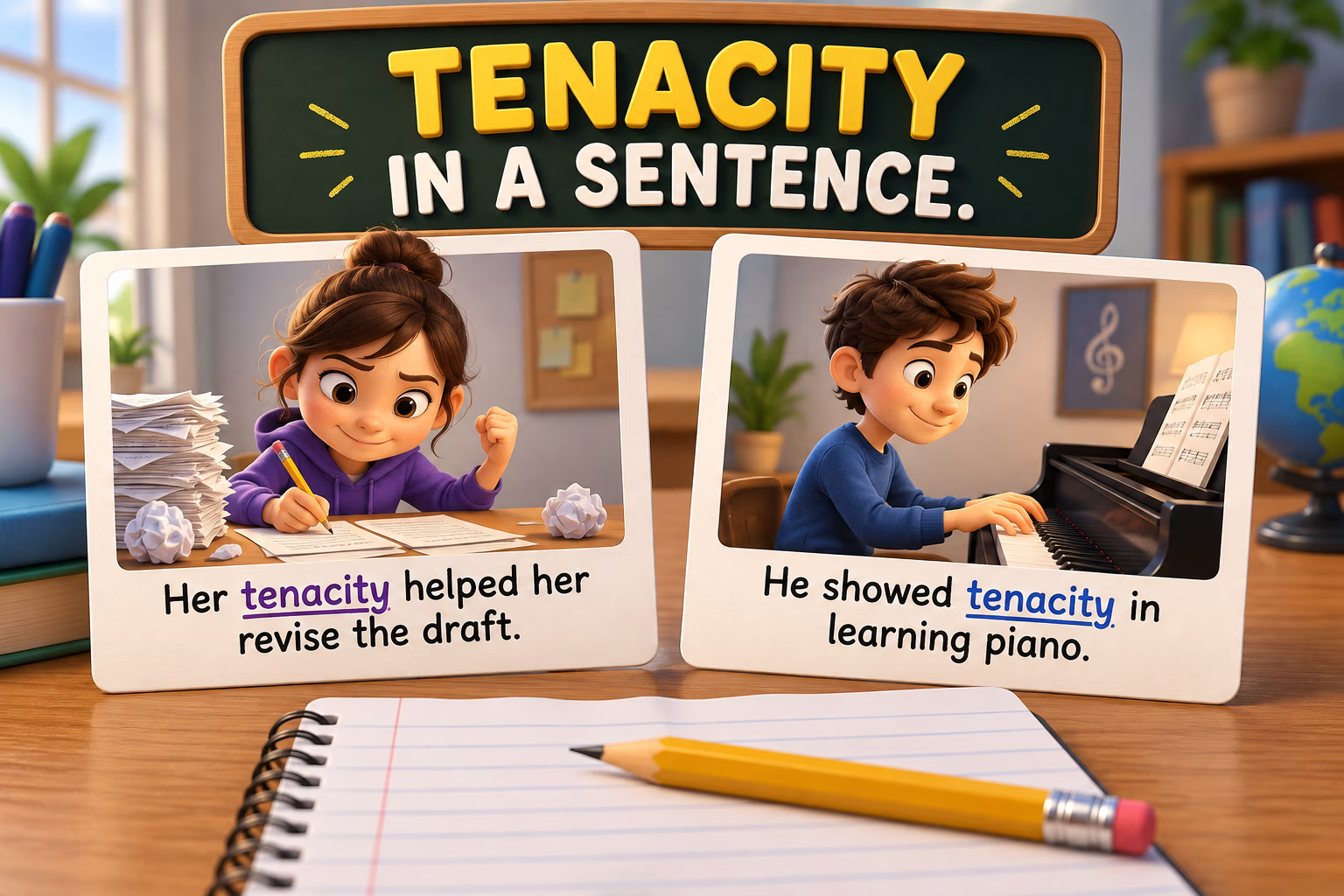
Tenacity sentence examples by situation
These examples show how the noun fits into a complete sentence. They use realistic outcomes rather than promising that persistence always leads to success.
- School: Her tenacity in revising the essay helped her make the main point easier to follow.
- Learning a skill: With tenacity and regular practice, Omar learned the piano passage one measure at a time.
- Work: The technician’s tenacity helped the team trace the software bug to one outdated setting.
- Research: After several inconclusive trials, the researchers’ tenacity led them to test a different explanation.
- Sports: The runner showed tenacity by adjusting her pace after the weather changed.
- Community work: Neighbors’ tenacity in organizing weekly cleanups made the park easier for everyone to use.
- Creative work: His tenacity as a songwriter showed in the drafts he kept refining, not in refusing all feedback.
- Problem-solving: The child’s tenacity helped him try another method after the first puzzle strategy failed.
- Everyday task: She approached the complicated form with tenacity, asking for help when one section was unclear.
- Nature: The plant’s tenacity surprised the gardener as it kept growing in the narrow crack.
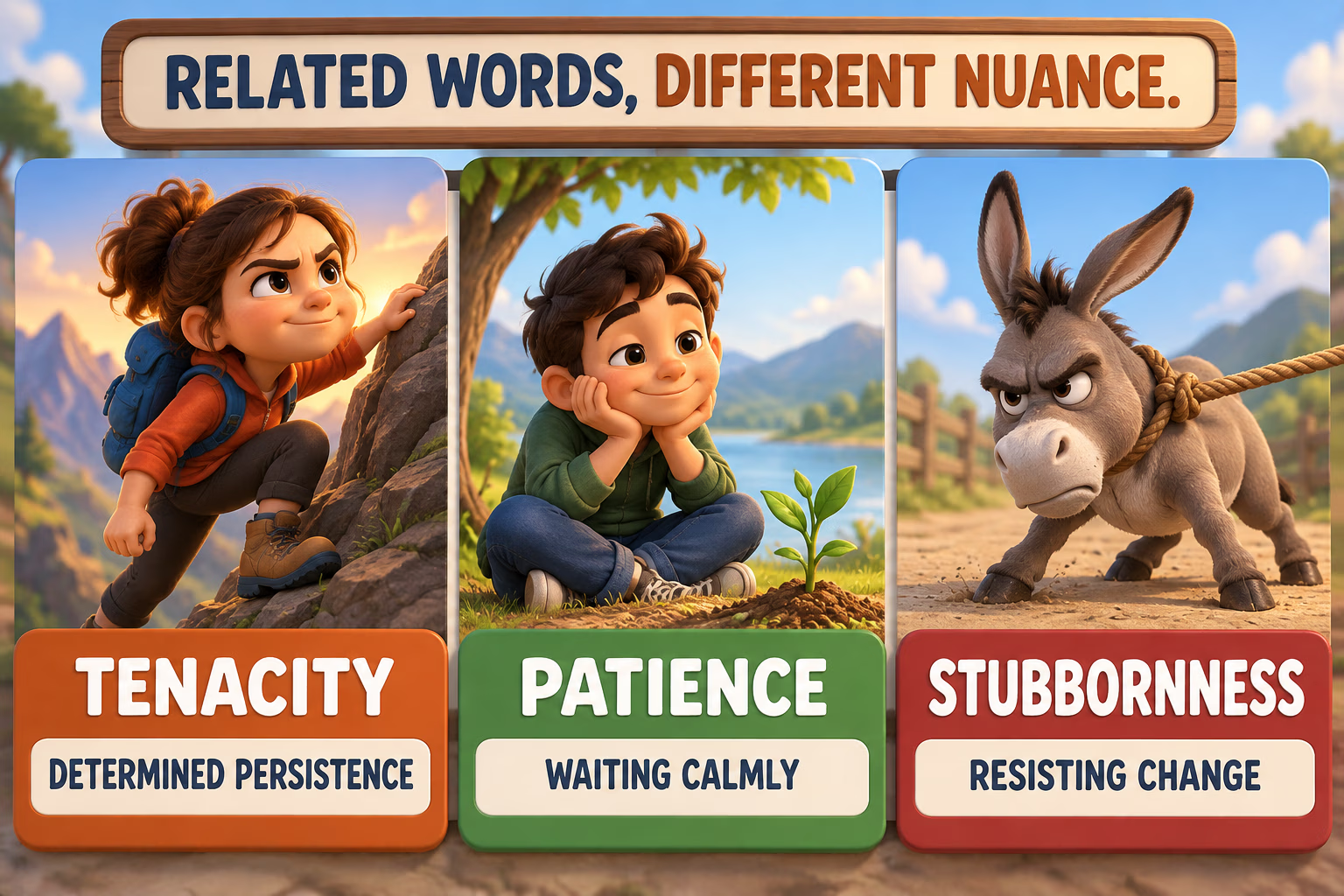
Tenacity, persistence, perseverance, and stubbornness
These words overlap, but they do not have identical tone. Tenacity often suggests determined effort; persistence is a broad, fairly neutral word for continuing; and perseverance often praises sustained effort through difficulty. Stubbornness more often suggests resistance to changing one’s mind, even when a change may be sensible.
| Word | Typical emphasis | Example |
|---|---|---|
| tenacity | Firm continued effort; can sound admiring or, in some contexts, unyielding | The editor’s tenacity helped uncover a missing record. |
| persistence | Continuing or repeating an effort; often neutral | Persistence in asking clear questions helped resolve the billing error. |
| perseverance | Continuing through hardship; usually approving | Her perseverance through months of language practice improved her fluency. |
| determination | A firm decision or resolve to do something | His determination to finish the application kept him on schedule. |
| stubbornness | Refusing to change position; often critical | Stubbornness kept the group arguing after new evidence appeared. |
A helpful editing question is whether the sentence praises sustained effort or criticizes inflexibility. “The negotiator pursued the issue with tenacity” sounds positive; “her tenacity about the outdated rule delayed the meeting” can sound critical. Context supplies the evaluation.
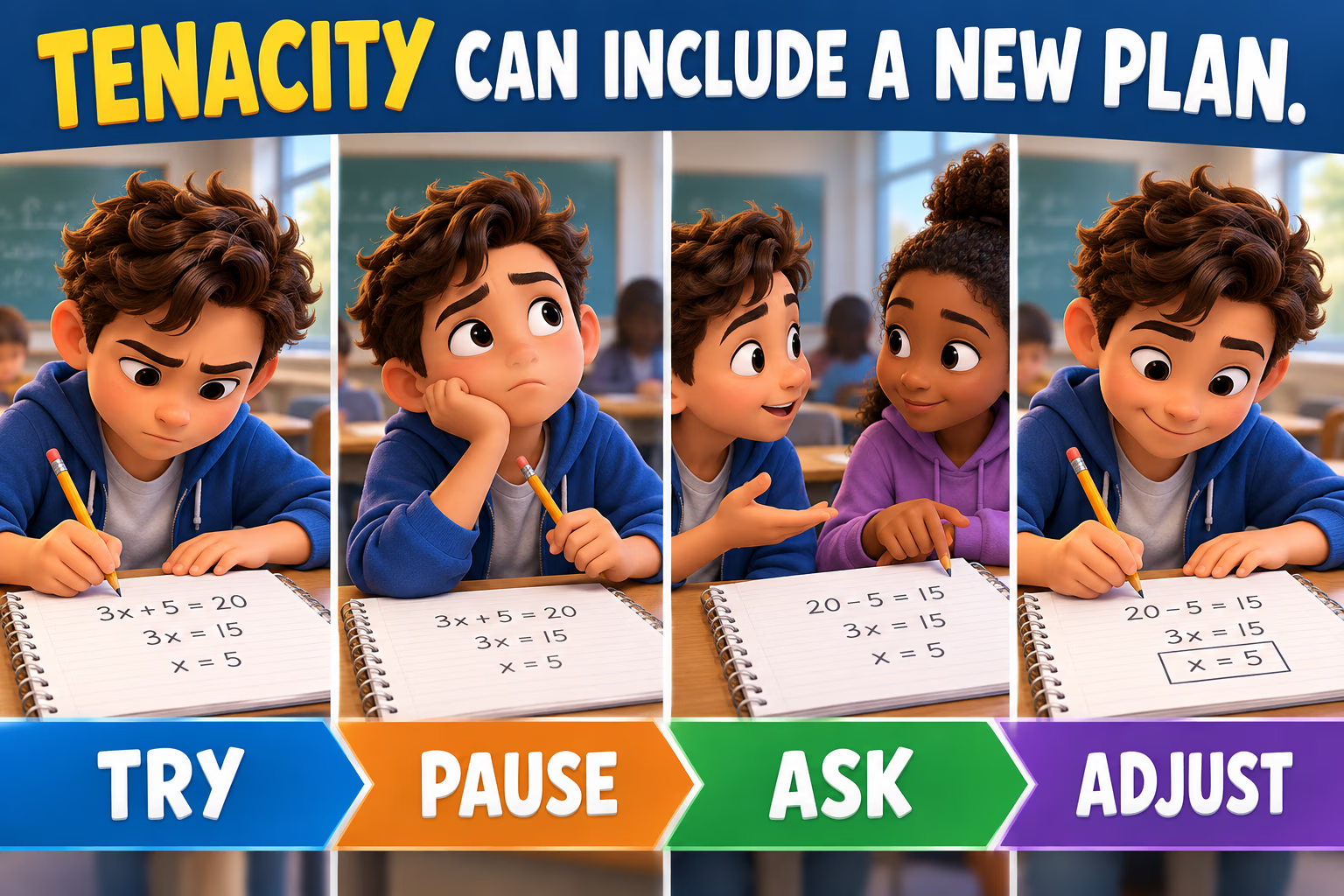
Does tenacity mean never giving up?
No. Tenacity means continuing with determination, but sensible persistence can include changing methods, setting a new timeline, asking for support, resting, or deciding that a goal no longer fits. Continuing unchanged despite harm, missing information, or a better option is not automatically a virtue.
Use the word to describe an action or quality you can point to: repeated practice, careful revisions, follow-up questions, or problem-solving after a setback. Avoid claiming that tenacity alone caused an outcome or that anyone can achieve anything by wanting it enough. Skills, access, time, health, resources, and circumstances also shape results.
For a child-friendly example, “Mina showed tenacity when she tried a new way to solve the puzzle” praises effort and learning. It does not tell a child to continue an unsafe activity or suggest that a difficult result means they did not try hard enough.
Frequently asked questions about tenacity
Is tenacity a noun or an adjective?
Tenacity is a noun: “His tenacity impressed the coach.” Tenacious is the adjective: “He was a tenacious learner.” Tenaciously is the adverb: “He practiced tenaciously.”
Is tenacity countable?
Cambridge labels tenacity an uncountable noun. The usual form is “show tenacity” or “a great deal of tenacity,” rather than “a tenacity.”
What preposition follows tenacity?
Common constructions include “tenacity in doing something” (“tenacity in solving the problem”) and “with tenacity” (“she worked with tenacity”). Choose the construction that makes the relationship clear; a sentence does not need a preposition after every use.
What is a simple tenacity sentence for kids?
“With tenacity, Luis tried a different way to build the tower.” This shows persistence through a challenge while leaving room to adapt; it does not promise that every goal is possible or require someone to continue when they need help.
Can tenacity have a negative meaning?
Yes. The word often sounds admiring, but it can suggest inflexibility when someone continues despite strong reasons to change course. “She showed tenacity in checking the facts” praises effort; “his tenacity about the disproved claim frustrated the team” criticizes it.

Note on the preserved examples below
The original article below is retained exactly as written, including its repeated classroom and college examples. Treat its phrases “never giving up,” “achieve anything we set our minds to,” and “being strong and determined in everything” as motivational language, not literal rules or guaranteed outcomes. Persistence does not require ignoring safety, health, disability, access needs, feedback, or changing circumstances; rest, support, accommodations, and revising a goal can be sensible choices. These examples model one possible use of the word and do not imply that outcomes depend only on individual effort.
Tenacity is the relentless determination and persistence to achieve a goal, no matter the obstacles that may arise. It is the unwavering drive to persevere through challenges and setbacks, refusing to give up until success is achieved.
Individuals with tenacity possess a strong resolve and resilience, allowing them to overcome difficulties with a steadfast commitment to their objectives. The quality of tenacity is often admired and revered, as it is a key element in achieving personal and professional aspirations.
7 Examples Of Tenacity Used In a Sentence For Kids
- Tenacity means never giving up, no matter how hard things get.
- When we face challenges, we can show tenacity by trying our best and not giving up.
- Tenacity is like having a superpower that helps us keep going even when things are tough.
- We can show tenacity by being brave and not letting obstacles stop us.
- It’s important to have tenacity because it helps us reach our goals.
- Remember, with tenacity we can achieve anything we set our minds to.
- Let’s all show tenacity by being strong and determined in everything we do.
14 Sentences with Tenacity Examples
- Tenacity is essential when studying for challenging exams in college.
- College students in India must show tenacity when balancing academics and extracurricular activities.
- Developing tenacity will help students persevere through tough times in their academic journey.
- With tenacity, students can overcome setbacks and keep pushing towards their goals.
- Showing tenacity in networking and building relationships can open up opportunities for college students.
- Maintaining tenacity in pursuing internships can lead to valuable work experience for students.
- College students need tenacity when managing multiple assignments and deadlines.
- Demonstrating tenacity in learning new skills can enhance a student’s employability.
- Cultivating tenacity in research projects can lead to groundbreaking discoveries in academia.
- Developing tenacity in public speaking can boost a student’s confidence and communication skills.
- College students can benefit from the tenacity to seek out mentors and guidance for their career paths.
- Applying tenacity in entrepreneurship can help students build successful ventures in the future.
- Utilizing tenacity in volunteer work can create a positive impact on society and enhance personal growth.
- Having tenacity in pursuing academic excellence can lead to various opportunities for scholarships and grants.
How To Use Tenacity in Sentences?
Tenacity is a noun that describes the quality of being determined and persistent. When using tenacity in a sentence, it is important to keep in mind its meaning to ensure that your message comes across clearly.
To use tenacity in a sentence, simply integrate it into your writing to convey the idea of someone’s perseverance. For example: “Despite facing numerous obstacles, she showed remarkable tenacity in achieving her goals.” In this sentence, tenacity is used to highlight the person’s strong determination in overcoming challenges.
When incorporating tenacity into your writing, consider the context in which you are using the word. Make sure it fits appropriately and accurately conveys the intended meaning. For instance, “His continued pursuit of excellence in the face of adversity exemplifies his remarkable tenacity” illustrates how tenacity can be utilized to showcase someone’s unwavering dedication.
By practicing using tenacity in sentences, you can enhance your writing skills and effectively communicate the idea of perseverance and determination. Remember to use tenacity in a way that aligns with its definition and conveys the intended message clearly.
Conclusion
In conclusion, the sentences with “tenacity” displayed a resolute determination and persistence in various contexts. These sentences illustrated the quality of tenacity as an essential trait for overcoming challenges, achieving goals, and persevering in the face of adversity. Whether in personal growth, professional success, or academic pursuits, the consistent theme of unwavering resolve was evident in each use of the word.
Through these examples, it is clear that individuals who exhibit tenacity are more likely to withstand obstacles, reach milestones, and ultimately find success. The notion of tenacity serves as a reminder of the power of determination and grit in navigating life’s hurdles and making progress towards one’s aspirations.


