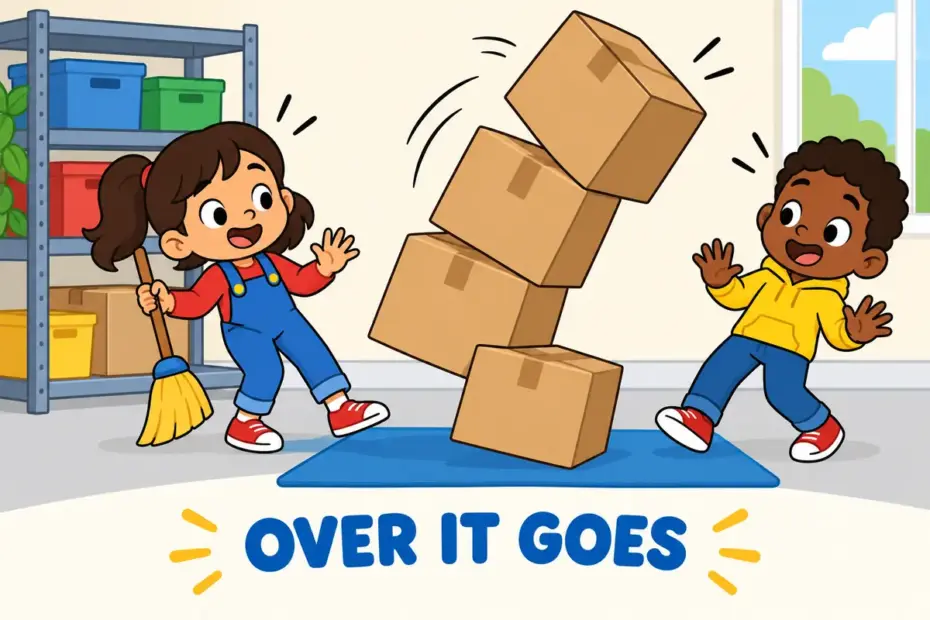
Tip over means to lose balance and fall onto one side, or to make something do so. To use tip over in a sentence, decide whether the thing falls by itself or is pushed: “The vase tipped over in the wind.” The phrasal verb works with or without an object, and it is separable when it has one.
Tip over at a glance
- Tip over is a separable phrasal verb; its forms are tip over, tips over, tipped over and tipping over.
- It means to fall or turn onto one side, or to make something do so.
- The usual pattern is a subject plus tip over, or tip something over with an object.
- The verb belongs to everyday description and news writing about accidents.
- The commonest error is using tip over when the real action is a deliberate knock with a hand.
What does tip over mean?
Tip over is a phrasal verb meaning to turn onto a side after losing balance, or to make something turn that way. The Cambridge entry for tip over gives fall and overturn as its core senses, and the cause can be wind, uneven ground, a nudge or an unsteady load. Where the movement is grand and sudden, a stack may topple suddenly, and a small boat in rough water may capsize in the swell.
| Sense | Plain meaning | Example sentence |
|---|---|---|
| Fall onto a side | Something unstable turns over by itself | The vase tipped over in the wind. |
| Make something fall | A person or force turns an object onto its side | He tipped over the bucket by mistake. |
| Turn partly upside down | A vehicle or craft rolls onto its side or back | The canoe tipped over in the shallows. |
One limitation is worth stating plainly. Tip over describes a fall, not a blow. If a hand or a moving object sends something down, the accurate verb is knock over a drink, because an impact starts the fall. Choose tip over when the thing itself becomes unstable.
How do you use tip over in a sentence?
The verb can stand alone or take an object, and it is separable when it does. Five patterns cover almost every real sentence, and the pronoun rule is the one learners miss.
| Pattern | Example | What it signals |
|---|---|---|
| subject + tip over (no object) | The lamp tipped over on the desk. | Intransitive: the thing falls on its own. |
| subject + tip + object + over | She tipped the glass over. | Object sits between verb and particle. |
| subject + tip over + object | The wind tipped over the signboard. | The object follows the particle, also correct. |
| tip + it + over | He nudged the box and tipped it over. | A pronoun must go between verb and particle. |
| be tipped over | The cart was tipped over by the crowd. | Passive voice, used when the cause is unclear or distant. |
Tip over in a sentence: examples across contexts
The verb keeps its meaning but shifts its company depending on the text. The nine sentences below move from a news report to a fiction scene, and each one shows which words a writer reaches for alongside it.
| Context | Example sentence | Why this works |
|---|---|---|
| News report | A lorry tipped over on the bypass during the gale. | A plain subject and a clear cause suit a report. |
| Safety notice | Never leave a ladder where it can tip over. | Warns about a risk without naming a person. |
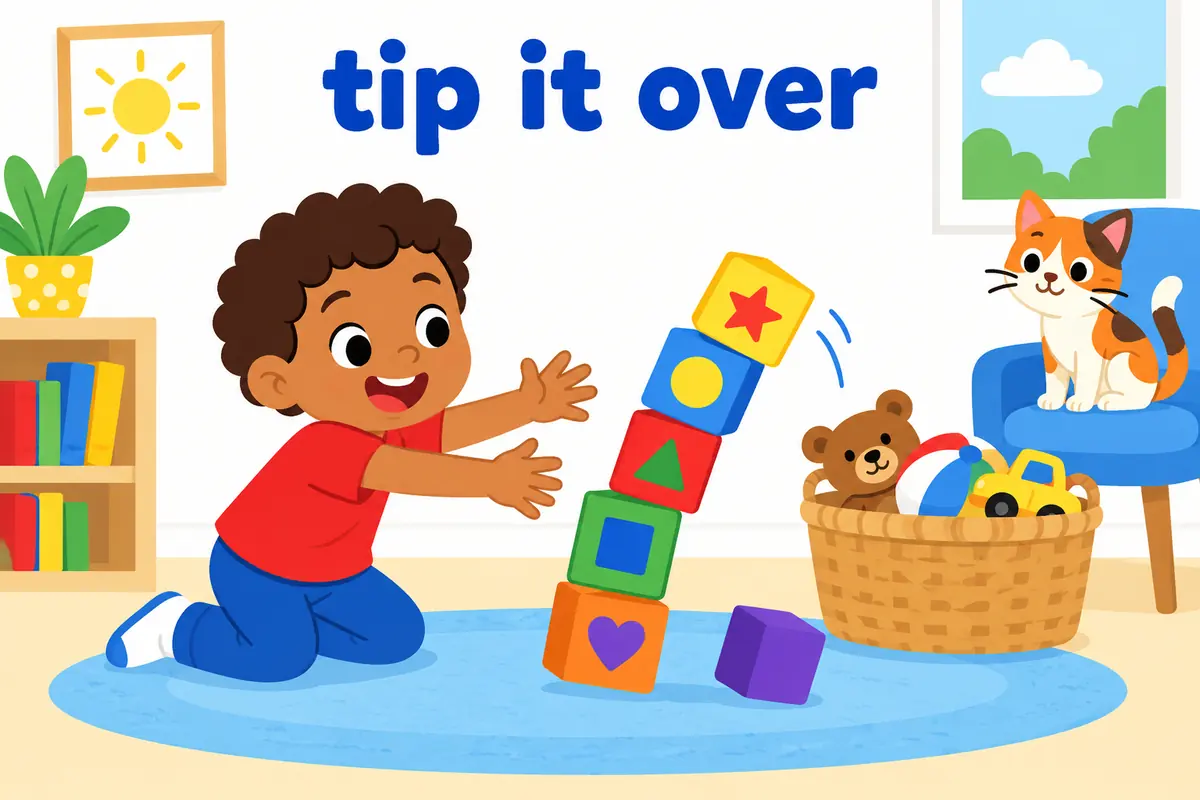
| Classroom story | The tower of blocks tipped over with a clatter. | A harmless subject keeps the word playful. |
| Sports writing | The canoe tipped over at the final bend. | Names the craft and the moment, as commentary does. |
| Home advice | Shelve heavy pans low so they cannot tip over. | Gives an instruction that leans on the verb. |
| Fiction | A chair tipped over as he rushed from the room. | Uses the soundless fall to suggest sudden movement. |
| Science writing | The dish tipped over when the table was nudged. | Keeps the cause mechanical and measurable. |
| Travel writing | A wooden sign had tipped over beside the track. | Paints a small scene of neglect. |
| Weather report | Several bins tipped over along the seafront overnight. | Ties a widespread effect to one cause. |
Notice how the examples without an object keep the thing as the subject, while the examples with an object make a person or a force responsible. That choice between falling and causing a fall is the clearest signal of the verb’s sense.
Tip over vs knock over
Tip over and knock over a drink both end with something on its side, but they disagree about the cause. The table sets out the contrast.
| Attribute | tip over | knock over |
|---|---|---|
| Core meaning | Fall or turn onto a side | Send something falling with a blow |
| Cause | Often unstable ground or wind | Almost always a person or a moving object |
| Typical subject | A vase, a canoe, a stack of boxes | An arm, a car, a wave |
| Register | Neutral and everyday | Neutral and slightly more active |
| What it implies | Loss of balance | A deliberate or careless impact |
| Grammar | Separable, and often intransitive | Usually transitive with an agent |
When the fall becomes a roll, loose stones tumble down a slope, and whatever tips over will fall to the ground unless something catches it. If the container was full, the contents spill the contents, and a clumsy hand can simply upset a tray.
Verdict: choose tip over when balance is lost and the thing turns onto a side by itself, and knock over only when an impact from a hand or a moving object causes the fall.
Word forms and grammar of tip over
Tip over inflects regularly through the verb tip, and it keeps a fixed pronoun rule. The table lists the forms and marks the order that is not standard.
| Form | Part of speech | Example |
|---|---|---|
| tip over | phrasal verb, base form | The stack may tip over if you add more. |
| tips over | phrasal verb, third person singular | The full crate tips over easily. |
| tipped over | phrasal verb, past and past participle | The bin tipped over in the wind. |
| tipping over | phrasal verb, present participle | The tower is tipping over. |
| tip | base verb, without over | He tipped the jug to pour. |
| tip over it | non-standard | Avoid this order; write tip it over. |
The base verb tip can stand alone when the sense is a gentle slant, as when someone tips a jug to pour, but the particle over is what adds the overturn. Keeping that difference in mind prevents the most common error, which is letting a pronoun sit after the particle.
Common mistakes with tip over
- Incorrect:
She tipped over it while cleaning.Correct: She tipped it over while cleaning. Rule: A pronoun goes between the verb and the particle, never after it. - Incorrect:
He knocked the vase over the table.Correct: He knocked the vase over with a sweep of his arm. Rule: Knock over needs the object straight after knock; over is not a preposition of place here. - Incorrect:
The canoe tipped over a rock.Correct: The canoe tipped over on the rocks. Rule: Tip over describes a fall, so a rock needs on or against, not the particle alone. - Incorrect:
The wind tipped over.Correct: The wind tipped over the signboard. Rule: The transitive use needs an object naming what was made to fall. - Incorrect:
The cup tipped over down on the floor.Correct: The cup tipped over and fell on the floor. Rule: Combine the tilting and the falling with and, not with stacked prepositions.
Practice using tip over
Work through the six items, then check the reasoning rather than only the answer.
- Fill the gap: The tall stack of books ______ when the table shook.
- Choose the better word: The boy reached out and (tipped over / tipped) the glass on purpose.
- Correct the error: She tipped over it as she set the table.
- Build a sentence: use tip + object + over about a bucket in a garden.
- Spot the register: which belongs in a safety notice — never leave the ladder where it can tip over, or the ladder, like, tipped over?
- Rewrite in the passive: The crowd tipped over the barrier. Begin with The barrier.
Answers
- tipped over — the stack lost its balance on its own, which is the intransitive sense.
- tipped over — a full overturn is described by the phrasal verb, while tipped alone means leaning to pour.
- She tipped it over as she set the table — the pronoun belongs between the verb and the particle.
- Model answer: The gardener tipped the bucket over beside the rose bed.
- Never leave the ladder where it can tip over — a notice stays plain and avoids the vague filler word.
- The barrier was tipped over by the crowd — the passive moves the fallen object to the front.
The bottom line
Use tip over in a sentence when something loses its balance and falls onto a side, or when a person makes it do so. The two nuances that decide most sentences are these: the verb can take an object or stand alone, and a pronoun goes between tip and over.
Frequently asked questions about tip over
Is tip over one word or two?
Tip over is a phrasal verb written as two words. The base verb tip means to lean or slant, but adding over adds the idea of falling all the way onto a side. Do not write it as one word or hyphenate it, and keep both words together in the base form.
Can tip over be used without an object?
Yes. Tip over often stands alone, as in the vase tipped over in the wind, where the thing falls by itself. It can also take an object, as in she tipped the glass over, where a person causes the fall. The meaning stays the same; only the cause changes.
What is the difference between tip over and knock over?
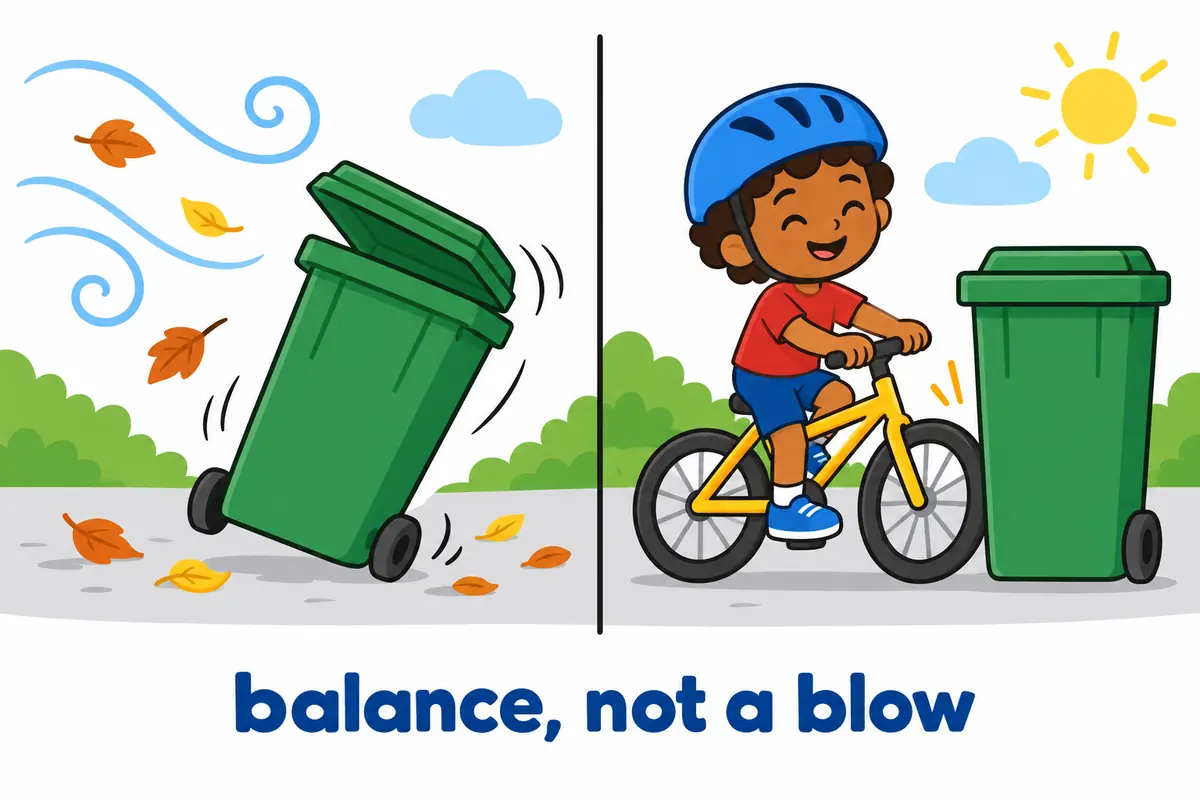
Tip over means to lose balance and fall onto a side, and it happens with wind, uneven ground or a nudge. Knock over means to send something falling with a blow, and it usually needs a person or a moving object as the cause. A gust tips a bin over; a cyclist knocks it over.
Is tip over separable?
Yes. You can write she tipped over the bucket or she tipped the bucket over, and both are correct. A pronoun must go between the two parts, so it is tip it over, never tip over it. That placement rule is what marks tip over as a separable phrasal verb.
Have you ever experienced the frustration of watching your drink “tip over” on a wobbly table? When an object such as a glass or a vase accidentally falls over from an unstable surface, it is called “tipping over.”
This common occurrence happens when the center of gravity of an object is not properly balanced, causing it to lose stability and topple to one side. Objects are more likely to tip over when placed on uneven or slippery surfaces.
7 Examples Of Tip Over Used In a Sentence For Kids
- The toy car can tip over if you push it too hard.
- Be careful not to tip over your water bottle.
- The tree branch might tip over if you climb on it.
- The cup might tip over if you fill it too much.
- The book might tip over if you stack too many on top.
- The chair might tip over if you lean back too far.
- The flowerpot might tip over if you bump into it.
14 Sentences with Tip Over Examples
- I accidentally tip over my cup of chai while studying for my exams.
- Be careful not to tip over your laptop while working in the crowded library.
- It’s easy to tip over a stack of books if you’re not careful with your shelves.
- Don’t tip over your chair while leaning back during a boring lecture.
- Ensure you don’t tip over the whiteboard marker while writing on the board.
- The gust of wind caused the umbrella to tip over during the monsoon season.
- Watch out for stray cables that could easily make you tip over your phone or laptop.
- During lunch breaks, students may accidentally tip over their food trays in the busy cafeteria.
- Avoid holding too many books at once, as you might inadvertently tip over the stack.
- Carefully navigate through the crowded halls to not tip over someone’s backpack lying on the floor.
- The unsteady table leg made it easy for the coffee mug to tip over during group discussions.
- Tip over your water bottle by mistake? No worries, just quickly clean it up before it spills everywhere.
- The strong wind outside might just be enough to tip over the overloaded dustbin near the hostel entrance.
- Make sure to securely fasten your water bottle in the side compartment of your bag to avoid any tip over accidents.
How To Use Tip Over in Sentences?
Tip Over is a phrasal verb that means to cause something to fall over by pushing it, knocking it, or overturning it.
To use Tip Over in a sentence, follow these steps. First, identify the object that is being tipped over. Second, determine the action that is causing the object to fall. Third, combine the object and action in a sentence to convey the meaning of tipping over.
For example, “The strong gust of wind tipped over the picnic table in the backyard.” In this sentence, “the strong gust of wind” is the cause, and “the picnic table” is the object that fell over, showing how Tip Over is used in context.
To master using Tip Over effectively, consider the following tips: practice incorporating the phrasal verb in various sentences to enhance your understanding and usage. Additionally, pay attention to the context in which Tip Over is used in order to grasp its meaning accurately.
In summary, Tip Over is used to describe the action of causing something to fall over. By following these guidelines and practicing, you can become proficient in using the phrasal verb Tip Over in your conversations and writing.
Conclusion
In conclusion, when objects are unbalanced, they can easily tip over. This can happen with anything from a glass of water on a wobbly table to a tall bookshelf not properly secured to the wall. Whether it’s a playful cat knocking something over or a strong gust of wind causing something to topple, being mindful of stability and weight distribution can help prevent accidents caused by tipping over.
Maintaining a clutter-free environment, securing top-heavy furniture, and avoiding placing heavy items on unstable surfaces are simple yet effective ways to reduce the risk of things tipping over. By taking these precautions and being aware of potential hazards, we can create a safer and more stable environment for ourselves and those around us.