
Vouch for means to give a personal assurance that somebody is reliable or that something is true. To use vouch for in a sentence, name the person or claim after for: a manager vouches for a new hire, or the records vouch for the date. The preposition never leaves the verb.
Vouch for at a glance
- Vouch for is a phrasal-prepositional verb meaning to assure or to confirm.
- Its forms are vouches for, vouched for and vouching for.
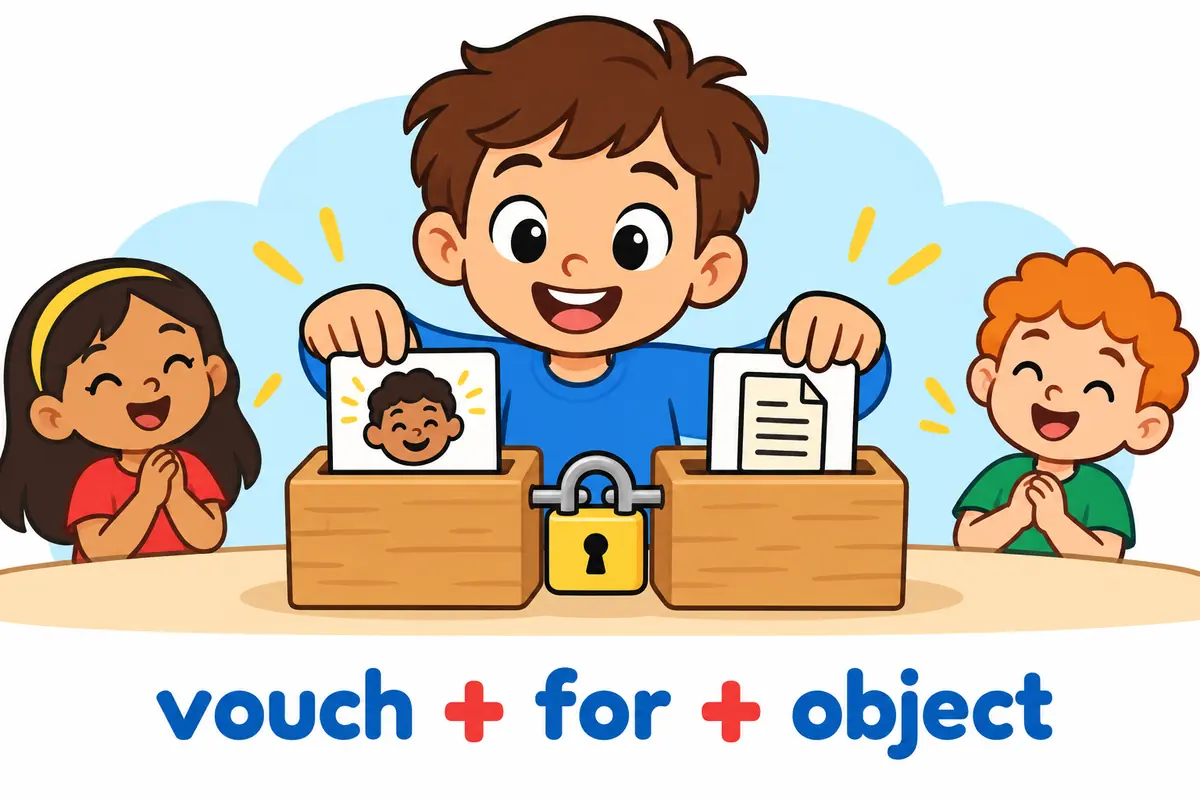
- The preposition for is fixed, so no object can come between vouch and for.
- The object may be a person, a claim, a report or a set of records.
- The commonest error is dropping for and writing I can vouch him.
What does vouch for mean?
Vouch for is a phrasal-prepositional verb meaning to give a personal assurance that somebody is reliable or that something is true. It has three closely related senses: guaranteeing a person, confirming a claim, and providing evidence for a fact. All three keep the preposition for before the object.
| Sense | Plain meaning | Example sentence |
|---|---|---|
| Guarantee a person | Assure others that someone is reliable | Her tutor vouched for her attendance. |
| Confirm a claim | Say that a statement is true | The accounts vouch for the figures. |
| Give evidence for | Serve as proof of a fact | The letters vouch for the date of the sale. |
The Cambridge entry for vouch for records the senses of confirming and of personally guaranteeing, and shows the preposition locked to the verb. Where a writer only wants to state that something is true, confirm the figures is the plainer choice, because vouch for always adds a person and their reputation.
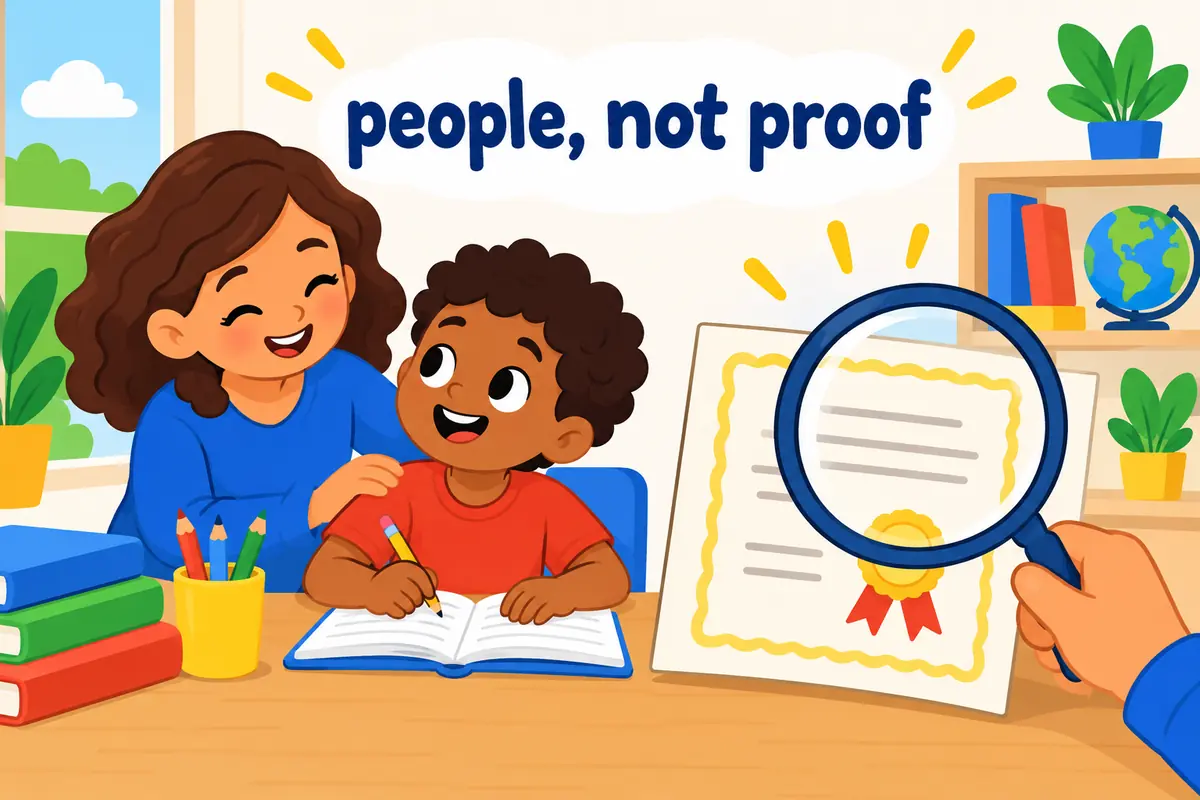
One limitation matters. Vouch for rests on personal knowledge, so it is a weak word when the speaker has none. Saying I can vouch for the safety of a bridge you have never inspected is a claim you cannot support. Where the point is documentary proof, evidence, not assurance, is what a reader needs.
How do you use vouch for in a sentence?
The phrase is not separable. The preposition for stays next to the verb, and the object follows it, so nothing ever slips between. That single rule explains the passive too, where the person or claim becomes the subject and for stays in place.
| Pattern | Example | What it signals |
|---|---|---|
| vouch for + somebody | I can vouch for him. | A personal assurance about a person. |
| vouch for + something | The records vouch for the dates. | Evidence confirms a fact. |
| can or could + vouch for | I can vouch for her reliability. | A modal frames the assurance as personal and conditional. |
| be vouched for | The story was vouched for by two witnesses. | Passive; the claim becomes the subject. |
| vouch for the fact that | Nobody can vouch for the fact that he was there. | A clause needs the fact as the object. |
To back a colleague rather than guarantee them, writers often prefer support a colleague, which names help rather than assurance. The guarantee sense sits closest to guarantee a result, though that verb promises an outcome rather than a character.
Vouch for in a sentence: examples across contexts
The phrase keeps its shape while the setting changes. The sentences below show the person and the claim senses in places where each sounds natural.
| Context | Example sentence | Why this works |
|---|---|---|
| Reference letter | I have known Ada for six years and can vouch for her judgement. | The person sense with first-hand knowledge named. |
| Workplace email | Our finance team can vouch for the accuracy of the totals. | The claim sense with a team as the source. |
| News report | Two residents vouched for the account given to police. | Witnesses confirm a statement. |
| Legal writing | The clerk vouched for the authenticity of the seal. | Formal confirmation of an object. |
| Customer review | I cannot vouch for the delivery times, only for the product. | Limits the assurance honestly. |
| Academic writing | The archive vouches for the earlier date of the treaty. | A document serves as evidence. |
| Conversation | Ask Ravi; he can vouch for me. | The person sense in a short spoken sentence. |
| Sports report | Her coach vouched for the injury before the selectors met. | A named authority gives the assurance. |
| Job interview | My last manager will vouch for how I handle deadlines. | Future assurance tied to a specific skill. |
Notice how often the modal can appears. Vouching is a personal act, and can marks the speaker as the limited source of the assurance rather than an official one.
Vouch for vs attest to and confirm
Vouch for overlaps with two verbs of proof and matches neither exactly. To attest to the signature is the formal, often legal act of bearing witness, while to verify a claim is to check it against evidence.
| Attribute | vouch for | attest to | confirm |
|---|---|---|---|
| Core job | Personally assure or confirm | Bear formal witness | State that something is true |
| Source of proof | The speaker’s own knowledge | The speaker’s formal position | Facts already on record |
| Usual object | A person or a claim | A document, fact or signature | A fact, booking or figure |
| Register | Neutral to business | Formal and legal | Neutral and official |
| Example | I can vouch for her. | Two officers attested to the seal. | The bank confirmed the transfer. |
Verdict: choose vouch for when a person stakes their own reputation, attest to for a formal legal witness, and confirm when the facts already exist and are simply being restated.
Word forms and grammar of vouch for
The verb inflects on vouch, and the particle for never changes. There is no noun built from the phrase, so writers borrow voucher or guarantee instead, neither of which means the same thing.
| Form | Part of speech | Example |
|---|---|---|
| vouch for | base phrasal-prepositional verb | I cannot vouch for the schedule. |
| vouches for | verb, third person singular | The director vouches for her record. |
| vouched for | verb, past and past participle | Two neighbours vouched for him. |
| vouching for | verb, present participle | She is vouching for the new supplier. |
| vouched-for | attributive adjective | The vouched-for applicant was hired at once. |
Do not confuse the phrase with vouchsafe, which means to grant something, or with a voucher, which is a document. A page on call for evidence shows another phrasal verb built on for, and a page on endorse a product covers the public, promotional side of backing something.
Common mistakes with vouch for
- Incorrect:
I can vouch him.Correct: I can vouch for him. Rule: The preposition for is required before every object. - Incorrect:
I can vouch for it is true.Correct: I can vouch for the fact that it is true. Rule: Vouch for takes a noun object, so a clause needs the fact as its head. - Incorrect:
She vouched him for his honesty.Correct: She vouched for his honesty. Rule: For comes before the object, never after it. - Incorrect:
The report vouches the numbers.Correct: The report vouches for the numbers. Rule: For is fixed to the verb in every sense. - Incorrect:
I can vouch for that he will arrive.Correct: I can vouch for his arrival. Rule: Use a noun phrase, not a that-clause after for.
Practice using vouch for
Work through the six items, then read the reasons rather than only the answers.
- Fill the gap: My old supervisor will ______ my punctuality.
- Choose the better word: The bank will (vouch for / attest to) the transfer once the payment clears.
- Correct the error: Two witnesses vouched the driver.
- Build a sentence: use vouch for about a referee who guarantees a candidate’s honesty.
- Spot the register: which belongs in a legal document, The clerk attested to the seal, or The clerk swore the seal was real?
- Rewrite with the noun: Nobody could confirm the date from memory. Use vouch for.
Answers
- vouch for — the supervisor gives a personal assurance about a person.
- confirm — the facts exist on record, so confirm is the plainer official verb.
- Two witnesses vouched for the driver — for must come before the object.
- Model answer: The referee can vouch for the candidate’s honesty.
- The clerk attested to the seal — attest to is the formal legal witness.
- Nobody could vouch for the date from memory — the claim sense fits the noun phrase.
The bottom line
Use vouch for in a sentence when you personally guarantee a person or confirm a claim you know at first hand. The two details that decide most sentences are that the preposition for is fixed, and that the object must be a noun phrase rather than a that-clause. Where the assurance is impersonal, confirm or attest to usually reads more precisely.
Frequently asked questions about vouch for
Is vouch for one word or two?
It is always two words in the verb, vouch for, and the two never merge. There is no single word vouchfor. A related noun is voucher, which names a document rather than a promise, so keep the verb phrase separate in every sentence.
Can you vouch for a thing and not just a person?
Yes. The object after for may be a person or a thing, so you vouch for a colleague and also vouch for the accuracy of a report. The person sense carries a personal guarantee, while the thing sense leans on evidence, but both obey the same pattern.
Does vouch for need an object?
Yes. Vouch for cannot stand alone in its main sense; it needs the preposition and an object. You vouch for somebody or something. Without an object the verb is incomplete, so a sentence such as the manager vouched for reads as unfinished rather than brief.
Who can vouch for you?
Usually someone with direct knowledge, such as a former employer, a teacher or a colleague. A reference letter exists so that a named person can vouch for an applicant. Vouching for a stranger is weak, because the assurance rests on first-hand experience.
Have you ever needed someone to vouch for your character or reliability? When someone vouches for you, they are essentially speaking on your behalf, endorsing your trustworthiness or abilities. This act of validation can be crucial in various situations, from job applications to personal recommendations.
When someone vouches for you, they are affirming their belief in your integrity or competency, lending their credibility to boost your own. This gesture can make a significant impact, assuring others of your worthiness or capabilities. Getting someone to vouch for you can help build rapport, establish credibility, and open up opportunities that may have been otherwise inaccessible.
7 Examples Of Vouch For Used In a Sentence For Kids
- My friend will vouch for me in the game.
- I will vouch for my sister’s drawing skills.
- Can you vouch for your classmates’ good behavior?
- I can vouch for the fact that I brushed my teeth today.
- The teacher will vouch for our hard work in class.
- Let’s all vouch for each other’s honesty.
- I will vouch for the delicious taste of my mom’s cooking.
14 Sentences with Vouch For Examples
- Vouch for your friend’s character when recommending them for a college committee position.
- Ask your professor to vouch for your attendance in class if needed.
- Vouch for your classmate’s academic achievements when writing a letter of recommendation for them.
- Get a senior student to vouch for the credibility of a particular course before enrolling in it.
- Vouch for the authenticity of your research sources in your college assignments.
- Have your lab partner vouch for your contribution to a group project.
- Ask a club member to vouch for your leadership skills when running for a position in the student council.
- Vouch for your roommate’s behavior and responsibility when they are looking for a new roommate.
- Get your internship supervisor to vouch for your work ethic and skills while applying for a job.
- Vouch for the quality of a particular book or resource when recommending it to your peers.
- Have a senior student vouch for the usefulness of certain study techniques before implementing them.
- Ask your professor to vouch for your understanding of a particular topic during a class discussion.
- Vouch for a classmate’s participation in group discussions during a presentation evaluation.
- Get a college counselor to vouch for your commitment to personal development when applying for scholarships.
How To Use Vouch For in Sentences?
Vouch For is a phrase used to express support or endorsement for someone or something. When using “vouch for” in a sentence, you are essentially affirming the credibility, character, or overall quality of the subject being discussed.
Here are a few examples to help you understand how to use “vouch for” correctly:
- “I can vouch for Sarah’s honesty as she has always been truthful with me.”
- “I vouch for the authenticity of this painting, as it has been verified by an expert.”
- “My friend asked me to vouch for her qualifications during the job interview.”
- “Having known him for many years, I can vouch for his reliability and trustworthiness.”
- “I am happy to vouch for the effectiveness of this product, as I have personally used it before.”
Remember, when using “vouch for,” you are offering your assurance or guarantee about someone or something. It is a way of providing a recommendation or confirming the validity of a claim. By using this phrase, you are indicating that you have firsthand knowledge or experience that validates the subject in question.
Conclusion
In conclusion, the phrase “vouch for” is commonly used to express confidence, support, or assurance about someone or something. It serves as a testament to one’s belief in the credibility or trustworthiness of a person or a statement. For example, “I can vouch for his honesty” indicates a personal endorsement of the individual’s integrity.
By using the phrase “vouch for,” speakers convey a sense of reliability and reliability in their affirmation or recommendation. It implies a level of certainty and conviction in the endorsement being made. Overall, the phrase adds weight and credibility to statements or assertions, making it a powerful tool for expressing confidence and support in various contexts.


