
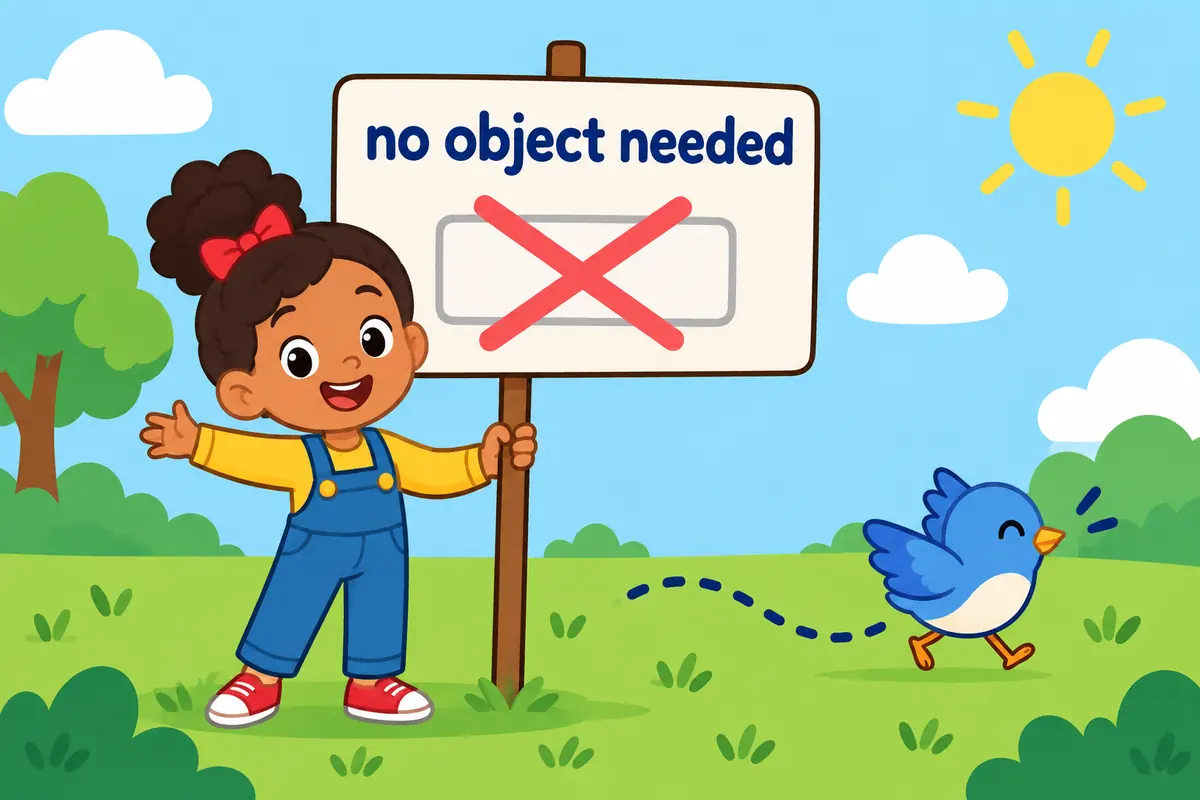
Wander off is an intransitive phrasal verb meaning to move away from a place or group, often without noticing. To use wander off in a sentence, name who left and where they left from: “The puppy wandered off toward the gate.” The verb takes no object, so you never wander something off.
Wander off at a glance
- Wander off is an intransitive phrasal verb; its forms are wanders off, wandered off and wandering off.
- It takes no object, so it is never split: the particle stays in place.
- It often pairs with from, toward or into, as in wander off from the group.
- The usual subjects are people, children, animals and, figuratively, attention or a conversation.
- The commonest error is adding an object, as in the children wandered off the trip.
What does wander off mean?
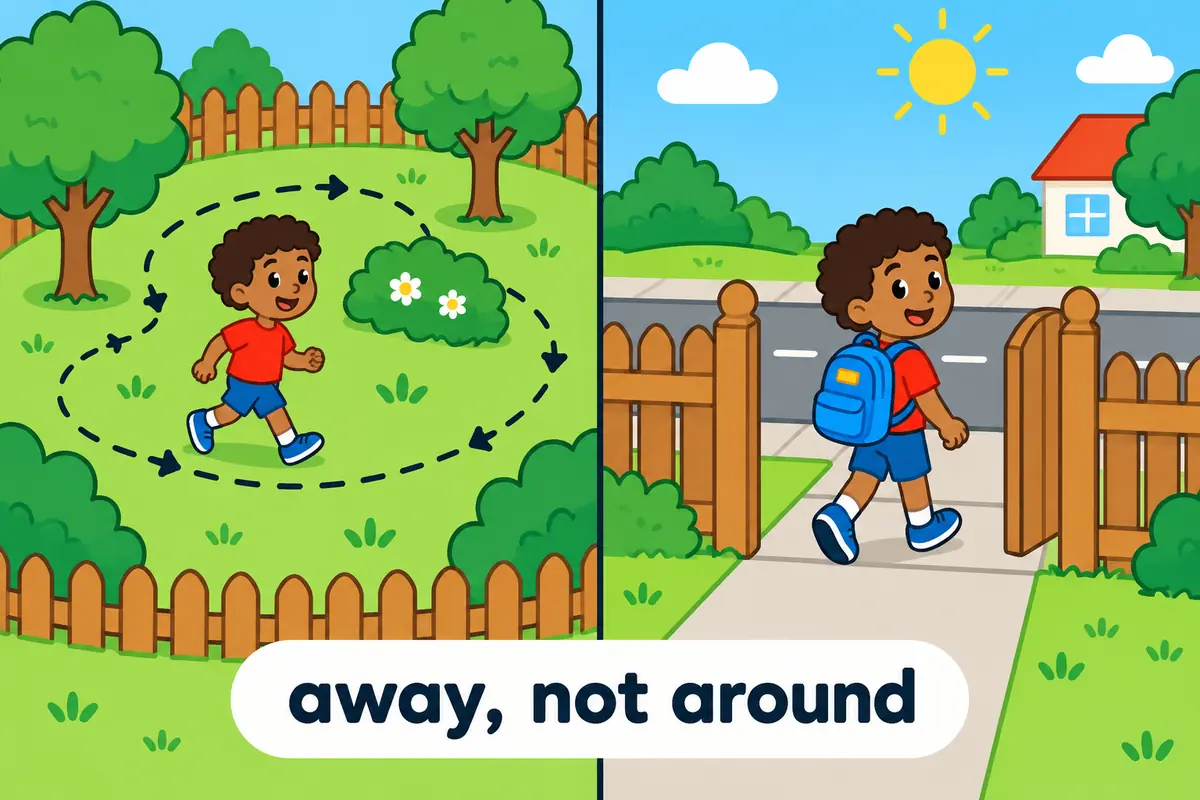
Wander off is a phrasal verb meaning to walk away from a place or group, usually in a slow, unplanned way. The Cambridge entry for wander off records the movement sense, and the same idea transfers to a mind or a conversation that drifts from its subject. Two uses sit close together: the particle use, where wander off stands alone, and the preposition use, where off takes a noun, as in wander off the path. Where the movement is aimless but stays in one area, roam is the closer verb.
| Sense | Plain meaning | Example sentence |
|---|---|---|
| Leave a place or group | Walk away without a fixed purpose | The children wandered off during the break. |
| Drift from a topic | Of a mind or talk, move away from the point | Her attention wandered off mid-sentence. |
| Stray from a route | Move gradually off a path or boundary | We wandered off the trail and lost the way. |
One limitation matters. Wander off describes a gradual, often unwitting movement, so it is wrong for a deliberate exit. A pupil who leaves class on purpose does not wander off, because that word softens the act. For a planned departure, use leave or set off.
How do you use wander off in a sentence?
Wander off is intransitive, so it needs no object, and the particle cannot be separated from the verb. When you name the starting point, add from; when you name a direction, add toward or into. A mind that loses focus does the same thing figuratively, and writers often choose drift there instead.
| Pattern | Example | What it signals |
|---|---|---|
| wander off (no object) | The toddler wandered off near the pond. | The default intransitive use; the place is only implied. |
| wander off + from + group | He wandered off from the tour group. | Names the starting point with from. |
| wander off + toward or into + place | She wandered off toward the orchard. | Adds the direction of the movement. |
| wander off + the + noun | We wandered off the path and got lost. | Here off is a preposition, so it takes a noun. |
| let someone wander off | Do not let the dog wander off. | Infinitive after a verb of permission or warning. |
The distinction between the two offs is the key to the whole word. In he wandered off, off is a particle attached to the verb and nothing follows it. In he wandered off the path, off is a preposition and the path is its object, which is why a noun appears after it.
Wander off in a sentence: examples across contexts
Wander off keeps its gentle, unhurried feel wherever it appears. The twelve sentences below move from a park to a meeting room, and each one shows who drifted away and from what. When the movement keeps circling inside one area, meander captures it better than wander off.
| Context | Example sentence | Why this works |
|---|---|---|
| Family outing | The puppy wandered off while we packed the picnic. | Shows the movement happening unnoticed. |
| Classroom | My eyes wandered off to the window during the test. | Uses the figurative, attentional sense. |
| News report | The toddler wandered off from a busy playground before noon. | Adds from to name the starting point. |
| Travel writing | We wandered off the marked track and found a quiet stream. | Uses off as a preposition with a noun. |
| Meeting notes | The discussion wandered off into the budget for next year. | Transfers the verb to a conversation. |
| Farm notice | Sheep may wander off if the gate is left open. | Ties the verb to a clear cause. |
| Novel dialogue | Do not wander off, the guide called after us. | Uses the infinitive after a warning. |
| Volunteer briefing | Each pair wandered off toward a different stall. | Pairs the verb with a direction. |
| Sports report | The winger wandered off his position and left a gap. | Shows off as a preposition with a role. |
| Parenting blog | Children wander off the moment something shiny appears. | Explains the trigger in the same line. |
| Historical prose | The regiment wandered off course in the fog. | Uses the stray-from-a-route sense. |
| Everyday talk | He wandered off halfway through my story. | Captures the informal, human scale. |
Wander off vs stray and drift
Wander off overlaps with stray and depart and drifts toward both. Stray already carries the idea of leaving a proper area, often with a hint of danger, while drift suggests movement guided by something other than choice.
| Attribute | wander off | stray | drift |
|---|---|---|---|
| Core meaning | Walk away, often unwittingly | Leave the proper area or path | Be carried along slowly |
| Implied danger | Low; the tone is gentle | Higher; the subject is often lost | Low; the subject may be passive |
| Typical subject | Children, animals, attention | Animals, walkers, thoughts | Boats, snow, conversation |
| Commonest frame | wander off or wander off from | stray from or stray into | drift away, drift off to sleep |
| Register | Neutral and warm | Neutral, slightly formal | Neutral and reflective |
Verdict: choose wander off for a gentle, aimless movement away, stray when the leaving breaks a boundary, and drift when the movement is slow and not really chosen.
Word forms and grammar of wander off
Wander off is not separable, because there is no object to split it around, and its related words all keep the root wander. The noun wanderer names a person, and the same particle appears in back off, though that verb means withdraw rather than leave unnoticed.
| Form | Part of speech | Example |
|---|---|---|
| wander off | phrasal verb, base form | Do not wander off on your own. |
| wanders off | phrasal verb, third person singular | He wanders off every afternoon. |
| wandered off | phrasal verb, past and past participle | They wandered off after lunch. |
| wandering off | phrasal verb, present participle | She keeps wandering off topic. |
| wanderer | noun | The wanderer found a quiet road. |
| wandering | adjective | A wandering herd blocked the lane. |
| wander off it | non-standard | Drop the pronoun: wander off takes no object. |
Common mistakes with wander off
- Incorrect:
The child wandered off the group.Correct: The child wandered off from the group. Rule: When you name what the subject left, you need from, because off alone is a particle with no object. - Incorrect:
He wandered off it during the lesson.Correct: He wandered off during the lesson. Rule: Wander off takes no direct object, so a pronoun cannot follow it. - Incorrect:
She wandered the off puppy.Correct: She followed the puppy that had wandered off. Rule: The verb is inseparable, so the particle always stays with the verb. - Incorrect:
The class wandered off on purpose to avoid the quiz.Correct: The class left quietly to avoid the quiz. Rule: Wander off implies an unwitting movement, so it is the wrong verb for a deliberate exit. - Incorrect:
Please wander off your chair before the bell.Correct: Please do not wander off before the bell. Rule: Wander off is never followed by the thing left behind without from or a prepositional off.
Practice using wander off
Work through the seven items, then read the reasoning rather than only the answer.
- Fill the gap: The goat ______ toward the open field while we talked.
- Choose the better word: My attention (wandered off / wandered it off) during the lecture.
- Correct the error: She wandered off the tour group near the museum.
- Build a sentence: use wander off with a direction about a child at a fair.
- Spot the register: which belongs in a safety notice – children must not wander off, or kids, do not go wander off, okay?
- Add the right preposition: The hikers wandered ______ the marked trail and lost their way.
- Rewrite without a change of sense: He left the campsite without telling anyone. Use wander off.
Answers
- wandered off – the movement away is gradual and unwatched.
- wandered off – the verb is intransitive, so it takes no pronoun object.
- She wandered off from the tour group – naming what she left requires from.
- Model answer: The child wandered off toward the carousel.
- Children must not wander off – the notice keeps the neutral, gentle verb.
- off – here off is a preposition, so it can take the trail as its object.
- He wandered off from the campsite without telling anyone – from names the starting point.
The bottom line
Use wander off in a sentence for a slow, unwatched movement away from a place, a group or a topic, and leave the verb without an object. The two details that decide most sentences are that the particle cannot be separated, and that naming the starting point needs from. Where off is followed straight by a noun, it becomes a preposition, as in wander off the path, and the grammar changes even though the gentle meaning does not.
Frequently asked questions about wander off
Does wander off take an object?
As a phrasal verb, wander off takes no object. You can say the child wandered off but not the child wandered off the group, because the verb already contains the idea of leaving. To name the starting point, add from: the child wandered off from the group. The only object that follows off directly belongs to off as a preposition.
What is the difference between wander and wander off?
Wander means to walk slowly without a clear direction, often inside one area. Wander off adds the idea of leaving that area or group, so the movement has an implied starting point. A visitor can wander around a museum all morning, but the moment they wander off, they have gone away from where they were expected to stay.
Can wander off describe the mind?
Yes. The verb transfers easily from feet to thoughts, so attention, eyes and conversations can all wander off. In this figurative use it means to lose focus or drift from the subject. Writers often prefer drift for the mind because it sounds even less deliberate, but wander off is perfectly idiomatic.
Is wander off separable?
No. Wander off is an intransitive phrasal verb, so there is no object to put between the verb and the particle. With a pronoun object, wander off is simply wrong, so he wandered off it cannot be repaired by moving the word it. The particle always stays attached to wander.