The difference between wander vs wonder is movement versus thought: use wander for roaming with no fixed route, and wonder for feeling curious or amazed. Wander is nearly always a verb of motion, while wonder is a verb and a noun that introduces a question or expresses awe.
Wander vs wonder at a glance
- Wander is almost always a verb meaning to roam; wonder is both a verb and a noun.
- Wander uses the a sound of land; wonder uses the u sound of under.
- Wander pairs with around, off and through; wonder pairs with why, if and whether.
- Wander describes bodies, animals and drifting attention; wonder describes thinking and awe.
- Swapping the two turns a walk into a question or a question into a walk.
Wander vs wonder: the master comparison
| Criterion | Wander | Wonder |
|---|---|---|
| Core meaning | Move without a fixed route | Feel curious or amazed |
| Part of speech | Verb, with a rare noun use | Verb and noun |
| Grammar after it | A place or nothing at all | A clause with if, whether or a wh-word |
| Typical subject | People, animals, paths and thoughts | People who are thinking |
| Vowel sound | a as in land | u as in under |
| Common phrases | wander off, wander around | no wonder, wonder why |
| Noun form | Rare and literary | Common, as in a sense of wonder |
| What it implies | Movement or drift | Curiosity or awe |
The one-letter difference hides two different jobs. Wander is a verb of motion that is often finished by a place such as through the market, while wonder is a thinking verb that is finished by a clause such as whether it will rain. That grammar, not the spelling, is the quickest test.
What does wander mean?
Wander is a verb meaning to move about without a fixed route, to drift from a subject, or, of a path or river, to follow a winding course. The Cambridge entry for wander lists the roaming and the drifting senses. Close in meaning is meander along a river, though meander always suggests a slow, winding movement rather than aimless walking. Wander rarely serves as a noun, so a phrase such as a wander through the hills belongs to informal, literary description.
| Sense | Plain meaning | Example sentence |
|---|---|---|
| Roam without a route | Walk with no fixed direction | We wander the old town at dusk. |
| Drift in thought | Let attention leave the subject | My mind wandered during the lecture. |
| Wind along | Follow a curving course | The path wanders beside the cliff. |
| Stray from a group or route | Move away unintentionally | The hikers wandered from the marked trail. |
Because the roaming sense needs a place, a sentence with no place usually signals the mental sense instead. Attention, eyes, thoughts and gaze all wander without an object, which is why the drifting use feels lighter than the walking one.
What does wonder mean?
Wonder is a verb and a noun. As a verb it means to feel curious and want to know, or to feel surprise; as a noun it names curiosity, awe, or a remarkable thing. The Cambridge entry for wonder covers the questioning and the marvelling senses. Where wander moves the body, wonder engages the mind, and writers who feel awe may simply stand in awe. Wonder also forms the polite opener I wonder whether, which softens a request, and the exclamation no wonder, which marks a predictable outcome.
| Sense | Plain meaning | Example sentence |
|---|---|---|
| Verb: be curious | Want to know something | I wonder if the shop is open. |
| Verb: be amazed | Feel surprise at something | They wondered at the scale of the canyon. |
| Noun: awe | A feeling of marvel | She stared in wonder. |
| Noun: a marvel | A remarkable thing | The wonders of the deep sea. |
The noun is common and durable, as in a sense of wonder or the wonders of space, so wonder appears in titles far more often than wander does. That frequency is one more clue that the two words behave differently even when they sit in the same sentence.
How do you use wander and wonder in a sentence?
| Pattern | Example | What it signals |
|---|---|---|
| wander + preposition + place | We wandered through the market. | Place-based roaming. |
| wander off or wander around | The dog wandered off. | Movement away from a point. |
| subject + wander, of thought | My attention wandered. | Mental drifting. |
| wander + from + route | The walkers wandered from the path. | Unintended straying. |
| wonder + if or whether | I wonder whether it will rain. | A question in the mind. |
| wonder + wh-word | She wondered why he left. | Curiosity about a fact. |
| wonder + at + noun | They wondered at the view. | Awe. |
| no wonder | No wonder she was tired. | A fixed phrase meaning not surprising. |
The pattern column is the practical heart of the comparison. If the next word is a place, choose wander; if it is if, whether or a wh-word, choose wonder. A subject such as attention or gaze can wander with no object at all, which is why the drifting sense needs no place phrase.
Wander and wonder in a sentence: examples across contexts
| Context | Example sentence | Why this works |
|---|---|---|
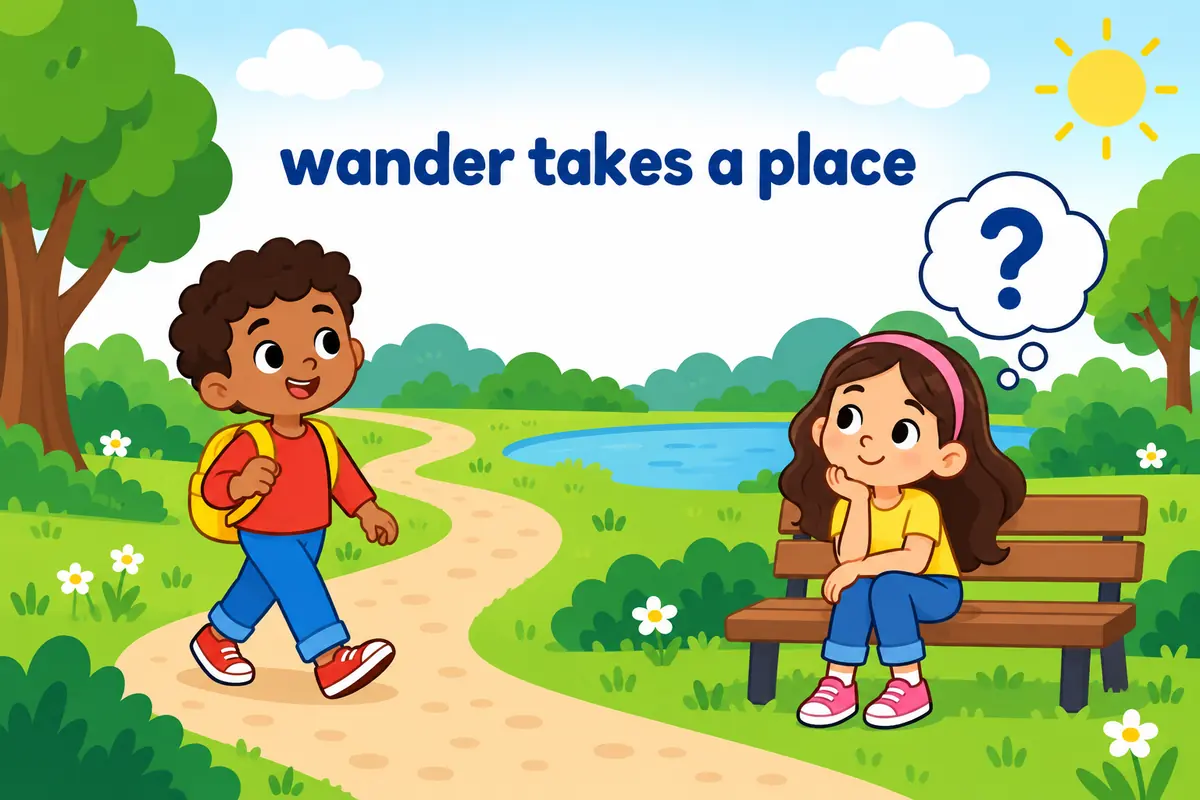
| Travel writing | We wandered through the narrow streets until dusk. | Wander takes a place. |
| Everyday conversation | I wonder if the shop is still open. | Wonder introduces a clause. |
| Formal email | I wonder whether you could confirm the date. | A polite indirect question. |
| Academic writing | Attention wanders when tasks are too easy. | Mental drift with no object. |
| Narrative | Her eyes wandered to the window. | The gaze moves without aim. |
| News feature | Hikers who wander off the trail risk injury. | Uses the warning sense with off. |
| Exclamation | No wonder the queue was long. | A fixed phrase built from wonder. |
| Classroom | You may wander from the topic in a first draft. | Formal advice about drifting. |
| Diary | I wondered whether to write at all. | Reflective wonder with a clause. |
| Travel guide | Visitors wander freely through the old quarter. | Roaming presented as a pleasure. |
| Reflective writing | He let his thoughts drift, then wondered at the silence. | Contrasts moving attention with awe. |
The table also shows the fixed phrases you can borrow directly. No wonder sounds natural in speech, and I wonder whether belongs in a polite email, while wander off suits a warning about children, pets or hikers who leave a marked route.
Which should you use?
| Situation | Use | Why |
|---|---|---|
| Describing a walk with no fixed route | wander | It names physical roaming. |
| Asking yourself a question | wonder | It introduces a clause. |
| Feeling lost in admiration | wonder | Wonder at conveys awe. |
| A pupil losing concentration | wander | It describes drifting attention. |
| Writing that something is not surprising | wonder | The fixed phrase is no wonder. |
Read the table by asking what kind of verb you need. A verb of motion almost always means wander, and a verb that opens a question almost always means wonder. When the subject is a mind or an attention span, reach for wander; when the subject is a person wanting to know, reach for wonder.
Word forms and grammar of wander and wonder
| Form | Part of speech | Example |
|---|---|---|
| wander | verb | They wander the old town. |
| wanders | verb, third person | Her gaze wanders. |
| wandered | verb, past | We wandered for hours. |
| wandering | participle | a wandering cat |
| wanderer | noun | a lone wanderer |
| wonder | verb and noun | I wonder; a sense of wonder |
| wondered | verb, past | She wondered why. |
| wonderful | adjective | a wonderful surprise |
Wander also feeds the nouns wanderer and wanderlust, while wonder gives the adjective wonderful; a sceptical reader who wants a reasoned guess may speculate about an outcome rather than wonder. Notice that the noun wonder appears in titles such as Wonders of the Sea, but the noun wander stays rare and usually means a short, casual walk.
Common mistakes with wander and wonder
- Incorrect:
I wander where she went.Correct: I wonder where she went. Rule: use wonder for a question in the mind; wander means to roam. - Incorrect:
We wondered around the market.Correct: We wandered around the market. Rule: physical roaming takes wander. - Incorrect:
I wonder through the park every morning.Correct: I wander through the park every morning. Rule: motion through a place takes wander. - Incorrect:
I am wander if you can help.Correct: I wonder if you can help. Rule: wonder is the verb, and only wonder can introduce an if clause. - Incorrect:
I wandered whether to stay.Correct: I wondered whether to stay. Rule: whether belongs with wonder, never with wander. - Incorrect:
He wondered through the forest.Correct: He wandered through the forest. Rule: a physical route takes wander.
Practice using wander and wonder
- Fill in the blank: I ______ if the train is late.
- Fill in the blank: The children ______ through the meadow.
- Choose the better word: My mind began to ______ during the lecture. (wander / wonder)
- Correct the error: We wondered through the old town.
- Build a sentence: use wander off about a dog.
- Spot the register: which sentence belongs in a polite email? A) I wonder whether you could confirm the date. B) I wander whether you could confirm the date.
Answers
- wonder – a question in the mind takes wonder.
- wandered – motion through a place takes wander.
- wander – drifting attention is a kind of roaming.
- We wandered through the old town. – walking takes wander.
- Sample: The dog wandered off during the picnic. – off marks movement away.
- A – wonder introduces the polite question.
The bottom line
Wander and wonder differ by one letter and one idea: wander moves a body without a route, and wonder moves a mind toward a question or a moment of awe. Choose wander for walking, drifting attention and winding paths, and wonder for curiosity, polite enquiries and the phrase no wonder. A final check is to read the sentence aloud: if the next word is a place, keep the a; if the next word is a question word, switch to the o.
Frequently asked questions about wander vs wonder
How do you pronounce wander and wonder?
Wander rhymes with the word on and uses the short a of land, while wonder rhymes with under and uses the short u. British speakers keep the two vowels clearly apart, and many American speakers make them sound nearly identical, so the sentence context usually does the distinguishing.
Is wonder always spelled with an o?
Yes. Wonder, meaning curiosity or awe, always carries an o, while wander, meaning to roam, always carries an a. The two never swap vowels. If you can replace the word with roam, spell it wander; if you can replace it with ask myself, spell it wonder.
Can wander and wonder both be nouns?
Wonder is a common noun, as in a sense of wonder or the wonders of space. Wander exists as a noun only in literary or informal phrases such as a wander through the hills, and it stays rare. In everyday writing, treat wander as a verb and wonder as either a verb or a noun.
What does no wonder mean?
No wonder is a fixed phrase meaning it is not surprising, as in no wonder she was tired. It comes from wonder as a noun for something remarkable. It is spelled with an o, so the phrase is never no wander, which would describe an absence of roaming instead.