Witty in a Sentence: Meaning, Usage & Examples
Witty means clever and amusing, especially in the use of words. In a sentence, it usually describes a remark, reply, line, story, or person whose humor comes from an apt idea or turn of phrase; the adjective can be playful, dry, or sharp depending on context.
- Part of speech: adjective.
- Typical pattern: “a witty remark” or “her reply was witty.”
- Related adverb: wittily, as in “he answered wittily.”
- Meaning: clever and humorous; not simply loud, silly, or funny by accident.
- Tone: wit can be kind, ironic, or cutting, so fit it to the audience and moment.

What does witty mean in a sentence?
Witty describes a person, remark, or piece of writing that uses cleverness to create humor. Cambridge Dictionary defines it as “using words in a clever and funny way”; the emphasis is on an amusing idea or expression, not on whether every reader laughs.
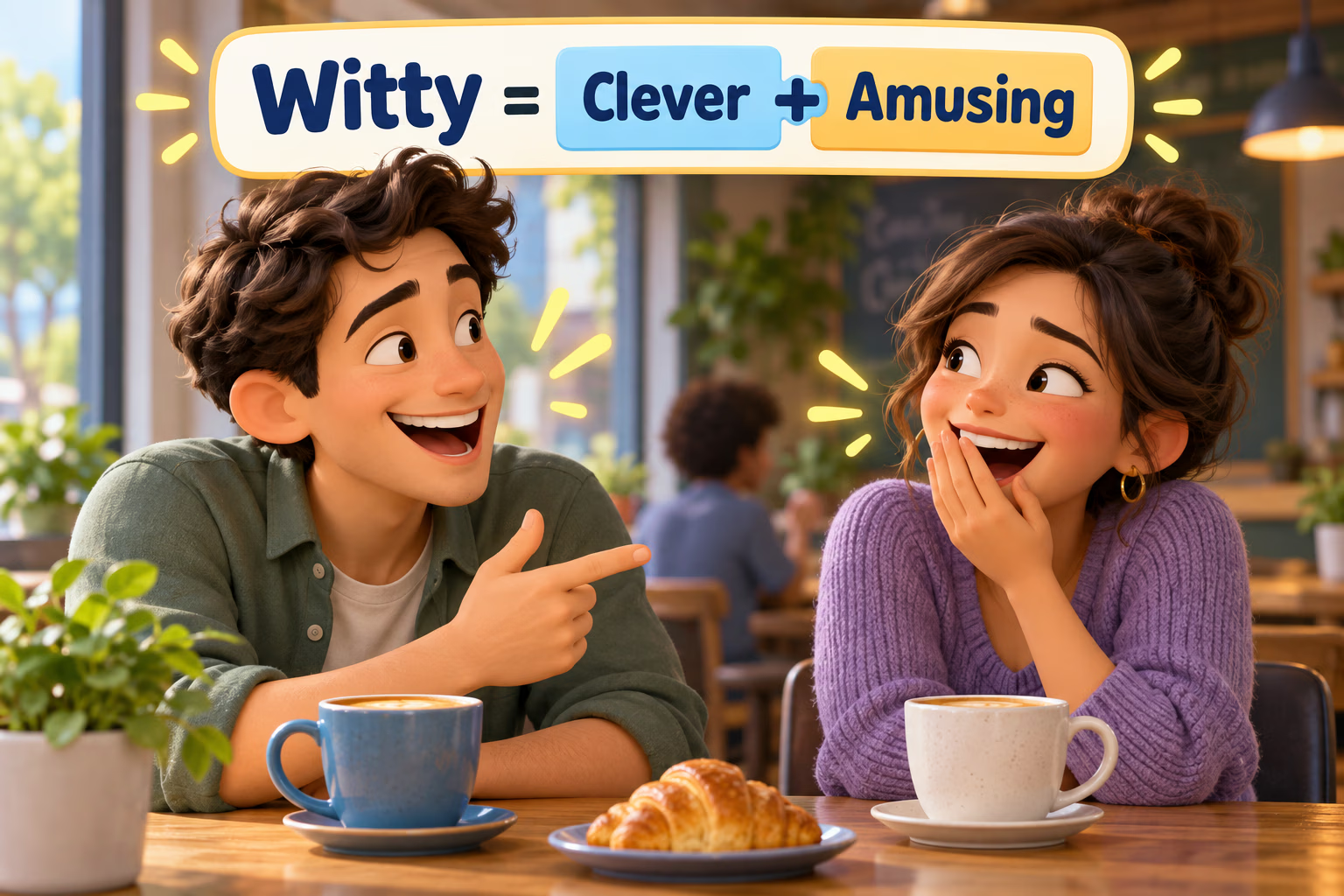
A witty line can rely on wordplay, an unexpected comparison, irony, or concise observation. Wit does not automatically mean kindness: a sharp remark may also embarrass or criticize someone. The examples here keep the joke focused on a situation or idea instead of a person’s identity, appearance, or vulnerability.
How do you use witty correctly?
Witty is an adjective, so it most often appears before a noun or after a linking verb. Cambridge Grammar describes adjectives as words that describe qualities and notes that adjective phrases can modify nouns or follow linking verbs.
| Pattern | Example | What it shows |
|---|---|---|
| witty + noun | “Mina wrote a witty caption for the office plant.” | The adjective comes before the noun it describes. |
| subject + linking verb + witty | “His reply was witty but still considerate.” | The adjective describes the subject after was. |
| witty enough + infinitive | “The headline was witty enough to make the team smile.” | An intensifier can follow the adjective. |
| wittily + verb | “The host wittily redirected the conversation.” | Use the adverb wittily to describe how an action is done. |
Use wittier for a comparison and wittiest for the highest degree: “The second draft is wittier,” or “That was her wittiest line.” These forms compare perceived style; they are judgments, not measurable scores.
When does a witty sentence fit the situation?
A witty sentence works best when its humor supports the purpose of the exchange. Purdue OWL explains that tone and audience shape how language is received; a line that feels warm among friends may seem flippant in a condolence note, safety warning, or tense work discussion.

For friendly wit, aim the joke at an ordinary inconvenience, a shared situation, or your own harmless mistake. Avoid assuming that sarcasm will sound playful in writing: without voice and facial expression, a reader may interpret it as criticism. A witty sentence is optional; clarity and respect matter more than getting a laugh.
Note on the preserved source: The original 21 examples remain below without wording changes. Treat them as legacy practice examples, not equally natural models: phrases such as “witty smile,” “witty solutions,” and “witty self-care routines” are less typical unless the smile, solution, or routine itself contains an amusing idea. The source’s broad claims about how wit affects audiences are not guarantees; whether a line seems funny or appropriate depends on context.
Do you enjoy adding a touch of humor and intelligence to your conversations? A “witty” sentence is a clever and amusing remark that showcases quick thinking and humor in a succinct manner.
Witty sentences often leave a lasting impression due to their clever wordplay and subtle humor. They can be used to engage an audience, lighten the mood, or simply showcase one’s sharp wit.
7 Examples Of Witty Used In a Sentence For Kids
- Witty jokes make us laugh.
- Be witty and kind to your friends.
- Think witty thoughts and have fun.
- A witty smile can brighten someone’s day.
- Say something witty to make others smile.
- Being witty means being clever and funny.
- Let’s all be witty together!
14 Sentences with Witty Examples
- During a debate competition, he delivered a witty response that left the audience in splits.
- The professor appreciated her witty sense of humor in the midst of a boring lecture.
- At the college fest, the stand-up comedian’s witty jokes had everyone roaring with laughter.
- During a group study session, he impressed his classmates with his witty solutions to complex problems.
- While preparing for exams, she used witty memory tricks to remember difficult concepts.
- In a heated discussion about current affairs, he made a witty remark that caught everyone off guard.
- During a workshop on public speaking, the instructor encouraged students to add witty anecdotes to their presentations.
- At a creative writing workshop, she penned a witty short story that received rave reviews.
- During a team project presentation, he used witty visuals to illustrate key points.
- When faced with a tough assignment, she tackled it with a witty approach that made it easier to understand.
- During a college event, the emcee kept the audience engaged with her witty banter.
- In a group discussion about social issues, she shared witty insights that sparked meaningful conversations.
- During a career fair, he stood out by introducing himself with a witty one-liner that impressed recruiters.
- When dealing with college stress, she turned to witty self-care routines to lighten the mood.
How To Use Witty in Sentences?
Witty is an adjective that describes someone or something as clever, humorous, and quick-witted. When using Witty in a sentence, it is important to ensure that the context is appropriate for the word’s meaning.
To use Witty in a sentence, start by identifying a person, situation, or description that exemplifies cleverness or humor. For example, “She had a Witty response that made everyone in the room laugh.” In this sentence, “Witty” is used to highlight the clever and humorous nature of the response.
Another way to use Witty in a sentence is by describing a piece of writing, dialogue, or action as clever or humorous. For instance, “The author’s Witty banter between the characters made the novel engaging and entertaining.” Here, “Witty” is used to emphasize the clever and humorous elements in the author’s writing.
When using the word Witty in a sentence, it is important to consider the tone and context of the situation to ensure the word fits appropriately. Whether describing a person, situation, or piece of writing, Witty can add a touch of cleverness and humor to your language.
Practice incorporating Witty into your sentences to become more comfortable with using it in various contexts and scenarios.
Conclusion
In summary, using sentences with witty elements can add humor and cleverness to writing, making it more engaging and memorable for the readers. Witty sentences often contain clever wordplay, sarcasm, or unexpected twists that can entertain and provoke thought. Writers can effectively use wit to lighten the tone of serious topics, engage the audience, and leave a lasting impact.
Incorporating witty sentences into writing requires a good understanding of language, context, and audience. By carefully crafting sentences with witty elements, writers can enhance their content, making it more enjoyable and appealing to a wide range of readers. Ultimately, wit can be a powerful tool in creating engaging and entertaining writing that leaves a lasting impression.
Original witty sentence examples
These new examples use witty in ordinary adjective patterns. They are illustrative sentences written for this guide, not quotations or claims about real people.
- The witty caption turned a photo of the sleepy office cat into the day’s best email.
- Her witty reply made the long elevator ride feel shorter.
- The novel’s witty dialogue gave each character a distinct voice.
- He added a witty title to the presentation, then kept the data section straightforward.
- The guide offered a witty observation about the rain: “The forecast arrived with its own water.”
- A witty note on the empty cookie jar read, “The investigation continues.”
- The student gave a witty answer that explained the pun without making fun of the question.
- The host’s witty introduction welcomed the speaker and set a relaxed tone.
- Her witty comparison made the tangled charging cables sound like a family reunion.
- The editor chose the wittier headline because it was clear as well as amusing.
- His witty comment about the printer’s dramatic pause made the team laugh at the delay, not at a colleague.
- The play is witty in places, but its serious ending is not played for laughs.
- The witty sign said, “This door opens after a brief career in customer service.”
- She answered wittily, but changed the subject when she saw the joke had landed poorly.
- The toast was warm and witty without turning the guest of honor into the punchline.
What makes a sentence witty?
A witty sentence usually combines a recognizable situation with a compact surprise. It may use a double meaning, contrast, understatement, or a precise observation; it does not need every technique at once.
- Wordplay: “The calendar was fully booked, but it still made time for Monday.”
- Unexpected comparison: “My inbox is a garden where unread messages grow wild.”
- Understatement: “The map was a little unhelpful; it sent us to a different continent.”
- Reversal: “I bought a self-help book, then asked it to explain itself.”
These are examples of possible comic mechanisms, not a formula that guarantees laughter. The shared reference must be understandable to the intended reader, and a punchline may not work if it distracts from the message.
Witty, funny, clever, and sarcastic
| Word | Main emphasis | Example |
|---|---|---|
| witty | Clever, amusing expression or observation | “Her witty reply turned the mix-up into a shared joke.” |
| funny | Amusing or causing laughter; it can also mean strange | “The dog’s funny walk made us laugh.” |
| clever | Showing skill, ingenuity, or quick understanding; not necessarily humorous | “That was a clever way to organize the notes.” |
| sarcastic | Often uses cutting or ironic language; it can sound mocking | “His sarcastic reply made the disagreement sharper.” |
The words can overlap, but they are not interchangeable in every sentence. A witty remark is usually humorous and clever; a funny event may be amusing without clever wordplay, and a clever solution may be serious. Sarcasm describes a style that may be witty, but can also be hurtful or simply tense.
Quick editing check for a witty line
- Keep the point clear. If readers need a paragraph of explanation, the joke may be obscuring the message.
- Check the target. Make the situation or your own minor mistake the subject of the joke, not a vulnerable person.
- Read it in context. Consider the reader, setting, stakes, and whether humor belongs there.
- Trim extra words. A shorter line often makes the turn easier to notice.
- Be ready to revise. If a reader hears a barb where you intended warmth, clarify rather than insisting they should laugh.
Frequently asked questions about witty sentences
Is witty an adjective or an adverb?
Witty is an adjective: “a witty line” or “the line was witty.” Wittily is the related adverb: “the speaker answered wittily.” Use the form that matches the word being described.
Can a witty sentence be serious?
A witty remark may appear in a serious piece of writing, but its humor can change the tone. If the subject is sensitive or the message needs gravity, a direct sentence may serve readers better than a joke.
Does witty always mean sarcastic?
No. Wit can come from wordplay, a surprising comparison, or an observant turn of phrase without sarcasm. Sarcasm may be witty, but it often carries criticism and can be misunderstood without vocal cues.
What is a simple sentence using witty?
“Her witty reply made everyone smile” is a simple example. Here, witty modifies the noun reply and means the reply is clever and amusing.
Sources
Definitions and grammar: Cambridge Dictionary: witty; Cambridge Dictionary: wittily; Cambridge Grammar: adjectives and adverbs. Writing context: Purdue OWL: Tone, Mood, and Audience.
Conclusion: In a witty in a sentence example, witty is an adjective describing clever, amusing expression. Place it before a noun (“a witty reply”) or after a linking verb (“the reply was witty”); choose humor that suits the audience and keeps the meaning clear.


