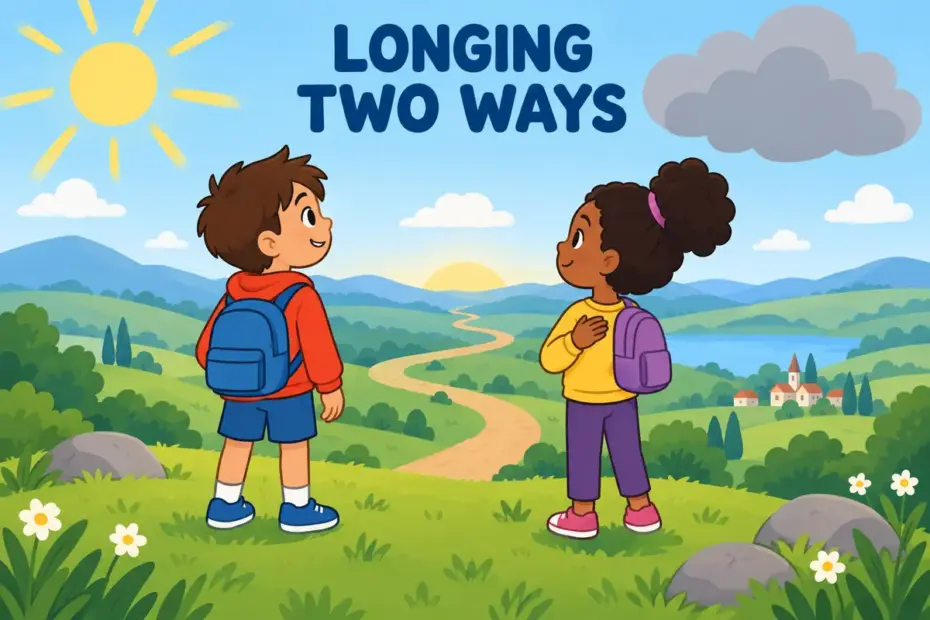
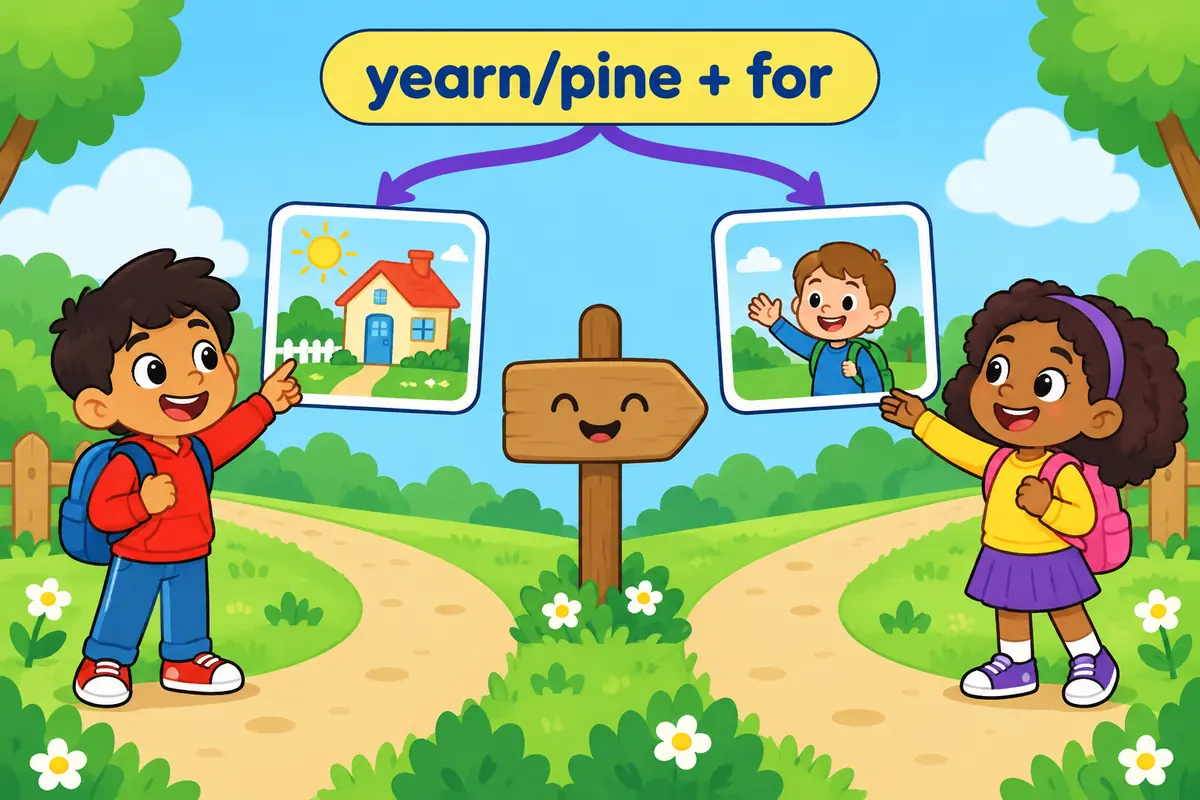
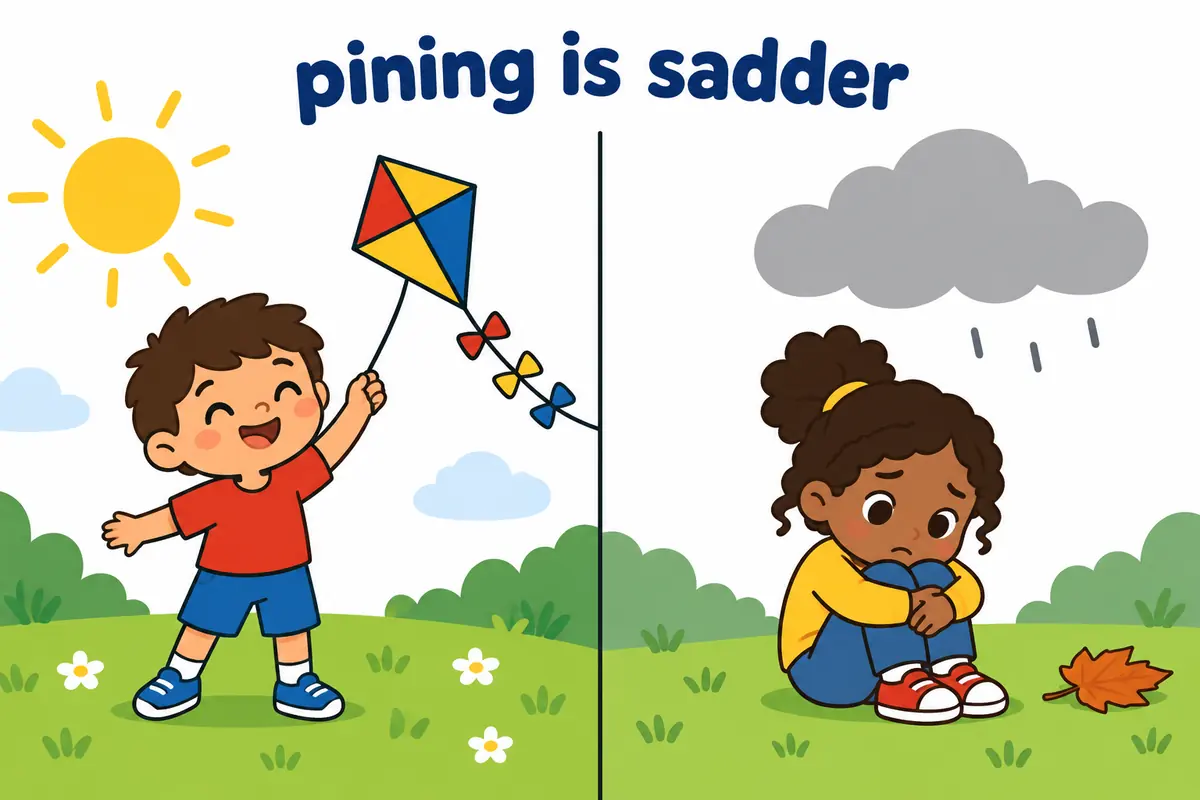
Yearn vs pine comes down to intensity and tone: yearn is a steady, broad longing, while pine adds visible sadness and is often tied to missing someone or somewhere. Use yearn for an ongoing want and pine when the longing hurts. Both take for, as in “She yearned for home” and “He pined for the coast.”
Yearn vs pine at a glance
- Both are intransitive verbs that normally take for before the object of longing.
- Yearn suggests a strong, steady desire; pine suggests a sad, often romantic ache.
- Yearn takes to before another verb, as in yearn to travel; pine rarely does.
- Pine also exists as a noun for the tree, which creates its own confusions.
- The commonest learner error is dropping for or replacing it with after.
Yearn vs pine: the master comparison
The quick rule is that yearn describes the strength of a desire and pine describes its sorrow. The table below sets the two verbs against the criteria that decide most sentences.
| Criteria | Yearn | Pine |
|---|---|---|
| Core meaning | Want something strongly and steadily | Long for something with visible sadness |
| Emotional weight | Warm and hopeful | Heavier, often melancholy |
| Typical pattern | yearn for; yearn to | pine for; pine away |
| Common object | Freedom, peace, a chance, a home | A person, a place, the past |
| Duration | Can be long and calm | Often framed as suffering over time |
| Register | Literary but widely used | More literary and romantic |
| Implied outcome | The want may still be met | The loss is usually felt as settled |
What do yearn and pine mean?
Yearn is a verb meaning to feel a strong, persistent desire for something, and pine is a verb meaning to long for something while suffering because of it. The Cambridge Dictionary entry for yearn and the Cambridge Dictionary entry for pine both record the pattern with for. Yearn points at the desire itself; pine points at the ache that the desire brings.
The two verbs also differ in what they can take. Yearn accepts for a noun and to before another verb, as in yearn to belong. Pine is most at home with for and in the set phrase pine away, which describes a person wasting slowly through longing. For the full set of worked examples, compare how to use yearn with how to use pine.
| Word | Plain meaning | Example sentence |
|---|---|---|
| Yearn | Feel a strong, steady desire | Many graduates yearn for meaningful work. |
| Yearn to | Feel a strong desire to do something | She yearned to see the sea again. |
| Pine | Long for something with sadness | He pined for his childhood village. |
| Pine away | Waste slowly through longing | The dog pined away while its owner travelled. |
One limitation is worth stating. Neither verb suits ordinary wants: you do not yearn for a sandwich or pine for a parking space. For small, practical desires, wish for a break or want is the honest choice, because these two verbs carry a weight that a snack cannot support.
How do you use yearn and pine in a sentence?
Both verbs are intransitive and usually pair with for, and yearn has the extra pattern yearn to plus a verb. To keep the sadness, add pine away or pine after; to keep the desire neutral, use yearn. When the longing is intense and hungry, crave a taste of home carries more appetite than either.
| Pattern | Example | What it signals |
|---|---|---|
| yearn for + noun | They yearned for quieter days. | a broad, steady desire |
| yearn to + verb | I yearn to see the mountains. | a desire to act |
| pine for + noun | She pined for her old friends. | sad longing for what is lost |
| pine away | He pined away in the empty house. | longing that wears a person down |
| long for + noun | We long for the summer. | a plain, shared form of desire |
Yearn vs pine in a sentence: examples across contexts
| Context | Example sentence | Why this works |
|---|---|---|
| Conversation | I yearn for a quiet weekend. | uses the steady-desire sense clearly. |
| Memoir | She pined for the house she grew up in. | ties the sadness to a lost place. |
| News feature | Refugees yearn for a safe return. | keeps the desire broad and dignified. |
| Song lyric | He pined for her through the winter. | uses the romantic, sorrowful sense. |
| Academic writing | Workers yearn for stable hours. | stays measured and concrete. |
| Letter | I yearn to see you again. | pairs the desire with the to pattern. |
| Nature writing | The caged bird pined for open sky. | frames longing as gentle suffering. |
| Workplace | Staff yearn for clearer guidance. | applies the verb to a practical hope. |
| Travel writing | They pined for the warmth of the south. | links sadness to a remembered place. |
| Online review | Readers yearn for stories with real depth. | shows a broad, shared desire. |
| Letter home | I pine for the sound of the sea. | ties the sadness to a vivid detail. |
If the longing is described as moving and restless, ache for a lost friend brings the physical sense of pain, and hanker after a change adds a slightly informal, restless edge.
Which should you use?
Choose by the feeling you want the reader to hear, not by length or formality. The situations below cover most real sentences.
| Your situation | Best choice | Example |
|---|---|---|
| A strong but hopeful want | Yearn | She yearned for a second chance. |
| Sadness over a person or place | Pine | He pined for his hometown. |
| A desire to do something | Yearn to | They yearned to travel again. |
| Longing that is wearing someone down | Pine | The patient pined away in the ward. |
| A plain, practical want | Neither | I wish for a shorter meeting. |
Verdict: reach for yearn when the desire is strong and open, and for pine when the longing carries grief or romance; if the want is small, both verbs overreach.
Synonyms of yearn and pine
Other verbs of wanting sit around these two, and each adds a different shade. Crave suggests appetite, ache suggests pain, and hanker is the most informal. The table shows the nuance each one brings.
| Word | Nuance | Example |
|---|---|---|
| crave | Urgent, almost physical appetite | She craved the taste of home cooking. |
| long | General and warm | They longed for a quiet summer. |
| hanker | Restless and informal | He hankered after a fresh start. |
| ache | Painful and emotional | I ached for a kind word. |
| wish | Light and practical | I wish for a shorter journey. |
| desire | Broad and formal | They desired a fairer system. |
Word forms and grammar of yearn and pine
| Form | Part of speech | Example |
|---|---|---|
| yearn, yearns, yearned | verb forms | He yearns to be understood. |
| yearning | participle and noun | Her yearning for home grew. |
| pine, pines, pined | verb forms | They pined for the old town. |
| pining | participle and adjective | The pining dog waited by the gate. |
| pine | noun (tree or wood) | A tall pine shaded the path. |
| yearn + object | non-standard | Incorrect: She yearned a holiday. |
The noun use of pine names the tree, which is why a sentence such as they pined for the pines can confuse a reader; keep the verb and the noun apart. To express a gentler, more general desire, long for a holiday is the everyday choice.
Common mistakes with yearn and pine
She yearned a better life.She yearned for a better life. Both verbs need for before a noun object.He pined to see her.He yearned to see her. The to pattern belongs to yearn, not pine.They pined for the pines.They pined for the forest. Keep the verb pine away from the noun pine to avoid confusion.I pine for a cup of tea.I could do with a cup of tea. Small, practical wants are too light for pine or yearn.The city pined for rain.The city longed for rain. A place or system longs or needs; pine suits people and animals.
Practice using yearn and pine
- Fill in the blank: After months abroad, she ______ for home.
- Choose the better word: He (yearned / pined) for his late wife, and the sadness never eased.
- Correct the error: They yearned a quieter life in the country.
- Build a sentence: Use yearn to to describe a student who wants to study abroad.
- Spot the register: Which sentence belongs in a formal feature? A) She was super desperate to go back. B) She yearned for the life she had left behind.
- Fill in the blank: The lonely dog ______ away while its owner was away.
- Correct the error: I pine for a parking space near the door.
Answers
- yearned — the steady, hopeful desire for home fits yearn, and the past tense matches months abroad.
- pined — the sentence stresses grief over a loss, which is the sorrowful sense of pine.
- They yearned for a quieter life in the country. — the verb needs for before the noun object.
- Model answer: She yearns to study abroad next year. — yearn to introduces the action the person wants to take.
- B — the feature needs the literary weight of yearned for, while A is too casual.
- pined — the set phrase pine away describes wasting slowly through longing.
- I would like a parking space near the door. — a small practical want is too light for pine, which carries sadness.
The bottom line
Yearn vs pine is a matter of feeling more than grammar: yearn names a strong, steady desire, and pine names a longing that carries sadness, especially for a person or a place. Both are intransitive and take for, and only yearn takes the to pattern before another verb. Use neither for small, practical wants, where wish or want is honest. Pick pine when the loss already hurts.
Frequently asked questions about yearn and pine
What preposition follows yearn and pine?
Both verbs normally take for before their object, as in yearn for peace and pine for home. Yearn also takes to before another verb, as in yearn to travel. Pine rarely takes to, which is the clearest grammatical difference between them.
Can yearn and pine be used in the passive voice?
No. Both verbs are intransitive, so they have no direct object to turn into the subject of a passive sentence. You can only write that someone yearns or pines for something, never that something is yearned or pined for. That rule applies to every tense and to both verbs equally.
What is the noun form of yearn?
The noun is yearning, meaning a strong, persistent desire, as in a yearning for home. The participle yearned is uncommon, while the adjective yearning works before nouns. Pine forms pining in the same way, as in a pining heart. Both nouns name the feeling rather than the thing that is wanted.
Is pine only about romantic longing?
No. Pine can describe longing for a place, a time or a way of life, and it also describes animals that waste away through separation. The romantic sense is common, but the core idea is sorrowful longing rather than love alone.