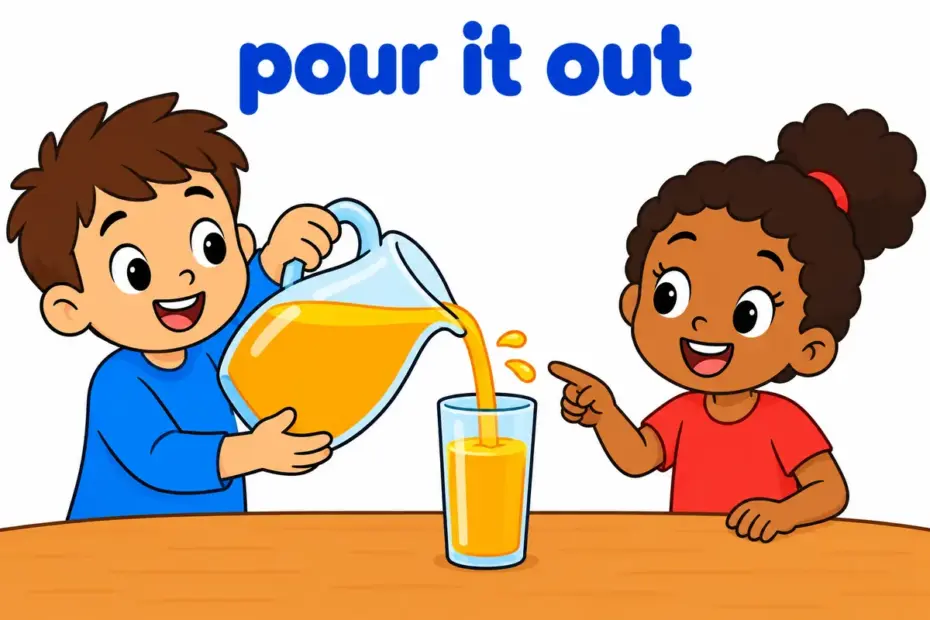
Pour out means to cause liquid or emotion to flow freely from a container or a person. To use pour out in a sentence, put the thing being emptied between pour and out or after out: “She poured out the tea.” This verb is transitive and separable, so a pronoun must sit in the middle.
Pour out at a glance
- Pour out is a separable transitive phrasal verb; its forms are pour out, pours out, poured out and pouring out.
- The dominant pattern is pour out + the contents, or pour + pronoun + out.
- It belongs to neutral English and appears in both everyday speech and emotional writing.
- Common collocations include pour out the tea, pour out your heart, pour out a story and pour out of a door.
- The commonest learner error is placing a pronoun after the particle, as in pour out it.
What does pour out mean?
Pour out is a phrasal verb meaning to empty a container by tipping it, or to release feelings and words in a steady flow. The Cambridge entry for pour out records both the physical emptying sense and the figurative one, and the figurative use is very common: a person pours out grief, a story or a complaint just as a jug pours out water. When the point is to hold back rather than release, a verb such as express is calmer, and a stream of talk can be said to vent instead.
| Sense | Plain meaning | Example sentence |
|---|---|---|
| Empty a container | Tip liquid out of something | He poured out the last of the milk. |
| Release feeling | Say or show emotions freely | She poured out her worries to a friend. |
| Come out in numbers | Move out of a place in a crowd | Fans poured out of the stadium at the final whistle. |
One limitation is worth stating: pour out implies a container or a person that was holding something back. It is not the right verb for a slow leak or a steady drip, where seep or trickle fit better, and it says nothing about whether the flow was wanted.
How do you use pour out in a sentence?
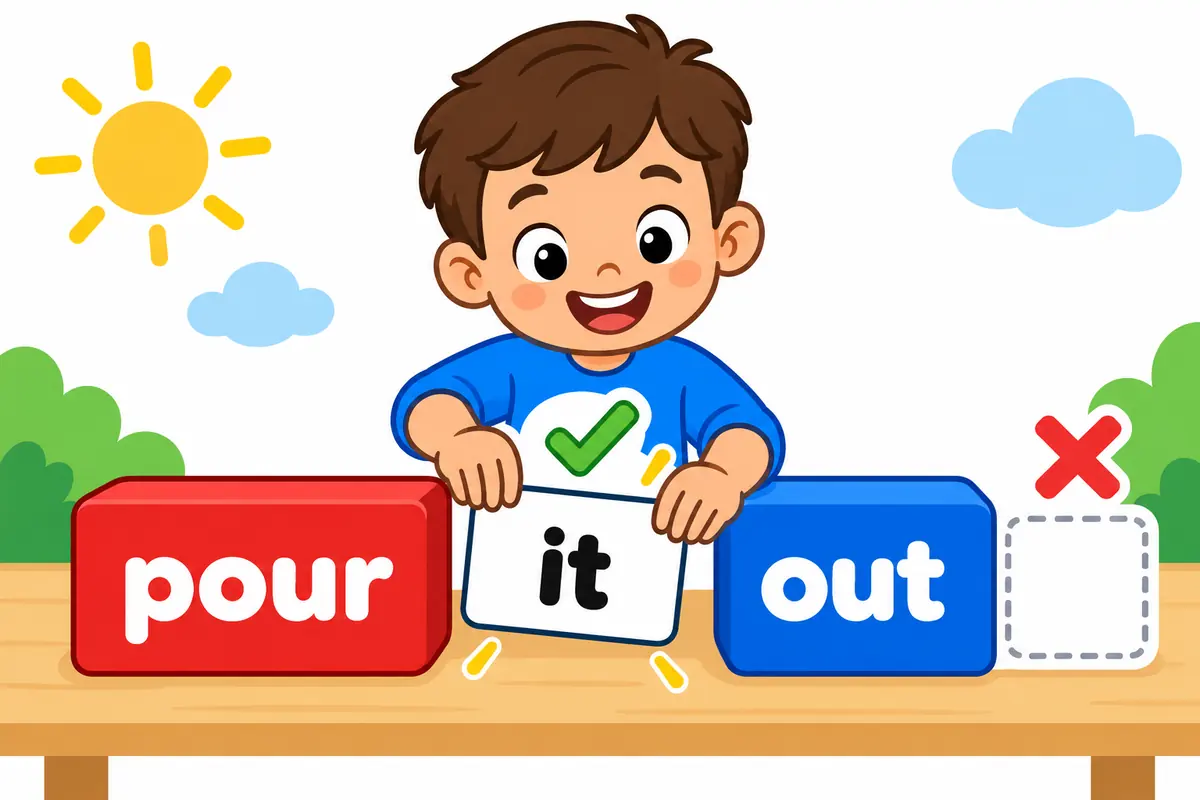
Pour out is transitive, so it needs an object, and it is separable, so that object can sit after the particle or between the verb and the particle. A pronoun, however, must go in the middle.
| Pattern | Example | What it signals |
|---|---|---|
| pour out + noun | They poured out the lemonade. | A long noun object sits comfortably after out. |
| pour + noun + out | They poured the lemonade out. | The same meaning with the object between verb and particle. |
| pour + pronoun + out | Please pour it out. | A pronoun must take the middle position. |
| pour out + of + place | Students poured out of the hall. | An intransitive crowd sense with of before the place. |
| pour out + feeling | He poured out his grief. | A figurative object, with no literal container. |
Notice the two grammatical homes of this verb. In the physical and emotional senses it is transitive and separable, but in the crowd sense it is intransitive and takes of, as in the crowd poured out of the exit rather than the crowd poured out the exit. Getting this split right is what separates a natural sentence from one that sounds translated.
Pour out in a sentence: examples across contexts
| Context | Example sentence | Why this works |
|---|---|---|
| Kitchen | Pour out the pasta water before you add the sauce. | A practical instruction with a clear object. |
| News report | Crowds poured out of the station after the delay. | The intransitive crowd sense with of. |
| Letter to a friend | She poured out everything she had kept quiet for years. | A figurative object measuring released feeling. |
| Customer service | Complaints poured out of the inbox all morning. | Treats a place as the source of a flow. |
| Sports writing | Players poured out of the tunnel to a roaring crowd. | Movement in numbers, vivid but accurate. |
| Science report | Lava poured out of the vent for three days. | A natural flow from a named opening. |
| Business email | Please pour out the old samples and restock the shelf. | A transitive instruction to empty a container. |
| Memoir | He poured out his story to a stranger on the train. | Confiding to a named listener with to. |
| Weather feature | Rain poured out of a black sky all night. | A steady stream from one source. |
| Music review | The singer poured out a ballad to a silent hall. | Turns a performance into a flow of feeling. |
| Hospital note | Staff poured out of the ward when the alarm rang. | Movement in numbers from a named place. |
The transitive sense always has contents to move, while the crowd sense has only a place to leave, so the preposition of is the quickest way to tell the two apart in writing. In the emotional sense the object is abstract, which is why the verb handles a confession and a jug of water with the same grammar.
Pour out vs gush and spill
These three verbs all describe liquid leaving a container, but they differ in force and control.
| Feature | Pour out | Gush | Spill |
|---|---|---|---|
| Core meaning | Empty a container in a controlled flow | Flow out suddenly and forcefully | Lose liquid by accident |
| Control | Deliberate | Often uncontrolled | Unintentional |
| Force | Steady and even | Strong and fast | Whatever the tilt allows |
| Typical source | A jug, a pot or a person’s heart | A spring or a broken pipe | An overfull cup or a knocked glass |
| Result | The container is emptied | Liquid shoots upward or outward | A mess is made |
| Example | She poured out the soup. | Water gushed from the crack. | He spilt the juice on the mat. |
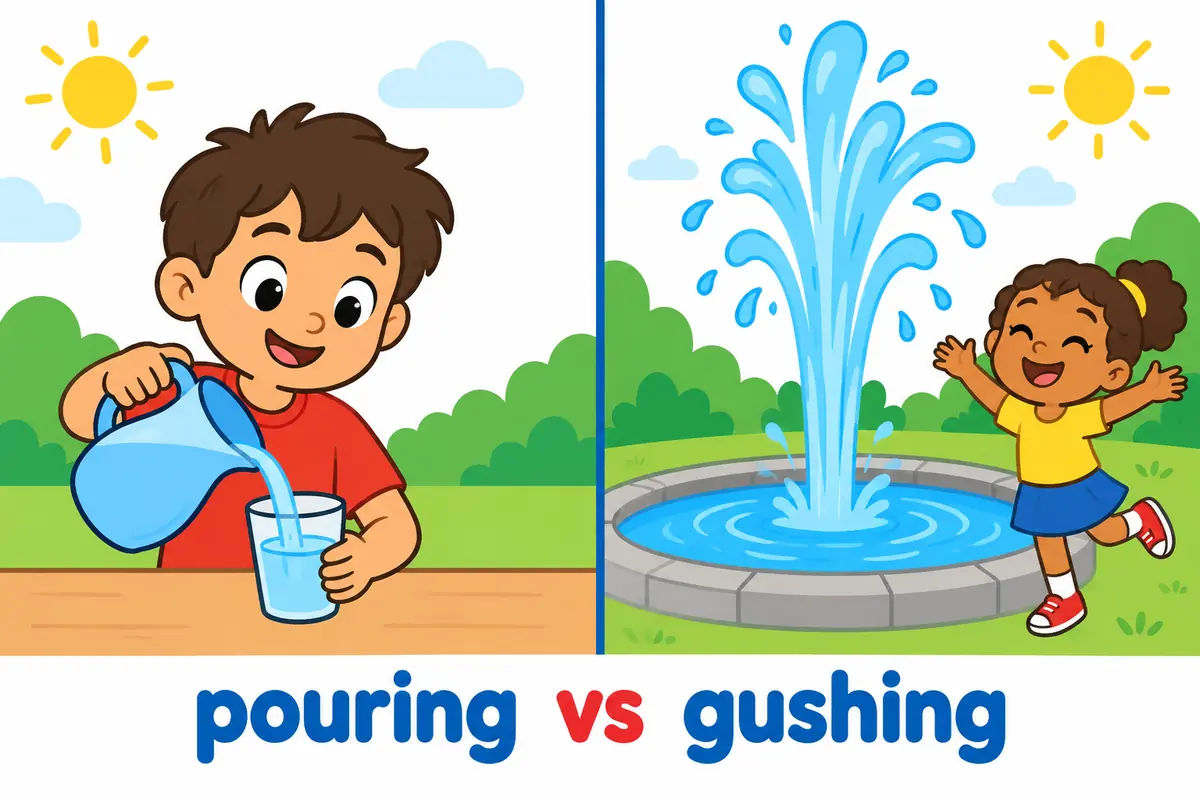
Use pour out for a controlled emptying, gush for a sudden forceful flow, and spill when the loss was an accident. A useful test is intention: if you meant to move the liquid, pour out is safe, but if the movement surprised you, the sentence wants gush or spill.
Word forms and grammar of pour out
| Form | Part of speech | Example |
|---|---|---|
| pour out | base phrasal verb | They pour out the water every morning. |
| pours out | third person singular | Smoke pours out of the chimney. |
| poured out | past tense and participle | He poured out the whole story. |
| pouring out | present participle | Fans were pouring out of the gates. |
| pour it out | separable order | Pour it out before it cools. |
| pour out it | non-standard | Wrong: a pronoun must take the middle slot. |
Pour out also pairs with the particle down in pour down, which describes heavy rain falling rather than liquid leaving a container. The two share the base verb but differ in the direction of the flow, so the particle carries the whole distinction.
Common mistakes with pour out
Two things trip learners up most often: the position of a pronoun and the choice between the transitive and crowd patterns. Checking both takes a moment and prevents the sentences that instantly mark a non-native writer.
- Incorrect: Please pour out it. Correct: Please pour it out. Rule: A pronoun object goes between the verb and the particle.
- Incorrect: The crowd poured out the stadium. Correct: The crowd poured out of the stadium. Rule: The crowd sense is intransitive and needs of.
- Incorrect: He poured out the bottle. Correct: He emptied the bottle. Rule: You pour out the contents, not the container.
- Incorrect: Complaints poured out from the customers. Correct: Complaints poured in from the customers. Rule: Pouring in describes arrival; pouring out describes departure.
- Incorrect: She poured out herself to the group. Correct: She poured her heart out to the group. Rule: The idiom uses heart, not a reflexive pronoun.
Practice using pour out
- Fill in the blank: __________ the old oil before you refill the lamp.
- Fill in the blank: The children __________ out of the classroom when the bell rang.
- Choose the better word: Water (gushed / poured out) from the cracked pipe and hit the ceiling.
- Correct the error: Please pour out it into the sink.
- Build a sentence: a traveller telling a long story to a stranger, using pour out.
- Spot the register: Which sentence belongs in a science report? (a) Lava poured out of the vent. (b) Lava gushed everywhere.
- Correct the error: The crowd poured out the train.
Answers
- Pour out — the imperative uses the base form with a clear object.
- poured out — past tense matches the completed action.
- gushed — a forceful jet under pressure fits gush, not a controlled pour.
- Please pour it out into the sink — the pronoun moves to the middle.
- The traveller poured out his story to a stranger — the figurative object names what was released.
- Sentence (a) — a measured verb suits a factual report.
- The crowd poured out of the train — the crowd sense needs of.
The bottom line
Pour out means to empty a container or release feeling in a steady flow, and it works in three patterns: transitive with a noun, separable with a pronoun in the middle, and intransitive with of for crowds. Remember that the physical and emotional senses take an object, while the crowd sense does not. Keep it apart from gush, which is forceful, and spill, which is accidental. When in doubt, ask whether something was held and then released; if so, pour out is the verb that names the moment.
Frequently asked questions about pour out
Is pour out separable?
Yes. A noun object can follow the particle or sit between the verb and the particle, so pour out the tea and pour the tea out are both correct. A pronoun, however, must take the middle position: pour it out is right, while pour out it is not used.
What does pour your heart out mean?
To pour your heart out is to tell someone your deepest feelings without holding back. The idiom uses heart as a fixed object and takes to before the listener, as in he poured his heart out to a friend. It is a figurative extension of the container sense.
Can people pour out of a place?
Yes. In this intransitive sense, a crowd, a class or a team moves out of a building in a continuous stream, as in fans poured out of the gates. The pattern needs of before the place, and it never takes a direct object.
What is the difference between pour out and pour down?
Pour out means contents leave a container or a person, while pour down describes rain falling heavily from the sky, as in it poured down all afternoon. The particle changes the source: out points to something emptied, and down points to weather coming from above.