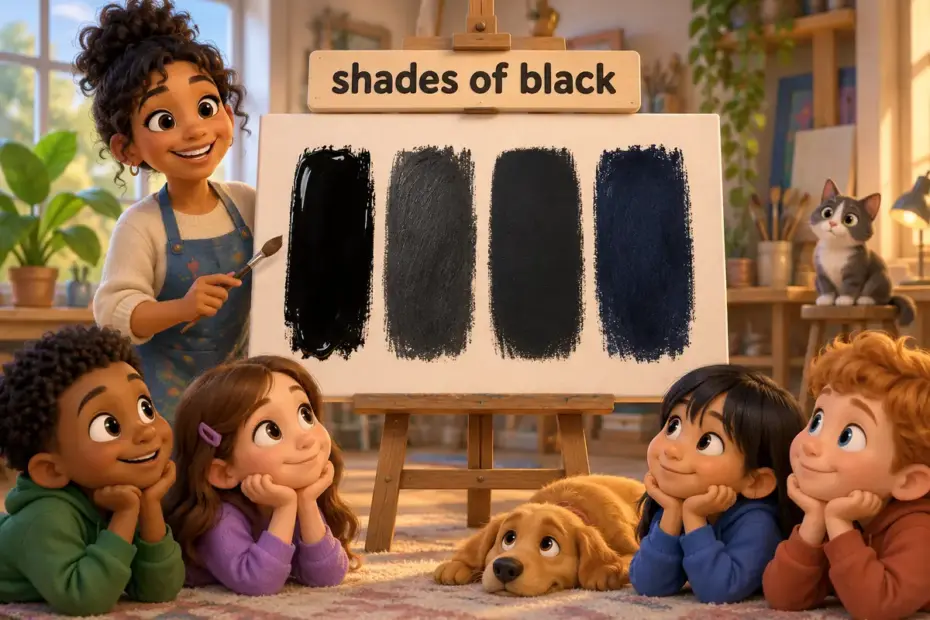
Black color names give writers a way to be precise about the darkest end of the palette, so coal, jet, onyx and charcoal each carry a different picture. The plain word black is the base, and the named shades add gloss, texture or temperature to an otherwise simple description. A set of related describing words sits in adjectives for black.
Black color names at a glance
- Black is the plain base word for the darkest colour, and it works as both an adjective and a noun.
- Named shades such as jet, ebony and onyx suggest a surface as well as a colour.
- Some names hint at temperature: ink and midnight lean blue, while coal and soot stay neutral.
- Black also forms fixed phrases such as pitch black, jet-black and as black as coal.
- The commonest error is forgetting that the verb form is blacken, not black.
What are black color names?
Black color names are the words English uses for very dark shades, ranging from the plain adjective black to specific names that borrow from materials and objects. A shade such as ebony borrows from dark wood, jet borrows from a glossy mineral, and charcoal borrows from burnt wood, so each name brings a picture with the colour. For a bright colour as a contrast, see adjectives for color blue.
| Name | Shade it suggests | Example |
|---|---|---|
| Black | the plain word for the darkest colour | She wore a black coat. |
| Jet | deep, glossy black | Jet hair shone under the lamp. |
| Ebony | rich dark wood-black | An ebony piano stood in the corner. |
| Onyx | smooth, stone black | The onyx tiles felt cool underfoot. |
| Charcoal | soft grey-black | A charcoal suit looks formal. |
| Ink | dark blue-black | The ink-dark sky deepened at dusk. |
| Midnight | very dark blue-black | A midnight dress suits the evening. |
| Raven | glossy black with a hint of blue | A raven feather can look blue in the light. |
| Obsidian | glassy black from cooled lava | Obsidian forms when lava cools fast. |
| Coal | dusty, flat black | Coal-black eyes watched the fire. |
| Pitch | complete darkness | The room was pitch black. |
| Soot | smudged grey-black | Soot-black walls lined the old chimney. |
One honest limit belongs here. These names are descriptive rather than technical, so a paint shop or a printer will use different, coded terms; the literary shades are for writing, not for mixing ink.
How do you describe black in a sentence?
The word black is an adjective first, and the named shades follow a few set patterns.
| Pattern | Example | What it signals |
|---|---|---|
| black + noun | He drove a black car. | a plain colour adjective |
| a shade + black | The wall was a deep charcoal black. | a named shade in front of black |
| as black as + noun | Her hair was as black as coal. | a simile |
| black with + cause | His hands were black with soot. | covered by something |
| blacken | The sky blackened before the storm. | a change over time |
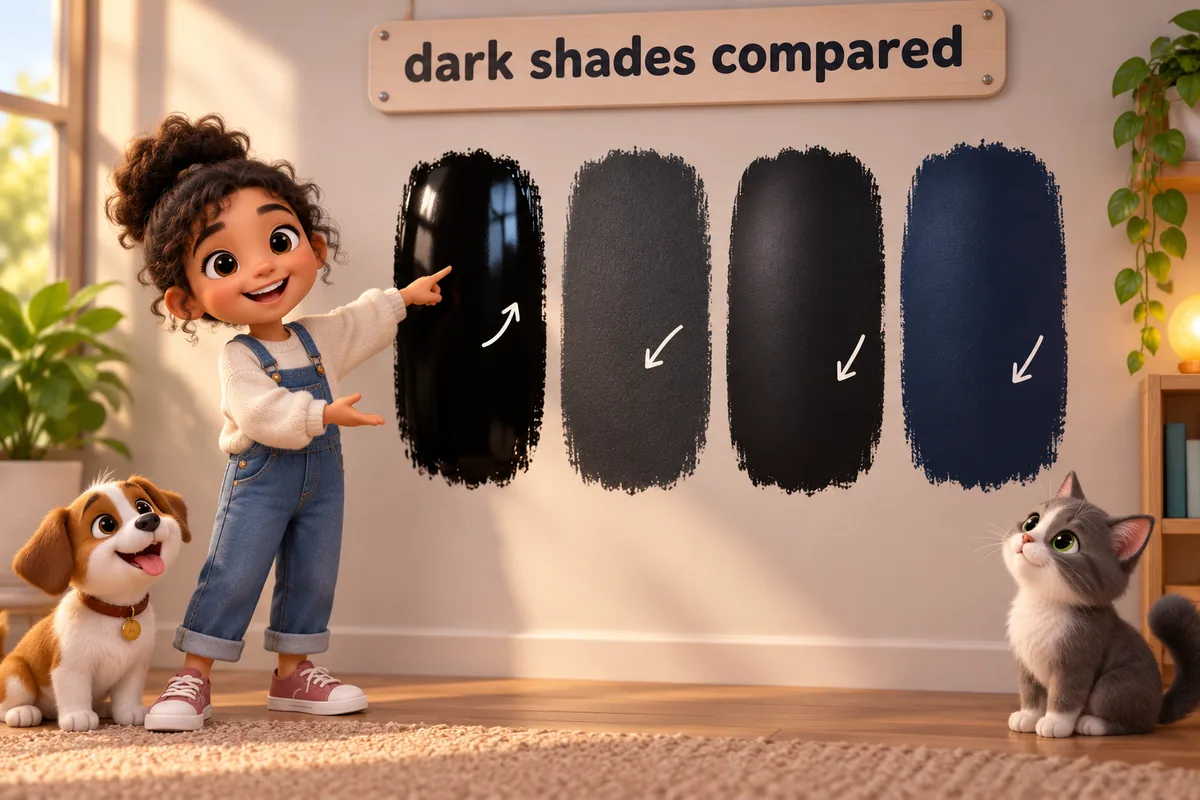
Black color names: examples across contexts
The shades move from a fashion note to a science caption, and each setting draws on the name that fits best. A familiar compound appears in examples of black cat in a sentence, and a scientific use of the word appears in black hole in a sentence.
| Context | Example sentence | Why this works |
|---|---|---|
| Classroom | Name three shades of black and say where each one comes from. | a simple task |
| Fashion note | A charcoal coat feels softer than a jet one. | a style comparison |
| Story | The ink-dark sea rolled under the moon. | atmosphere |
| Conversation | Would you call that kitten jet black or just black? | an everyday question |
| Science caption | Obsidian is a natural glass formed from cooled lava. | a factual note |
| Art description | The painter used an onyx ground behind the figure. | a studio detail |
| Interior design | An ebony table anchors the pale room. | a design choice |
| Poem | Raven wings cut the grey sky. | figurative language |
| Weather report | The sky turned pitch black before the hail. | a dramatic detail |
| Product listing | Available in midnight, charcoal and onyx. | a colour range |
Which black shade should you choose?
Match the shade to the surface and the mood, because a glossy name and a matte name never read the same way.
| Situation | Pick | Example |
|---|---|---|
| Formal clothing | charcoal | A charcoal suit reads as formal without being severe. |
| Glossy hair | jet | Jet hair catches the light at every turn. |
| Evening dress | midnight | A midnight gown suits a late event. |
| Nature writing | raven | A raven-black wing flashed blue in the sun. |
| Art and design | onyx | An onyx background feels heavy and rich. |
The plain word black is rarely wrong, and the named shades are for when the surface matters: choose jet for gloss, charcoal for softness and midnight for a blue tinge, and keep black as the safe default.
Word forms and grammar of black color names
Black changes shape across the parts of speech, and a few of the shades take a hyphen.
| Form | Part of speech | Example |
|---|---|---|
| black | adjective | A black cat crossed the path. |
| black | noun | Black is the absence of light, not a colour of light. |
| blacken | verb | Smoke blackened the ceiling. |
| blackness | noun | The blackness of the cave was total. |
| jet-black | compound adjective | Her jet-black hair shone. |
| inky | adjective | An inky darkness filled the room. |
Common mistakes with black color names
Mistake 1: breaking a fixed simile. Incorrect: Her hair was black like coal. Correct: Her hair was as black as coal. Rule: the fixed simile uses the as … as frame.
Mistake 2: inventing an intensifier. Incorrect: The room was black dark. Correct: The room was pitch black. Rule: pitch is the standard word that intensifies black.
Mistake 3: using the adjective as a verb. Incorrect: The sky black before the storm. Correct: The sky blackened before the storm. Rule: the verb is blacken, which adds -en to the adjective.
Mistake 4: adding a suffix to a shade. Incorrect: The tiles were charcoalness. Correct: The tiles were charcoal. Rule: named shades work as plain adjectives and need no suffix.
Mistake 5: using jet alone for a surface. Incorrect: She wore a jet dress. Correct: She wore a jet-black dress. Rule: jet usually combines with black as jet-black to name the glossy shade.
Practice using black color names
- Fill in the blank: The storm clouds looked ___ black before the rain.
- Choose the better word: A glossy, light-catching black is best described as (jet / soot).
- Correct the error: Her coat was black like coal.
- Build a sentence: use a shade and black to describe a formal suit.
- Spot the register: which line suits a product listing, (a) Comes in a few dark shades, or (b) Available in midnight, charcoal and onyx?
- Fill in the blank: When lava cools fast it forms ___, a natural glass.
Answers
- pitch, because pitch black is the fixed phrase for total darkness.
- jet, because jet names a glossy black and soot names a dull smudge.
- Her coat was as black as coal; the simile uses as … as.
- The suit was a deep charcoal black.
- (b), because a product listing names the exact shades.
- obsidian, because obsidian is glassy black volcanic glass.

The bottom line
Black color names let a writer choose the exact darkness and surface, from the plain adjective black to glossy jet, soft charcoal and blue-tinged midnight. Use the named shades when the surface matters, keep the fixed phrases such as pitch black and as black as coal intact, and remember that the verb is blacken. For the everyday phrases built on the word, see black and white in a sentence.
Frequently asked questions about black color names
What are some names for the colour black?
Names for black include jet, ebony, onyx, charcoal, ink, midnight, raven, obsidian, coal, pitch and soot. Each one borrows from a material or an object, so jet and ebony suggest gloss while charcoal and soot suggest a softer, dustier black. The plain word black remains the safe default.
What does black-and-white mean?
Black-and-white describes an image without colour, such as an old photograph or film. As a phrase it also means thinking in simple opposites with no middle ground, as when someone sees a problem as black and white. The hyphen joins the two words when they act as one adjective.
Is black a colour?
In everyday language black is a colour, and it is the darkest one. In science, black is the absence of light, because a black surface absorbs almost all the light that reaches it instead of reflecting a wavelength back. Both senses are correct in the right setting.
What is the difference between black and ebony?
Black is the plain colour word, while ebony names a rich, dark wood and the near-black shade it suggests. Ebony carries a hint of warmth and shine because it comes from polished wood, so a writer chooses ebony to describe a surface with depth and black for a flat, simple darkness.