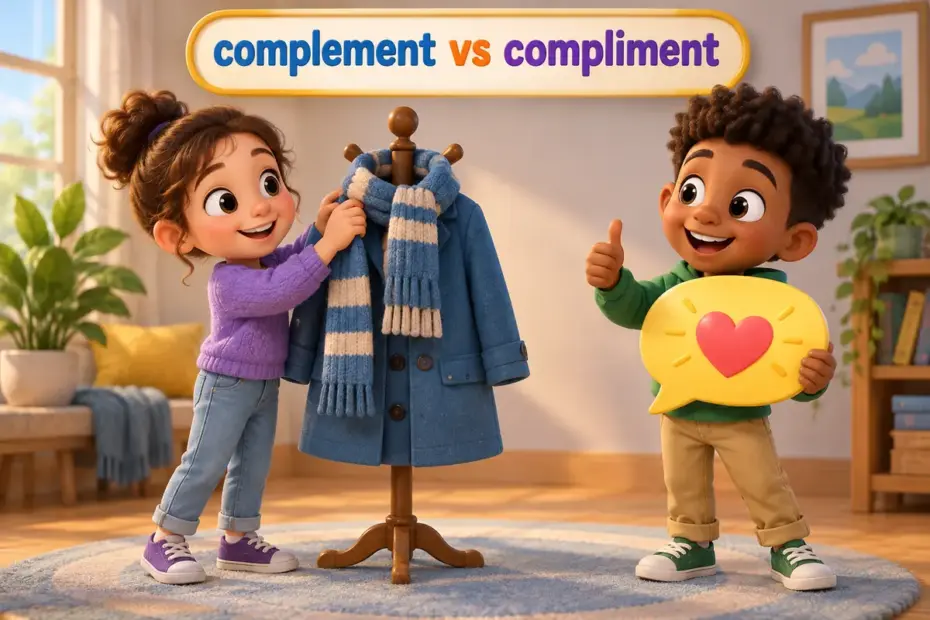
Complement vs compliment sound the same but split cleanly: a complement completes or matches something, while a compliment is a remark that praises. The letters are the clue, since complement shares its e with complete and compliment shares its i with praise. “The scarf complements the coat” matches; “she gave a compliment” praises.
Complement vs Compliment at a glance
- Complement means to complete or go well with something.
- Compliment means a remark or act of praise.
- Complement is spelled with e, as in complete; compliment is spelled with i, as in praise.
- Both words work as nouns and as verbs, so spelling alone separates them.
- The commonest error is writing compliment when the sentence means completes.
What do complement and compliment mean?
Complement is a noun or verb meaning something that completes or matches another thing. Compliment is a noun or verb meaning an expression of praise. The Cambridge entry for complement and the Cambridge entry for compliment show the split, and one line makes it plain: a sauce complements a dish, while a guest compliments the cook.
| Sense | Word | Plain meaning | Example |
|---|---|---|---|
| Something that completes | complement | Goes well with another thing | The wine complements the meal. |
| Full set or crew | complement | The complete number needed | The ship has a full complement of crew. |
| Remark of praise | compliment | A kind thing said to someone | She paid me a compliment. |
| To praise someone | compliment | To say something approving | He complimented her drawing. |
| Given free of charge | complimentary | The adjective for free or praising | The hotel offers complimentary tea. |
What is the difference between complement and compliment?
The difference is meaning, not sound, and one letter carries it. Complement comes from complete and means to fit together, while compliment means to praise, so a pair such as addition vs edition shows the same pattern: a single letter decides which word the reader meets.
| Test | Complement | Compliment |
|---|---|---|
| Core meaning | completes or matches | praises |
| Spelling hook | e for complete | i for I praise |
| Part of speech | noun or verb | noun or verb |
| Related adjective | complementary, meaning matching | complimentary, meaning praising or free |
| Typical partner | complement + thing | compliment + person + on |
| Common phrase | complement each other | pay a compliment |
Choose complement when two things fit together and compliment when someone offers praise.
How do you use complement and compliment in a sentence?
Both follow fixed patterns, and the object is the fastest test; to watch the verb behave, read complement in a sentence.
| Pattern | Example | What it signals |
|---|---|---|
| complement + thing | The curtains complement the sofa. | two things that match |
| complement each other | The two skills complement each other. | a natural pairing |
| be complementary to | This approach is complementary to the first. | things that work together |
| compliment + person + on | She complimented him on his speech. | praise aimed at a person |
| pay someone a compliment | He paid her a compliment. | a fixed praise phrase |
| be complimentary about | The critic was complimentary about the play. | expressing approval |
Complement and compliment in a sentence: examples across contexts
Reading the pair in different registers makes the choice automatic, and more praise frames sit in compliment in everyday sentences.
| Context | Example sentence | Why this works |
|---|---|---|
| Classroom | The red diagram complements the blue text. | complement means matches |
| Workplace email | Your summary complements the report well. | complement means completes |
| News report | The coach complimented the team on its defence. | compliment praises a person |
| Fashion writing | The bag complements the dress without competing. | complement means suits |
| Everyday speech | My aunt complimented my cooking. | compliment is spoken praise |
| Academic writing | The two methods are complementary. | complementary means working together |
| Customer service | The hotel gave us a complimentary breakfast. | complimentary means free here |
| Recruitment | The team needs its full complement of staff. | complement means a complete set |
| Music writing | The strings complement the piano theme. | complement means harmonize |
| Narration | He accepted the compliment with a nod. | compliment is the praise received |
Which should you use?
Match the word to the meaning: things that fit together take complement, and praise takes compliment.
| Situation | Use | Example |
|---|---|---|
| Two colours that suit each other | complement | The cushions complement the rug. |
| Praising a friend’s work | compliment | I complimented her essay. |
| A complete set of staff | complement | The office has its full complement. |
| A free item at a hotel | complimentary | A complimentary drink awaited us. |
Register does not change the rule, though the praise sense of compliment appears most in speech and personal writing, while the matching sense of complement clusters in design, science, and music.
Word forms and grammar of complement and compliment
| Form | Part of speech | Example |
|---|---|---|
| complement | noun or verb | Spices complement the dish. |
| complements | verb, third person | The frame complements the art. |
| complemented | verb, past | The pairing complemented the room. |
| complementary | adjective, matching | The two courses are complementary. |
| compliment | noun or verb | She gave him a compliment. |
| compliments | verb, third person | He compliments the team often. |
| complimented | verb, past | They complimented her speech. |
| complimentary | adjective, praising or free | The review was complimentary. |
Common mistakes with complement and compliment
Mistake 1: compliment for completes. Incorrect: The sauce compliments the fish. Correct: The sauce complements the fish. Rule: matching takes complement, with an e.
Mistake 2: complement for praise. Incorrect: He complemented her on the win. Correct: He complimented her on the win. Rule: praise takes compliment, with an i.
Mistake 3: complementary for a free item. Incorrect: The hotel offers a complementary shuttle. Correct: The hotel offers a complimentary shuttle. Rule: free items take complimentary.
Mistake 4: compliment to a thing. Incorrect: The scarf compliments the coat. Correct: The scarf complements the coat. Rule: compliment praises people, so a matching object takes complement.
Mistake 5: a full compliment. Incorrect: The crew reached its full compliment. Correct: The crew reached its full complement. Rule: a complete set takes complement.
Practice using complement and compliment
- Fill in the blank: The blue curtains ___ the pale walls nicely.
- Choose the better word: The teacher (complemented / complimented) my presentation.
- Correct the error: The two musicians compliment each other perfectly.
- Build a sentence: use pay a compliment about a friend’s new jacket.
- Spot the sense: in which sentence does complimentary mean free, (a) a complimentary note, or (b) a complimentary ticket?
- Fill in the blank: The crew returned with a full ___.
Answers
- complement, because the curtains match the walls.
- complimented, because the teacher praised my work.
- The two musicians complement each other perfectly; matching takes complement.
- I paid my friend a compliment on her new jacket.
- (b), because a complimentary ticket is given free.
- complement, because a full set of crew is meant.

The bottom line
The complement vs compliment choice comes down to one letter and one meaning: complement, with an e, completes or matches, while compliment, with an i, praises. Link the e to complete and the i to praise, and the pair stops being a problem. Watch the adjectives too, since complementary means matching and complimentary means praising or free.
Frequently asked questions about complement and compliment
What is the difference between complementary and complimentary?
Complementary means completing or matching, as in two complementary colors, while complimentary means praising or given free, as in a complimentary remark or a complimentary ticket. They follow the same split as the base words, so the e form matches and the i form praises or costs nothing.
How can I remember complement vs compliment?
Link each word to a longer relative. Complement shares its e with complete, its core meaning, and compliment carries an i, which you can link to the phrase I praise. Say complete or I praise to yourself and the correct vowel becomes obvious.
Can compliment ever mean free?
Not the noun itself, but its adjective form can. Complimentary means both praising and given free of charge, as in a complimentary drink. So a hotel offers a complimentary item, but a guest pays a compliment. The noun always means praise.
Do we say complement each other or compliment each other?
Use complement each other when two things fit together, as in the two flavors complement each other. Use compliment each other when two people praise one another, as in the teammates compliment each other often. The meaning decides, so check whether the sentence is about matching or praising.