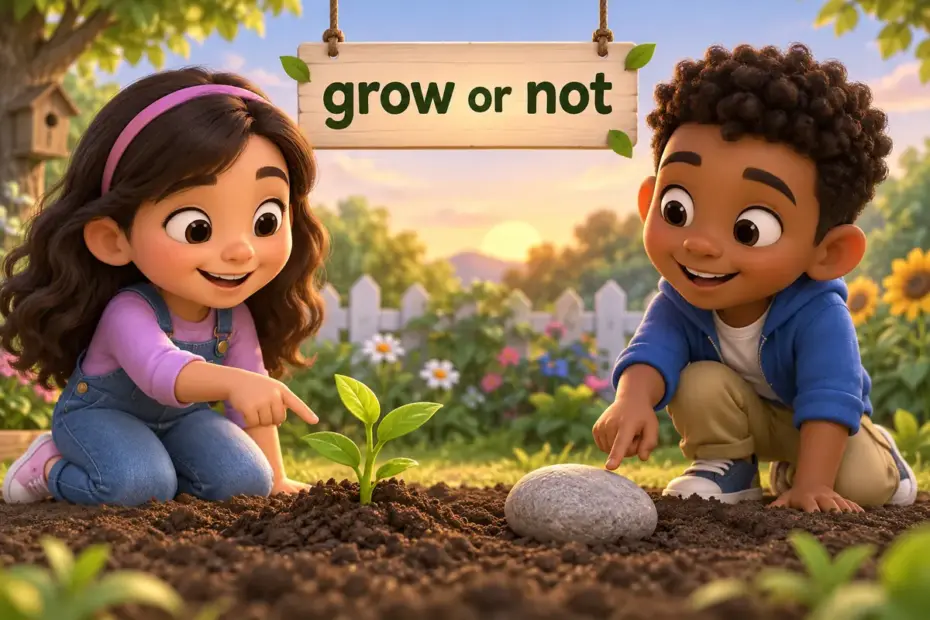
Living and non living things are sorted by what they can do, not by what they look like. Living things grow, take in energy, respond to their surroundings and reproduce, while non living things such as rocks, water and chairs do none of these, as in a seedling that leans toward a window.
Living and non living things at a glance
- Living things grow, feed, breathe and reproduce.
- Non living things do none of these processes.
- Both can be natural, such as a tree and a stone.
- Both can be man-made, such as a dog and a chair.
- Movement alone does not decide the difference.
- The commonest error is treating a car as living because it moves.
What are living and non living things?
Living things carry out life processes such as growth, nutrition and reproduction, while non living things do not. This definition sorts a plant and an animal from a rock and a chair.
| Feature | Living things | Non living things |
|---|---|---|
| Growth | Grow and change over time | Keep the same form |
| Energy | Take in food or light | Do not feed |
| Response | React to light, touch or heat | Do not respond |
| Reproduction | Make new living things | Do not reproduce |
| Cells | Made of cells | Not made of cells |
| Examples | Plants, animals, people | Rocks, water, chairs |
What are the characteristics of living things?
Living things share a set of processes that together define life. A single process is not enough, but all of them together mark a living thing.
| Process | What it means | Example |
|---|---|---|
| Growth | Getting larger or changing form | A seedling becomes a tree. |
| Nutrition | Taking in energy | A plant absorbs light. |
| Respiration | Releasing energy from food | A runner breathes faster. |
| Excretion | Removing waste | The body removes used water. |
| Movement | Changing place or position | A root grows downward. |
| Sensitivity | Reacting to surroundings | Flowers open in light. |
| Reproduction | Making new individuals | A bird lays eggs. |

Living and non living things across contexts
The same distinction appears in a classroom, a garden and a kitchen. The phrase also has a figurative life, as in these living stone examples.
| Context | Sentence | Why this works |
|---|---|---|
| Classroom | The plant grew toward the light. | Growth and response mark it as living. |
| Garden | The seeds sprouted within a week. | Reproduction and growth are present. |
| Kitchen | The bread dough rose and bubbled. | Yeast is a living thing at work. |
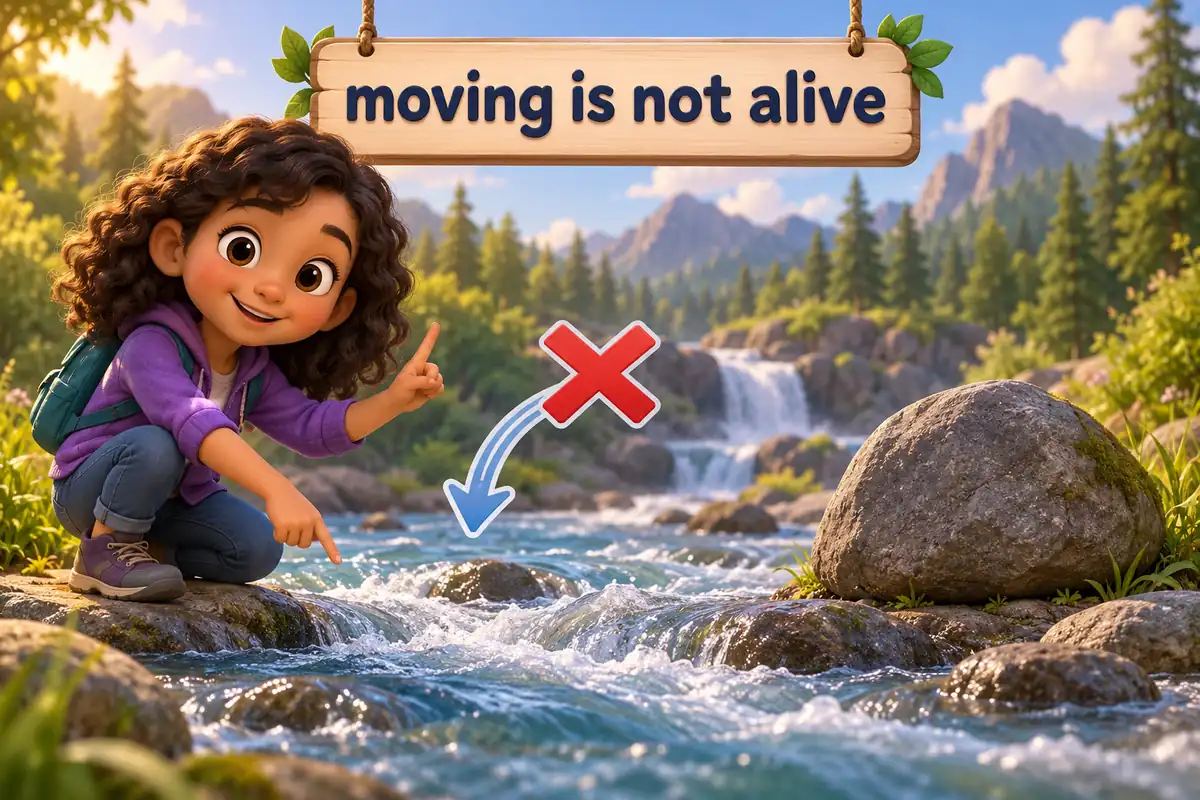
| Nature walk | The stream carried a leaf along. | Water moves but does not grow. |
| Playground | The children ran to the swing. | Self-movement and growth are present. |
| Museum | The fossil rested in the stone. | It was once living but is now non living. |
| Farm | The hen laid two eggs today. | Reproduction marks a living animal. |
| Kitchen | The kettle hissed and then stopped. | A machine reacts but is not alive. |
How do you tell a living thing from a non living thing?
Use a short test: does it grow, feed, respond and reproduce? A thing that does all four is living, and a thing that does none is non living. A person’s work for money appears in make a living examples, where living keeps its sense of being alive.
| Test | Living | Non living |
|---|---|---|
| Does it grow? | Yes, it changes over time | No, it stays the same |
| Does it feed? | Yes, it takes in energy | No, it needs no food |
| Does it respond? | Yes, to light or touch | No, it does not react |
| Does it reproduce? | Yes, it makes new ones | No, it cannot |
| Is it made of cells? | Yes, in most cases | No, it is not |
Word forms and grammar of living and non living
The words living and alive both relate to life, but they fit different sentence slots. The edge of the idea appears in living dead examples, where the two states are set against each other.
| Form | Part of speech | Example |
|---|---|---|
| living | adjective before a noun | a living plant |
| non living | adjective before a noun | a non living object |
| life | noun | Life needs water. |
| alive | adjective after be | The seed is still alive. |
| dead | adjective | The tree is dead. |
| lifeless | adjective | The dry soil looks lifeless. |
The distinction is harder than the simple list suggests, because a few cases sit on the edge. A virus carries genetic material and can copy itself, yet it needs a host to do so, which is why some teaching lists leave it out. A flame grows, moves and uses oxygen, yet it is not made of cells, so it stays non living. A dormant seed looks as still as a stone, yet it is alive and waiting. These awkward cases are useful in class, because they push learners past the easy examples and towards the idea that life is a set of processes rather than a single visible sign.
It also helps to notice that living things depend on non living things, so the two groups are not separate worlds. A plant draws water and minerals from non living soil, and an animal breathes non living air. The living and the non living together form the environment, which is why a change to the water or the air can affect every living thing that depends on it. That dependence is the reason the two groups are best taught together rather than apart.
Common mistakes with living and non living things
Each pair shows a weak line, a repair, and the rule behind the fix. The generalising phrase appears in among other things examples.
- Incorrect:
A car is living because it moves. - Incorrect:
A seed is non living because it is not moving. - Incorrect:
Water is living because plants drink it. - Incorrect:
Everything that moves is alive. - Incorrect:
Fire is living because it grows and uses air.
Practice classifying living and non living things
Six short tasks cover the traits, the test and the common errors.
- Fill the gap: “A seedling is a ______ thing.” (living / non living)
- Choose the living trait: “A chair does not (grow / stand).”
- Correct the error: “A car is living because it moves.”
- Build a sentence naming two life processes of a plant.
- Spot the mistake: “A river is living because it flows.”
- Write one sentence that says why a stone is non living.
Answers
- living, because a seedling grows and needs water.
- grow, because growth is a life process and standing is not.
- A car is non living because it does not grow or reproduce, because movement alone is not life.
- A plant grows and makes its own food, because both are life processes.
- A river flows but does not grow or reproduce, so it is non living.
- A stone is non living because it does not grow, feed or reproduce, because it lacks cells.
The bottom line
Living and non living things are told apart by what they do, not by whether they move. Living things grow, feed, respond and reproduce, while non living things do none of these. Use the four-part test and remember that a moving river or a humming machine is still non living.
Frequently asked questions about living things
Is a seed living or non living?
A seed is living, even when it looks still and dry. It is in a resting state and can begin to grow when it gets water and warmth. Movement is not the test, because a seed is alive whenever it can carry out life processes.
Why is a car non living even though it moves?
A car is non living because it does not grow, feed, respond on its own or reproduce. It moves only when a person supplies fuel and control, so its motion is not self-movement. It is also made of metal and plastic, not cells.
Is a fallen leaf living or non living?
A fallen leaf comes from a living tree but is no longer living itself. Once it is cut off and dries, it cannot grow or feed, so it is non living. It was made by a living thing, which is not the same as being one.
What are the seven life processes?
The seven life processes are growth, nutrition, respiration, excretion, movement, sensitivity and reproduction. A thing that carries out all seven is living. Teaching them as a set helps learners see that no single process, such as movement, is enough on its own.