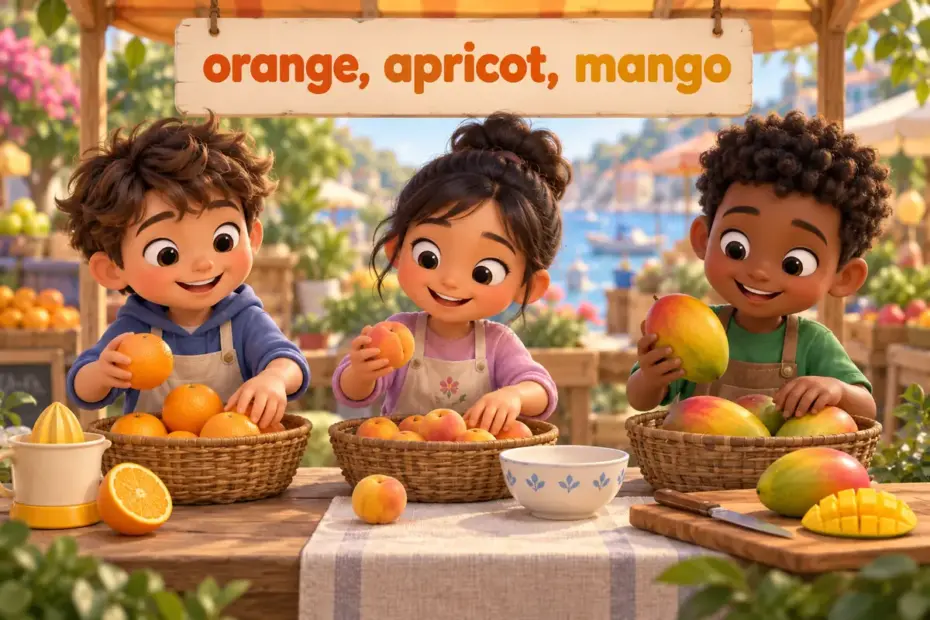
A list of orange fruit names and uses covers the many fruits that share that warm colour, from the citrus orange itself to apricots, mangoes and persimmons. Each one has a name tied to its family and a set of everyday uses, and one example shows the pattern: an orange gives juice and zest.
List of orange fruit names and uses at a glance
- Orange fruits fall into three broad families: citrus, stone fruits and tropical fruits.
- The word orange names both a fruit and its colour, a rare double duty in English.
- Many names add a variety word to a base fruit, as in navel orange or blood orange.
- Citrus fruits give juice and zest, while soft fruits are eaten fresh or dried.
- The commonest error is treating tangerine, mandarin and clementine as exact synonyms.
What are orange fruits?
Orange fruits are the fruits whose skin or flesh is orange, and they divide into citrus, stone and tropical families. The describing words that often sit before fruit names are gathered in adjectives for fruit. The citrus group is acidic and juicy, the stone group is soft with a single hard pit, and the tropical group grows in warm climates, so the family predicts both the taste and the use.
| Family | What it is like | Common names |
|---|---|---|
| Citrus | acidic and juicy, with a thick peel | orange, tangerine, mandarin, clementine, grapefruit, kumquat |
| Stone fruits | soft flesh around one hard pit | apricot, peach, nectarine, persimmon, loquat |
| Tropical | large, sweet and warm-climate | mango, papaya, cantaloupe, physalis |
| Dried orange fruits | same fruit with the water removed | dried apricot, dried mango, dried peach |
How are orange fruit names built?
Fruit names are mostly a base fruit plus a variety word, and the added word shows the size, the colour or the place it was grown. The citrus base noun behaves much like any other, as seen in citrus fruit in a sentence.
| Pattern | Example | What it signals |
|---|---|---|
| variety + base fruit | navel orange | a named type of one fruit |
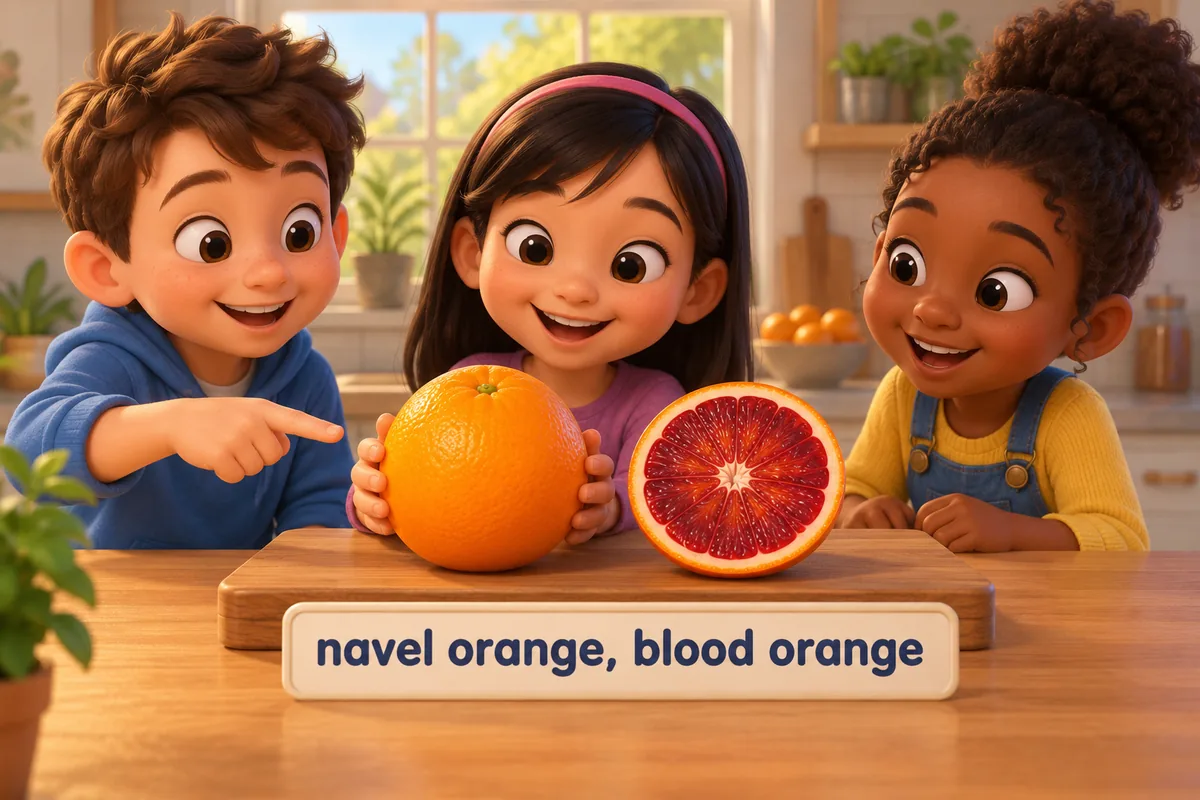
| colour + base fruit | blood orange | the deep colour inside |
| place + base fruit | Valencia orange | where the type was grown |
| size word + base fruit | dwarf mandarin | the size of the tree or fruit |
| base fruit alone | apricot | the whole fruit in one word |
List of orange fruit names and uses across contexts
The names appear on menus, in recipes and in shops, and the family decides which use fits. Turning these fruits into a drink is shown in fruit juice in a sentence, while preserving them by removing water is shown in dried fruit in a sentence.
| Context | Example sentence | Why this works |
|---|---|---|
| Recipe | Grate the orange zest over the cake batter. | citrus peel used for flavour |
| Breakfast menu | Serve the apricot with yoghurt and honey. | a soft fruit eaten fresh |
| Market stall | These mandarins peel easily for children. | a trait tied to a use |
| Juice bar | Blend the mango with a little water. | a tropical fruit turned to drink |
| Bakery | Candied orange peel decorates the buns. | peel preserved in sugar |
| Health blog | A persimmon is sweetest when fully ripe. | a ripeness rule for one fruit |
| Supermarket | Loose kumquats are sold by weight. | a small citrus sold whole |
| Picnic list | Pack nectarines that will not bruise in the bag. | a stone fruit chosen for travel |
| Cafe | The grapefruit is pressed to order. | a sharp citrus for juice |
| Store cupboard | Dried mango makes a chewy snack. | preserved fruit for later |
Which word should you use?
Several orange fruits are close relatives, and the choice depends on size, peel and sweetness rather than on colour alone. Fine shades and describing words for the colour itself appear in adjectives for orange.
| Pair | Usual difference | Example |
|---|---|---|
| mandarin and tangerine | tangerine is a type of mandarin, often deeper orange | Peel a mandarin for a snack. |
| clementine and satsuma | clementines are seedless; satsumas are very easy to peel | The clementine has no pips. |
| orange and grapefruit | grapefruit is larger and more bitter | Halve the grapefruit for breakfast. |
| apricot and peach | apricot is smaller and less juicy | Dice the apricot for the tart. |
| persimmon and mango | persimmon is soft and sweet when ripe; mango is firmer | Slice the mango for the salad. |
Choose the specific name when the variety changes the use, because a clementine peels easily while a grapefruit needs cutting. When the exact type is unknown, the family word citrus or stone fruit keeps the sentence accurate without naming a variety you cannot confirm.
Word forms and grammar of orange fruit names
Fruit works as both an uncountable mass noun and a countable one, and the choice changes the meaning of the sentence.
| Form | Part of speech | Example |
|---|---|---|
| fruit | uncountable noun | Fruit is good for you. |
| fruits | count noun, plural | The tree bears three kinds of fruits. |
| orange | count noun | One orange is enough. |
| oranges | count noun, plural | Press two oranges for juice. |
| citrus | uncountable noun | Citrus grows well in warm regions. |
| zest | uncountable noun | Add the zest of one lime. |
| ripen | verb | The mangoes ripen on the sill. |
Use fruit as a mass noun for the food in general, and fruits when you mean several kinds: fruit is healthy describes the category, while tropical fruits names specific types. Citrus is uncountable and takes a singular verb, as in the citrus is ripe.
Common mistakes with orange fruit names
Mistake 1: the three small citrus names treated as synonyms. Incorrect: A clementine and a tangerine are always the same fruit. Correct: A clementine is a seedless type of mandarin, and a tangerine is another type. Rule: each name marks a distinct variety with its own peel and seeds.
Mistake 2: orange used only as a colour. Incorrect: The wall is painted a fruit called orange. Correct: The colour orange is named after the fruit. Rule: orange is both a noun and a colour word, so check the sentence for which one you mean.
Mistake 3: fruit pluralised for a general statement. Incorrect: Fruits are good for you. Correct: Fruit is good for you. Rule: as a general food, fruit stays uncountable.
Mistake 4: peel and rind swapped. Incorrect: Grate the rind of the orange for the cake. Correct: Grate the zest of the orange for the cake. Rule: the zest is the outer coloured layer used for flavour, while rind names the whole skin including the bitter white part.
Mistake 5: a stone fruit cut without removing the pit. Incorrect: Slice the whole apricot, pit and all. Correct: Halve the apricot and remove the pit first. Rule: a stone fruit contains one hard pit that is not eaten.
Practice using orange fruit names
- Fill in the blank: Grate the ___ of the orange over the batter.
- Choose the better word: Halve the (grapefruit / clementine) to serve at breakfast.
- Correct the error: Fruits are good for you.
- Build a sentence: use mango to describe a tropical fruit in a smoothie.
- Spot the register: which suits a menu, (a) Some orangey fruit thing, or (b) Chilled papaya with lime?
- Fill in the blank: Dried ___ makes a chewy snack.
Answers
- zest, because the coloured outer layer gives the flavour.
- grapefruit, because a large firm citrus is halved rather than peeled.
- Fruit is good for you; the general food is uncountable.
- She blended the ripe mango into a thick smoothie.
- (b), because a menu uses a precise fruit name and a preparation.
- mango, because dried mango keeps its sweetness as a snack.
The bottom line
A list of orange fruit names and uses is easier to learn by family: citrus, stone and tropical fruits each taste and behave differently. The citrus group gives juice and zest, the stone group is eaten fresh or baked, and the tropical group suits smoothies and salads. Name the family when a variety is uncertain, and the specific fruit when the use depends on it.
Frequently asked questions about orange fruits
Are oranges the only orange-colored fruit?
No. Many fruits are orange, including apricots, peaches, mangoes, persimmons and cantaloupe, and each belongs to a different family. The citrus orange is simply the fruit that gave the colour its name, so the colour word and the fruit word are the same in English.
Is a tangerine the same as a mandarin?
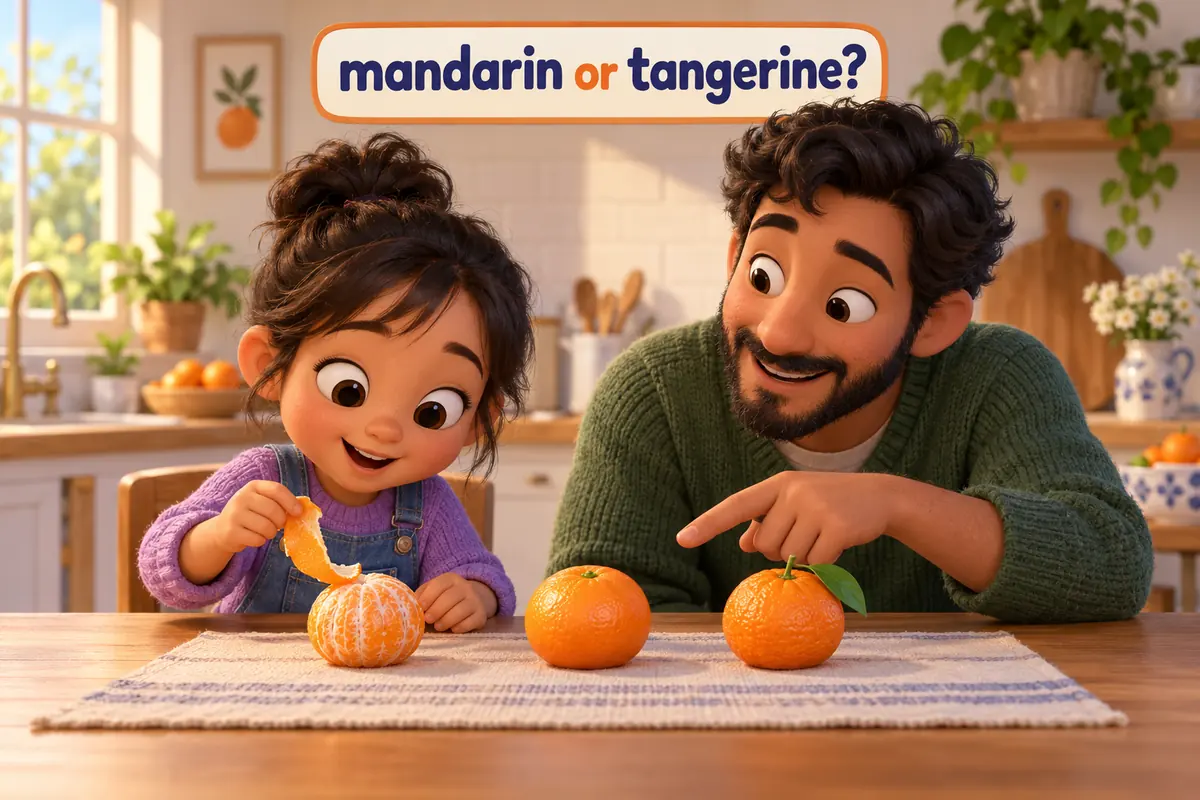
A tangerine is one type of mandarin, so every tangerine is a mandarin but not every mandarin is a tangerine. Tangerines are usually a deeper orange and slightly tart, while mandarins as a group include clementines and satsumas. The precise name depends on the variety.
What is the difference between zest and peel?
Zest is the thin coloured outer layer of citrus skin, used for flavour because it holds the oils. Peel is the whole skin, including the bitter white pith beneath. Recipes ask for zest when they want flavour and for peel when they need the whole outer skin.
Why is fruit sometimes countable?
Fruit is uncountable when it names the food in general, as in fruit is healthy. It becomes countable when you mean distinct types, as in the market sells tropical fruits. The same pattern applies to many food words, including fish and cheese.