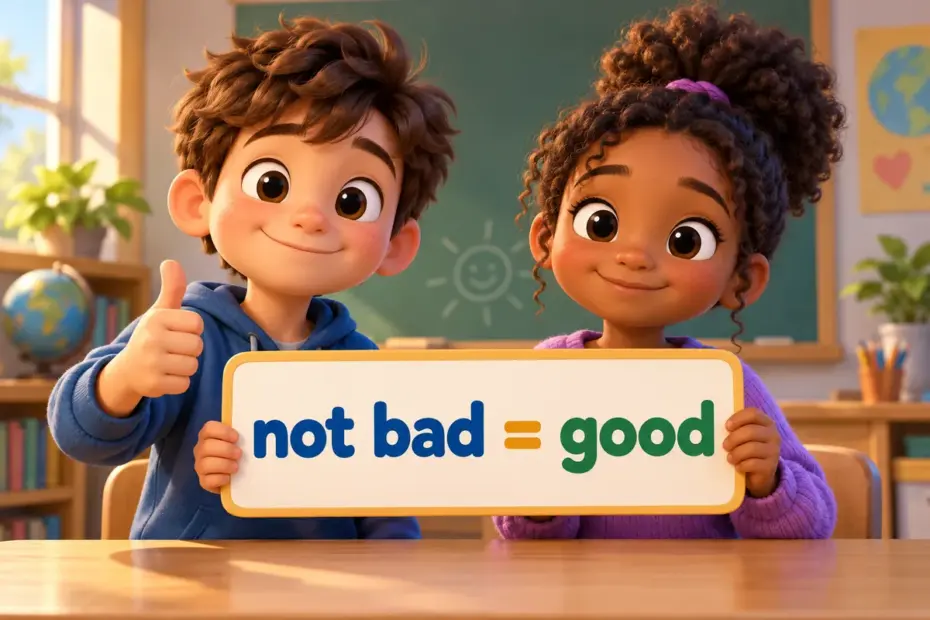
Litotes in English meaning uses and examples all point to one figure of speech: a statement made by denying its opposite, as in not bad for quite good. The device softens a claim and often sounds modest, which is why it appears in polite, formal and understated writing.
Litotes at a glance
- Litotes states something by denying its opposite.
- It usually turns a positive into a double negative.
- It softens praise and hedges criticism.
- It is common in polite, formal and understated writing.
- Not bad, not uncommon and no small feat are typical examples.
- The commonest error is reading a double negative as a plain negative.
What is litotes?
Litotes is a figure of speech in which a point is made by denying its opposite, so not bad means fairly good and not uncommon means fairly common. It softens the claim and often signals modesty or caution.
| Litotes | Literal meaning | Why it is used |
|---|---|---|
| not bad | not good, literally | to mean fairly good, with modesty |
| not uncommon | not rare | to mean fairly common, gently |
| no small feat | not a small achievement | to stress difficulty without boasting |
| not unhappy | not sad | to soften a positive claim |
| not without merit | lacking no value | to praise cautiously in formal writing |
| not a little | not a small amount | to mean a good deal, in older prose |
How do you form a litotes?
Most litotes follows one of a few patterns, and each one changes the strength of the claim. The table shows the shape and the effect it creates.
| Pattern | Example | Effect |
|---|---|---|
| not plus an adjective | not bad | Softens praise. |
| not plus an un- word | not uncommon | States a positive through a double negative. |
| no plus a noun | no small feat | Adds emphasis. |
| not without plus a noun | not without risk | Hedges a warning. |
| a negative verb | I never disliked it | States a mild positive. |

Litotes in English meaning uses and examples in context
Litotes appears wherever a writer wants to sound measured, from a book review to a letter of reference. The wider habit of saying less than you mean appears in these understatement sentence examples.
| Context | Sentence | Why this works |
|---|---|---|
| Book review | The novel is not without charm. | It praises with restraint. |
| Letter of reference | Her work was not unsatisfactory. | A cautious formal positive. |
| Conversation | The film was not bad at all. | Friendly, understated praise. |
| Academic writing | The evidence is not inconclusive. | It states a careful positive. |
| News report | The delay was no small matter. | It stresses importance calmly. |
| Speech | This is no small achievement. | It celebrates without boasting. |
| Everyday chat | I am not unhappy about the result. | It softens a pleased reaction. |
| Formal email | The offer is not unwelcome. | It accepts politely and cautiously. |
What is the difference between litotes and understatement?
Litotes and understatement both say less than they mean, but only litotes works by denying the opposite. A related effect that depends on the listener appears in irony sentence examples.
| Feature | Litotes | Understatement |
|---|---|---|
| Method | Denies the opposite | Plays down the size |
| Form | Often a double negative | Often a mild word |
| Example | not bad for good | a scratch for a deep cut |
| Effect | Softens and hedges | Minimises for effect |
| Overlap | A kind of understatement | The broader habit |
Word forms and grammar of litotes
The word litotes keeps the same form for singular and plural, and it usually appears with an article in careful writing. Where the intent is to mock rather than to soften, the tone turns into sarcasm.
| Form | Note | Example |
|---|---|---|
| litotes | the same form in singular and plural | Litotes is a figure of speech. |
| a litotes | used with an article, though rare | The line reads as a litotes. |
| litotic | adjective, uncommon | a litotic phrase |
| no small feat | fixed phrase | Finishing early was no small feat. |
| not uncommon | fixed phrase | Rain here is not uncommon. |
Litotes works best when the reader already knows the norm, because the denial leans on a shared expectation. Saying a film is not bad only lands if both people accept that most films might be poor; in a context with no such baseline, the double negative can seem evasive. That is why litotes thrives in reviews, references and speeches, where the writer and the reader share standards, and why it feels hollow in a message that needs a plain yes or no. The restraint carries meaning only against a background that the reader can supply, which is why a cautious referee can praise without making a bold claim in writing.
A second risk is overuse. Because litotes softens every claim, a page of doubled negatives slowly turns vague, and the reader loses track of what is actually being praised or blamed. The device is strongest when it stands alone against plainer sentences, so one not without merit after several direct statements draws attention, while five in a row cancel each other out. Writers who want to be seen as careful should choose their moment rather than applying the pattern to every judgement.
For learners, the practical rule is simple: read the denial, then flip it to the positive it implies. Not uncommon is common, not unhappy is content, and no small feat is a real achievement. Reading it that way keeps the meaning clear, even when the surface grammar looks negative, and it stops a double negative from being taken for a plain refusal. A reader who mistakes the double negative for a plain negative will take not bad as faint praise, when the writer means something much closer to good.
Common mistakes with litotes
Each pair shows a weak line, a repair, and the rule behind the fix.
- Incorrect:
Not uncommon means never. - Incorrect:
The service was not bad, so it was terrible. - Incorrect:
I am not unhappy, so I am sad. - Incorrect:
The task was no easy, it was hard. - Incorrect:
He was not without money, so he was poor.
Practice using litotes
Six short tasks cover the meaning, the form and the contrast.
- Fill the gap: “The climb was no small ______.” (feat / feet)
- Choose the one meaning fairly good: “not bad / not good.”
- Correct the error: “Not uncommon means never.”
- Build a sentence using “no small feat” about finishing a project.
- Spot the litotes: (a) not unhappy, or (b) very happy.
- Write one litotes that means the food was quite good.
Answers
- feat, because no small feat is the fixed phrase.
- not bad, because litotes denies the opposite to mean the positive.
- Not uncommon means fairly common, because the double negative cancels.
- Finishing the report a week early was no small feat, because the phrase stresses effort.
- (a) not unhappy, because it denies the opposite of a positive.
- The meal was not bad at all, because the double negative means quite good.

The bottom line
Litotes in English meaning uses and examples all turn on one move: denying the opposite to make a softened point. It is a kind of understatement, common in polite and formal writing, and it usually appears as a double negative such as not bad or not uncommon. Read it as the positive it implies.
Frequently asked questions about litotes
What is a simple example of litotes?
A simple example is not bad, which means fairly good. Another is not uncommon, which means fairly common. In each case the speaker denies the opposite of the intended meaning, so the double negative cancels into a gentle positive rather than a negative.
Is litotes the same as irony?
Litotes and irony are different. Litotes softens a point by denying its opposite, as in not unkind for quite kind, and the meaning stays clear. Irony says the opposite of what is meant, so the listener must infer the real meaning from the context and tone.
Why do writers use litotes?
Writers use litotes to sound modest, cautious or polite. It lets a reviewer praise a book as not without charm, or a referee call work not unsatisfactory, without making a bold claim. The restraint itself carries meaning, which is the point.
Where is litotes most common?
Litotes is common in formal and polite writing, such as reviews, references and speeches, and in understated everyday speech. It appears often in English writing that values restraint, including academic prose, where a careful not inconclusive sounds more measured than a blunt positive.